

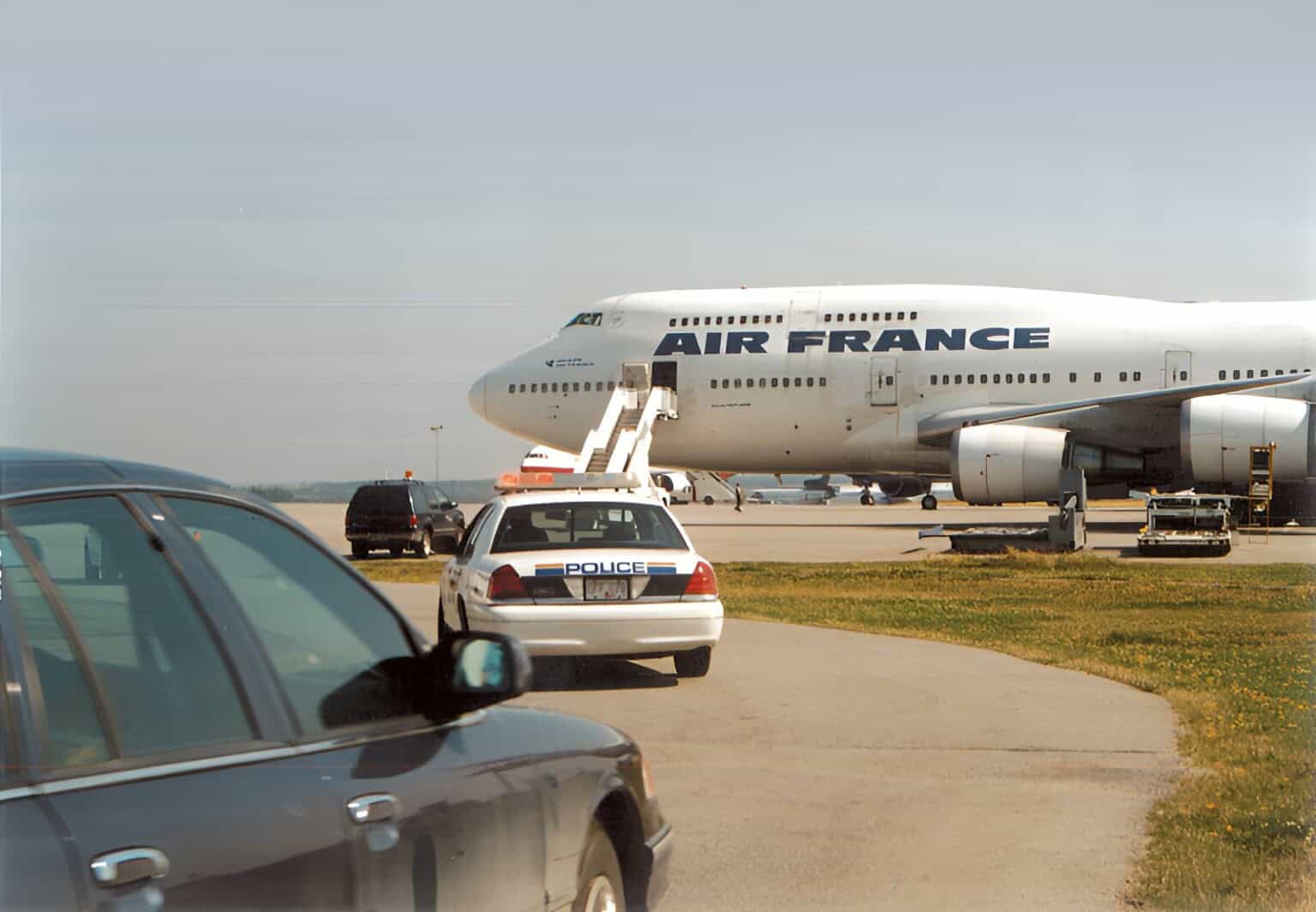
Gander International could absorb 38 diverted airliners in a single afternoon because it had been built for aircraft that could not cross the Atlantic without stopping for fuel. By 2001, no airliner needed it.
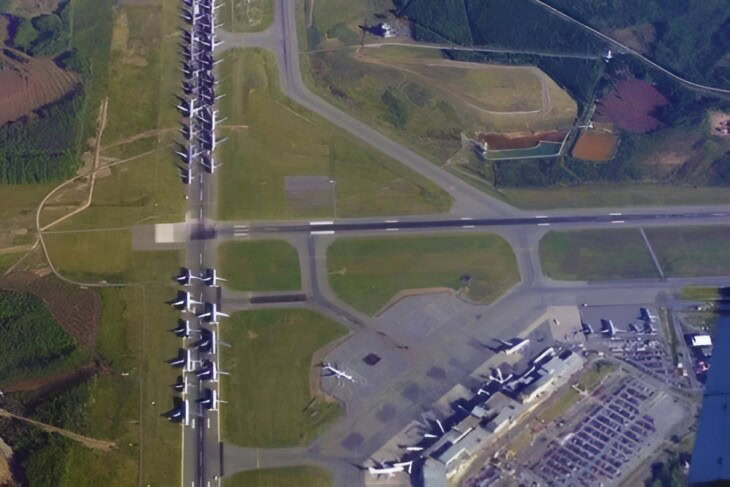
On the afternoon of September 11, 2001, 38 aircraft carrying 6,656 passengers and crew landed at Gander International Airport in Newfoundland. Canada called the diversion effort Operation Yellow Ribbon. The 2001 census put the town’s population at 9,651.
The airport could take them because it had been built for a job it no longer had. Gander was sited in 1935 on the great circle route between New York and London, in an era when no airliner could make the crossing in one hop.
By the mid-1940s it was handling 13,000 aircraft and a quarter of a million passengers a year, according to the airport authority’s own history. By 2001 it had a runway over 10,000 feet long, a ramp sized for that traffic, and almost none of the traffic left.
The Airport Existed Because Nothing Could Fly the Atlantic Nonstop
Construction began in 1936 and the field opened in 1938 as Newfoundland Airport. With four runways, it was briefly the largest airport in the world, built on a bog in a place with no town attached to it yet.
The Royal Canadian Air Force took it over in 1940 and renamed it RCAF Station Gander in 1941. RAF Ferry Command and the US Army Air Forces used it to stage newly built aircraft across to Europe and to fly anti-submarine patrols over the western Atlantic.
The commercial era that followed was the reason the town got its nickname. Piston airliners like the Douglas DC-4 and the Lockheed Constellation could not reach Europe without a stop, so Pan American, BOAC, Air France and Scandinavian Airlines all scheduled through Gander, and the terminal picked up a steady traffic of film stars, royalty and heads of state waiting out a refuelling.
Locals called it the Crossroads of the World, and for about fifteen years that was close to literal. Nearly every airliner flying between North America and Europe touched down on the same stretch of Newfoundland concrete.
Then the range problem got solved. The de Havilland Comet 4 and the Boeing 707 entered service in 1958, and a jet that could fly New York to London without stopping had no reason to descend into Newfoundland.
The airport authority dates the collapse to the early 1960s, when the scheduled carriers stopped coming because they “now had the capability of flying the Atlantic without stops.” What the carriers left behind was the infrastructure: runways, ramp and fuel farm sized for an airline industry that had moved on.
Thirty-Eight Aircraft, 6,656 People, a Town of 9,651
At 09:45 Eastern on September 11, the FAA’s national operations manager invoked the emergency plan that closes American airspace, and every aircraft inbound to the United States needed somewhere else to go.
Operation Yellow Ribbon was Canada’s answer. Transport Minister David Collenette closed Canadian airspace to inbound international traffic, and NAV CANADA began pushing the flights already committed over the ocean toward airports that could physically take them.
The totals depend on who counted. Transport Canada logged 224 diverted flights carrying more than 33,000 people; NAV CANADA put the aircraft figure at 239.
Halifax took the most, 47 aircraft and roughly 7,300 people. Vancouver took 34 and about 8,500. Gander took 38 and 6,656, St. John’s 21, and Moncton 10.
The distribution is the whole story. Halifax is a metropolitan area of several hundred thousand people; Gander was a town of 9,651 that absorbed a passenger load close to Halifax’s and effectively doubled its own population in an afternoon.
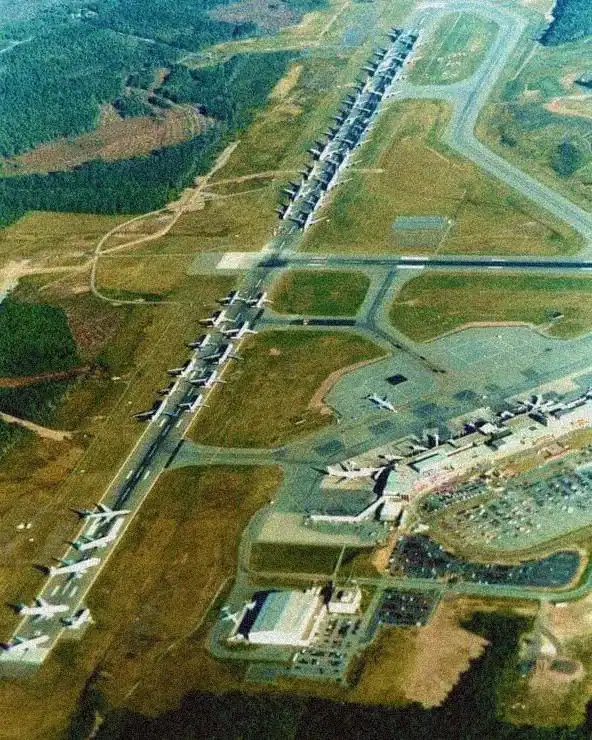
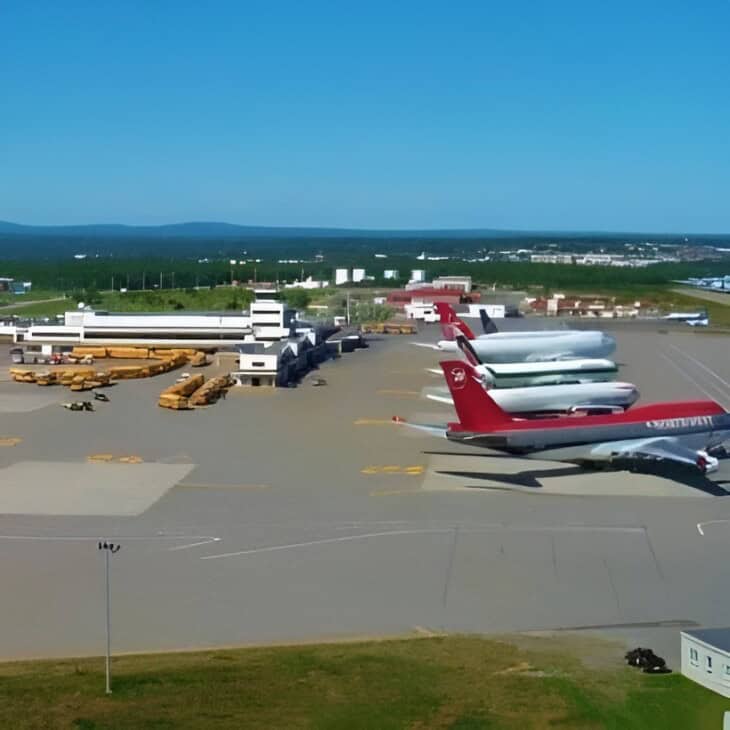
Thirty-eight jets, one small ramp
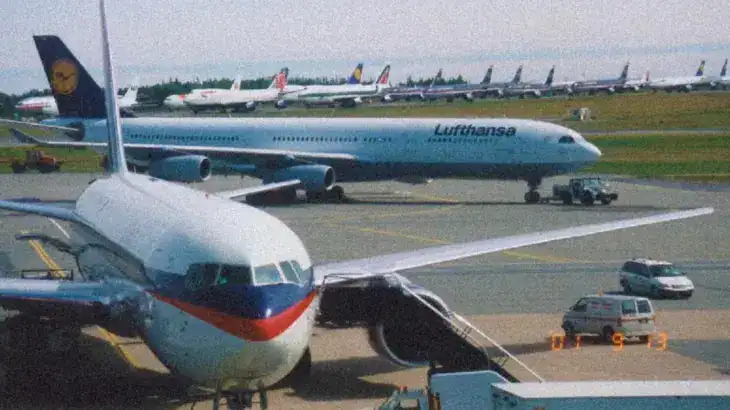
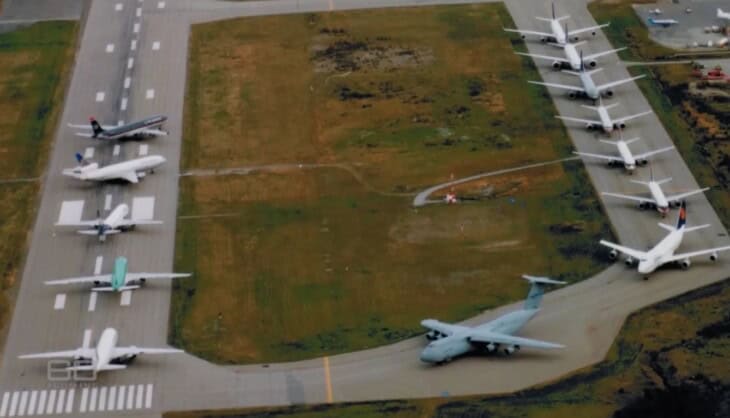
Gander’s apron held 38 airliners at once on September 11, 2001, most of them widebodies. Twenty-three years later, in 2024, the entire airport handled 115,978 passengers for the whole year.
Most accounts describe the Gander diversions as 38 wide-body aircraft, and most of them were: Boeing 747-400s, 767s, A330s, A340s, DC-10s and Lockheed L-1011 TriStars. Photographs from the ramp also show narrowbodies and US military transports, so the tidy “38 widebodies” line is close rather than exact.
American airspace reopened on September 13. The last of the aircraft stranded at Gander did not leave until September 16, five days after they landed.
Gander Still Controls Half the North Atlantic
The runway is the visible half of what Gander does. The larger job is the airspace above and east of it.
NAV CANADA’s Gander control centre runs the western portion of North Atlantic oceanic airspace, handing traffic to Shanwick at 30 degrees west, the midpoint of the ocean. The North Atlantic is the busiest oceanic airspace in the world, carrying up to 3,000 flights a day between the two continents, and flying it without radar coverage is a genuinely different discipline from domestic control.
On December 26, 2024, NAV CANADA marked 500,000 flights handled through the Gander flight information region in a single calendar year, a first. The pace of growth is the notable part: the jump from 300,000 to 400,000 took twelve years, from 2003 to 2015, and the next 100,000 took under ten.
The airport itself is now sold on exactly the capability that made it useful in 2001. It runs 24 hours, advertises wide-body turnarounds in under an hour, keeps four fuel suppliers on the field and staffs for unscheduled arrivals: mechanical, medical, or a passenger who has to come off.
Newfoundland still catches them. On August 23, 2026, a Delta A330 bound for Rome turned into St. John’s with an engine problem rather than press on across the ocean, which is the ordinary logic of a diversion: you go to the field that can take you, not the one you wanted.
What Gander Is Now
In 2024 Gander International handled 115,978 passengers and 24,037 aircraft movements. Scheduled service is flown by Air Canada Express and PAL Airlines, regional operations into a terminal built for intercontinental ones.
Two runways survive of the original four. The main one runs past 10,000 feet and the second 8,900 feet, both 200 feet wide, which is more pavement than a town of 11,880 would ever build for itself.
That surplus is the point. An airport whose commercial reason for existing died in 1958 kept the physical plant, and the physical plant is what made an unrepeatable afternoon survivable.
Gander’s value was never really in the flights that stopped there. It is in the ones that never have to, and in the one day when 38 of them did.
Sources and references used for research and fact-checking.
- Wikipedia, Gander International Airport
- Wikipedia, Operation Yellow Ribbon
- Wikipedia, Gander, Newfoundland and Labrador
- Gander International Airport Authority, Our History
- Gander International Airport Authority, Technical Stops
- NAV CANADA, Celebrating a Major Milestone: 500,000 Flights Managed by Gander FIR
- Wikipedia, Gander Automated Air Traffic System
- National September 11 Memorial & Museum, Lend a Hand, Do What You Can: Remembering the Generosity of Gander
Get the Newsletter
The latest aviation news and stories sent to your inbox.
About the Author

Tim is the owner and lead editor of AeroCorner since 2019, overseeing aviation content covering aircraft, airlines, airports, and the broader aviation industry. Through years of researching, writing, editing, and publishing aviation-focused content, he has developed extensive practical knowledge of commercial aviation and air travel. Based in Asia and a frequent traveler himself, Tim also brings firsthand passenger experience to AeroCorner’s coverage. Outside of publishing, he has also explored aviation firsthand through hands-on flight training in New Zealand.