

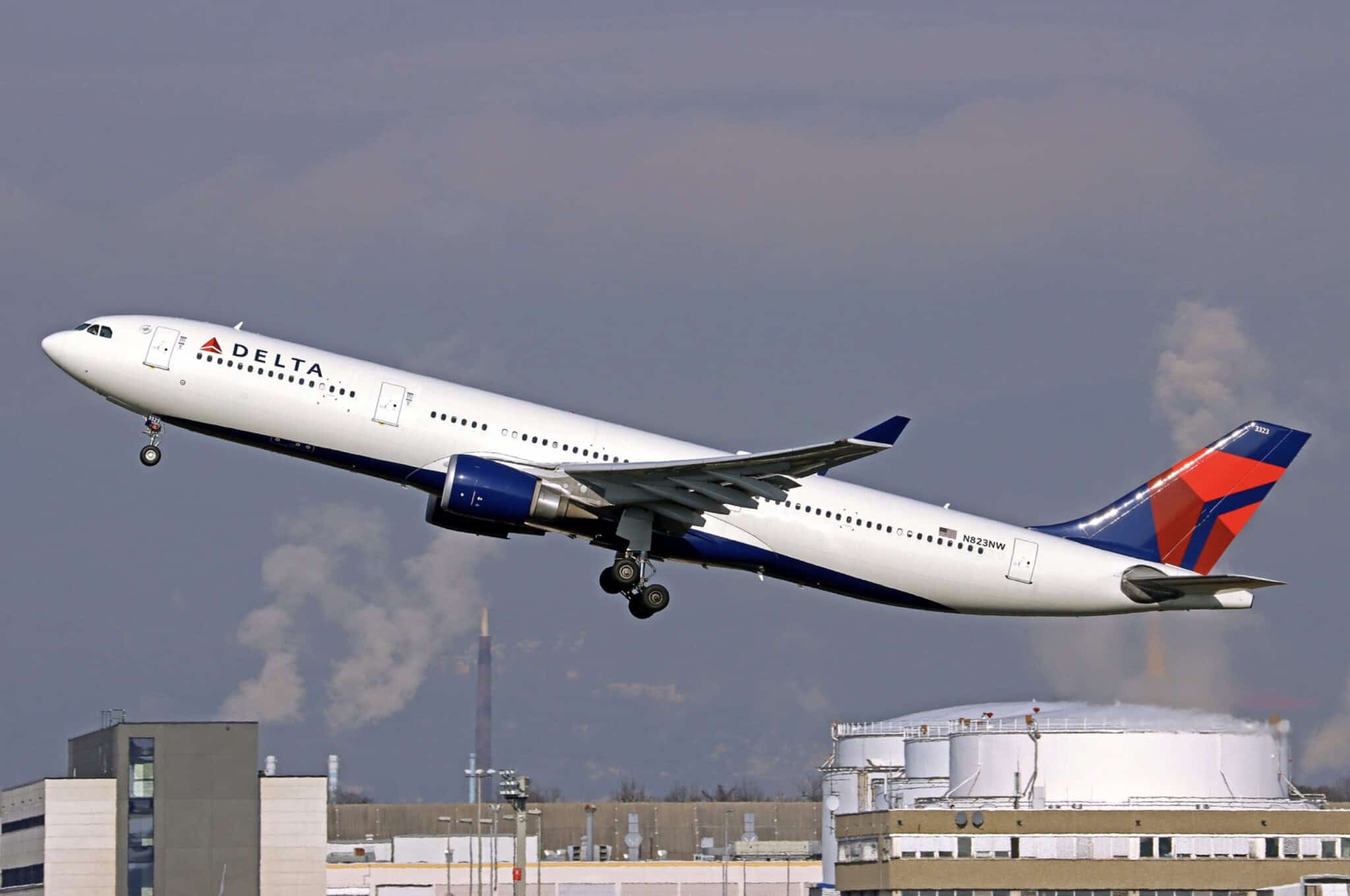
On August 23, 2026, Delta Air Lines flight DL182 diverted to St. John’s, Newfoundland, after the crew reported a mechanical issue with one of the Airbus A330’s two engines roughly four hours into an overnight flight from New York’s JFK to Rome.
The aircraft, an 11-year-old A330-300 registered N823NW, was carrying 267 passengers and 13 crew, 280 people in total. Delta told CBC News its crew followed standard procedure in diverting rather than continuing across the ocean.
The jet landed safely at St. John’s International Airport shortly before 11:30 p.m. local time, and the airport’s fire department met the aircraft as a precaution. No injuries were reported.
The A330-300 is powered by two General Electric CF6-80E1 engines, and Delta has not said which one was affected. The airline’s statement described only a “mechanical issue,” a common holding phrase while maintenance teams inspect the engine on the ground.
Passengers were bused to hotels for the night and given meal vouchers. A replacement A330, registered N428DX, flew the group back to JFK the next morning so Delta could rebook them onto new flights to Rome, according to Simple Flying.
Why St. John’s catches Atlantic emergencies
St. John’s sits at the easternmost tip of North America, closer to Europe than any other major airport on the continent. Along with Gander to its west and Shannon and Keflavik on the European side, it is one of a handful of airports positioned specifically to catch mid-ocean emergencies.
Twin-engine widebodies like the A330 cross the Atlantic under rules called ETOPS, which require every point on the route to stay within a set flying time of an airport equipped to handle the aircraft. Delta’s A330-300s carry a 180-minute ETOPS rating, so the airline plans every North Atlantic crossing around airports like St. John’s and Gander that fall inside that window.
That planning is why a diversion like DL182’s counts as routine rather than dramatic in an airline’s eyes, even with 280 people aboard. AeroCorner has more on how those calls get made in its guide to how flight diversions actually work.
ETOPS, in one line
An ETOPS-rated route keeps a twin-engine jet within a set flying time, usually up to three hours depending on the aircraft’s certification, of an airport that can handle it at any point over open ocean.
This was not the first widebody to make an unplanned Atlantic stop this year. A SWISS A330 diverted to Bangor in a similar precautionary landing after smoke was reported in the cabin.
5:43 p.m. EDT, Aug. 23
Departure. Flight DL182 leaves New York JFK for Rome Fiumicino with 280 people aboard.
~9:40 p.m. EDT
Engine issue reported. About four hours into the crossing, the crew reports a mechanical problem with one engine and requests a diversion.
11:15 p.m. NDT
Diversion to St. John’s. The A330 lands safely; airport firefighters meet the aircraft as a precaution.
Aug. 24, 9:50 a.m.
Replacement aircraft departs. A second Delta A330 (N428DX) flies the stranded passengers back to JFK, landing at 11:07 a.m.
What Delta hasn't said
Delta has confirmed only that the fault involved one of the aircraft’s two GE CF6-80E1 engines, not the specific failure. That detail typically surfaces only if a formal investigation is opened.
Delta has since rebooked the affected passengers onto new flights to Italy and apologized for the disruption, the airline said.
Get the Newsletter
The latest aviation news and stories sent to your inbox.
About the Author

Tim is the owner and lead editor of AeroCorner since 2019, overseeing aviation content covering aircraft, airlines, airports, and the broader aviation industry. Through years of researching, writing, editing, and publishing aviation-focused content, he has developed extensive practical knowledge of commercial aviation and air travel. Based in Asia and a frequent traveler himself, Tim also brings firsthand passenger experience to AeroCorner’s coverage. Outside of publishing, he has also explored aviation firsthand through hands-on flight training in New Zealand.