

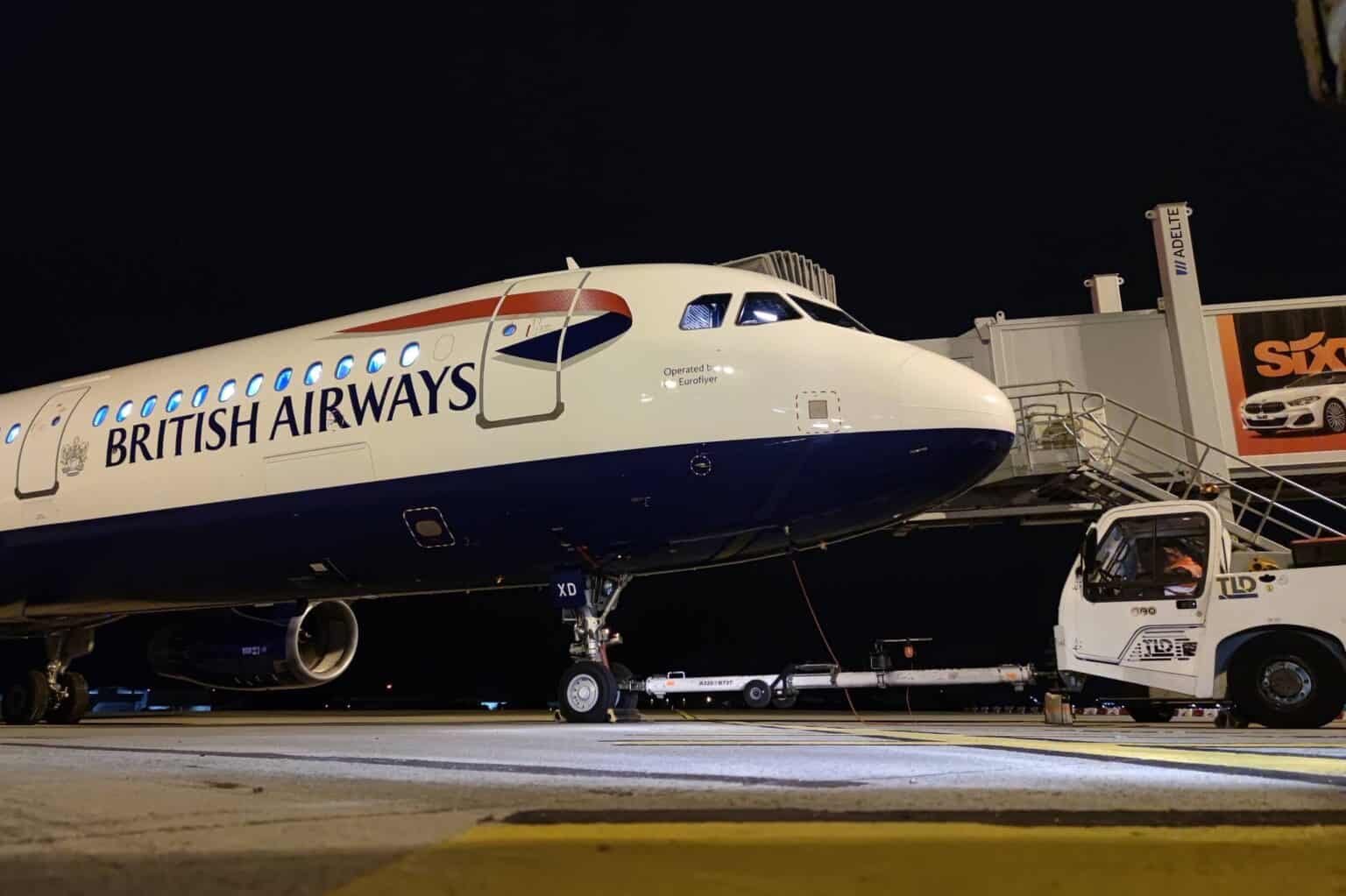
British Airways flight BA2660 from London Gatwick to Faro, Portugal, declared an emergency and returned to Gatwick on the morning of Tuesday, October 13, 2026. Flight trackers and UK press reports say the trigger was a cracked passenger window on the right side of the cabin.
British Airways has not confirmed the window. In a statement quoted by the Evening Standard, the airline said the aircraft “diverted following a minor technical issue and landed safely back at London Gatwick.”
What happened on BA2660
The flight was operated by an Airbus A321 registered G-EUXD, according to AIRLIVE. Flightradar24’s history for G-EUXD lists the October 13 BA2660 sector to Faro as diverted to Gatwick.
The jet left Gatwick at around 9 a.m. local time and turned back about an hour into the flight. GB News reported that tracking data showed the reversal shortly after the aircraft crossed Brittany in north-western France.
Tracking service AirNav Radar posted on X that a passenger window was cracked and that the flight deck was running checks before choosing where to divert. AIRLIVE reported that the crew set the 7700 emergency squawk after finding damage to a window panel on the right side, near row 3.
The Telegraph reported that messages it had seen placed the crack on a right-hand passenger window. AIRLIVE also said cabin pressure was maintained, a detail British Airways has not addressed.
British Airways said it had “apologised to customers for the delay to their journey” and that its teams were working to get their travel plans back on track. The airline has not said how many people were on board or when they reached Faro, and no report so far mentions injuries.
GB News, citing registration records, put the aircraft at about 22 years old with seating for up to 218 passengers. It also reported that the flight was operated by BA Euroflyer.
How an A321 cabin window is built, and why crews still turn back
A crack in “the window” can mean very different things, because a passenger window is three panes, not one. The UK Air Accidents Investigation Branch (AAIB) laid out the design in its 2024 report on an A321neo, a newer version of the same family, that lost several windowpanes after takeoff from Stansted.
Each window assembly holds an outer pane and an inner pane of stretched acrylic, one of the materials in our guide to what airplane windows are made of, set in a rubber seal with no adhesive. A small vent hole in the inner pane lets cabin pressure into the gap between the two.
According to the AAIB, either pane can carry the full pressure difference across the fuselage on its own. That redundancy is the point: if one pane fails, the other still holds the cabin.
The third layer, the one passengers can touch, is a scratch pane fixed to the cabin trim. The AAIB describes it as sacrificial and not part of the load-bearing structure, so a crack there alone has no structural meaning.
A crew in flight may not be able to confirm which layer has cracked. If it is a structural pane, the window is down to its backup, which is why turning back rather than pressing on is the conservative call.
The Stansted case shows how much margin the design carries. Two complete window assemblies were missing when that A321neo landed, yet the AAIB found that the cabin had stayed pressurized normally throughout the flight.
A different kind of window event made news in July, when an engine failure shattered a Ryanair cabin window over North Macedonia. Nothing reported so far points to an external cause on BA2660.
What is still unconfirmed
British Airways has described the cause only as a minor technical issue. The cracked window, its position near row 3, and the report that cabin pressure was maintained all come from flight trackers and press reports, not from the airline. Which pane cracked, and why, has not been published at the time of writing.
Sources and references used for research and fact-checking.
Get the Newsletter
The latest aviation news and stories sent to your inbox.
About the Author

Tim is the owner and lead editor of AeroCorner since 2019, overseeing aviation content covering aircraft, airlines, airports, and the broader aviation industry. Through years of researching, writing, editing, and publishing aviation-focused content, he has developed extensive practical knowledge of commercial aviation and air travel. Based in Asia and a frequent traveler himself, Tim also brings firsthand passenger experience to AeroCorner’s coverage. Outside of publishing, he has also explored aviation firsthand through hands-on flight training in New Zealand.