

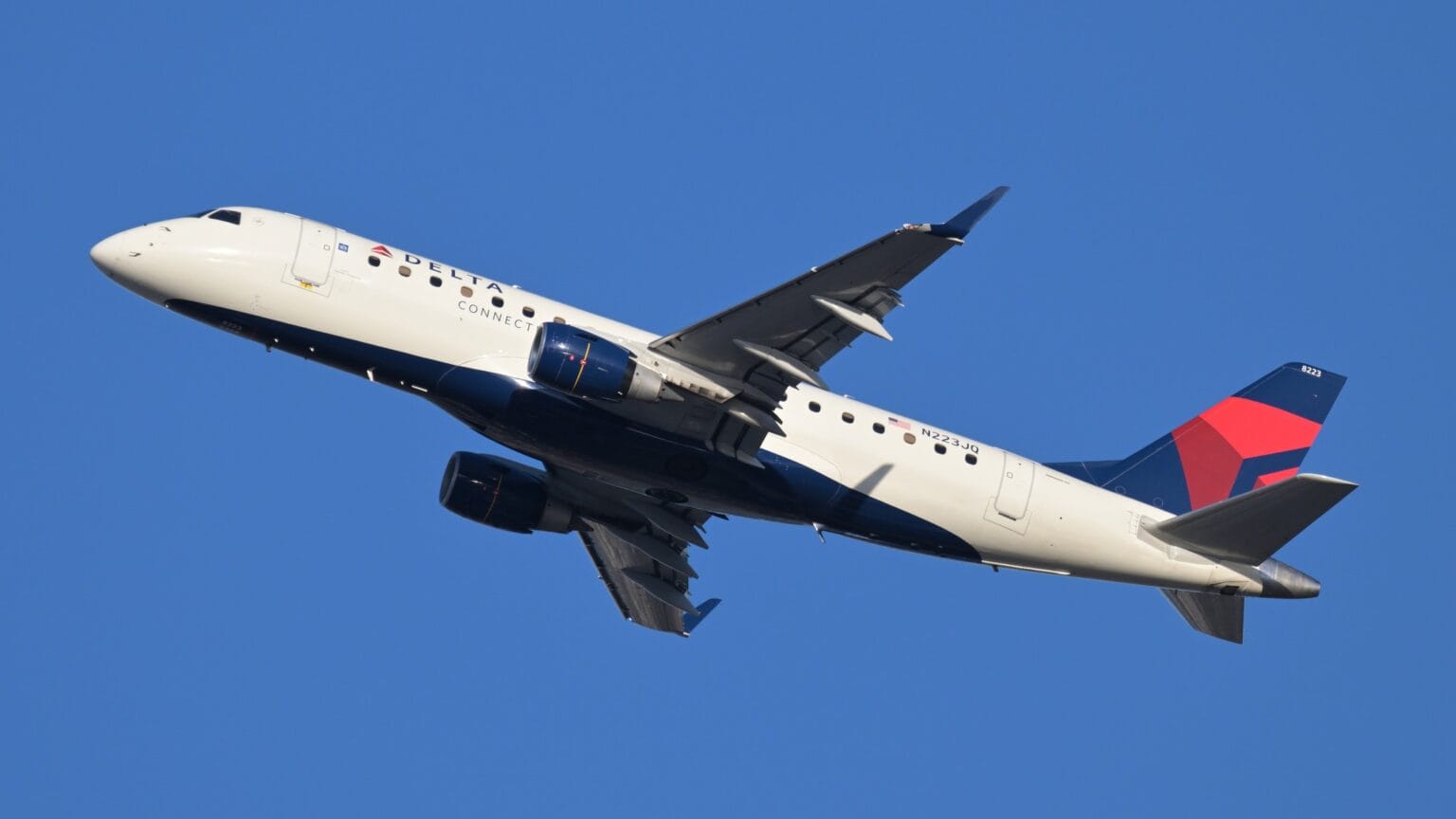
Delta Connection flight DL5656 from Columbus, Ohio, to New York JFK turned back on the morning of October 12, 2026, after its landing gear would not retract. The Embraer 175, operated by Republic Airways and registered N223JQ, landed back in Columbus 27 minutes after takeoff.
The flight was first reported by The Aviation Herald, which said the crew stopped the climb at 13,000 feet (3,960 m) to troubleshoot what they described as a minor issue.
What happened on DL5656
FlightAware data shows the jet lifting off from John Glenn Columbus International at 7:09 a.m. EDT, departing runway 28R according to The Aviation Herald. It climbed northeast and levelled off just under 13,000 feet about eight minutes later.
The Aviation Herald reported that the crew talked with dispatch about whether to continue to New York or go back. They chose to return because the landing gear had not retracted, and a passenger told the outlet the crew announced the gear problem and the return.
The tracking data shows the descent beginning at about 7:20 a.m., roughly 35 miles (56 km) northeast of the airport. The E175 touched down on runway 28L at 7:37 a.m. and reached the gate at 7:44 a.m.
The Aviation Herald’s report does not say whether the crew declared an emergency, and it gives no passenger count. At the time of writing, AeroCorner had found no public statement from Delta or Republic about the flight.
Passengers reached JFK on another jet
A second DL5656 left Columbus at 8:42 a.m. and landed at JFK at 10:07 a.m., about an hour and a half after the first attempt, according to FlightAware. N223JQ’s own flight history logs no further flights that day, so the trip was flown by another aircraft.
FAA registry records list N223JQ, an Embraer 175, by its formal model name, ERJ 170-200 LR, built in 2008 and registered to Delta Air Lines. Republic flies it for Delta, and FlightAware lists it on the Columbus to JFK schedule again from October 13.
Why a gear that stays down ends the flight
With the gear stuck down, the wheels are already in the position they need for landing. The problem is the rest of the trip.
Extended gear adds drag, so the jet burns more fuel, and it must stay below its maximum landing gear extended speed, which FAA regulations call VLE. That breaks the fuel and timing the flight was planned on, which assumed a clean airframe at cruise altitude.
A gear that will not retract can also point to a fault elsewhere. The FAA’s maintenance technician handbook explains that a squat switch or proximity sensor on the main gear tells the airplane whether it is on the ground, and that this signal blocks retraction until the strut extends at takeoff.
The handbook adds that the squat switch is wired into many other system circuits as well. What actually stopped the gear on N223JQ has not been made public.
The dispatcher’s role in the decision
The call to dispatch was not a formality. Under 14 CFR 121.533, the captain and the aircraft dispatcher share responsibility for releasing a domestic airline flight, and the dispatcher must monitor it and can redispatch or cancel it if either of them judges it cannot continue safely as planned.
The captain remains in command and responsible for the safety of everyone on board. On DL5656 the answer was the departure airport, still close behind the jet, and the same weighing of options sits behind any flight diversion.
A widebody faced the same problem on a much longer trip in July, when an American Airlines 777 diverted to JFK after its gear stayed down on a Boston to London flight.
Sources and references used for research and fact-checking.
- FAA, Aircraft registry inquiry: N223JQ
- FAA, Aviation Maintenance Technician Handbook, Airframe, Volume 2 (FAA-H-8083-31A), Chapter 13: Aircraft Landing Gear Systems
- eCFR via Cornell LII, 14 CFR 121.533, Responsibility for operational control: domestic operations
- eCFR via Cornell LII, 14 CFR 1.2, Abbreviations and symbols
Get the Newsletter
The latest aviation news and stories sent to your inbox.
About the Author

Tim is the owner and lead editor of AeroCorner since 2019, overseeing aviation content covering aircraft, airlines, airports, and the broader aviation industry. Through years of researching, writing, editing, and publishing aviation-focused content, he has developed extensive practical knowledge of commercial aviation and air travel. Based in Asia and a frequent traveler himself, Tim also brings firsthand passenger experience to AeroCorner’s coverage. Outside of publishing, he has also explored aviation firsthand through hands-on flight training in New Zealand.