

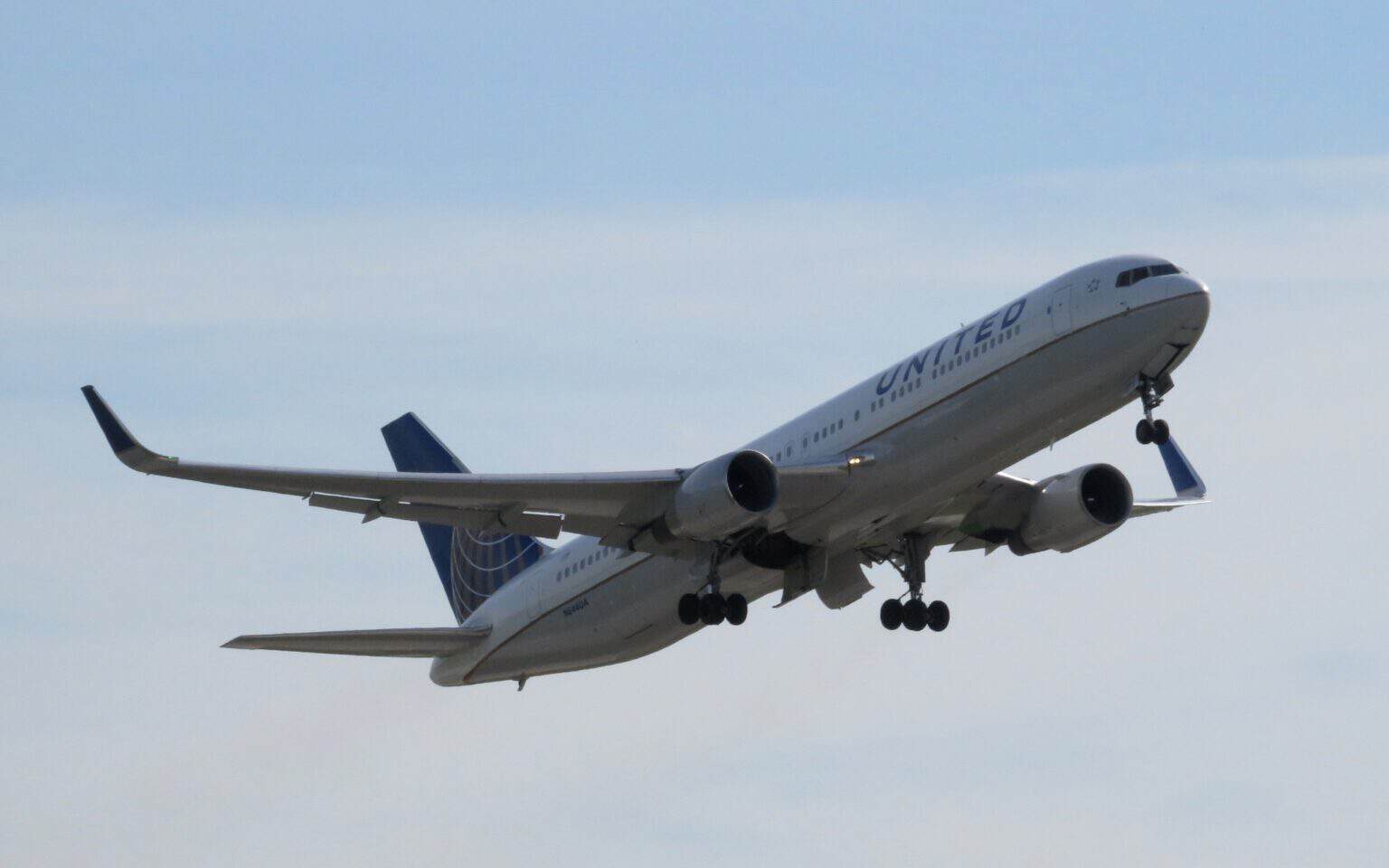
United Airlines flight UA946 from Washington Dulles to Amsterdam diverted to St. John’s, Newfoundland, early on Monday, October 12, 2026, after a problem with one of its two engines over the North Atlantic. The airline said the Boeing 767-300 landed safely and its 122 passengers and nine crew members got off normally.
The jet, registration N644UA, received its US airworthiness certificate in May 1991, which makes it about 35 years old. United put the passengers in hotels overnight and said it was sending a different aircraft to fly them on to Amsterdam.
What happened on UA946
Flight-tracking data from FlightAware shows N644UA left Washington Dulles at 8:47 p.m. EDT on Sunday, October 11. It was scheduled to reach Amsterdam Schiphol the next morning.
According to The Aviation Herald, the crew were cruising at 37,000 feet about 370 nautical miles east of St. John’s when a problem developed with one of the jet’s Pratt & Whitney PW4060 engines. They let the aircraft drift down to 26,000 feet, turned back toward Newfoundland and declared an emergency.
A media advisory from the St. John’s Regional Fire Department, reported by CBC News, said its Kent’s Pond station responded to a large aircraft with an “in-flight emergency” at around 2:28 a.m. local time. FlightAware logged the 767 landing at St. John’s International Airport at 3:29 a.m. Newfoundland time, 5 hours and 11 minutes after it left Dulles.
The Aviation Herald said it landed on runway 28 about 90 minutes after the turnaround and that it had received information the aircraft arrived with one engine shut down. United has not confirmed a shutdown. In an email to CBC News, the airline described the cause only as an unspecified “engine issue.”
“We arranged overnight hotel accommodations for our customers and are sending a different aircraft to take them to Amsterdam,” United said in its statement. Schiphol listed the original flight as cancelled, and N644UA’s scheduled return flight from Amsterdam to Dulles that afternoon was also cancelled, according to FlightAware.
At the time of writing, United had not said what went wrong with the engine or which of the two engines was involved, and there was no public word on when the replacement aircraft would leave St. John’s.
Why a twin-engine jet over the Atlantic turns back to Newfoundland
A twin-engine airliner cannot fly just any path across an ocean. Under US airline rules in 14 CFR 121.161, a two-engine jet may not stray more than 60 minutes from an adequate airport unless the FAA has approved it for extended operations, known as ETOPS.
ETOPS approval lets airlines fly farther from land, but only on a planned route that keeps an adequate diversion airport within an approved flying time. Newfoundland sits at the eastern edge of North America, so for a jet early in an eastbound crossing, its airports are the closest land behind it.
That is why the UA946 crew, about 370 nautical miles (426 miles, 685 km) east of St. John’s, turned back west rather than pressing on. It is not an unusual stop: in August, a Delta A330 with engine trouble diverted there too.
Dropping down to a lower altitude, as the UA946 crew did, is also a standard move. A twin running on one engine typically cannot hold its normal cruising level, so the crew descends to an altitude the remaining engine can sustain.
An aging fleet type at United
N644UA is a Boeing 767-300 owned by United, according to FAA registry data, with an airworthiness date of May 17, 1991. Its registry entry lists Pratt & Whitney PW4000-series engines rated at 60,000 pounds of thrust.
It is not United’s first widebody engine event in recent months. In August, another United 767-300ER on flight UA957 shut down an engine over France and returned to Geneva, and on October 6 a United 777 on flight UA888 to Beijing turned back to San Francisco after an engine shutdown.
Whether the UA946 problem is linked to the engine’s type or the jet’s age is not known. United has not published a cause, and no investigating agency had announced an inquiry at the time of writing.
Sources and references used for research and fact-checking.
Get the Newsletter
The latest aviation news and stories sent to your inbox.
About the Author

Tim is the owner and lead editor of AeroCorner since 2019, overseeing aviation content covering aircraft, airlines, airports, and the broader aviation industry. Through years of researching, writing, editing, and publishing aviation-focused content, he has developed extensive practical knowledge of commercial aviation and air travel. Based in Asia and a frequent traveler himself, Tim also brings firsthand passenger experience to AeroCorner’s coverage. Outside of publishing, he has also explored aviation firsthand through hands-on flight training in New Zealand.