

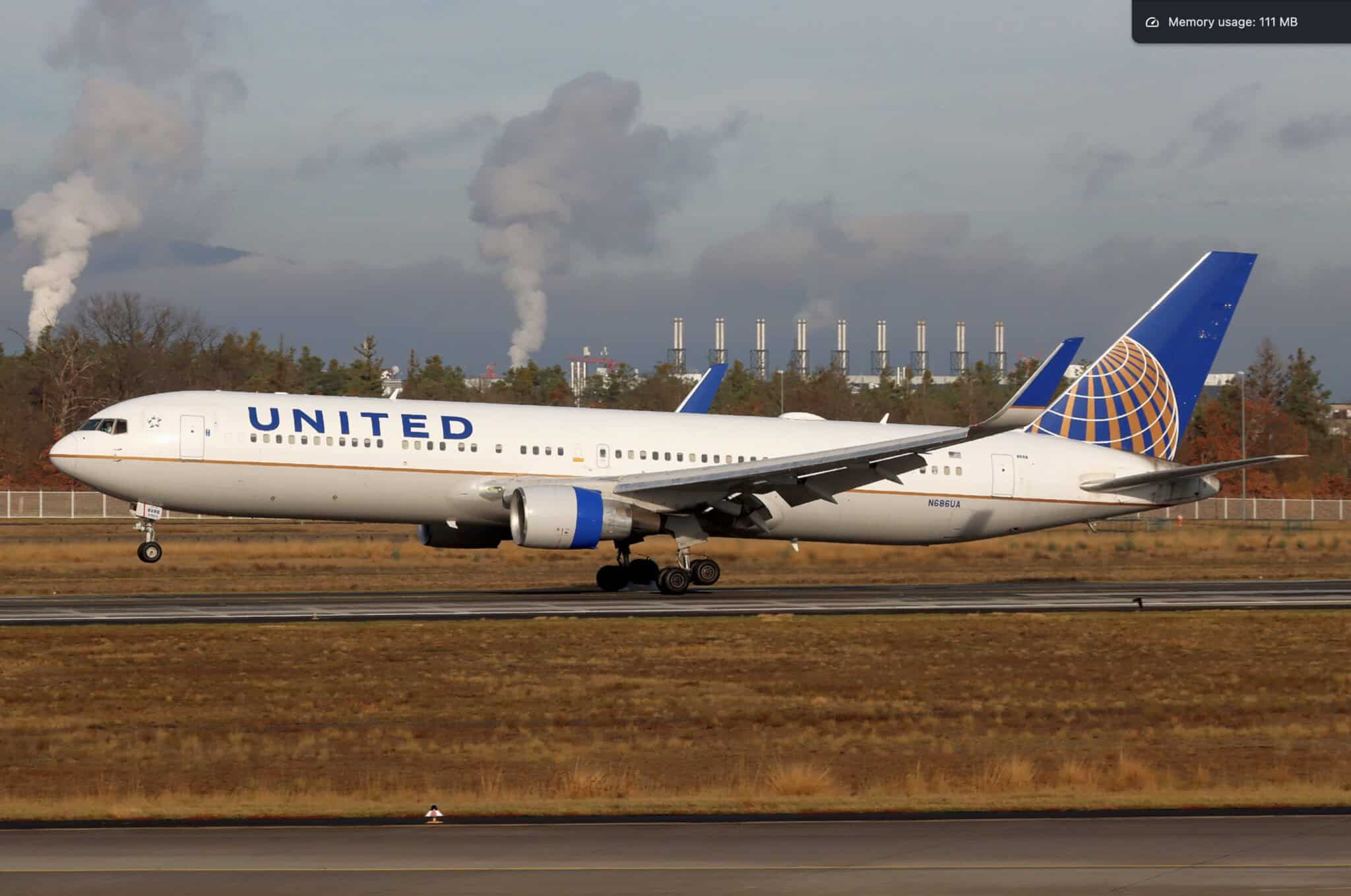
United Airlines flight UA957 turned back to Geneva on August 20, 2026, after the left engine of its Boeing 767-300ER failed about 30 minutes into a flight to Newark. The jet landed safely with no injuries, the fourth United 767 in six weeks to divert or turn back for a mechanical fault.
An Engine the Captain Called “Blown”
UA957, registered N686UA, departed Geneva‘s runway 22 at 09:18 local time. About 30 minutes later, climbing through French airspace, the crew halted the climb, squawked an emergency code, and turned back, according to AirLive.
Around 23,000 feet, the left engine produced a loud bang and was shut down. Aviation Herald quoted a passenger who described “a rumbling noise from the left hand side as well as some smell of burning plastics.”
The aircraft landed back on runway 22 roughly 50 minutes after departure, met by rescue crews on standby, and taxied to a remote stand rather than the terminal, a routine precaution while ground staff and the crew work through the paperwork that follows any emergency landing. After landing, the captain told passengers the engine had “blown,” per Aviation Herald.
Cause not yet confirmed
Neither United nor a French or Swiss aviation authority has said what failed inside the engine. The aircraft remained in Geneva after the diversion for inspection.
The Fourth United 767 Mechanical Event Since July
N686UA is about 23 years old, one of three 767-300ERs United acquired from Hawaiian Airlines in 2019, making it one of the youngest jets in a subfleet whose oldest aircraft is over 35, according to SimpleFlying’s fleet-age reporting.
It is also the fourth time in six weeks that a United 767 has diverted or turned back for a mechanical problem, with a different tail number and a different system failing each time. All four flights landed safely with no injuries reported among the hundreds of passengers involved.
July 11, 2026
Engine vibration over the Atlantic. UA509, a 24-year-old 767-400 (N76065), diverted to Shannon, Ireland, after the crew reported vibrations and an odor from the right engine on a Rome-to-Newark flight.
July 20, 2026
Hydraulic failure south of Greenland. UA956, a 26-year-old 767-300ER (N673UA), turned back to Newark after a backup hydraulic system failed on a flight to Geneva, burning roughly six hours of extra fuel.
August 4, 2026
Autopilot and autothrottle loss. UA169, a 25-year-old 767-400ER (N76054), lost both systems at once over the Atlantic and diverted to Dublin on a Venice-to-Newark flight.
August 20, 2026
Engine failure over France. UA957, a 23-year-old 767-300ER (N686UA), lost its left engine climbing out of Geneva and returned there safely.
AeroCorner covered the Dublin diversion in August and, at the time, noted that a single precautionary event did not point to a fleet-wide issue. Four separate faults across four different aircraft and four different systems in six weeks does not establish one either, since engines, hydraulics, and flight-control automation do not share common parts or maintenance schedules.
What the run does confirm is the age of the fleet flying these routes: United’s 767s average in their low-to-mid twenties, and the airline has not said when it will retire them, even as it works through a broader plan to retire about 80 aircraft in 2027 as new narrowbody deliveries arrive.
Older aircraft, more scheduled maintenance
Airlines fly aging widebodies like the 767 under maintenance programs that get more, not less, frequent as an airframe ages. A precautionary diversion, while inconvenient, is that system working as intended: a fault gets caught and inspected before it becomes something worse.
Get the Newsletter
The latest aviation news and stories sent to your inbox.
About the Author

Tim is the owner and lead editor of AeroCorner since 2019, overseeing aviation content covering aircraft, airlines, airports, and the broader aviation industry. Through years of researching, writing, editing, and publishing aviation-focused content, he has developed extensive practical knowledge of commercial aviation and air travel. Based in Asia and a frequent traveler himself, Tim also brings firsthand passenger experience to AeroCorner’s coverage. Outside of publishing, he has also explored aviation firsthand through hands-on flight training in New Zealand.