

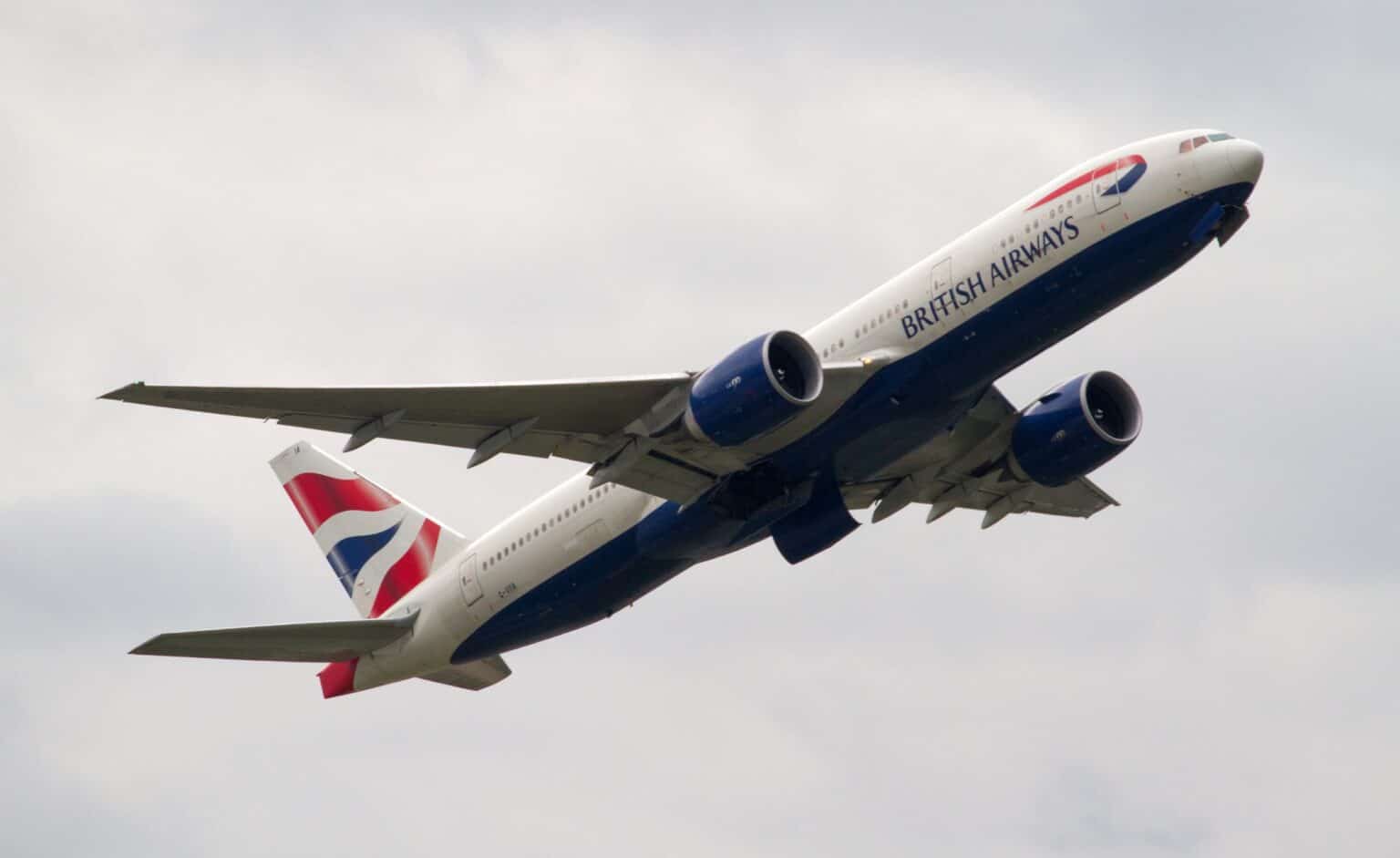
British Airways flight BA295 from London Heathrow to Chicago O’Hare made an emergency descent over the Irish Sea on Monday, October 5, 2026, with the passenger oxygen masks deployed. The Boeing 777, registered G-VIIA, turned back and landed at Heathrow at about 5 p.m. local time.
British Airways has called the cause “a technical issue” and has not said what failed. The Aviation Herald reports that the crew started the descent because the aircraft lost cabin pressure, and that the passenger masks were released.
What happened on BA295
The flight left Heathrow at about 12:15 p.m., roughly an hour behind schedule. It was cruising at 36,000 feet, about 40 nautical miles south of Dublin, when the crew began an emergency descent, according to The Aviation Herald.
FlightAware data cited by NBC News shows the jet going from 36,000 feet to 9,000 feet in around seven minutes. That works out to an average of roughly 3,800 feet per minute, the figure The Aviation Herald gives.
The crew then turned back toward London instead of continuing to Chicago. British Airways said in a statement that “the aircraft landed safely after our highly-trained pilots returned to Heathrow following a technical issue.”
The airline added that customers left the aircraft normally and that its teams were working to get their travel plans back on track. Neither the statement nor the flight-tracking reports give the number of people on board.
Why the crew went straight down to 9,000 feet
At cruise altitude, the air outside the cabin is far too thin to keep a person conscious for long. The FAA’s guidance for high-altitude pilots, Advisory Circular 61-107B, puts the time of useful consciousness at 35,000 feet at 30 seconds to one minute, and at 15 to 30 seconds after a rapid decompression.
That is why the passenger oxygen masks exist. They are designed to buy time while the pilots, on their own oxygen supply, take the aircraft down to air people can breathe.
Leveling off at 9,000 feet puts the cabin below 10,000 feet. That is the line above which US airline oxygen rules, in 14 CFR 121.329, start to require supplemental oxygen for crew and passengers.
Why the jet took four hours to land
Once a jet cannot hold cabin pressure, it has to stay low. Down there, its engines burn fuel far faster than at cruise, so continuing across the Atlantic was not an option.
Turning back created a different problem: a widebody fueled for a transatlantic flight is heavier than it is allowed to land at. The Aviation Herald reports that the crew dumped fuel near Cardiff, and NBC News, citing FlightAware, says the jet spent around four hours zigzagging over the Bristol Channel.
It touched down on Heathrow’s runway 27L about four hours after leaving 36,000 feet. In August, an Air France 777 bound for Ottawa made a similar decision after a pressurization problem and flew back to Paris.
British Airways’ oldest jet
G-VIIA is a Boeing 777-200ER. It is the first 777-200ER Boeing built, the lead aircraft in that variant’s certification program, and British Airways’ oldest active jet, according to Simple Flying.
The aircraft first flew in October 1996 and joined British Airways in July 1997. Monday’s emergency came a day after the 30th anniversary of that first flight, according to The Aviation Hub.
Age alone says little about the cause, which British Airways has not named. At the time of writing, no investigation report has been published.
Sources and references used for research and fact-checking.
Get the Newsletter
The latest aviation news and stories sent to your inbox.
About the Author

Tim is the owner and lead editor of AeroCorner since 2019, overseeing aviation content covering aircraft, airlines, airports, and the broader aviation industry. Through years of researching, writing, editing, and publishing aviation-focused content, he has developed extensive practical knowledge of commercial aviation and air travel. Based in Asia and a frequent traveler himself, Tim also brings firsthand passenger experience to AeroCorner’s coverage. Outside of publishing, he has also explored aviation firsthand through hands-on flight training in New Zealand.