

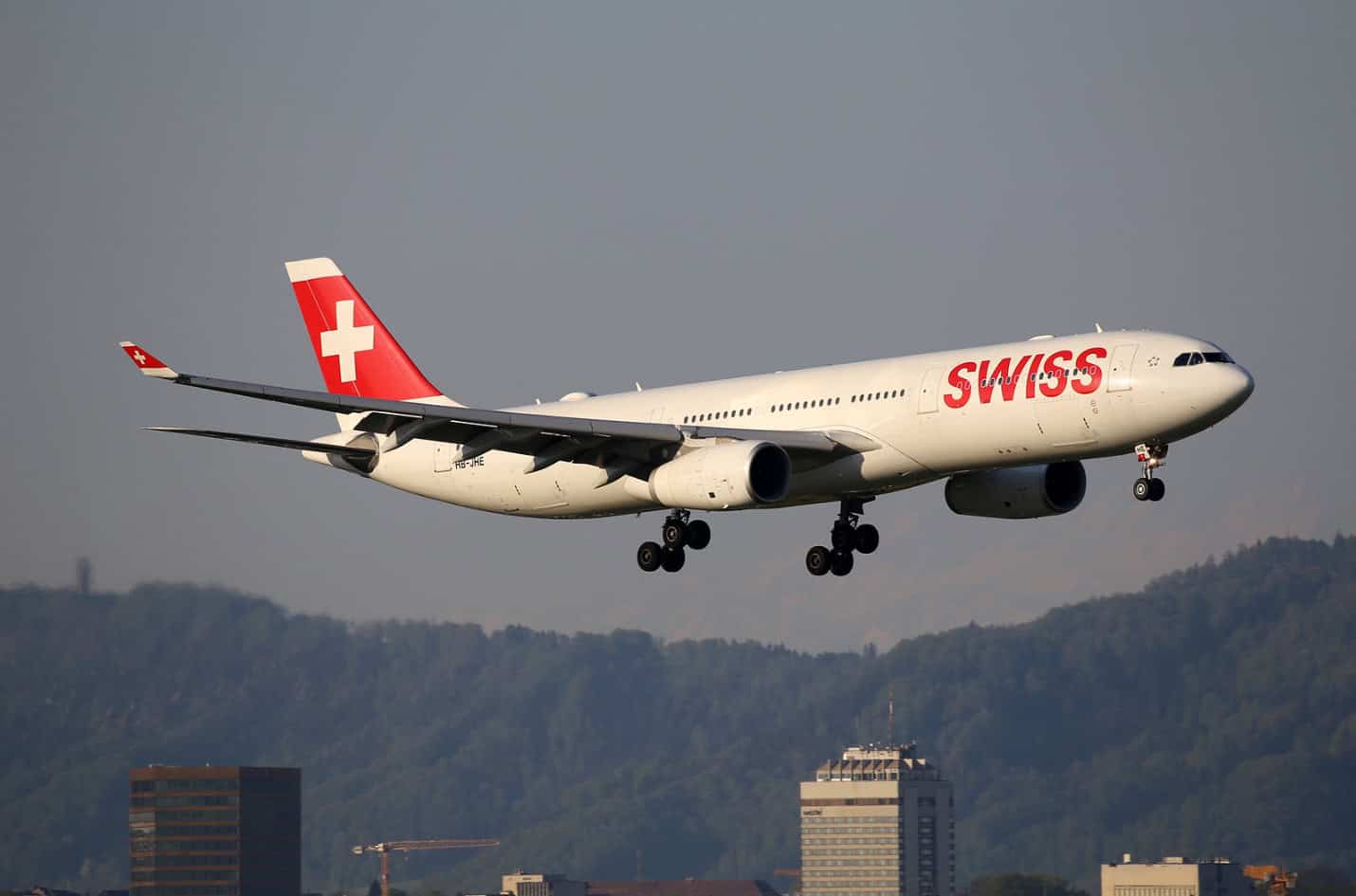
On July 27, 2026, a SWISS Airbus A330 bound for New York declared an emergency and diverted to Bangor, Maine, after smoke of unknown origin filled the forward business-class cabin over the North Atlantic. All 208 passengers and crew aboard flight LX16 landed safely, and firefighters who met the aircraft found no sign of fire or heat.
What happened on flight LX16
The flight left Zurich for New York’s John F. Kennedy International Airport at around 10:26 a.m. local time. Roughly five to six hours later, cruising near Nova Scotia at about 32,000 feet, the crew reported smoke in the forward section of the business-class cabin.
The pilots set the transponder to squawk 7700, the universal emergency code, and requested an immediate diversion to Bangor International Airport. The Airbus descended sharply and landed a little over ten minutes later. The aircraft, registration HB-JHK, was a roughly 14-year-old A330-300.
The jet stopped on the runway for close to an hour while crews inspected it, briefly closing the field, before it was moved to the terminal. No injuries were reported. Passengers were later rerouted on a replacement aircraft and reached New York several hours behind schedule.
SWISS said its crew acted out of caution and that it had not yet identified what produced the smoke. “In a situation like this, we take no risks, which is why our crews always choose the safest course of action and act out of an abundance of caution,” the airline said in a statement. It added that it would not speculate on the cause until a full inspection was complete.
Why smoke is the emergency crews fear most
Smoke or fumes from an unknown source are treated more urgently than almost any other in-flight problem. An engine can be shut down and a system can be isolated, but a fire hidden behind a panel can spread faster than a crew can find it, and at cruise altitude there is nowhere to escape to.
For that reason, airline procedures for smoke of unknown origin push crews toward a single decision: get the aircraft on the ground at the nearest suitable airport as soon as possible. Pilots typically don oxygen masks, run a smoke checklist, and divert without waiting to confirm whether an actual flame exists. The absence of visible fire, as in this case, does not lower the urgency.
Why Bangor keeps catching these flights
Bangor sits almost directly under the great-circle tracks between Europe and the US East Coast. It has a long runway, light traffic, and US Customs and Border Protection staff on site, which is why transatlantic flights in trouble routinely put down there. For a jet over Nova Scotia, it is often the first good option in US airspace.
That geography is the reason a Swiss-registered widebody ended up in northern Maine rather than turning back across the ocean. Bangor handles these diversions regularly, and its Customs facilities let a full load of international passengers clear entry without a special arrangement. It is the same logic that has drawn many a troubled flight off the North Atlantic over the years, much like another transatlantic flight that diverted after turbulence injured its crew.
The cause of the smoke remains open. Early passenger accounts described an electrical smell, and one traveler suggested it may have come from a seat, echoing a similar odor-driven diversion traced later to a piece of cabin equipment. SWISS has not confirmed any of that.
Still a developing story
Accounts of where the smoke appeared varied, with some early reports referring to the cockpit and the airline pointing to the forward business-class cabin. No cause has been determined, and until the inspection is finished any explanation is provisional.
Get the Newsletter
The latest aviation news and stories sent to your inbox.
About the Author

Tim is the owner and lead editor of AeroCorner since 2019, overseeing aviation content covering aircraft, airlines, airports, and the broader aviation industry. Through years of researching, writing, editing, and publishing aviation-focused content, he has developed extensive practical knowledge of commercial aviation and air travel. Based in Asia and a frequent traveler himself, Tim also brings firsthand passenger experience to AeroCorner’s coverage. Outside of publishing, he has also explored aviation firsthand through hands-on flight training in New Zealand.