

Table of Contents
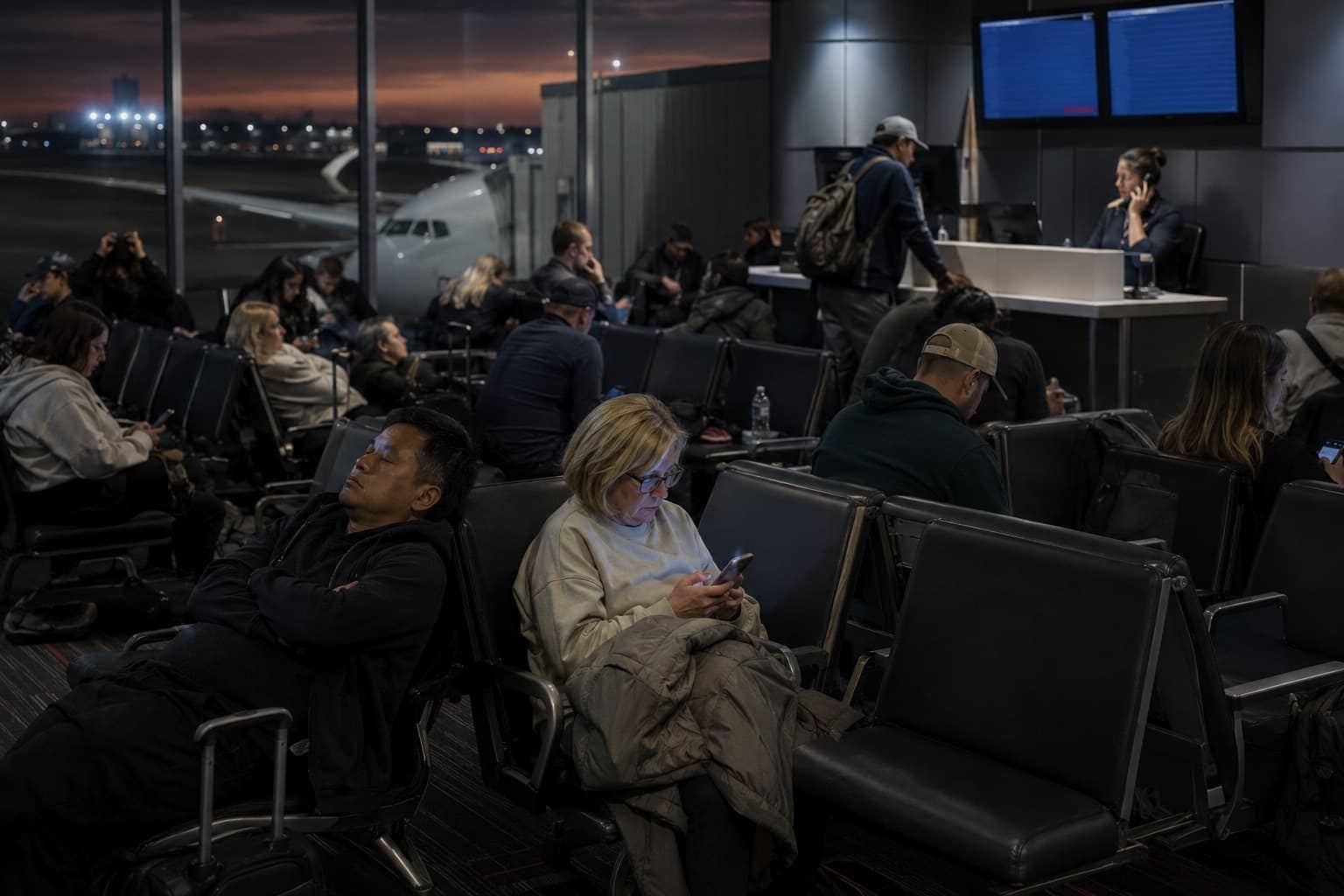
You are sitting at the gate, door closed, ready to go. The captain comes on the PA and says something like: “Folks, we’ve been issued an ATC ground delay. Our expect-departure clearance time is in about 40 minutes. We’ll keep you updated.” You look out the window. The sky above you is clear. The aircraft is fully loaded and fuelled. Nothing is visibly wrong. And yet you are going nowhere.
This happens tens of thousands of times a year across the US, and it is almost never explained to passengers in any meaningful way. The phrase “ATC delay” covers a range of specific, structured programmes that the Federal Aviation Administration runs to manage the national airspace, and the mechanics behind them are genuinely interesting.
The delay you are sitting in did not happen because someone forgot to plan, or because the system is broken. It happened because a group of specialists at a facility in northern Virginia looked at a weather forecast several hours ago and made a calculated decision to spread the pain out early, before it became something much worse. Here is what is actually happening.
The room where it all connects
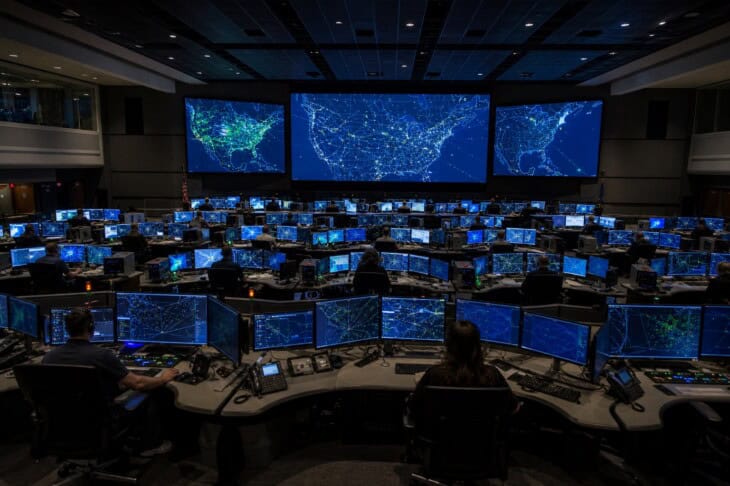
In Warrenton, Virginia, about 45 miles southwest of Washington DC, there is a facility called the Air Traffic Control System Command Center. The FAA refers to it as the ATCSCC, or simply the Command Center. It is the only facility of its type in the United States, and its job is to see the national airspace as a single system rather than a collection of individual airports and sectors.
On a typical day, around 45,000 flights operate in US airspace. Individual air traffic control facilities manage their own patches of sky: towers handle the immediate airport environment, approach controls handle the area within roughly 40 to 50 miles, and the en-route centres handle the high-altitude routes in between. Each of those facilities is very good at managing the traffic in its own domain. What none of them can do alone is look at the entire country and decide how many flights should be heading toward San Francisco in three hours when a weather system is going to reduce that airport’s capacity to roughly half its normal level.
That is the Command Center’s job. Staffed around the clock by approximately 65 National Traffic Management Officers and Specialists, it monitors the entire National Airspace System and acts whenever demand is on course to exceed capacity at any significant point in the network. It does not separate aircraft or issue clearances: that work belongs to the individual controllers. The Command Center’s job is to prevent the system from ever reaching the point where those controllers are overwhelmed in the first place.
How the mathematics of delay actually works
The fundamental number in all of this is the Airport Acceptance Rate, known as the AAR. This is the number of arriving aircraft that an airport can safely handle per hour under current conditions. On a clear day at a large hub, the AAR might be 60 or higher. When low cloud, fog, thunderstorms, or heavy snow reduce runway visibility or require increased spacing between aircraft, that number can drop sharply, sometimes to half or less. When the Command Center sees that the scheduled demand for an airport is going to exceed its projected AAR for a sustained period, it has a choice to make.
The most common tool is the Ground Delay Program, or GDP. The Command Center uses software called the Flight Schedule Monitor to look at every flight scheduled to arrive at the affected airport during the capacity-constrained period, and assign each one an arrival slot. The slot is based on how long the flight takes to get there: a shorter flight gets a later departure time so that it arrives into the slower acceptance rate in an orderly queue. The result is an Estimated Departure Clearance Time, or EDCT, issued to each affected flight. Airlines are required to depart within five minutes before or after their EDCT. That is the mechanism behind the announcement you hear at the gate.
A Ground Stop is a different and more blunt instrument. Where a GDP still allows flights to depart, just at controlled intervals, a Ground Stop means exactly what it says: no aircraft bound for the affected airport departs until the stop is lifted. Ground Stops are typically used for shorter, sharper events where the Command Center does not yet have enough information to model a full GDP, or where the capacity drop is so sudden and complete that spacing is not the right solution. A tower in the path of a fast-moving thunderstorm cell might get a Ground Stop while the Command Center waits to see how quickly conditions will change.
The main flow control tools
Ground Delay Program (GDP): Assigns departure slots to flights bound for a capacity-constrained airport. Each flight gets an EDCT it must meet within five minutes. Flights depart, just in a controlled queue. Ground Stop: No departures to the affected airport until the stop is lifted. Used for sudden or short-duration events. Miles-in-Trail restriction: Requires a minimum distance between aircraft on a specific route or through a specific fix, used to thin out traffic entering a congested sector. Airspace Flow Program: A GDP-like programme applied not to an airport but to a fix or corridor, used when en-route weather reduces sector capacity.
There is also a class of restriction called miles-in-trail, which does not target a destination airport but a specific point in the airspace, a fix or a sector boundary. A miles-in-trail restriction of 40, for example, means that controllers must ensure at least 40 nautical miles of spacing between aircraft crossing a certain fix. These are used when weather reduces the capacity of an en-route sector, rather than an airport: the goal is to thin the flow before it arrives at the congested point. Inside each of the 22 en-route Air Route Traffic Control Centers, a Traffic Management Unit, or TMU, coordinates with the Command Center to implement these restrictions locally and feed information back about actual conditions in their sector of the system.
When a single storm becomes everyone’s problem
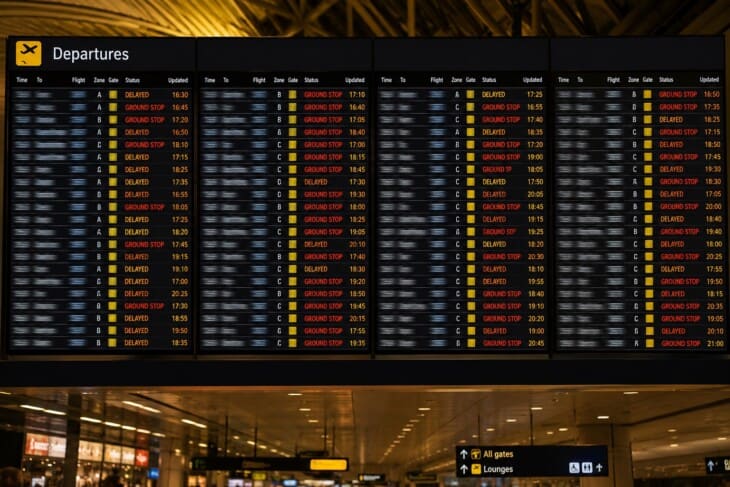
The reason that flow control matters is that the US air traffic network is almost entirely hub-and-spoke: a large proportion of domestic passengers connect through a small number of major airports, and those airports feed each other. A significant capacity reduction at Chicago O’Hare does not just affect Chicago. It affects every aircraft that was going to land at O’Hare and then depart again, which means it affects every city those connecting passengers were trying to reach. The delay at your gate in Boston may be because a thunderstorm cell sat over the western suburbs of Chicago for two hours this afternoon.
This is why the Command Center acts on forecasts rather than waiting for conditions to arrive. If weather is predicted to reduce San Francisco’s acceptance rate for a six-hour window starting at 3pm, a GDP will typically be issued several hours before that window opens. The goal is to spread the delays across the departure end of the system, at gates and airports around the country, where they are manageable. The alternative is allowing all those flights to depart on schedule, fill the en-route system, and then arrive at a constrained airport simultaneously, at which point controllers at the destination have no way to absorb them. Queues would form in the air rather than on the ground, burning fuel, increasing workload, and carrying far more risk.
Chicago O’Hare, April 28, 2026
When severe thunderstorms moved through the Chicago area in late April 2026, O’Hare International recorded more than 1,200 delays and 260 cancellations in a single day. A full ground stop was declared for incoming flights as the airport’s acceptance rate collapsed. The ripple effects reached every hub O’Hare connects to: Atlanta, Dallas, New York, Los Angeles, Denver, and Minneapolis all reported cascading delays as aircraft that should have turned at O’Hare and continued onward were held on the ground across the country. Passengers who had never planned to go anywhere near Chicago found their flights delayed because of a storm they couldn’t see from their gate.
There is another layer to this worth understanding. Airlines are not passive recipients of ground delay programmes. A process called Collaborative Decision Making allows airlines to participate in the slot assignment process, substituting aircraft and re-ordering their own flights within the slots they have been allocated. If an airline has a wide-body scheduled into a slot and a narrow-body with fewer passengers scheduled into a later slot, they can swap them. The Command Center sets the capacity envelope; the airlines work inside it. This was a deliberate policy shift from the 1990s, when the FAA issued delays unilaterally and airlines had no input into how those delays fell on their specific operations.
The next time you hear “we’re waiting on an ATC clearance time” from the flight deck, the most likely explanation is that the Command Center in Warrenton issued a GDP several hours ago, a slot was calculated for your flight, and you are now sitting on the ground because that is far safer and cheaper than sitting in a holding pattern over a congested airport at 10,000 feet. The delay is not a failure of the system. In most cases, it is the system working exactly as designed.
To understand how flow control decisions connect to the controllers who carry them out day to day, The People Watching Every Flight: Inside Air Traffic Control explains the role and the facilities involved. The staffing shortfalls that sometimes force additional flow restrictions are covered in Why There Aren’t Enough Air Traffic Controllers. For the broader picture of how the ATC system fits together, see How Air Traffic Control Actually Works.
FAQ
Sources and references used for research and fact-checking.
- Section 10. Ground Delay Programs - Federal Aviation Administration — FAA Order 7210.3 (Facility Administration)
- Ground Delay Program (GDP) - NBAA — National Business Aviation Association
- Ground Stop (GS) - NBAA — National Business Aviation Association
- Air Traffic Control System Command Center (ATCSCC) - Federal Aviation Administration
- David J. Hurley Air Traffic Control System Command Center Fact Sheet - Federal Aviation Administration
- Chapter 18. Traffic Management National, Center, and Terminal - Federal Aviation Administration — FAA Order 7210.3
- Section 7. Traffic Management Initiatives - Federal Aviation Administration — FAA Order 7210.3
- Lesson 3: Traffic Flow Management (ATFM) — Collaborative Decision Making - FAA TFM Learning
- Ground delay program - Wikipedia
Get the Newsletter
The latest aviation news and stories sent to your inbox.
About the Author

Tim is the owner and lead editor of AeroCorner since 2019, overseeing aviation content covering aircraft, airlines, airports, and the broader aviation industry. Through years of researching, writing, editing, and publishing aviation-focused content, he has developed extensive practical knowledge of commercial aviation and air travel. Based in Asia and a frequent traveler himself, Tim also brings firsthand passenger experience to AeroCorner’s coverage. Outside of publishing, he has also explored aviation firsthand through hands-on flight training in New Zealand.