

Table of Contents
Somewhere in the background of every flight you have ever taken, a set of voices you never heard was coordinating everything. The phrase “cleared for takeoff” that crackles through the cabin speaker represents the end of a chain of decisions made by people you will never meet, working in buildings you will never see, managing airspace you will never think about again once the wheels are up. Most passengers experience air traffic control as a brief announcement about a delay, or as background noise in an aviation documentary. The reality behind it is considerably more interesting.
The United States air traffic control system manages roughly 45,000 flights every day, across more than 29 million square miles of airspace, coordinated by around 10,000 certified professional controllers working from more than 300 facilities. It stretches from the ground control position at a small regional airport all the way to specialists coordinating transatlantic crossings over an ocean where no radar exists. Every aircraft on an instrument flight plan is in constant contact with some part of this system from the moment it taxis to the moment it parks. This series explains how the pieces fit together.
What this series covers
7 articles on the people, technology, and systems that manage every flight from pushback to touchdown — written for curious passengers, not aviation professionals.
The scale of the system
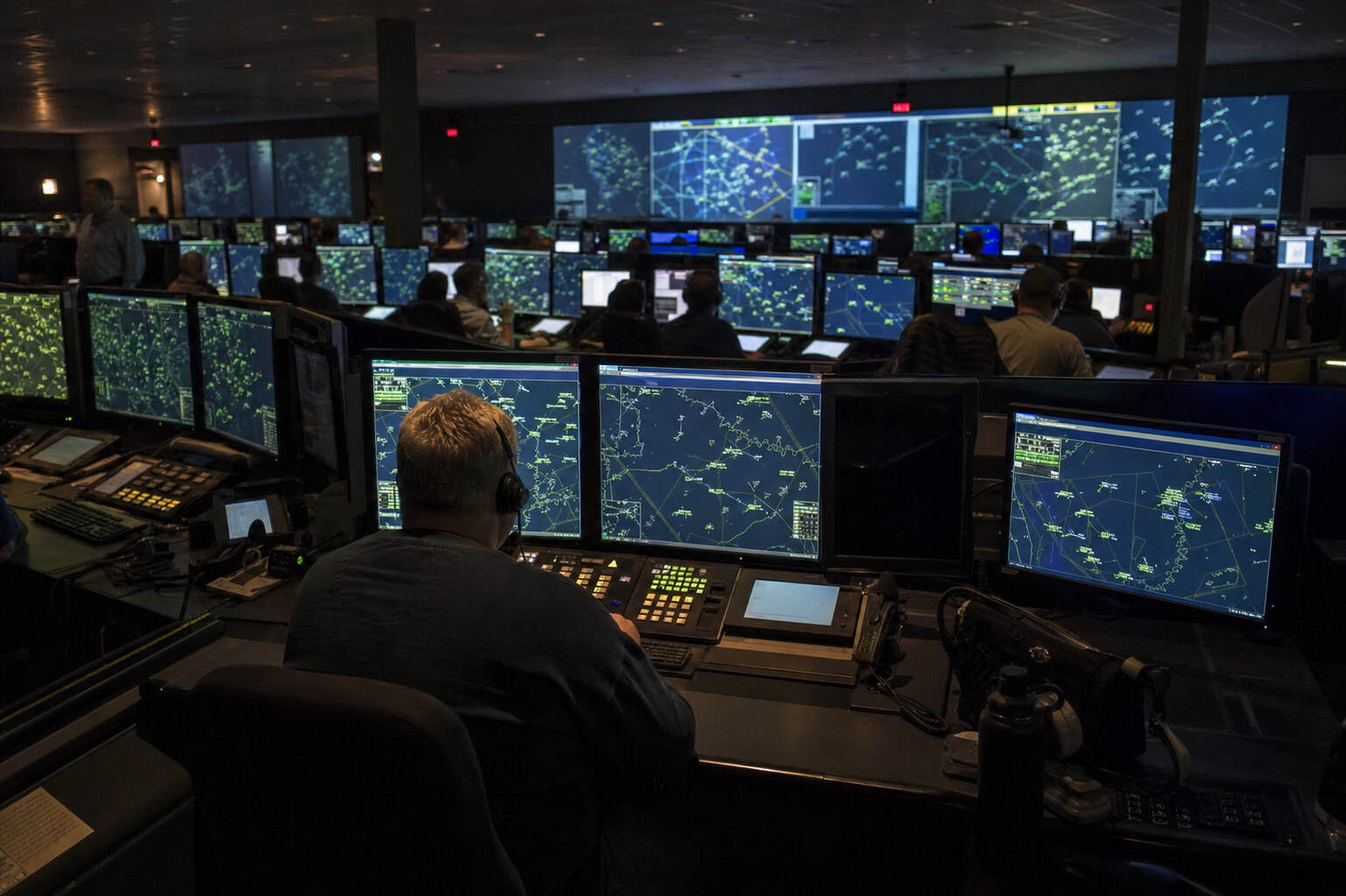
Air traffic control is not one thing. It is a layered system of facility types, each responsible for a different phase of flight and a different slice of airspace. Tower controllers handle the immediate vicinity of an airport: ground movement, takeoff clearances, landing sequences. TRACON controllers take over once an aircraft climbs above the airport environment, managing the departure and arrival flows for a region that might cover several airports and hundreds of square miles. En route controllers at Air Route Traffic Control Centers, known as Centers or ARTCCs, handle aircraft at cruise altitude across enormous blocks of airspace. A single flight on a transcontinental route will pass through the jurisdiction of several different controllers at several different facilities before it reaches its destination, each handing it off to the next with a precision that passengers never notice because it works.
Beyond the domestic structure, the system extends into airspace where the familiar tools stop working. Over the North Atlantic, where no ground radar exists and VHF radio cannot reach, a separate set of oceanic control facilities manages the flow of roughly 1,500 flights per day using procedural separation, satellite surveillance, and a track system redesigned twice daily around the movement of the jet stream. The same principles that govern a domestic departure, sequence, separate, coordinate, apply over the ocean, but the tools and the timescales are entirely different. Understanding that range is part of understanding what the system actually is.
What makes the system work, day after day, at the scale it operates, is a combination of procedure, technology, and people. The procedures are extraordinarily detailed: there are published rules for how far apart aircraft must be, how emergencies must be handled, how a clearance must be worded, and what a controller must do when a transponder shows 7700. The technology ranges from radar that updates every few seconds to satellites that track oceanic traffic every eight. And the people are the piece that makes both of those things function under the pressure of real-time air traffic, where every decision has a consequence and the margin for error is not large.
What this series covers
The series starts with the people and the structure. The People Watching Every Flight: Inside Air Traffic Control explains the three types of ATC facilities, what a controller’s sector actually looks like, how separation standards work in practice, and what it takes to become certified at a facility. It is the foundation for everything else in the series. From there, How Your Flight Gets Its Route (And Why It Changes) covers the IFR clearance structure that frames every instrument flight: what airways are, what a clearance actually contains, why your filed route rarely matches the route you fly, and how amendments get issued while the aircraft is already airborne. The structural problem running beneath both of those articles is covered in Why There Aren’t Enough Air Traffic Controllers, which examines the mandatory retirement age that forces controllers out at 56, the 2-to-5-year training pipeline that cannot produce certified replacements quickly, and the consequences for the facilities most critically short of staff.
Two articles cover the parts of the system that most passengers never think about at all. Flying Over the Ocean With No Radar explains the North Atlantic Track System, how SELCAL and HF radio allowed controllers to manage oceanic crossings for decades without radar coverage, and what the 2019 arrival of space-based ADS-B surveillance from the Iridium satellite constellation changed about that picture. The System That Prevents Mid-Air Collisions covers TCAS: how the Traffic Collision Avoidance System detects other aircraft through transponder interrogation, what the difference is between a traffic advisory and a resolution advisory, how two aircraft coordinate their escape maneuvers automatically, and why the Überlingen collision of 2002 made the rule that TCAS overrides ATC an absolute and unambiguous requirement.
The final two articles cover the system under pressure. The System That Manages Delays Before You Even Push Back explains how the FAA’s Air Traffic Control System Command Center in Warrenton, Virginia, orchestrates the entire national airspace from above: what a Ground Delay Program is, how departure slots are assigned, and why one understaffed facility on a clear day can hold aircraft on the ground at airports hundreds of miles away. Squawk 7700: What Happens When a Pilot Declares an Emergency covers what actually happens inside an ATC facility the moment that transponder code appears, the difference between MAYDAY and PAN-PAN, why the distinction between “minimum fuel” and a fuel emergency matters more than most passengers realise, and why the aviation system is specifically designed to reward early declaration over waiting to see how bad things get.
Where to start
If you are new to the series, the controller job article is the natural starting point. It establishes the facilities, the roles, and the separation standards that every other article builds on. If you arrived here wondering about a specific experience, such as an “ATC delay” on a clear day or an ocean crossing, the flow control and oceanic articles are designed to be read independently. If you are interested in how the airline side of the same operational world works, the companion series How Airlines Actually Work covers the dispatcher, the fuel decision, the turnaround, and the pricing system from the carrier’s perspective.
The system that manages every flight is more intricate than any single announcement from the cockpit suggests. The articles in this series are designed to give you enough of the real picture that the next time you hear “we’re holding for an ATC clearance,” you know what that means, who is involved, and what is actually happening on the other side of that radio. Start with The People Watching Every Flight.
Get the Newsletter
The latest aviation news and stories sent to your inbox.
About the Author

Tim is the owner and lead editor of AeroCorner since 2019, overseeing aviation content covering aircraft, airlines, airports, and the broader aviation industry. Through years of researching, writing, editing, and publishing aviation-focused content, he has developed extensive practical knowledge of commercial aviation and air travel. Based in Asia and a frequent traveler himself, Tim also brings firsthand passenger experience to AeroCorner’s coverage. Outside of publishing, he has also explored aviation firsthand through hands-on flight training in New Zealand.