

Table of Contents
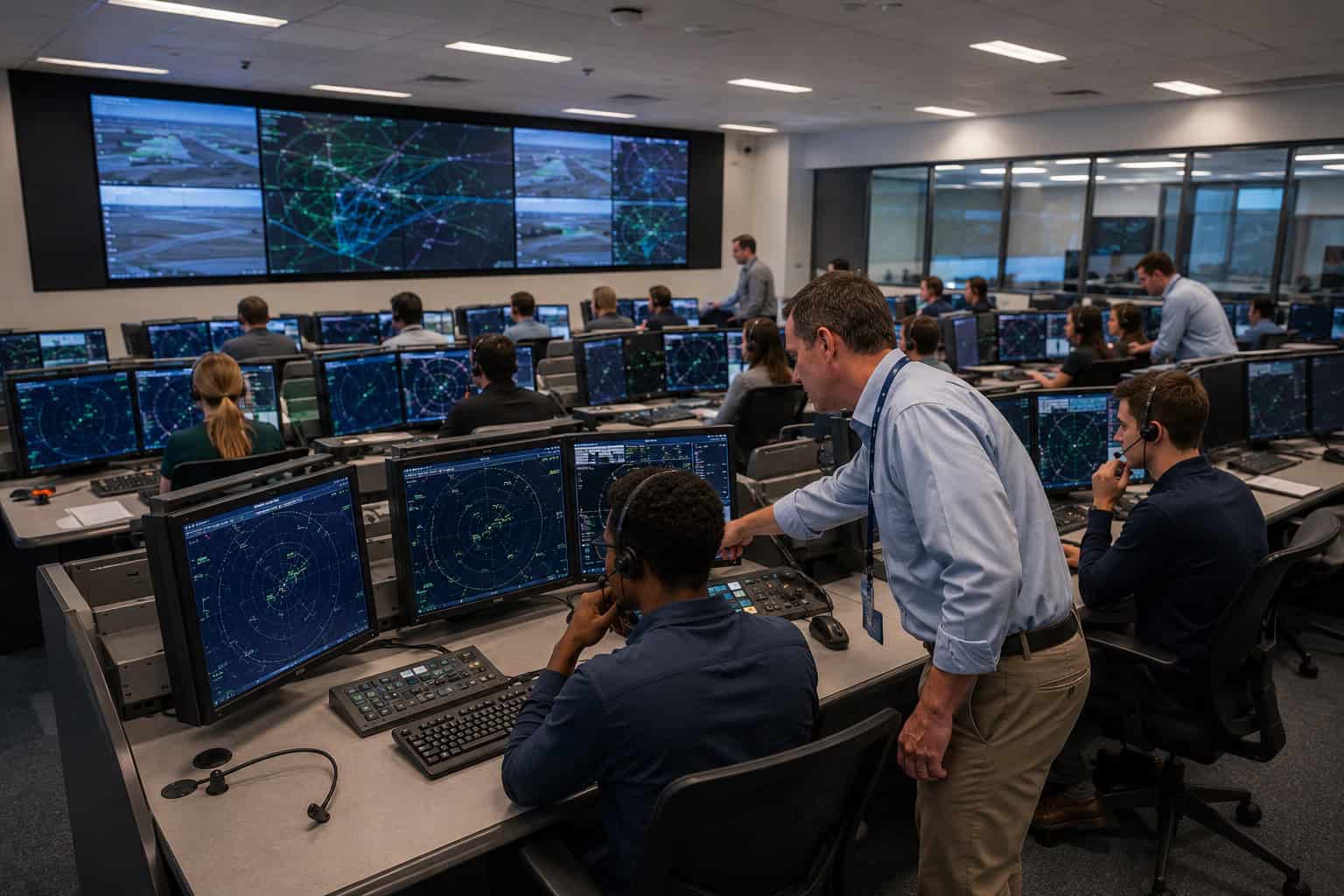
When an airline announces a delay blamed on “ATC,” most passengers picture some abstract congestion, a queue in the sky, the routine friction of a busy system. What they less often picture is a controller working their sixth consecutive day, on a ten-hour shift, in a facility running at 60 percent of the staffing level it needs to operate normally. And yet that is the condition inside many of the most critical air traffic control facilities in the United States today. The shortage of certified air traffic controllers is not a temporary post-pandemic disruption. It is a structural problem decades in the making, and it affects every flight you take.
The FAA has publicly acknowledged a target of somewhere between 12,500 and 14,600 certified professional controllers, depending on which workforce plan you consult and when. As of 2024, approximately 10,800 are actively working. Over 40 percent of the FAA’s terminal facilities are operating below 85 percent of their staffing targets. At the 26 en route centers and 24 busiest TRACON facilities, the FAA confirmed in 2023 that staffing had fallen to approximately 70 percent of the certified professional controller target. The gap is real, it is wide, and it has practical consequences every day in the form of flow restrictions, ground stops, and mandatory overtime that compounds the problem it was deployed to solve.
The retirement wall and the training bottleneck
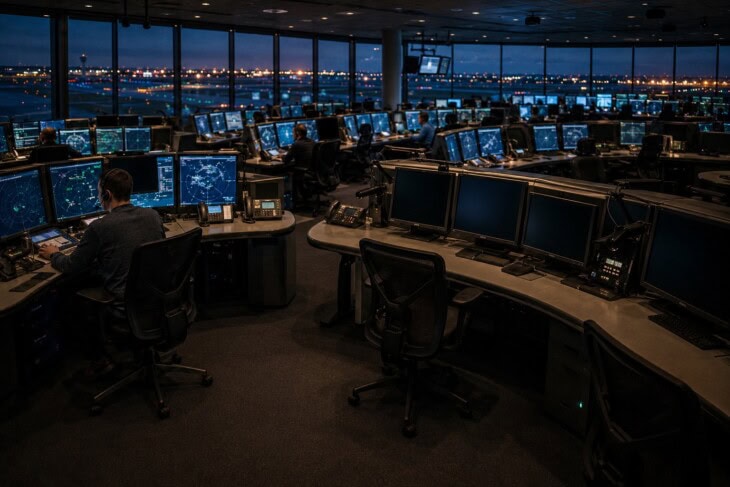
To understand why the staffing gap is so hard to close, you need to understand the shape of an air traffic control career. Under federal law, controllers must retire at 56. This is not a soft guideline: it is a statutory requirement, grounded in the physical and cognitive demands of the job and enforced without exception except in rare cases where a controller’s retirement can be extended to age 61 at the Secretary’s discretion. The mandatory retirement age creates a hard ceiling on every controller’s career length, and it interacts with another constraint that creates the structural problem: controllers must be hired before age 31.
The age 31 hiring limit exists because controllers need at least 25 years of service to qualify for the FAA’s enhanced retirement benefit. Working backward from age 56, the mathematics force an entry age ceiling. The result is a career window of roughly 25 to 30 years, at most. At the busier end of that career, controllers retire in waves, and there is no way to replace experienced controllers quickly, because experience is precisely what takes years to build.
Why hiring more does not immediately fix the gap
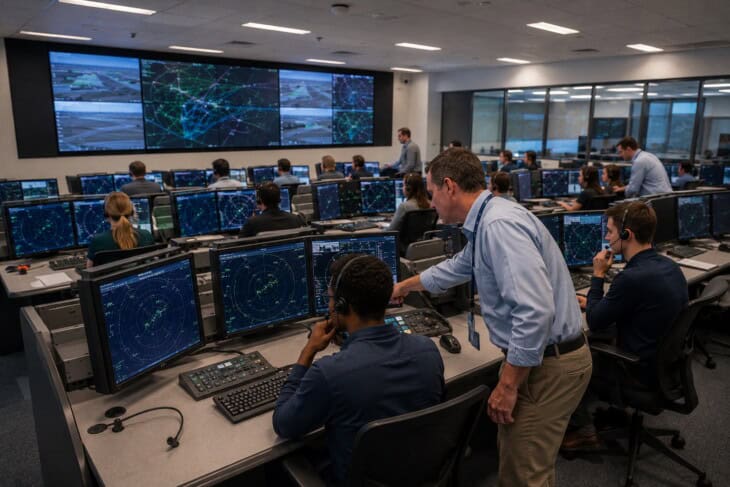
A new controller hire spends approximately 12 weeks at the FAA Academy in Oklahoma City before arriving at their assigned facility. At that facility, on-the-job training takes an additional two to five years depending on the complexity of the airspace, with washout rates of 30 to 60 percent along the way. A hire made today will not reach Certified Professional Controller status at a major TRACON for at least two to three years, and possibly longer. The FAA can accelerate hiring. It cannot accelerate certification. Every year it fails to hire enough controllers, the gap compounds, because the retirements at one end of the pipeline do not pause while training catches up at the other.
The FAA’s hiring pipeline has had its own complications beyond the structural mathematics. In 2014, changes to the controller applicant screening process, including the introduction of a biographical assessment that replaced or supplemented prior aptitude-based screening, drew criticism from collegiate aviation programs whose graduates had spent years preparing specifically for controller careers. The biographical assessment was eventually dropped by Congress in 2018. The effect of those hiring disruptions rippled through the pipeline for years. Controllers who were not hired in the mid-2010s when they would have been entering the workforce are not controllers today, and the training gap that resulted has never been fully recovered.
What understaffing actually looks like on the ground
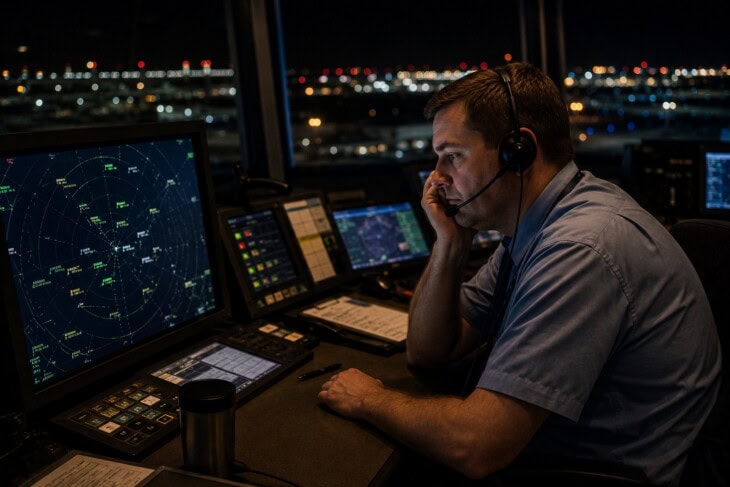
The consequences of running 30 percent below staffing targets are not abstract. In 2024, FAA air traffic controllers logged 2.2 million hours of overtime, at a cost of approximately $200 million. The average controller worked 167 hours of overtime during the year, a figure that represents a 308 percent increase per controller since 2013. Congressional testimony revealed that controllers at the most critically understaffed facilities have been working six-day weeks and ten-hour shifts, not occasionally but consistently, for years. Roughly 41 percent of the controller workforce logged 60-hour working weeks in 2024.
This matters for reasons beyond the controllers themselves. Fatigue is a documented safety risk in high-concentration cognitive work, and controlling is among the more cognitively demanding jobs in aviation. The FAA’s own traffic management protocols require flow restrictions and ground stops when staffing falls below operational minimums, not because of any malfunction, but because the system has built-in rules against operating with too few people. Those rules produce the “ATC delay” announcement. On a clear day at a major airport, with no weather in the region, a ground stop driven by staffing is the system working as designed. It is also the system signaling that it does not have enough people to do its job without artificial constraints on traffic flow.
The five most critically understaffed facilities in recent FAA and NATCA assessments are consistently among the most consequential in the national airspace: New York TRACON, Southern California TRACON, Chicago TRACON, Atlanta TRACON, and Dallas/Fort Worth TRACON. These are not peripheral facilities. They control the approaches and departures at the busiest airports in the country. Understaffing at any one of them propagates delays across the entire national airspace, because aircraft cannot be released into already-saturated airspace downstream.
July 2024: Newark’s airspace handed to Philadelphia
In July 2024, the FAA took the unusual step of transferring responsibility for Newark Liberty International Airport’s approach and departure airspace from the chronically understaffed New York TRACON to the Philadelphia TRACON, under a new callsign. The move required mandatory relocation of controllers from New York to Philadelphia and prompted a formal statement from NATCA, the National Air Traffic Controllers Association, describing the severity of conditions at New York TRACON. The facility, which manages one of the most complex and high-volume airspace environments in the world, had been operating at approximately 54 percent of its certified professional controller target. The temporary transfer was an acknowledgement that the staffing situation had reached a point where the facility could not be expected to manage its full scope of responsibility without structural intervention.
What is being done, and what would need to change
The FAA has significantly increased its hiring targets. The agency exceeded its hiring goals in fiscal year 2024, and committed to onboarding more than 2,200 new controllers in fiscal year 2026, with targets of 2,300 and 2,400 in the two years following. A new hiring package announced by the Department of Transportation in 2025 included financial incentives designed to attract and retain controllers at hard-to-staff facilities. These are meaningful steps, but they run directly into the certification bottleneck: hiring 2,200 people in a year does not produce 2,200 certified professional controllers for two to five years, depending on the facility. In the meantime, retirements continue.
The mandatory retirement age has become a focal point in the Congressional debate. Proposals have been made to raise the ceiling from 56 to 61, a change that would allow experienced controllers to continue working and reduce the attrition pressure on the pipeline. The FAA already has authority to extend individual controllers to age 61 in exceptional cases. Broadening that authority, or raising the statutory retirement age, would buy time for the hiring and training pipeline to close the gap. As of mid-2026, legislation to this effect had been introduced but not enacted.
There is also a longer-term question about technology. The FAA’s air traffic management infrastructure is a patchwork of systems, some of which date to the 1970s and 1980s. Modernisation projects, including updates to the facilities and equipment that support controllers, have been in progress for years and are frequently delayed and over budget. A more capable and better-integrated technological platform would not replace controllers, but it could reduce the cognitive load on the controllers who remain, and potentially allow a smaller workforce to manage a given traffic volume more safely. That modernisation is itself a multi-year project, and the staffing crisis is a problem measured in years, not decades.
The next time your departure is held for “ATC” on a clear day with no weather anywhere in the system, what is probably happening is that a facility somewhere along your route does not have enough controllers on position to safely absorb your flight at the moment it would arrive. The system slows itself down rather than operate beyond its safe capacity. That is the right response to the constraint. The constraint itself, a workforce gap that has been building for two decades and has not yet been bridged, is what the aviation system is genuinely working to resolve.
The day-to-day role of the controllers who are working through this shortage is covered in The People Watching Every Flight: Inside Air Traffic Control, which explains what the job involves and why the training pipeline takes as long as it does. The direct connection between understaffing and the flow control restrictions that produce most ATC delays is covered in the article on ground stops and flow control. Both are part of the How Air Traffic Control Actually Works series.
FAQ
Sources and references used for research and fact-checking.
- FAA Air Traffic Controller Workforce Plan 2025–2028 - Federal Aviation Administration
- Is There a Shortage of Air Traffic Controllers? - USAFacts
- Air Traffic Control Workforce: FAA Should Establish Goals and Better Assess Progress - Government Accountability Office
- Controller Hiring on Track but New York TRACON Far Understaffed - Aviation International News
- NATCA Statement on Mandatory Relocation of Controllers from New York to Philadelphia - National Air Traffic Controllers Association (NATCA)
- Air Traffic Controller Shortages Are a Nationwide Problem - Axios
- To Fix Air Traffic Controller Shortage, Congress Proposes Changing Retirement Limits - Government Executive
- The FAA's Real ATC Problem: How Certification Holds the Key to Hiring Woes - Global Air
- FAA Releases Bold, New Air Traffic Controller Hiring Plan - Federal Aviation Administration
- FAA Has Taken Steps to Validate Its Air Traffic Skills Assessment Test - DOT Office of Inspector General
Get the Newsletter
The latest aviation news and stories sent to your inbox.
About the Author

Tim is the owner and lead editor of AeroCorner since 2019, overseeing aviation content covering aircraft, airlines, airports, and the broader aviation industry. Through years of researching, writing, editing, and publishing aviation-focused content, he has developed extensive practical knowledge of commercial aviation and air travel. Based in Asia and a frequent traveler himself, Tim also brings firsthand passenger experience to AeroCorner’s coverage. Outside of publishing, he has also explored aviation firsthand through hands-on flight training in New Zealand.