

Table of Contents
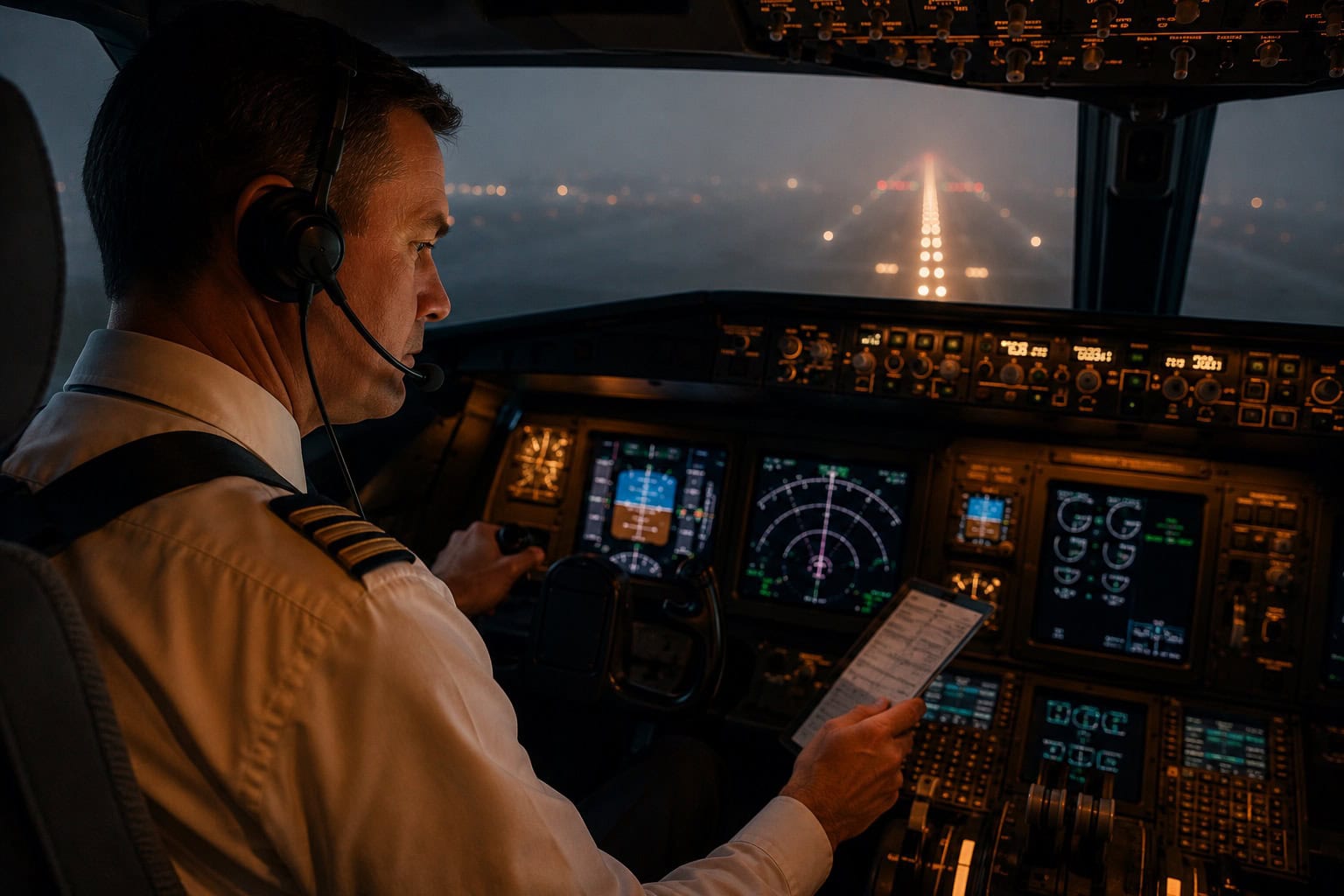
Somewhere between the chime of the seat belt sign and the calm voice on the PA saying “ladies and gentlemen, we are diverting to an alternate airport,” a set of events has already been set in motion that most passengers will never see. A four-digit code has been dialed into a transponder. A radar target has turned red on screens across multiple ATC facilities. A supervisor has been called to a workstation. Emergency vehicles have begun moving toward a runway. And a controller, calm and deliberate, has started clearing traffic out of a corridor that is now reserved for one flight.
The aviation emergency system is designed to compress a lot of coordination into very little time, and it is practiced until it becomes automatic. Understanding what actually happens when a pilot declares an emergency, what the different levels of declaration mean, and why declaring early is almost always the right call, gives passengers a clearer picture of a system that works quietly and effectively in the background of moments that feel anything but quiet.
The three codes and what each one triggers
Every aircraft flying in controlled airspace carries a transponder, a device that broadcasts a four-digit code identifying the flight to ATC radar systems. Three of those codes are reserved for emergencies, and each triggers a different response.
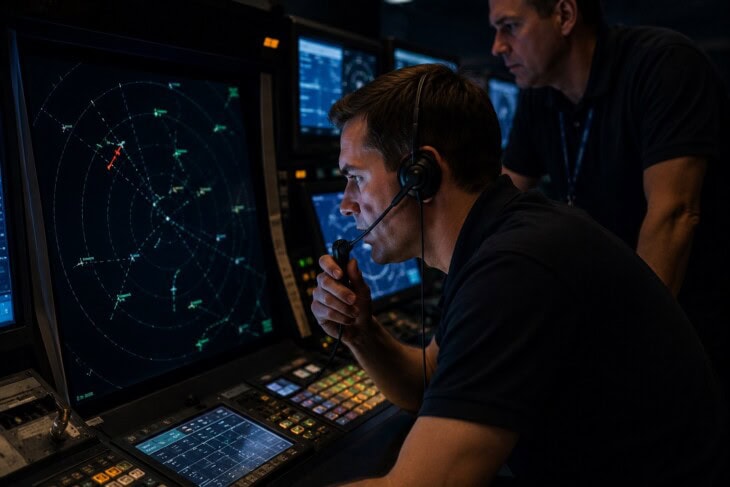
Code 7700 is the general emergency squawk. When a crew dials it in, every ATC radar facility covering that airspace sees the target change immediately, typically highlighted in a flashing display or labelled “EMRG” on the scope. The controller’s supervisor is notified. Adjacent sectors are coordinated. The controller begins clearing traffic from the aircraft’s path and working to establish the crew’s intentions: what is the nature of the emergency, where do they want to go, what do they need. Emergency vehicles at the destination airport are alerted and begin positioning. All of this begins in seconds, before the crew has necessarily said a single word on the radio. The squawk alone is enough to start the machine.
Code 7600 means radio communication failure. The crew can no longer talk to ATC, so the squawk is the only way to signal what is happening. Controllers who see a 7600 code know that the aircraft is almost certainly following the standard lost communications procedure: continuing on its last clearance, then flying to its destination at the expected time, descending to the lowest applicable altitude, and landing. ATC will clear other traffic out of the way and watch the transponder closely, reading the flight’s intentions from its movements rather than its words. The system is specifically designed to handle this scenario without radio contact.
Code 7500 means hijack. ATC procedure here is deliberately different. Controllers who see 7500 do not acknowledge it over the radio in any way that would alert anyone listening in the cockpit. Instead, the response happens entirely behind the scenes: security agencies are notified, military assets may be scrambled, and a coordinated response is assembled. If a controller needs to ask whether the code is intentional, they will do so in a way the crew can answer with a simple yes-or-no response that reveals nothing to any occupant of the flight deck who might be listening.
MAYDAY, PAN-PAN, and the fuel ladder
The squawk code is one part of the declaration. The radio call is the other, and the words used carry specific meaning that shapes the response a crew receives.
A MAYDAY call, spoken three times in the international convention, signals a distress situation: immediate danger to the aircraft or to lives aboard. Engine fire. Loss of control. Pilot incapacitation. A MAYDAY commands radio silence on the frequency in use, clearing the channel for the emergency. Every resource available to ATC is directed toward that aircraft. The word itself, derived from the French “m’aidez” (help me), is recognized under ICAO standards by controllers worldwide.
A PAN-PAN call, also spoken three times, signals urgency rather than immediate distress: a serious situation the crew can manage with time to troubleshoot, but one that warrants priority handling from ATC. A passenger medical issue that requires diversion, a pressurisation concern being investigated, a hydraulic advisory being worked through. PAN-PAN gets the crew to the front of the queue. MAYDAY clears the queue entirely.
Fuel emergencies have their own language, and the distinction matters considerably. Declaring “minimum fuel” is an advisory, not an emergency. It tells ATC that the crew cannot accept any undue delay en route to their destination, but it does not grant priority handling and does not trigger an emergency response. It is information.
Declaring “MAYDAY FUEL,” by contrast, is a full emergency declaration: the fuel remaining is below the planned final reserve, a safe landing at the nearest suitable airport is required with priority handling, and ATC must act accordingly. The gap between minimum fuel and MAYDAY fuel can be narrow in time, and crews who wait too long at the advisory stage before escalating have, in documented incidents, found themselves in a genuine emergency with less maneuvering room than they needed.
The three levels of an aviation emergency call
PAN-PAN PAN-PAN PAN-PAN — urgency. Serious situation, not immediately life-threatening. Priority handling from ATC. MAYDAY MAYDAY MAYDAY — distress. Immediate danger to life or aircraft. Radio silence commanded, full emergency response. Minimum fuel — advisory only. Cannot accept delay but not yet an emergency; no priority handling guaranteed. Once fuel reaches emergency levels: MAYDAY FUEL, which triggers full emergency handling.
Why pilots hesitate, and why they should not
There is a persistent reluctance in aviation to declare emergencies, particularly among commercial crews, and it has been documented enough times in accident investigations to be taken seriously as a safety issue. The reasons vary. Some crews worry about the consequences: FAA scrutiny, required reports, the perception among colleagues that an emergency declaration reflects a failure to manage the situation. Some hesitate because the situation does not feel catastrophic yet, and there is a professional instinct to keep troubleshooting before involving external agencies. Some simply do not want to cause disruption to other traffic, to the airport, to the passengers.
Almost every one of these concerns is either overstated or misplaced. The legal framework under 14 CFR 91.3 gives the pilot in command authority to deviate from any regulation to meet an emergency, and provides a clear process for reporting any such deviation after the fact. The paperwork involved in a typical emergency declaration, where no accident has occurred and no regulations have been violated, is minimal. The FAA and NTSB are generally far more interested in understanding what happened than in penalizing crews for having declared. And the value to the system of knowing that a crew needs help, sooner rather than later, is enormous.
ATC can do significantly more with more time. A crew that declares at the first sign of a serious developing situation gives controllers minutes to prepare the airspace, position emergency equipment, coordinate with the destination airport, and brief supervisors. A crew that waits until the situation is critical gives controllers seconds to do the same work. The difference in what can be arranged in those extra minutes is not marginal.
United Airlines Flight 232, Sioux City, 19 July 1989
When the tail engine of United 232, a DC-10, disintegrated at altitude and destroyed all three independent hydraulic systems, the crew lost conventional flight control. They declared an emergency immediately and diverted to Sioux Gateway Airport in Iowa, working with ATC for over 40 minutes while they developed a technique to steer using differential thrust on the two remaining engines. Sioux City TRACON cleared the airspace, offered runway options, and had fire and rescue units fully positioned before the aircraft arrived. The aircraft cartwheeled on landing and broke apart. Because emergency crews were in place and the airport had been prepared during that 40-minute window, 185 of the 296 people aboard survived. Every one of those preparations required time the crew created by declaring immediately.
After the emergency
Once an aircraft with a declared emergency is on the ground, the immediate operational response winds down. What follows depends entirely on what happened. If the flight landed without an accident, defined under NTSB regulations as an occurrence involving death, serious injury, or substantial aircraft damage, there is typically no mandatory report to either the FAA or the NTSB. The crew may be asked by their airline’s safety team to document what occurred. The FAA may request a written account if any regulatory deviations took place during the emergency, which is a routine and generally uncomplicated process. In most cases, a declared emergency that ends in an uneventful landing results in far less paperwork than crews fear.
If an accident has occurred, the NTSB must be notified immediately and a formal report filed within ten days. The investigation process that follows is focused on understanding what happened and preventing recurrence, not on assigning blame to crews who declared emergencies. The aviation safety record in the commercial sector is as strong as it is partly because the system has consistently rewarded early disclosure and penalized concealment. A crew that squawks 7700 the moment they recognise a serious situation is doing exactly what the system is designed for.

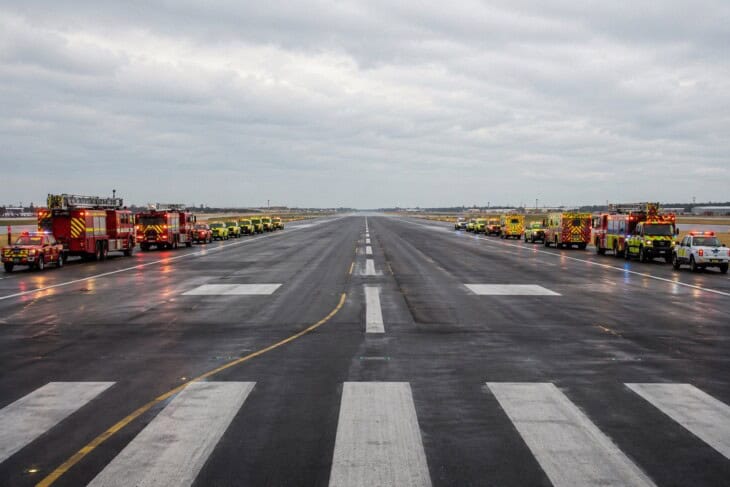
The next time an aircraft diversion is announced on your flight, or you notice emergency vehicles lining a runway as your plane touches down somewhere unexpected, the machine behind that response is already in its final stages. The declaration happened earlier. The coordination happened in the minutes that followed. The vehicles, the cleared airspace, the prepared controllers, all of it came from someone in the cockpit deciding to ask for help at the right moment. For the broader picture of how controllers manage the ATC system when things go wrong, the article on TCAS and collision avoidance covers the automated safety layer that operates alongside controller decisions. The staffing realities that shape how many controllers are available to respond are covered in why there aren’t enough air traffic controllers. Both are part of the How Air Traffic Control Actually Works series.
FAQ
Sources and references used for research and fact-checking.
- Section 3. Distress and Urgency Procedures - FAA Aeronautical Information Manual (AIM), Chapter 6
- Chapter 10. Emergencies - FAA Air Traffic Control Order JO 7110.65
- Section 2. Beacon/ADS-B Systems — Emergency Codes - FAA Air Traffic Control Order JO 7110.65
- Fuel Emergencies: Guidance for Controllers - SKYbrary
- Comparison of Minimum Fuel, Emergency Fuel, and Related Declarations - Federal Aviation Administration
- Pan-Pan vs Mayday: The Difference Between Distress Calls - Simple Flying
- Squawking 7700: In-Flight Emergencies from a Pilot's Perspective - Flightradar24
- Great Expectations: Minimum Fuel Situations - NASA Aviation Safety Reporting System (ASRS)
- United Airlines Flight 232 Accident Report - National Transportation Safety Board
Get the Newsletter
The latest aviation news and stories sent to your inbox.
About the Author

Tim is the owner and lead editor of AeroCorner since 2019, overseeing aviation content covering aircraft, airlines, airports, and the broader aviation industry. Through years of researching, writing, editing, and publishing aviation-focused content, he has developed extensive practical knowledge of commercial aviation and air travel. Based in Asia and a frequent traveler himself, Tim also brings firsthand passenger experience to AeroCorner’s coverage. Outside of publishing, he has also explored aviation firsthand through hands-on flight training in New Zealand.