

Table of Contents
Somewhere in the last few seconds before your aircraft begins its takeoff roll, a voice comes through the flight deck speakers: “Cleared for takeoff.” Three words. They sound routine. But behind them is a human being sitting in a darkened room or a glass-walled tower, holding responsibility for a patch of sky that may currently contain a dozen other aircraft, all moving, all on instrument flight plans, all depending on that controller to keep them separated.
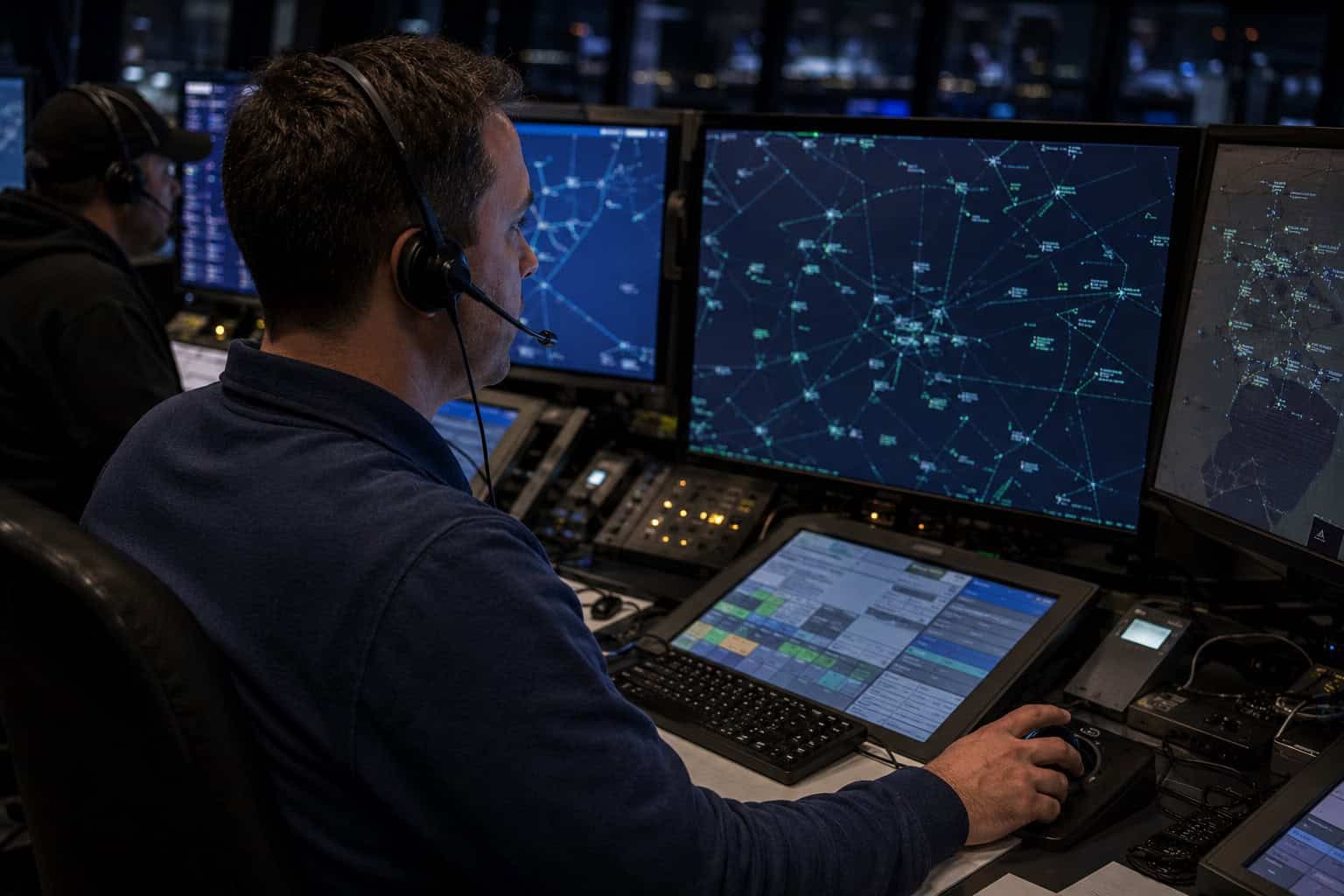
Most passengers have never seen the inside of an air traffic control facility. The system that manages roughly 45,000 flights a day across the United States is almost entirely invisible from the cabin. The controller’s voice is familiar, but the work behind it, the scope on their desk, the handoffs to the next facility, the separation standards they are maintaining to the foot and the second, is unknown. It is one of the most demanding and least understood jobs in aviation.
The ATC system is not one place or one type of controller. It is a layered network of facilities, each responsible for a different phase of your flight, passing your aircraft from one to the next in a continuous chain from the moment you push back from the gate to the moment you touch down. Here is how that chain works, and who is holding each link.
Three facilities, one continuous handoff
The first controller your flight interacts with works in the tower. Air Traffic Control Towers, formally called ATCTs, sit at airports and are responsible for the ground and immediate airspace within roughly five nautical miles of the field. Tower controllers manage which runways are active, issue takeoff and landing clearances, sequence arriving and departing traffic, and keep everything on the ground moving without conflict. When you hear “cleared for takeoff, runway 28 left,” that is a tower controller. When you hear “turn left, contact departure,” that is the tower handing you to the next facility as your aircraft climbs out of its airspace.
The next facility is the TRACON, which stands for Terminal Radar Approach Control. TRACONs are radar facilities, almost always located away from the airport itself, that manage the bubble of airspace extending roughly 40 to 50 miles around a primary airport and up to about 17,000 feet. TRACON controllers sequence arriving aircraft into the approach, vector departures out to their en-route altitudes, and manage the complex geometry of multiple streams of traffic converging on and diverging from the same airport simultaneously. Large airports like New York, Chicago, and Los Angeles have some of the busiest and most complex TRACONs in the world, managing traffic for multiple major airports within a single facility.
Once your flight climbs above the TRACON’s ceiling and heads for cruise altitude, it enters the airspace managed by an Air Route Traffic Control Center, known as an ARTCC or simply a Center. There are 21 Centers in the contiguous United States, each responsible for an enormous chunk of en-route airspace that can exceed 100,000 square miles. A Center controller does not see your aircraft through a window. They see a data tag on a radar scope: a callsign, an altitude, a groundspeed, a destination. Their job is to keep that tag from getting too close to any other tag in their sector, to issue altitude changes as needed, and to hand the flight off cleanly to the next sector or facility as it moves through their airspace.
The sector, the scope, and what separation actually means
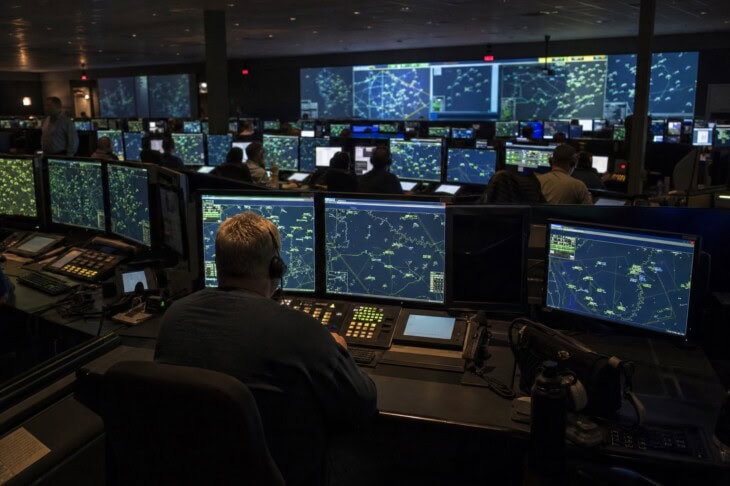
Within each Center and TRACON, the airspace is divided into sectors: defined volumes of sky, each assigned to a team of controllers. A busy Center may have 50 or more sectors. Each sector is typically staffed by two controllers: a radar controller who issues clearances and talks to pilots, and a data controller who handles coordination with adjacent sectors, processes flight plan changes, and manages the flow of traffic into and out of the sector. When traffic is light, one controller may combine both roles. When it is heavy, additional controllers may be added, or sectors may be combined or split in real time to balance the load.
The fundamental task in every sector, at every altitude, is separation. Controllers must keep each aircraft a defined minimum distance from every other aircraft in their airspace. Vertically, the standard is 1,000 feet between aircraft below Flight Level 290 (about 29,000 feet), and 2,000 feet above that, except in airspace approved for Reduced Vertical Separation Minima, where 1,000 feet is maintained at all altitudes. Horizontally, the separation standard depends on the equipment in use: in radar-controlled airspace, the minimum is typically 3 nautical miles near the terminal and 5 nautical miles en route. These numbers are not advisory. They are the minimum. A controller who allows two aircraft to come closer than the applicable standard has committed what the FAA calls an operational error, a serious event that triggers investigation and, depending on severity, can end careers.
What makes the job cognitively demanding is that separation is not a static condition. Every aircraft in a sector is moving at several hundred miles per hour in three dimensions, constantly changing altitude, speed, or heading in response to weather, traffic, or clearances. A controller managing a busy sector is simultaneously projecting the future positions of a dozen or more aircraft, identifying potential conflicts minutes before they would become critical, and issuing instructions to resolve them while handling radio calls, coordinating with adjacent sectors, and tracking new arrivals entering the sector. There is no pause button.
The three ATC facilities at a glance
Tower (ATCT): Controls the airport surface and immediate surrounding airspace, roughly 5 nautical miles. Issues takeoff and landing clearances. TRACON: Radar facility managing the approach and departure environment, typically up to 40 to 50 miles from a primary airport and up to about 17,000 feet. Sequences arrivals and departures. Center (ARTCC): En-route facility managing high-altitude cruise flight across a large geographic area, often over 100,000 square miles. 21 Centers cover the continental United States.
Becoming a controller, and staying one
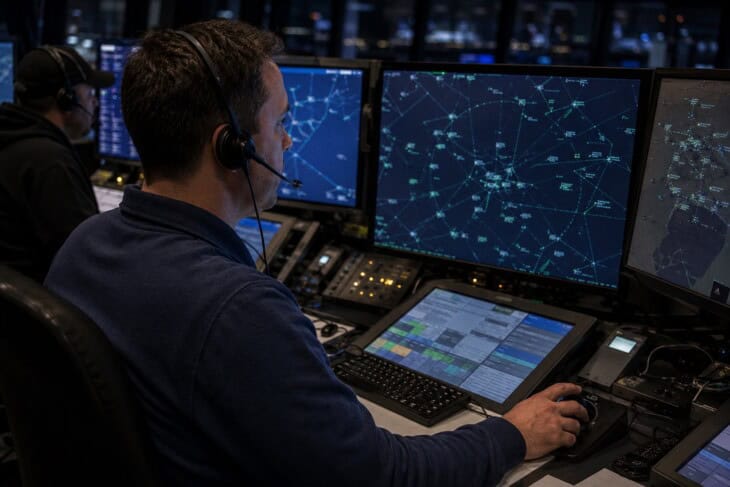
Becoming a fully certified air traffic controller in the United States is a lengthy process that filters heavily at every stage. Candidates must pass a battery of cognitive and aptitude tests, complete training at the FAA Academy in Oklahoma City, and then begin on-the-job training at the facility they are assigned to. The academy phase covers procedures, fundamentals, and simulated traffic scenarios. The facility phase is where most of the real learning happens, and it is where most candidates wash out. A controller in training must certify on each position in their facility, demonstrating to a certified trainer that they can handle live traffic safely and independently. At a simple tower, this might take a year. At a complex high-traffic facility like New York Center, it can take four or five years. Until a trainee is certified on a position, they cannot work it alone.
The career has a hard limit that has no equivalent in most professions: mandatory retirement at age 56, established under federal law. The original rationale, dating to a 1971 amendment, was the cumulative stress of the job and the effects of shift work, a concern that controllers would experience a form of burnout that would compromise safety. Research has questioned whether the scientific basis for the age-56 rule is as strong as the law assumes, but the rule remains in place. In practice it means that a controller certified at 30 has at most 26 years in the role. Combined with the long training pipeline, it creates a structural tension in the workforce: the system is always losing experienced controllers at the same time it is trying to bring new ones up to speed.
Chicago Center, September 26, 2014
In the early hours of a Friday morning, a contract employee working alone in the basement of the Chicago Air Route Traffic Control Center in Aurora, Illinois, deliberately cut fiber optic cables and started a fire before attempting suicide. The damage forced the shutdown of one of the busiest Centers in the National Airspace System. Chicago Center handles airspace over a significant portion of the upper Midwest and is a critical node for transcontinental traffic. The shutdown caused more than 2,000 flight delays and hundreds of cancellations at O’Hare and Midway airports over the following days, with ripple effects across the network. The incident illustrated something that most passengers never consider: the entire flow of traffic through a major region of US airspace runs through a single facility, staffed by a comparatively small number of people, in a building most travellers could not locate on a map.
The next time your flight is handed from departure to center, or from one center sector to another, there is a human being on the other end of each transfer who has spent years training for that position and who is carrying legal responsibility for every aircraft in their piece of sky. The role is the foundation the rest of the ATC system is built on. For how that system manages demand before your aircraft even leaves the gate, the article on ground stops and flow control explains the traffic management layer that sits above individual controllers. For the specific challenge of keeping the controller workforce staffed at the levels the system needs, why there aren’t enough air traffic controllers covers the structural problem in detail. Both are part of the How Air Traffic Control Actually Works series.
FAQ
Sources and references used for research and fact-checking.
- Air Traffic Control Facilities - Federal Aviation Administration
- Understanding ATC: the Difference Between TRACON and ARTCC - Aero Crew News
- 14 CFR Part 65 Subpart B — Air Traffic Control Tower Operators - Electronic Code of Federal Regulations (eCFR)
- Separation Standards - SKYbrary Aviation Safety
- Air Traffic By the Numbers - Federal Aviation Administration
- Review of the Scientific Basis for the Mandatory Separation of an Air Traffic Control Specialist at Age 56 - Bureau of Transportation Statistics / ROSAP
- Chicago ARTCC sabotage incident, September 26, 2014 - Wikipedia / news archives
- FAA Air Traffic Controller Workforce Plan 2025–2028 - Federal Aviation Administration
Get the Newsletter
The latest aviation news and stories sent to your inbox.
About the Author
Tim is the owner and lead editor of AeroCorner since 2019, overseeing aviation content covering aircraft, airlines, airports, and the broader aviation industry. Through years of researching, writing, editing, and publishing aviation-focused content, he has developed extensive practical knowledge of commercial aviation and air travel. Based in Asia and a frequent traveler himself, Tim also brings firsthand passenger experience to AeroCorner’s coverage. Outside of publishing, he has also explored aviation firsthand through hands-on flight training in New Zealand.