Mid Size Passenger Jets
Boeing's first jetliner, and the airplane that started the jet age for airline passengers.
Updated: by Tim de Vries
The latest aviation news and stories sent to your inbox.
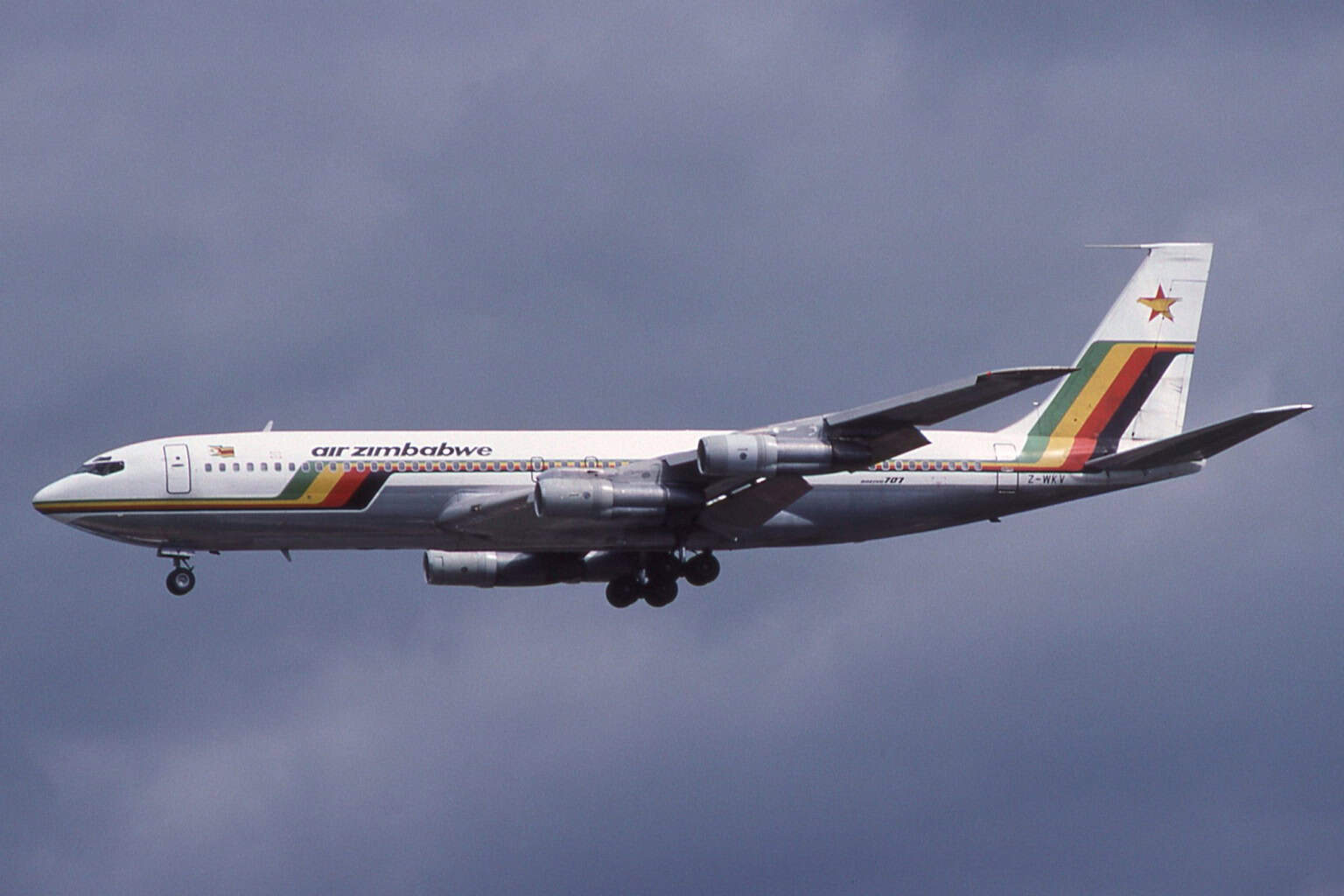
The Boeing 707 was Boeing’s first jet airliner and the aircraft that made jet travel routine. Pan Am flew the first 707 passenger service, New York to Paris, on October 26, 1958, and Boeing went on to deliver 1,010 aircraft in the 707 family, counting the shorter Boeing 720. No 707 carries airline passengers today; the survivors fly as military tankers, radar planes and transports.
Live Fleet Activity (B703)
Fetching live data…

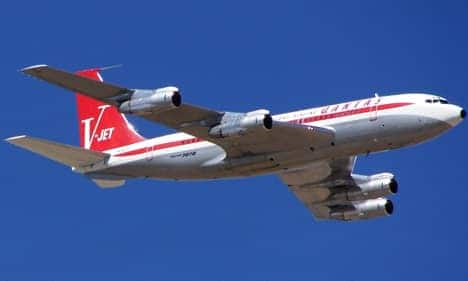


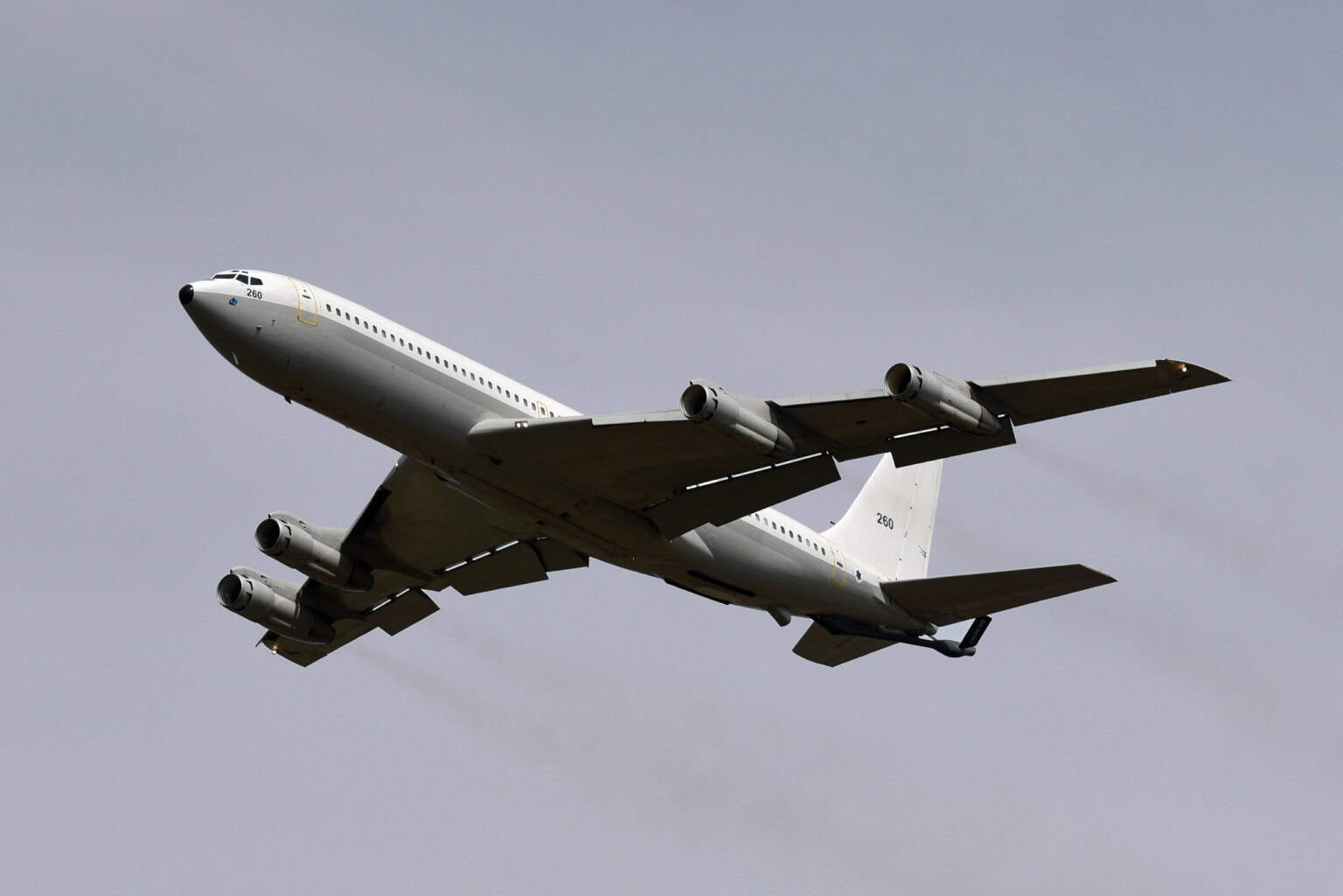
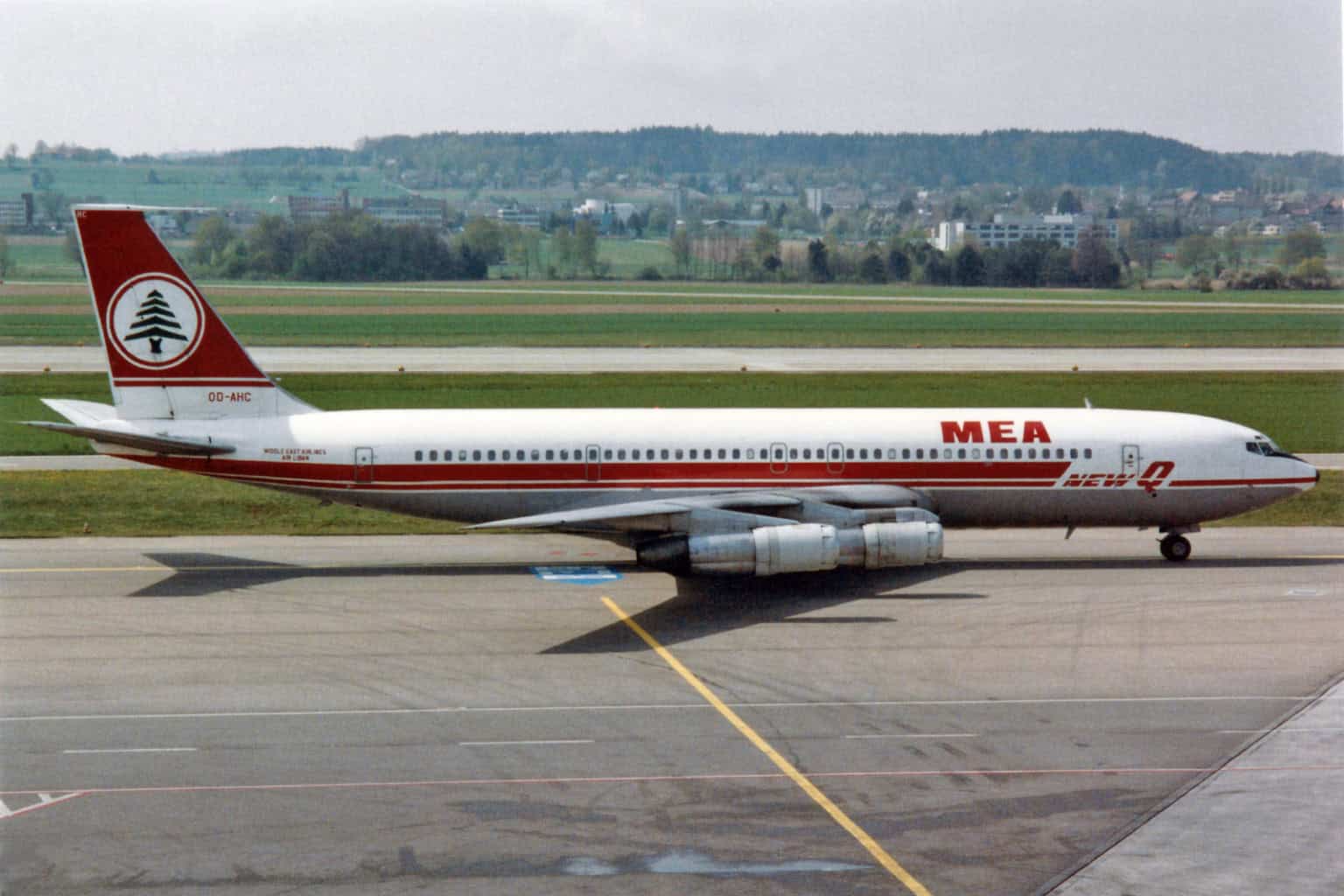
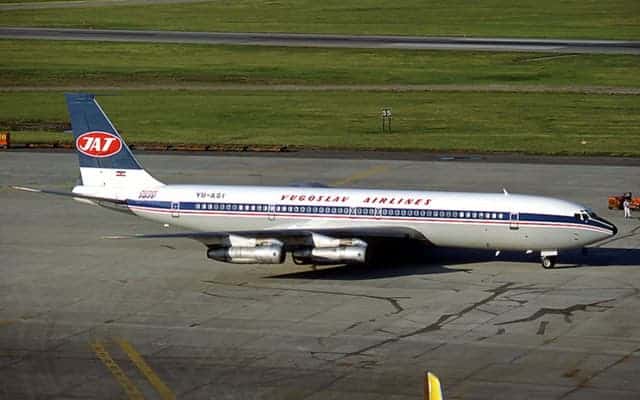

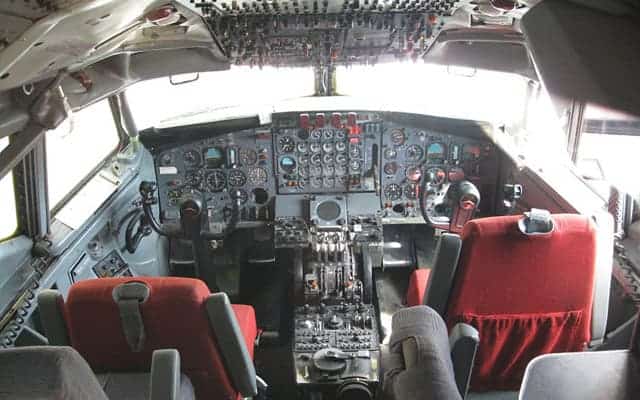
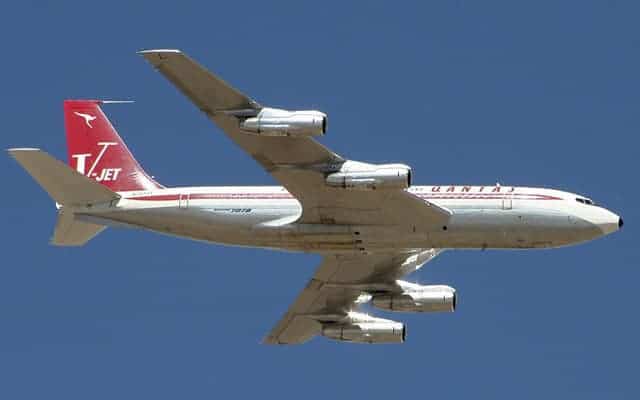

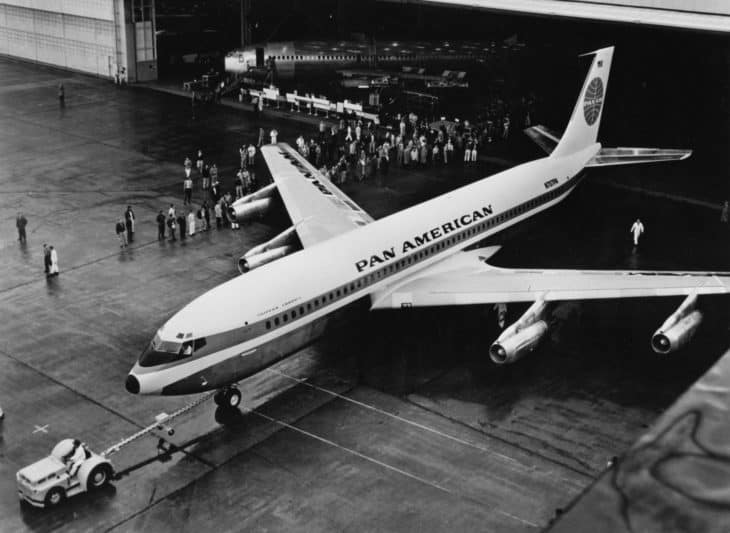
The Boeing 707 is the four-engine, narrow-body jetliner that made jet travel ordinary. It was Boeing’s first jet airliner, and Pan Am flew the first 707 passenger service from New York to Paris on October 26, 1958.
It was not the world’s first jetliner; the British de Havilland Comet got there first. But the 707 was the first to sell in large numbers, and it is widely credited with starting the jet age for airline passengers.
Boeing delivered 1,010 aircraft in the 707 family, a count that includes 154 of the shorter Boeing 720. No 707 has carried airline passengers since 2013, but dozens still fly as military tankers, radar planes and government transports.
At the end of the 1940s, Boeing was a bomber company that struggled to sell airliners. Its piston-engine 377 Stratocruiser sold only 56 examples and cost the company $15 million, while Douglas and Lockheed dominated the postwar airline market.
Boeing’s answer was a jet transport that could serve both the Air Force and the airlines. The key enabler was Pratt & Whitney’s JT3C turbojet, the civilian version of the J57 that already powered the B-52.
The prototype, the Model 367-80 or “Dash 80,” rolled out on May 14, 1954, and first flew on July 15, 1954. The U.S. Air Force became the first customer, ordering a derivative that became the KC-135 Stratotanker.
The passenger version was a far bigger gamble, because nearly all of Boeing’s revenue still came from military contracts. On August 7, 1955, test pilot Tex Johnston rolled the Dash 80 through a full barrel roll during a demonstration flight over Lake Washington, outside Seattle.
Johnston defended it to Boeing president Bill Allen as a 1 g maneuver that sold the airplane. He was told not to do it again.
Boeing’s propeller airliners carried 300-series model numbers, and the 400, 500 and 600 series were already used for missiles and other products. The jets therefore became the 700 series.
Boeing’s marketing staff chose 707 for the first one because it sounded better than 700.
The first commercial orders came on October 13, 1955, when Pan Am committed to 20 Boeing 707s and 25 Douglas DC-8s. The first production 707-120 flew on December 20, 1957, and the FAA certified the type on September 18, 1958.
Pan Am’s first 707 passenger flight left New York’s Idlewild Airport for Paris Le Bourget on October 26, 1958, with a fuel stop in Gander, Newfoundland. In December, National Airlines flew the first U.S. domestic jet service between New York and Miami with 707s leased from Pan Am.
American Airlines, TWA and Continental followed in 1959. Airlines that had ordered only the DC-8, such as United, Delta and Eastern, had no jets until September 1959 and lost transcontinental passengers in the meantime.
The 707 quickly became the most popular jetliner of its time. Its success led to rapid changes in airport terminals, runways, airline catering, baggage handling and reservations systems, and to upgraded air traffic control.
The 707’s wing is swept back 35 degrees, with the fuel carried inside it. Swept wings are prone to Dutch roll, an alternating yaw-and-roll wallow, so the 707 used a yaw damper that Boeing had developed on the B-47 bomber.
Pilots coming off straight-wing propeller airliners had never met the problem. On a 1959 customer-acceptance flight with the yaw damper switched off, a trainee’s inputs worsened a Dutch roll until three of the four engines tore off; the Braniff 707-227 crash-landed near Arlington, Washington, and four of the eight people on board died.
Johnston recommended a taller fin, a boosted rudder and a ventral fin under the tail. Those changes arrived during the fight to certify the -420 in Britain (below), and most of them were retrofitted to every 707.
The 707 was also the first commercial jet fitted with clamshell-type thrust reversers.
Early 707s used noisy, thirsty turbojets: the JT3C on the -120 and the JT4A on the -220 and -320. The dominant engine became the Pratt & Whitney JT3D, a turbofan version of the JT3C with more thrust and lower fuel burn.
Turbofan 707s carry a “B” suffix, as in 707-120B and 707-320B. A JT3D-3B is easy to spot by the large gray secondary-air doors around the front of the engine cowl, which suck open on takeoff and close as speed builds.
The Dash 80’s fuselage was only wide enough for four-abreast seating. Boeing widened it for the KC-135 and then again for the airlines, after Douglas launched the DC-8 with a wider cabin.
The final 707 fuselage is 12 ft 4 in (3.76 m) wide outside, enough for six-abreast economy seating with three seats on each side of the aisle. That cross-section was reused on the Boeing 727 and the 737, which also kept the 707’s nose and cockpit shape.

The 707’s variant names confuse almost everyone. They were certified as Series 100, 200, 300 and 400, but everyone calls them the -120, -220, -320 and -420, because “20” was Boeing’s own customer code for its development aircraft.
Each airline had its own code in place of the “20.” Pan Am’s was 21, so a 707-320B built for Pan Am was a 707-321B, and a later Pan Am 747-100 was a 747-121.
The -120 was the first production model, powered by JT3C turbojets and designed for coast-to-coast routes; it often needed a fuel stop crossing the North Atlantic. Boeing delivered 56.
Qantas ordered a shortened version, the 707-138, with 10 feet (3 m) taken out of the fuselage to stretch its range. Seven were delivered in 1959.
The -220 paired the -120 fuselage with more powerful JT4A turbojets for hot, high airports. Only five were built, all for Braniff, and one was lost on the test flight described above.
The -320 Intercontinental was the true long-haul 707, with a stretched fuselage and a bigger wing that carried more fuel. It first flew on January 11, 1958, and Pan Am carried the first passengers in August 1959.
The -420 was the same airplane with Rolls-Royce Conway engines, bought by BOAC, Lufthansa, Air-India, El Al and Varig. Britain’s Air Registration Board refused to certify it until Boeing added 40 inches to the fin, full rudder boost and an underfin; everything except the underfin became standard on all 707s.
Fitting JT3D turbofans produced the -120B in 1961 and the -320B in 1962. The -320B had a reworked wing with curved low-drag tips and could fly nonstop from Europe to the U.S. West Coast, or from the United States to Japan.
The -320C added a strengthened floor and a large main-deck cargo door, so one airplane could fly passengers or freight. It became the most-produced 707, with 337 deliveries in Boeing’s model summary.
Its new three-section leading-edge flaps improved takeoff and landing, and let Boeing delete the underfin. Later -320Bs built with the same wing were called 707-320B Advanced.
The Boeing 720, originally the 707-020, was a shorter, lighter derivative for short runways and shorter routes, with 154 built by 1967. The one-off 707-700 of 1979 tested CFM56 engines on a 707 airframe, but Boeing dropped the retrofit because it could have undercut the 757 and 767.

The full specification table for the Boeing 707 is on this page. It describes one variant, the 707-320C convertible with JT3D-7 turbofans, because no single set of numbers covers a family that spans three wings, several lengths and four engine types.
The range in the table, 2,900 nm (3,340 mi), is Boeing’s figure for a 707-320C hauling 13 cargo pallets plus 17,000 lb (7,720 kg) of cargo below deck. Passenger 707s flew farther: Frawley’s directory gives the 707-320B 5,000 nautical miles (9,265 km) with maximum fuel and 147 passengers in two classes.
The seat count, 194, is Boeing’s all-economy maximum for the passenger 707-320C at 32-inch pitch. Two extra emergency exits behind the wing raised the certified limit to 219, while airlines typically flew about 141 to 147 passengers in two classes.
The speed row is stored in knots. In Mach terms, EUROCONTROL lists a typical 707-300 cruise of Mach 0.80.
The Douglas DC-8 was the 707’s direct rival, and the contest was fierce. Douglas chose to wait for the bigger, more efficient JT4A engine and first flew the DC-8 on May 30, 1958.
Boeing answered with the costly redesign that produced the larger-winged 707-320. The DC-8 entered service on September 18, 1959, and Douglas built 556 in all.
The 707 outsold it comfortably. The DC-8 had the last word on longevity, though: CFM56-powered Super 70 conversions kept far more DC-8s flying into the 21st century than 707s.
The 707 and the Air Force’s KC-135 were developed in parallel from the Dash 80, but they are different airplanes. The 707 itself went on to serve dozens of air forces in its own right.
The best known is the Boeing E-3 Sentry, the AWACS radar plane with the rotating dome on its back. The U.S. Navy’s E-6 Mercury keeps communications open with ballistic missile submarines, and the E-8 Joint STARS was modified from 707-300 series airliners.
Military airframes kept the 707 line open after the last airliner left in 1978, with the final new-build 707 airframes completed as E-3s and E-6s in the early 1990s.
The VC-137, a special version of the C-137 Stratoliner, served as Air Force One from 1962 to 1990. SAM 26000 is displayed at the National Museum of the United States Air Force near Dayton, Ohio, and SAM 27000 at the Ronald Reagan Presidential Library in Simi Valley, California.
Canada flew the 707-347C as the CC-137 Husky from 1971 to 1997. Israel’s air force operates KC-707 “Re’em” tankers, and Iran bought 14 707-3J9C aircraft equipped for VIP transport, communications and in-flight refueling.

The 707 became a victim of its own success. By the late 1960s, air travel had grown so fast that the airplane was too small for the routes it had created.
Stretching it again was not practical, because bigger engines needed taller landing gear and the 707 had little ground clearance at takeoff. Boeing studied two stretches, the 707-620 and the 707-820, and cancelled both in 1966 in favor of the Boeing 747.
Its first-generation engines also aged badly on noise and fuel economy. International noise regulations enacted in 1985 threatened the fleet, and by the late 1980s 172 707s had been fitted with the “Quiet 707” hush kit.
TWA flew the last scheduled 707 passenger flight by a U.S. airline on October 30, 1983. Commercial 707 production had already ended in 1978.
As of January 2019, the accident tally in Wikipedia’s Boeing 707 entry for the 707 stood at 261 occurrences and 174 hull losses, with 3,039 deaths across six decades of service.
The deadliest was the Agadir crash of August 3, 1975. An Alia Royal Jordanian 707-321C, flying a charter for Royal Air Maroc from Paris, flew into a mountain near Tamri, Morocco, while descending to Agadir, killing all 188 people on board.
The last civil 707 was lost on January 14, 2019. A Saha Airlines 707-3J9C cargo flight landed at Fath Air Base near Karaj, Iran, instead of the much longer Payam airport runway nearby, and overran it; 15 of the 16 people on board died.
Yes, but only in military and government service. In July 2025, Simple Flying counted 79 active 707s in the ch-aviation fleet database, none of them with a passenger airline.
The largest operators were the U.S. Air Force’s E-3 Sentries, the U.S. Navy’s E-6B Mercury fleet, NATO’s E-3A component, and the Saudi, Israeli and French air forces. A handful of 707 tankers and transports were also listed in Iran, India, Chile and Congo, plus two contractor tankers operated by Omega Air.
That count has shrunk since. In June 2025, Israel said it destroyed Iran’s only aerial refueling aircraft, a 707-3J9C tanker, at Mashhad, and more Iranian 707s were reported destroyed on the ground in the 2026 strikes covered in our guide to the Iran Air Force.
The last airline to fly 707 passengers on a schedule was Iran’s Saha Airlines, which suspended the service in April 2013. You can no longer buy a ticket on a 707.
The most famous privately owned 707 belonged to John Travolta: N707JT, an ex-Qantas 707-138B he flew himself in retro Qantas colors. He donated it to the Historical Aircraft Restoration Society (HARS) in Australia in 2017.
Airworthiness restrictions ruled out a delivery flight, so the jet was dismantled in Georgia and shipped to Australia. Its fuselage, wings and tail were unloaded at Wollongong in May 2026, and HARS expects the rebuild for display at Shellharbour Airport to take at least six months.
Yes, in military and government service only. Simple Flying counted 79 active 707s in July 2025, mostly E-3 Sentry and E-6 Mercury aircraft plus Israeli and Saudi tankers, and none with an airline.
No. Travolta donated his ex-Qantas 707-138B, N707JT, to the Historical Aircraft Restoration Society in 2017, and it arrived in Australia by ship in May 2026 to be rebuilt for display.
The Agadir crash of August 3, 1975, when an Alia Royal Jordanian 707-321C chartered by Royal Air Maroc flew into a mountain in Morocco. All 188 people on board died.
It became too small for the traffic it created and could not be stretched further without a costly wing and landing-gear redesign. Boeing built the 747 instead, and noisy early-generation engines hastened the 707’s retirement.
The Dash 80 prototype first flew on July 15, 1954, and the first production 707-120 flew on December 20, 1957. Pan Am flew the first 707 passenger service on October 26, 1958.
Boeing delivered 1,010 aircraft in the 707 family, including 154 Boeing 720s. Commercial production ran from 1956 to 1978, and military airframes kept the line open into the early 1990s.
A 707-320B or -320C typically carried about 141 to 147 passengers in two classes. Boeing’s all-economy maximum was 189 for the -320B and 194 for the passenger -320C, and two extra exits raised the limit to 219.
No. The de Havilland Comet flew passengers first, but it was grounded after fatal accidents and returned as the Comet 4, still smaller and slower than the 707. The 707 was the first jetliner to be widely used.
Not exactly. Both came from the same Dash 80 prototype and were developed in parallel, but the KC-135 kept a narrower fuselage than the airliner. Boeing’s company designation for it was the Model 717.
Boeing gave its new jets the 700 series because the 300s were propeller airliners and the 400, 500 and 600 series were taken. Marketing picked 707 because it sounded better than 700.
Sources and references used for research and fact-checking.