

Table of Contents
The cabin lights go down somewhere past Newfoundland. You have the eye mask, the neck pillow, the seat as far back as it goes, and eight hours of darkness ahead of you.
Ninety minutes later you are still awake, watching the map crawl east. The person one seat over went under before the seatbelt sign did.
That is not a willpower failure, and it is not really about the seat. Falling asleep is a chain of physical events, and a pressurised cabin interferes with almost every link in it. Three of those interferences you can do something about.
How to Sleep on a Plane
The honest answer is that you cannot turn an aircraft cabin into a good place to sleep. You can only clear the obstacles it puts in front of a process that would otherwise run on its own.
Sleep is not a decision you make. Your core temperature drops, your body clock releases melatonin, your brain stops scanning for threats, and you cycle down through light sleep into deep sleep and REM.
Every one of those steps is measurably harder at 38,000 feet, and for reasons that have very little to do with legroom.
What is actually stopping you
Cold hands and feet block the heat loss that triggers sleep onset. An upright seat costs most of your REM sleep. Continuous cabin noise around 75 to 85 decibels fragments whatever sleep you do get. And your body clock is still set to the time zone you left. Alcohol makes most of that list worse, not better.
Falling asleep starts with losing heat, and the cabin closes the exit
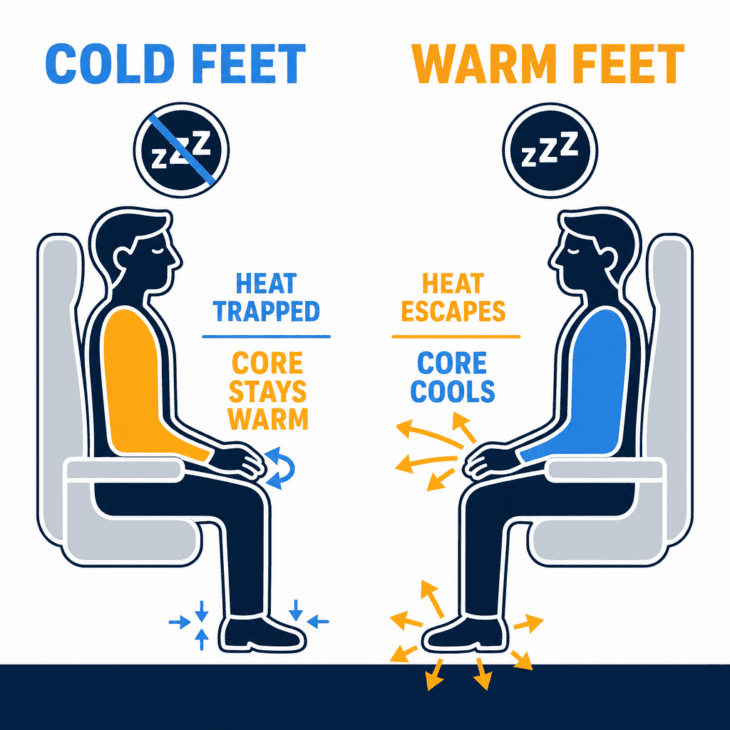
Before you can fall asleep, your core temperature has to drop by around one degree Fahrenheit (roughly half a degree Celsius). Your body does that by dumping heat, and it dumps most of it through your hands and feet.
The skin on your extremities carries dense shortcuts between arteries and veins that pass far more blood than ordinary capillaries can. When those open up, your hands and feet work as radiators.
A 1999 study in Nature found that the temperature gap between the extremities and the trunk predicted how quickly people fell asleep better than anything else the researchers measured. It beat core temperature itself, heart rate, melatonin onset, and how sleepy the volunteers said they felt.
Now put that mechanism in a cabin. Airlines keep the cabin deliberately cool, there is a vent blowing above your head, and the thin blanket goes over your torso while your feet sit in the coldest air in the row.
Cold extremities do the exact opposite of what sleep onset needs. The vessels clamp shut, the radiator closes, and your core temperature stays right where it was.
Which produces the least intuitive advice in this article. If you are cold on a plane, the fix is not more blanket across your chest. It is socks.
An upright seat costs you almost all of your REM sleep
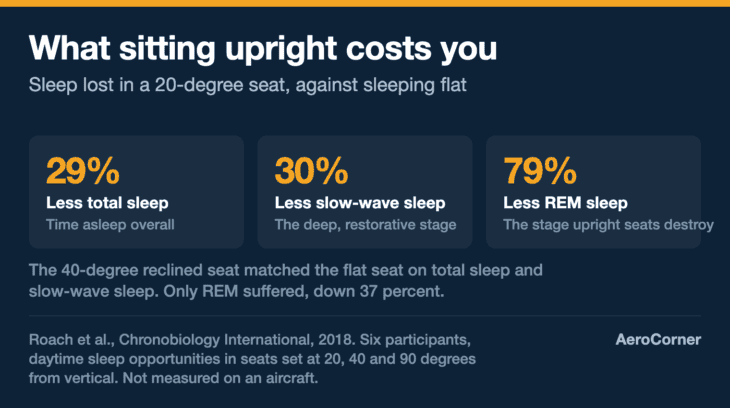
In 2018, sleep researchers in Australia gave six volunteers the same sleep opportunity in three different seats, changing nothing but the angle of the seat back: 20 degrees from vertical, 40 degrees, and fully flat at 90.
Measured against the flat seat, the upright seat produced 29 percent less total sleep, 30 percent less slow-wave sleep, and 79 percent less REM.
The 40-degree seat was the surprise. It delivered a similar amount of total sleep and slow-wave sleep to lying flat, and only REM took a real hit, down 37 percent.
| Seat back angle | Total sleep | Slow-wave sleep | REM sleep |
|---|---|---|---|
| 90 degrees (flat) | Baseline | Baseline | Baseline |
| 40 degrees (reclined) | Similar to flat | Similar to flat | 37% less |
| 20 degrees (upright) | 29% less | 30% less | 79% less |
Six people napping during the day is a small study, so treat the exact percentages as a direction of travel rather than a measurement of your flight.
The shape of the result is what matters, because most of the gap closes early. Getting from bolt upright to genuinely reclined buys back nearly all of the deep sleep. The last stretch to flat mostly buys REM.
The catch is that an economy seat does not get you there. Economy recline is measured in inches, not in the tens of degrees the researchers were changing, so a fully reclined coach seat sits far closer to their upright condition than to their reclined one.
That is also why airlines build crew rest compartments with actual bunks rather than simply fitting better seats. The industry worked out a long time ago that a seat is not a bed.
The drink before you sleep is doing the opposite of what you think
A cabin holds you at a pressure altitude of up to 8,000 feet (2,440 m), which is the ceiling the FAA sets in 14 CFR 25.841. The 787 and A350 hold nearer 6,000 feet (1,830 m).
Either way, pressurising the cabin to a mountain-town altitude rather than sea level means your blood oxygen saturation falls from around 97 percent on the ground into the low 90s in cruise. That is mild hypoxia, and on its own it is harmless for a healthy passenger.
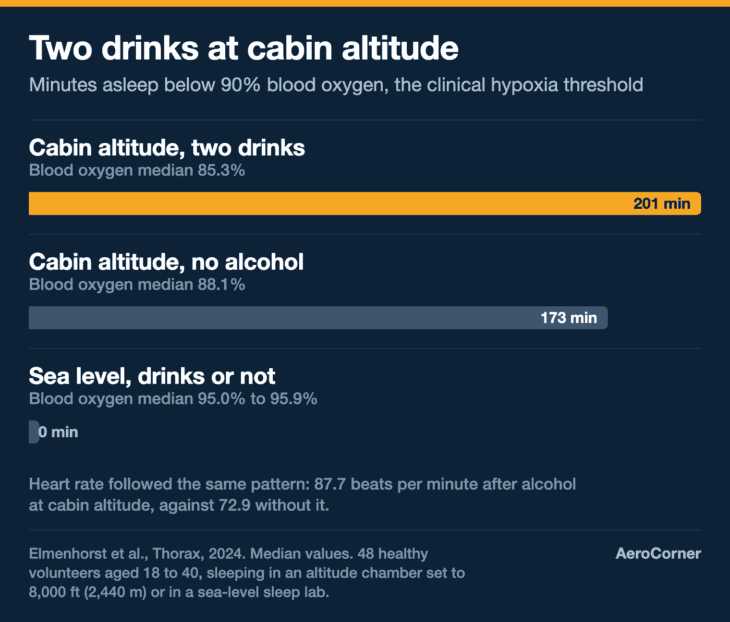
In 2024, researchers at the German Aerospace Center published the first study of what alcohol does on top of it. They put 48 healthy volunteers aged 18 to 40 through sleep sessions either in a normal sleep lab or in an altitude chamber set to 8,000 feet, with or without the equivalent of two beers or two glasses of wine.
At cabin altitude without alcohol, median blood oxygen during sleep sat at 88.1 percent and heart rate at 72.9 beats per minute. Add the two drinks and oxygen dropped to 85.3 percent while heart rate climbed to 87.7.
Those volunteers spent 201 minutes below 90 percent saturation, the threshold clinicians treat as hypoxic. In the sea-level sleep lab, that figure was zero minutes whether they drank or not.
A nightcap at 8,000 feet
Two drinks before sleeping at cabin altitude pushed healthy 18 to 40 year olds down to 85.3 percent blood oxygen and up to 87.7 beats per minute, and held them below the clinical 90 percent threshold for more than three hours. Deep sleep fell to 46.5 minutes, against 84 minutes on the same alcohol at sea level. Thorax, 2024.
The mechanism is not mysterious. Alcohol relaxes the muscles of the upper airway and blunts the reflex that normally rouses you when your breathing goes shallow.
In an environment that has already lowered your oxygen, those two effects stack. Alcohol also suppresses REM sleep and fragments the back half of the night, which is the part of the flight you were counting on.
This was a chamber, not a flight, and the volunteers were young and healthy. It is a controlled model of the cabin rather than a measurement of your actual 777, but the direction of the effect is not in doubt.
Noise, dry air, and the clock you brought with you
A cruising cabin runs at roughly 75 to 85 decibels of continuous noise, varying with the aircraft and where you are sitting. The World Health Organization’s indoor guideline for a bedroom is 30 decibels.
Decibels are logarithmic, so that gap is far wider than the two numbers make it look. Noise at cabin level does not need to wake you to cost you: it produces micro-arousals and stage shifts that lift you out of deep sleep without you ever registering it.
This is the one part of the problem where the cheap fix is genuinely well evidenced. Randomised trials of earplugs and eye masks in intensive care units, another environment engineered for terrible sleep, found better sleep quality, more REM, and higher overnight melatonin.
Cabin air is the quieter problem. Relative humidity in cruise usually sits below 20 percent and often in single digits, against the 30 to 60 percent range considered comfortable indoors.
That dryness works on your nose and throat over several hours. A raw throat at hour six is one of the most reliable ways to lose the second half of a night flight.
Then there is the clock. On a red-eye east across the Atlantic, the sleep window you are being offered lands in what your body still reads as late afternoon.
Body clocks move slowly on their own: roughly one hour a day travelling east, about an hour and a half travelling west. Most people’s internal day runs slightly longer than 24 hours, so delaying it is easier than advancing it.
Correctly timed light exposure is the strongest lever anyone has for shifting that clock, which is why what you do with the window shade and your screen matters more than the pillow does.
The CDC’s jet lag guidance puts melatonin second, at 0.5 to 5 mg, and notes that 0.5 to 1 mg is often enough to produce a shift. Timing matters more than dose: taken at the wrong point in your cycle, melatonin moves your clock the wrong way.
The myth: a better seat is the whole answer
It is easy to read the recline research and conclude that the fix is simply to buy a better seat. A lie-flat bed genuinely is the single largest improvement available, and nothing else on this list comes close to it.
The upgrade is not the fix
A lie-flat seat solves one of four problems. It does nothing about cabin noise, dry air, the pressure altitude, or the fact that your body clock is still five time zones behind the aircraft.
The passenger asleep across the aisle in the same economy row is not evidence that you are doing this wrong. They are on the lucky side of variables neither of you chose.
Their body clock happens to line up with the flight, they run warm, they are less noise-sensitive than you. None of that is technique.
What is genuinely in your control is narrower and much less glamorous than an upgrade: warm feet, whatever recline you have, ears and eyes covered, water instead of the second glass of wine, and a decision made before boarding about whether this is a sleep flight at all.
So the next time the lights go down and nothing happens, the useful question is not why you are bad at sleeping on planes.
It is which of the four obstacles you can still do something about at 38,000 feet. Most nights, the answer is your feet, your ears, and the drink you were about to order.
Sources and references used for research and fact-checking.
- Nature, Warm feet promote the rapid onset of sleep
- Chronobiology International, Flat-out napping: The quantity and quality of sleep obtained in a seat during the daytime increase as the angle of recline of the seat increases
- Thorax, Effects of moderate alcohol consumption and hypobaric hypoxia: implications for passengers' sleep, oxygen saturation and heart rate on long-haul flights
- Electronic Code of Federal Regulations, 14 CFR 25.841 - Pressurized cabins
- US Centers for Disease Control and Prevention, Jet Lag Disorder, CDC Yellow Book 2026
- World Health Organization, Guidelines for Community Noise
Get the Newsletter
The latest aviation news and stories sent to your inbox.
About the Author

Tim is the owner and lead editor of AeroCorner since 2019, overseeing aviation content covering aircraft, airlines, airports, and the broader aviation industry. Through years of researching, writing, editing, and publishing aviation-focused content, he has developed extensive practical knowledge of commercial aviation and air travel. Based in Asia and a frequent traveler himself, Tim also brings firsthand passenger experience to AeroCorner’s coverage. Outside of publishing, he has also explored aviation firsthand through hands-on flight training in New Zealand.