

Table of Contents
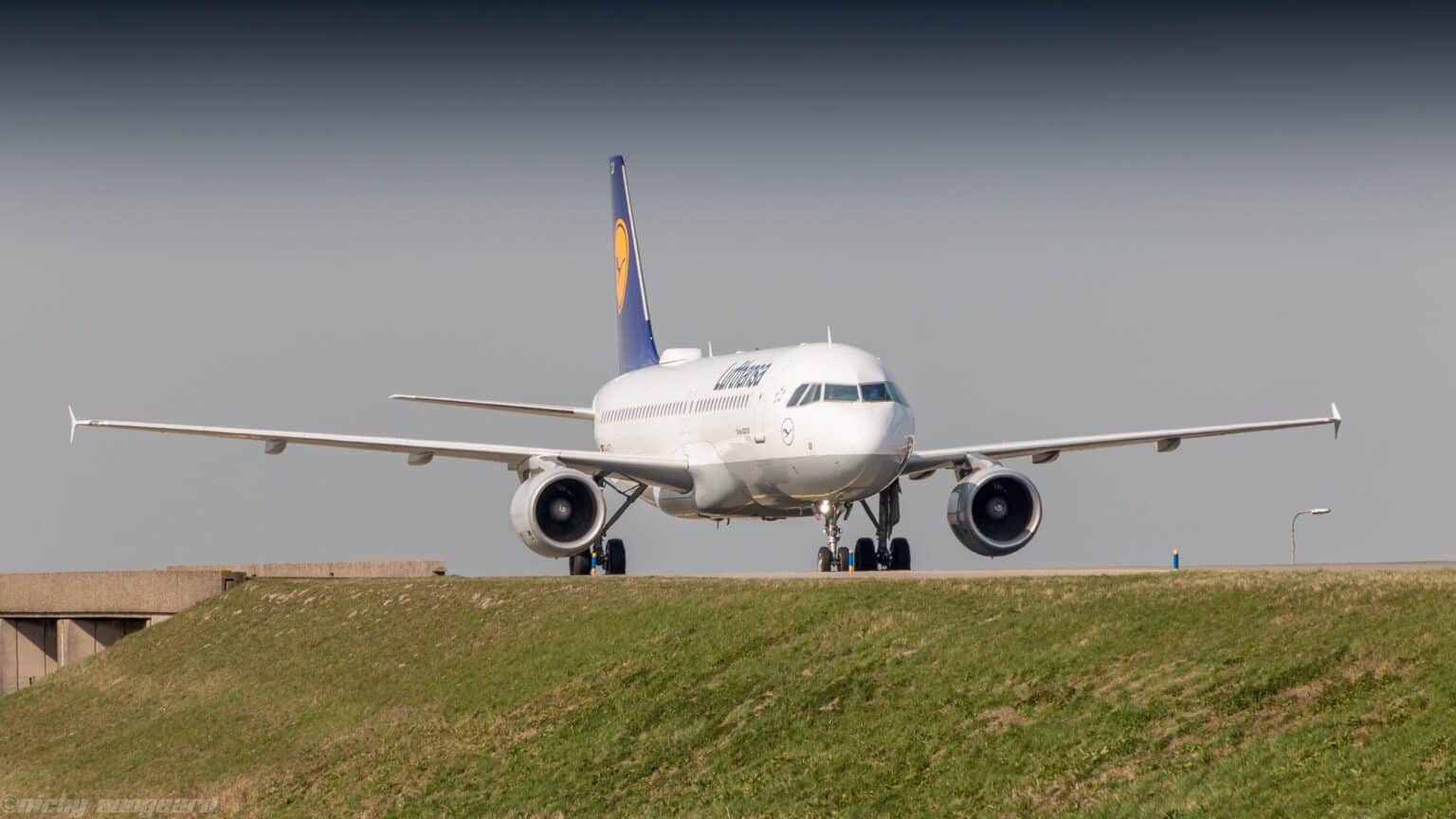
In December 2021, Lufthansa’s chief executive told a German newspaper that his airline group would have to fly 18,000 “additional, unnecessary flights” that winter, purely to hold on to its takeoff and landing rights.
The quote went around the world. Within weeks, “ghost flights” meant one thing to most people: empty airliners crossing Europe so an airline would not lose its place at a busy airport.
The rule behind that story is real, and it does push airlines to fly planes they would rather cancel. But the flight-by-flight data tells a stranger story than the headlines did. Here is what a ghost flight is, why the rule exists, and what the numbers actually show.
What Are Ghost Flights?
A ghost flight is a scheduled passenger flight that operates with no passengers, or almost none. The usual reason given is airport slots: at the busiest airports, an airline that stops flying a slot can lose the right to it.
There is no official definition. The often-quoted “fewer than 10% of seats filled” line traces back to a February 2022 answer in the UK Parliament, which counted departing international passenger flights with no more than 10% of their seats filled. It was a way of counting, not a legal term.
Ghost flights at a glance
What: passenger flights flown empty or nearly empty. Main driver: the use it or lose it rule, which makes airlines fly 80% of a slot series to keep it. When it boiled over: winter 2021/22, when Lufthansa said it faced 18,000 unnecessary flights. Today: the 80% rule is back in force in Europe and the UK, and UK data shows flights with no passengers down to about 90 a year.
The use it or lose it rule
At most airports, an airline can schedule a flight whenever it likes. At the most congested ones, it needs a slot: permission to land or take off in a given time window, handed out by an independent coordinator.
IATA counts more than 200 of these fully coordinated airports worldwide, and says half of all airline passengers depart from one. In the US the list is short: the FAA treats JFK, LaGuardia and Washington National as slot-controlled.
Slots come in series, at least five at the same time on the same day of the week across a season.
If an airline operates a series at least 80% of the time, it keeps it for the next equivalent season. Industry rules call this historic precedence. Everyone else calls it the 80/20 rule.
In Europe the rule is law, written into Articles 8 and 10 of EU Regulation 95/93. The US version is stricter on timing: at Washington National and LaGuardia, a slot not used 80% of the time over a two-month period is withdrawn.
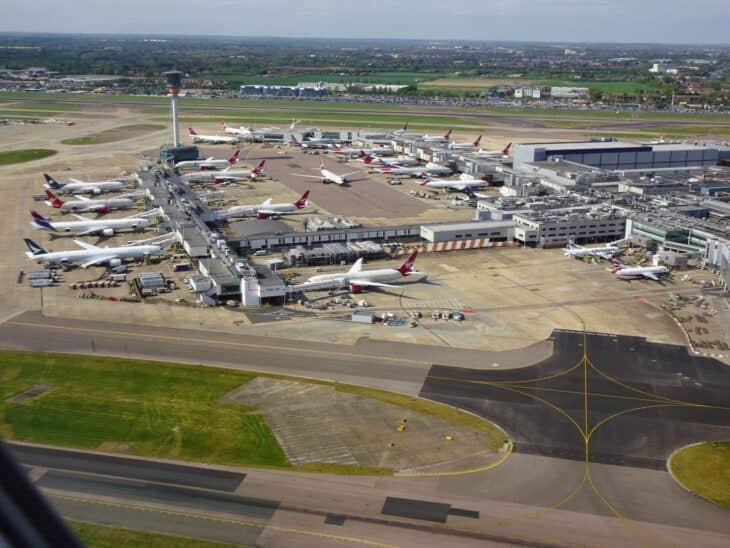
The rule exists to stop an airline from hoarding scarce capacity it is not using. At London Heathrow, which links 215 destinations, a planning condition from the Terminal 5 approval caps the airport at 480,000 takeoffs and landings a year.
A slot an airline gives up there does not go to waste. A rival will happily take it.
_(54540934691).jpg)
A $75 million timetable entry
In February 2016, Oman Air paid a reported $75 million for a single pair of Heathrow slots, one arrival and one departure a day. Seven years later, aviation data firm OAG said that price was still the record. In a May 2026 paper, British Airways’ parent IAG said some Heathrow slots have changed hands for £40 million or more.
Put those two facts together and the logic of a ghost flight is simple. Flying a half-empty plane costs fuel and crew time. Losing a slot can mean losing an asset worth tens of millions of dollars, permanently.
What the pandemic did to the rule
When travel collapsed in early 2020, nobody could fly 80% of a schedule. On March 30, 2020, the EU suspended the rule entirely: slots that went unused between March 1 and October 24, 2020, were treated as if they had been flown. The waiver was extended through the following winter.
From summer 2021, the EU brought the rule back in steps. Airlines had to fly 50% of their slots that summer and the following winter, 64% in summer 2022, and 75% in winter 2022/23. Full 80% use returned for summer 2023.
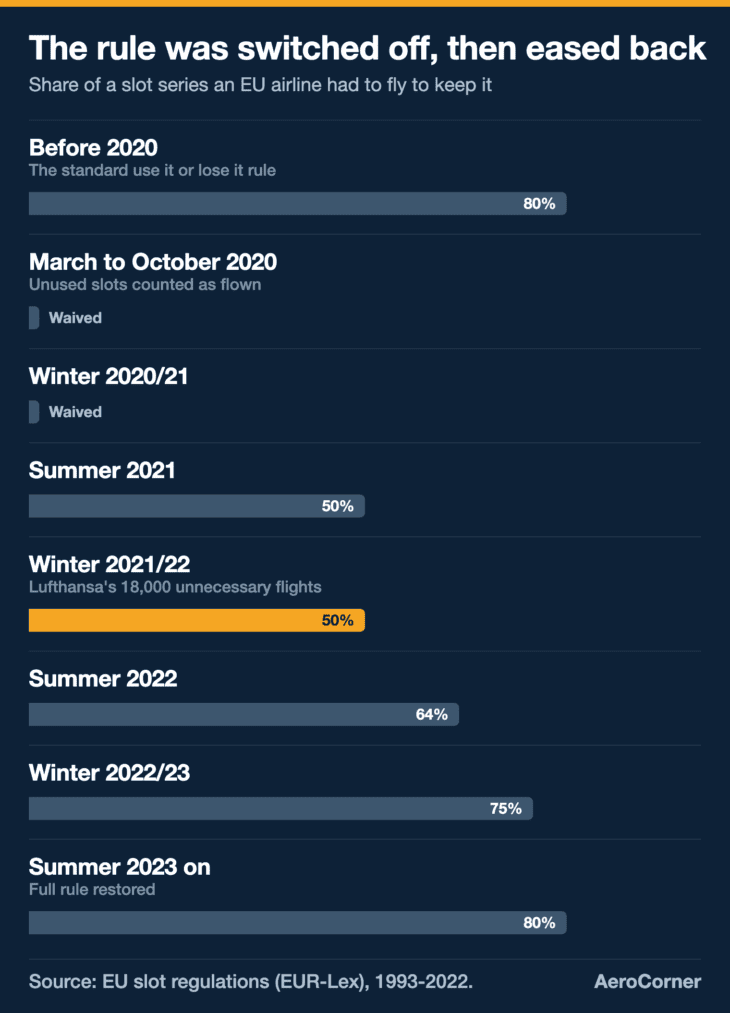
The UK, outside the EU by then, set its own levels: 50% for winter 2021/22, then 70% for both summer 2022 and winter 2022/23, before returning to 80% from March 26, 2023. The FAA’s COVID slot relief for US airports ended on October 29, 2022.
The fight came in winter 2021/22. Traffic was still well below 2019 levels, the EU threshold sat at 50%, and Lufthansa said that meeting it meant 18,000 flights it did not need. By mid-January 2022 it said it was flying about 100 “commercially unnecessary, barely occupied” flights a day.
Brussels Airlines, part of the same group, said it had 3,000 such flights to operate before the end of March. Belgium’s transport minister, Georges Gilkinet, wrote to the European Commission asking it to keep the threshold at 50% through the summer.
The Commission pushed back. A spokesperson said European air traffic was running at about 75% of 2019 levels, well above the 50% requirement, and that airlines facing travel bans could already claim an exemption. Since 2021, EU law has excused unused slots when public measures such as flight bans or quarantine rules severely impede travel on a route.
What the flight data actually shows
Most airlines do not publish how full each flight is. The UK is an exception. Its Civil Aviation Authority releases quarterly files that sort passenger services at reporting UK airports into load bands, from completely empty to at least half full.
AeroCorner tallied every one of those files from 2019 to 2024, counting flights in and out of UK airports and domestic flights once. Because the CAA publishes percentages per route, the totals are reconstructions, accurate to within a handful of flights.
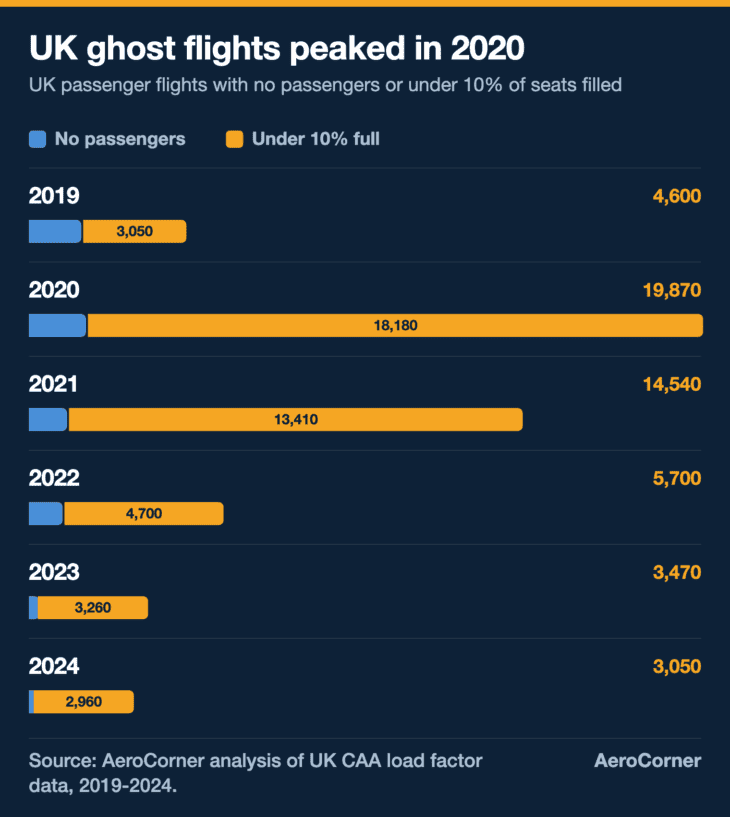
Three things stand out. First, near-empty flying peaked in 2020, at about 18,180 flights under 10% full. More than three-quarters of them flew between April and December, when the slot rule was suspended, so it cannot explain most of them.
Other obligations kept planes flying. In the US, airlines that took CARES Act aid had to keep serving the cities they served before March 1, 2020, and in the first week of May that year the average US airline flight carried 23 passengers.
Second, totally empty passenger flights are not a pandemic invention. With the full 80% rule in force in 2019, about 1,550 flights in and out of UK airports carried no passengers at all, nearly as many as in 2020.
The CAA files do not record why each flight operated. Airports and airlines asked about empty flights have pointed to repatriation, repositioning an aircraft for its next job, maintenance and airworthiness flights, and crew licensing. Those are the same moves covered in our guide to ferry and positioning flights, and none of them needs a slot rule to happen.
Third, the problem has shrunk. In 2024 about 90 flights in and out of the UK carried no passengers and about 2,960 were under 10% full. That is under 0.2% of the roughly 1.76 million flights in the files.
The myth vs. the reality
Myth: airlines fly thousands of completely empty planes to keep their slots
The slot rule does produce flights that would otherwise be canceled, but the famous numbers do not count empty planes. Lufthansa’s 18,000 were unnecessary flights, which it later described as barely occupied, not empty. Greenpeace’s widely shared estimate of more than 100,000 European ghost flights was Lufthansa’s figure scaled up by its market share, not a count.
Brussels Airlines went further. After its 3,000-flight figure made headlines, it told the Belgian newspaper La Libre that it had never flown a plane empty, only some very poorly filled ones.
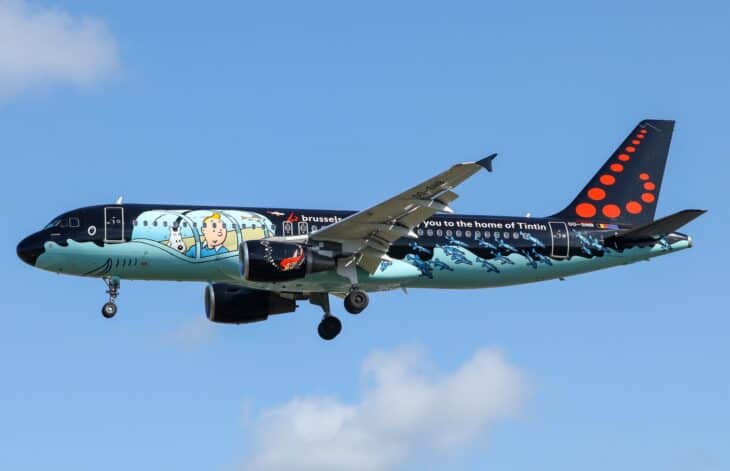
In the cases the airlines themselves described, a ghost flight was a lightly booked plane rather than an empty one. That is a terrible load factor, and still a real environmental cost. But it is not the empty cabin most people picture.
Another common explanation does not hold up either: that airlines fly empty planes so pilots keep their licenses current. US airline pilots do need three takeoffs and landings in type every 90 days, but FAA rules let them earn those in an approved flight simulator.
The other kind of ghost flight
Search for “ghost plane” and you will also find something much darker. In accident investigation, the term describes an aircraft that keeps flying on autopilot after its crew has been incapacitated.
The best-known case is Helios Airways Flight 522. On August 14, 2005, a Boeing 737-300 left Larnaca, Cyprus, with its pressurization mode selector still set to manual after a ground check. The crew succumbed to hypoxia, and the jet cruised on autopilot at 34,000 feet.
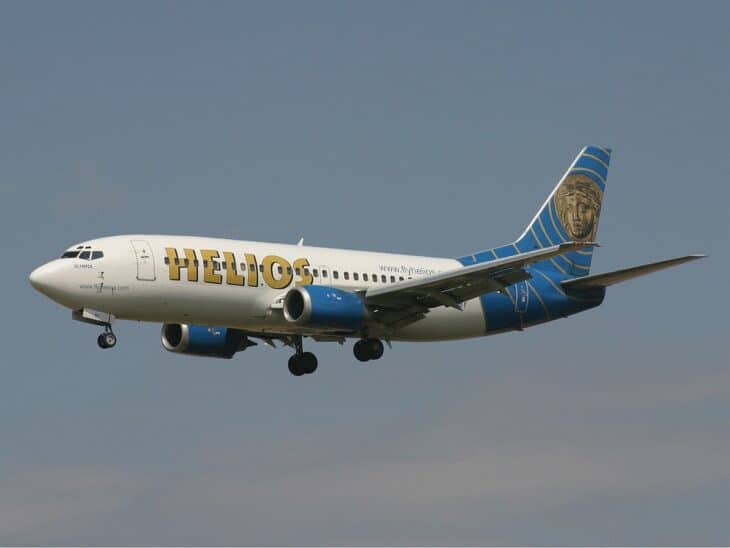

Two Greek Air Force F-16s intercepted it and found the captain’s seat empty. When the fuel ran out, it came down near Grammatiko, about 20 miles (33 km) northwest of Athens International Airport, killing all 121 people aboard.
The same pattern ended the 1999 flight that carried golfer Payne Stewart, whose Learjet flew on for hours after its pilots went silent.
Then there is the Ghost of Flight 401, the best-known ghost story in airline history. After Eastern Air Lines Flight 401 crashed in the Everglades on December 29, 1972, crews began telling stories of its captain and flight engineer appearing aboard other L-1011s, supposedly fitted with parts salvaged from the wreck.
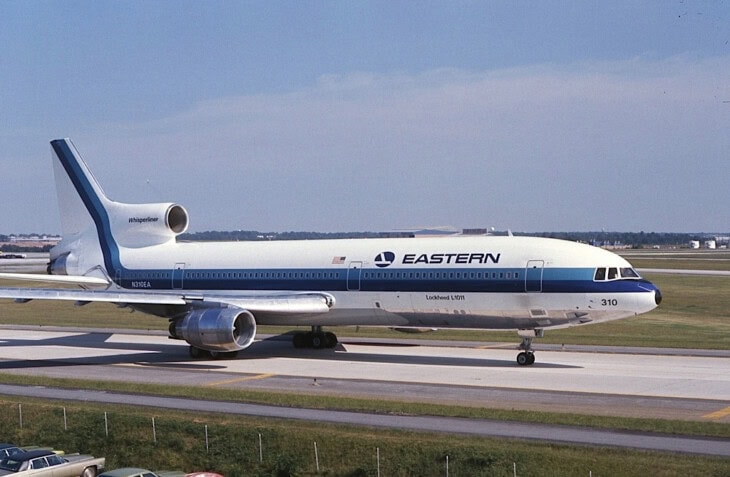
John G. Fuller’s 1976 book “The Ghost of Flight 401” made the legend famous. There is no evidence any of it happened, and Eastern’s chief executive, Frank Borman, called the stories “garbage.”
Are ghost flights still happening?
Yes, but far less often, and rarely in the way the 2022 headlines suggested. The 80% rule has been fully back in Europe and the UK since summer 2023. In the US, a limited waiver tied to air traffic controller staffing has eased the use requirement at JFK, LaGuardia and Washington National since September 2023, and it now runs to October 2027.
Europe has also kept a safety valve. In October 2022 the EU widened its exemption for unusable routes to cover other epidemics and the effects of the war in Ukraine, so an airline cut off from a market by a flight ban does not have to keep flying the route just to protect its slots.
So the next time you board a flight with rows of empty seats, the slot rule may well be part of the reason the airline did not cancel it. But a completely empty passenger jet is rare, and in the UK the record shows it was rare before the pandemic made ghost flights famous.
Sources and references used for research and fact-checking.
- EUR-Lex, Council Regulation (EEC) No 95/93 on common rules for the allocation of slots at Community airports
- EUR-Lex, Regulation (EU) 2020/459 amending Regulation (EEC) No 95/93
- EUR-Lex, Regulation (EU) 2021/250 amending Regulation (EEC) No 95/93
- European Commission, Aviation: slot relief rules for airlines amended and extended
- EUR-Lex, Commission Delegated Regulation (EU) 2022/255
- EUR-Lex, Regulation (EU) 2022/2038 amending Regulation (EEC) No 95/93
- legislation.gov.uk, Explanatory Memorandum to The Airport Slot Allocation (Alleviation of Usage Requirements) Regulations 2022
- UK Department for Transport, Government supports aviation sector recovery with airport slot alleviation for summer 2022
- Airport Coordination Limited, Department for Transport lays new SI providing alleviation for winter 2022
- UK Department for Transport, Government announces return to business as usual for aviation this summer
- legislation.gov.uk, The Airport Slot Allocation (Alleviation of Usage Requirements) Regulations 2021
- IATA, Worldwide Airport Slot Guidelines, Edition 4
- IATA, Slots
- Federal Aviation Administration, Slot Administration
- eCFR, 14 CFR 93.227: Slot use and loss
- Federal Register, Operating Limitations at New York LaGuardia Airport
- Federal Register, Notice on the end of COVID-19 slot relief
- Federal Register, Staffing-Related Relief Concerning Operations at Ronald Reagan Washington National Airport, John F. Kennedy International Airport, and LaGuardia Airport
- Airport Coordination Limited, LHR Local Rule 3: Administration of the Heathrow Air Transport Movement Cap
- OAG, Heathrow's slots: Europe's most valuable
- TTG, Oman Air pays record $75m for Heathrow slots
- UK Civil Aviation Authority, IAG paper on slots
- aeroTELEGRAPH, Lufthansa führt wegen EU-Slot-Regeln 18.000 unnötige Flüge durch
- Aero International, 100 unnötige Flüge am Tag: Lufthansa und EU streiten weiter um Slots
- SRF, EU-Kommission weist Vorwürfe der Lufthansa zu Leerflügen zurück
- The Brussels Times, Thousands of ghost flights scheduled to keep much-desired slots
- La Libre, Vols fantômes de Brussels Airlines: info ou intox?
- Greenpeace European Unit, Pointless ghost flights in EU cause climate damage equal to 1.4 million cars
- UK Civil Aviation Authority, UK airport load factor data
- UK Parliament, Written question UIN 119801: Air Routes
- The Guardian, Revealed: 5,000 completely empty ghost flights in UK since 2019, data shows
- The Points Guy, US DOT flight schedule rules during coronavirus aid
- Legal Information Institute, Cornell Law School, 14 CFR 121.439: Pilot qualification, recent experience
- Air Accident Investigation and Aviation Safety Board (Greece), Aircraft Accident Report 11/2006: Helios Airways Flight HCY522
- Wikipedia, Helios Airways Flight 522
- Wikipedia, Eastern Air Lines Flight 401
Get the Newsletter
The latest aviation news and stories sent to your inbox.
About the Author

Tim is the owner and lead editor of AeroCorner since 2019, overseeing aviation content covering aircraft, airlines, airports, and the broader aviation industry. Through years of researching, writing, editing, and publishing aviation-focused content, he has developed extensive practical knowledge of commercial aviation and air travel. Based in Asia and a frequent traveler himself, Tim also brings firsthand passenger experience to AeroCorner’s coverage. Outside of publishing, he has also explored aviation firsthand through hands-on flight training in New Zealand.