

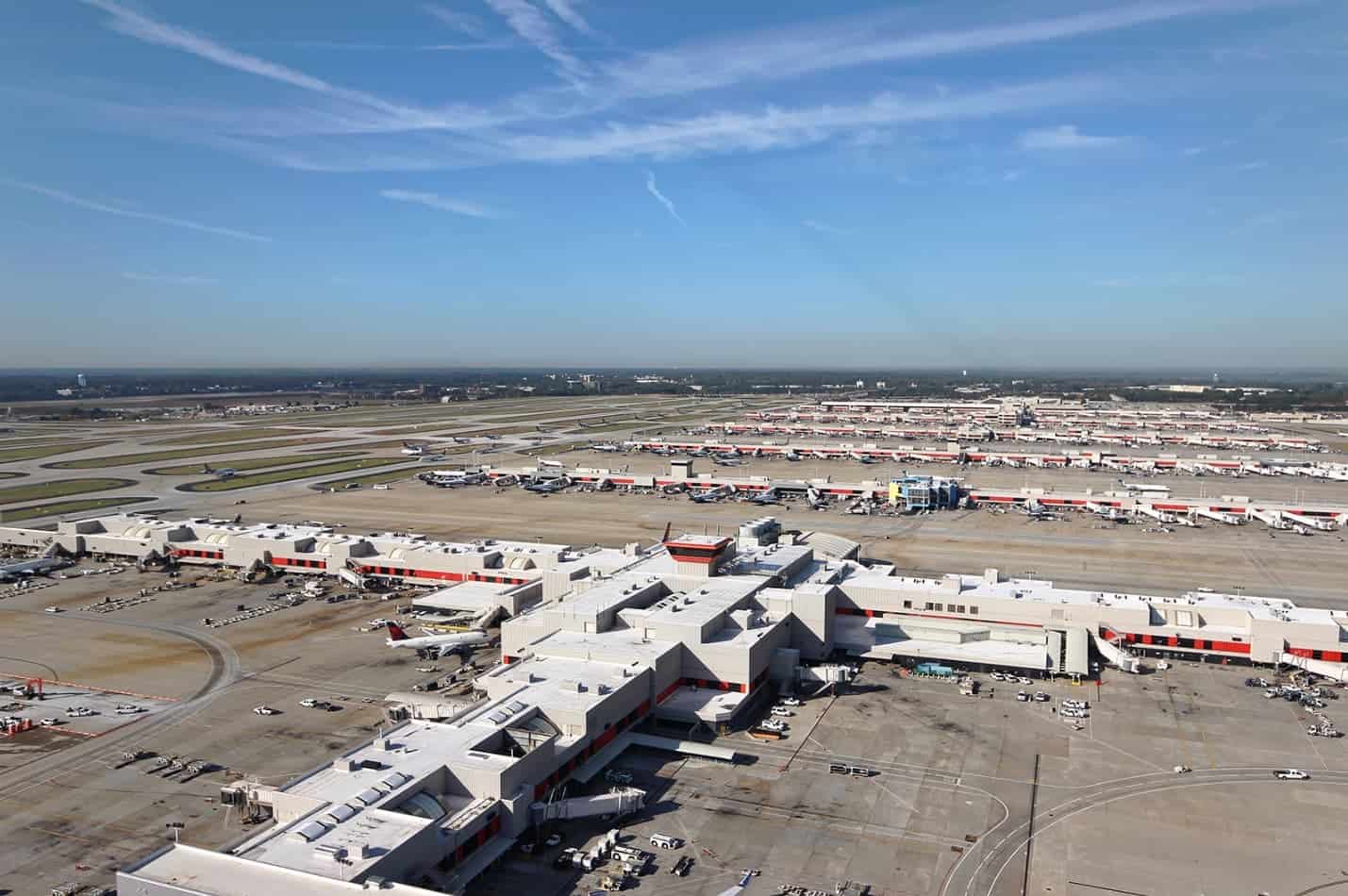
Ride the underground train that runs beneath the concourses at Atlanta’s airport and you are moving through the busiest passenger building on the planet. Roughly two hundred thousand people pass through it on a normal day, hauling roller bags between gates, chasing tight connections, glancing up at departure boards that stretch on for screens.
Here is the strange part: most of those people are not going to Atlanta at all. They will land, walk a concourse, board another aircraft, and leave again, without ever stepping outside into Georgia. For a huge share of its traffic, the world’s busiest airport is a place you pass through, not a place you go.
That raises an obvious question. The busiest airport on Earth should surely serve one of the world’s giant cities, somewhere like New York, London, Tokyo, or Dubai. Instead it serves Atlanta, a mid-size American metro that rarely tops anyone’s list of global capitals. The reason comes down to a lucky patch of geography and one airline’s decades-old bet on how air travel should be organised.
The short answer
Hartsfield-Jackson Atlanta International Airport, code ATL, has been the world’s busiest airport by passenger numbers for 26 of the last 27 years. In 2024 it handled about 108.1 million passengers, according to Airports Council International, comfortably ahead of Dubai in second place at 92.3 million. It is not a narrow lead, and it has proven remarkably durable.
What Atlanta is not is a big-city airport in the usual sense. It wins because of two things stacked on top of each other: a location near the population centre of the eastern United States, and its role as the primary hub of Delta Air Lines, built around the connect-through model that defines modern air travel. Put simply, ATL is busy because it is where America changes planes.
Why Atlanta leads the world
Two forces line up. Geographically, ATL sits within a two-hour flight of roughly 80 percent of the US population, which makes it the natural place to connect the country. Commercially, it is the largest hub of Delta Air Lines, whose hub-and-spoke network funnels passengers through Atlanta by design. The result is an airport where most travellers are not arriving or departing, just passing through.
Geography did the first half of the work
Start with where Atlanta sits. The airport is within about a two-hour flight of roughly 80 percent of the population of the United States. For an airline trying to connect the whole country through a single point, that is close to the ideal address.
A hub works best when it sits near the middle of the demand it serves, so that flights feeding in from every direction are short and cheap to operate. Atlanta is far enough south to anchor the busy Florida and Caribbean leisure markets, and central enough on the eastern seaboard to link the Northeast, the Midwest, Texas, and the West Coast without any single leg becoming a marathon.
The weather helps too. Atlanta rarely deals with the heavy winter snow that snarls hubs like Chicago or the coastal fog and congestion that slows the New York airports. A hub is only as reliable as its worst regular delays, and Atlanta’s climate keeps the machine turning most of the year.
None of that would matter if Atlanta were a small airport. It is not. It has surged past the megacity airports precisely because geography turned it into the country’s connecting crossroads rather than just a city’s front door.
| # | Airport | Passengers | Country |
|---|---|---|---|
| 1 | Atlanta (ATL) | 108.1M | United States |
| 2 | Dubai (DXB) | 92.3M | United Arab Emirates |
| 3 | Dallas Fort Worth (DFW) | 87.8M | United States |
| 4 | Tokyo Haneda (HND) | 85.9M | Japan |
| 5 | London Heathrow (LHR) | 83.9M | United Kingdom |
Total passengers, 2024. Source: Airports Council International world rankings, 2024.
Notice that three of the top five are American, and none of them are New York or Los Angeles. That is the fingerprint of the hub-and-spoke system, which is the second half of the answer.
The Delta hub-and-spoke machine
A hub-and-spoke network works like the spokes of a bicycle wheel. Instead of flying every city directly to every other city, an airline routes passengers through one central airport, the hub, where they change planes. It lets a carrier connect hundreds of cities with far fewer flights than direct routes would need, and it fills those flights by pooling passengers headed to many destinations onto the same aircraft.
Atlanta is the biggest and busiest hub of Delta Air Lines, one of the largest airlines in the world. Delta and its regional partners operate the clear majority of flights at ATL, running wave after wave of arrivals and departures timed so that passengers can land, connect, and leave within a tight window. On a typical day the airport handles well over a thousand flights to roughly 250 destinations.
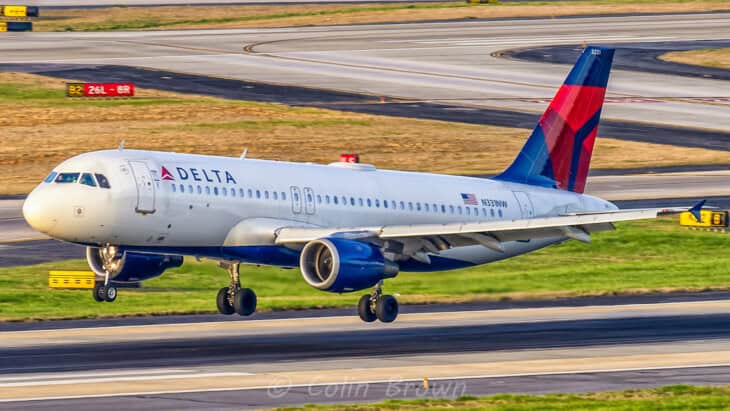
This is where those pass-through passengers come from. A large share of everyone at ATL, by most estimates somewhere between two-thirds and three-quarters, are connecting rather than starting or ending their trip in Atlanta. They are the through-traffic that a direct-only airline would never generate, and they are what pushes the passenger count so far above what the city alone could ever produce.
Most people at the world's busiest airport never leave it
Atlanta counts north of 100 million passengers a year, but the majority are connecting passengers who change planes and fly onward without exiting the terminal. By most estimates roughly two out of every three travellers at ATL are just passing through. The busiest airport on Earth owes its crown less to the city it serves than to the millions who use it as a doorway to somewhere else.
The choice was not obvious in advance. The airfield began in 1925 as Candler Field, built on an abandoned auto racetrack, and both Delta and the airline that became Eastern Air Lines made early use of it. Eastern was the larger carrier for decades, but Delta committed early to the hub-and-spoke model, wiring Atlanta as the connecting point between the Midwest and Florida.
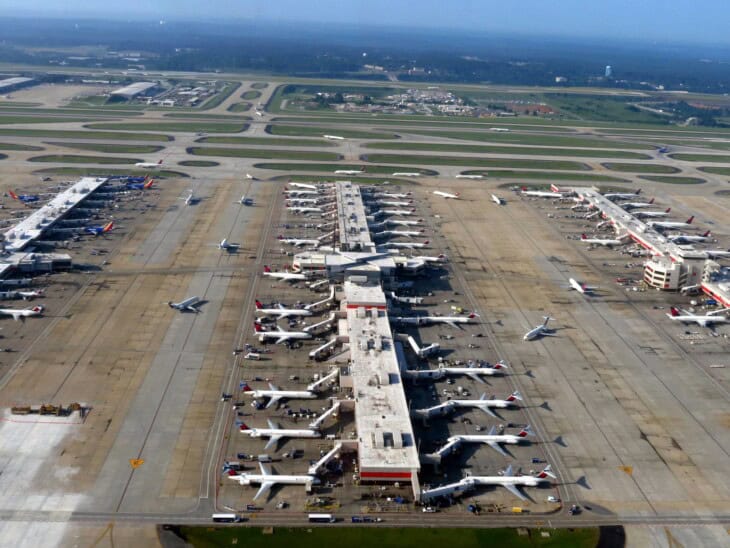
After US airline deregulation in 1978 let carriers build their networks freely, that head start compounded. Delta kept feeding Atlanta, the connecting traffic kept growing, and the airport kept expanding to match. The efficiency of the physical layout, a compact set of parallel concourses linked by that underground train, made it possible to move enormous crowds between gates quickly, which is the whole point of a hub. Decades later, the momentum has never really stopped.
The myth: busiest does not mean biggest
The instinct to expect the world’s busiest airport in its largest or most glamorous city is the thing worth unlearning. Passenger volume does not track city size, tourism fame, or economic weight. It tracks how much traffic an airline chooses to route through a single point.
The common misconception
People assume the busiest airport must belong to a megacity. In reality, a purely origin-and-destination airport, one where nearly everyone is starting or ending a trip, tops out at the size of the local market. A connecting hub adds a second, larger layer of pass-through passengers on top of local demand. That is why a mid-size city with a dominant hub airline can outrank New York, London, and Dubai.
You can see the pattern across the whole ranking. Dallas Fort Worth, the third busiest airport in the world, is the fortress hub of American Airlines, not the airport of a global megacity. Among the busiest airports in the United States, the leaders are consistently the big airline hubs rather than simply the biggest cities.
A pure origin-and-destination airport, where almost everyone begins or ends their journey locally, is capped by the size of the city around it. A hub is not. It stacks a second stream of connecting passengers on top of local demand, and that extra layer is exactly what lifts Atlanta above airports serving far larger cities.
It also explains why the title is so stable. Atlanta briefly lost the top spot in 2020, when the pandemic scrambled global traffic and a Chinese airport with huge domestic demand edged ahead for a year. As soon as international connecting traffic recovered, Atlanta was back on top. The structure that makes it busiest is baked into how the US airline network is built.
What would change it
Rankings do move, and Atlanta’s lead is not guaranteed forever. Dubai, built as a long-haul connecting point between Europe, Asia, and Africa, already carries more international passengers than Atlanta and has been closing the total gap. If global long-haul travel keeps growing faster than US domestic flying, a hub like Dubai could eventually take the overall crown.
For now, the sheer volume of American domestic connecting traffic keeps Atlanta ahead. The thing to remember is that its ranking rests on a strategy, not on the city’s fame. Change how airlines route their passengers and the number one airport changes with it.
So the next time someone assumes the busiest airport on Earth must be in New York or London, you can tell them it is in Atlanta, and that most of the people there are not even visiting. They are changing planes in the middle of the machine that keeps American air travel connected.
If the mechanics behind an operation like this interest you, it is worth seeing how airlines actually work to move that many aircraft and passengers through one airport every day.
Sources and references used for research and fact-checking.
Get the Newsletter
The latest aviation news and stories sent to your inbox.
About the Author

Tim is the owner and lead editor of AeroCorner since 2019, overseeing aviation content covering aircraft, airlines, airports, and the broader aviation industry. Through years of researching, writing, editing, and publishing aviation-focused content, he has developed extensive practical knowledge of commercial aviation and air travel. Based in Asia and a frequent traveler himself, Tim also brings firsthand passenger experience to AeroCorner’s coverage. Outside of publishing, he has also explored aviation firsthand through hands-on flight training in New Zealand.