


Table of Contents
Two people book the same flight and cannot agree on when to leave the house. One wants three hours at the airport. The other has done it in forty minutes, twice, and will tell you about it.
Both of them can cite something. The airline’s website says two hours, the airport’s own page says two or two and a half, and a viral video says fifteen minutes is plenty.
The reason nobody agrees is that this is not one question. It is four separate deadlines, and only one of them is your departure time. Once you know what they are, you can build your own number instead of borrowing someone else’s.
How Early Should You Arrive at the Airport?
Two hours before a domestic flight and three before an international one is the published default, and it is a safe one. Delta recommends two hours for domestic departures, and most airport authorities repeat the same pair of figures.
But that number is a hedge, not a calculation. It is sized to cover the worst plausible day at the worst plausible airport, so that the airline is never the reason you missed your flight. On an ordinary Tuesday at a mid-size airport it is generous by an hour or more.
The number that is actually right for you comes from working backward from four hard deadlines. Three of them land before your departure time, and the earliest one is almost always the checked bag.
The four deadlines, at a glance
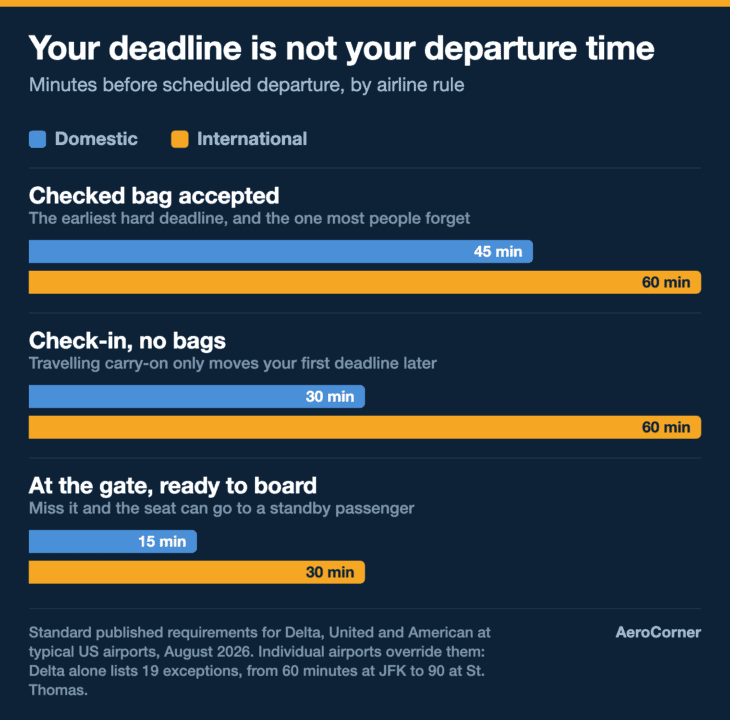
Every airline deadline is counted back from the scheduled departure time printed on your ticket, not from the boarding time on your phone. Checked bag accepted: 45 minutes domestic, 60 international. Check-in complete with no bags: 30 minutes domestic. At the gate and ready to board: 15 minutes domestic, 30 international. Security and the walk to your gate are not deadlines at all. They are the variable you have to buy insurance against.
The Rule Everybody Quotes Does Not Come From the TSA
The natural assumption is that the two-hour rule comes from the agency that runs the security line. It does not. The TSA publishes no arrival-time figure at all.
Its official travel checklist tells passengers only to “give yourself enough time to arrive at the airport early.” Its travel tips page says to allow for parking, bag drop, screening and the walk to the gate. Nowhere does it name a number of hours.
That silence is reasonable. The TSA controls one segment of your journey and cannot see the other three. It does not know how long the bag drop queue is, how far your gate is, or what time your airline shuts the door.
The two-hour figure comes from airlines and airport authorities instead. Both have a strong interest in you arriving early, and no particular interest in you arriving efficiently.
The Four Deadlines That Actually Bound You
1. The checked bag, 45 minutes out
This is the earliest hard deadline and the one people forget. All three big US carriers now require a checked bag to be accepted at least 45 minutes before scheduled departure on domestic flights, and 60 minutes on international ones.
That alignment is recent. Delta moved its domestic bag cutoff to 45 minutes on 8 April 2025, and United followed on 3 June 2025, tightening its domestic check-in deadline from 30 minutes. American was already there.
Read the word “accepted,” not “queued.” The clock stops when an agent has taken the bag, so at a busy hub on a Monday morning you need to be at the front of that line at the 45-minute mark, not the back of it.
2. Check-in itself, 30 minutes out
Travel with only a carry-on and this deadline replaces the bag cutoff, which is the single biggest lever you have. Delta still lets a bagless domestic passenger complete check-in as late as 30 minutes before departure.
Skipping the bag does not just save you the queue. It moves your first hard deadline fifteen minutes later and removes the one step of the journey whose length you cannot see from the curb.
3. The gate, 15 minutes out
Delta’s published rule is blunt: all customers must be at the gate and ready to board 15 minutes before scheduled departure. American publishes the same 15 minutes for domestic flights and 30 for international.
Miss it and you are not simply late. You are a no-show, and your seat can be handed to someone holding a standby ticket while you are still walking.
The door closes early because the departure time is an operational commitment, not a courtesy. The turnaround is scheduled to the minute, the crew is on a legal clock, and holding an aircraft for one passenger risks a delay that follows that airframe through the rest of its day.
4. Security and the walk, which have no deadline at all
These two are different in kind. Nothing happens at a fixed minute; they simply consume however long they consume, and what is left over is your margin.
The walk is the part travellers systematically underestimate, because at a big hub it is not a walk. At Dallas/Fort Worth the airside Skylink train takes close to ten minutes between the farthest gates, and at Denver two of the three concourses can only be reached by an underground train.
Boarding is the other quiet trap. Your boarding pass typically says boarding begins 30 to 45 minutes before departure, which means the window between the doors opening and the doors closing is often barely twenty minutes, and filling an aircraft takes most of it.
| Deadline | Domestic | International | If you miss it |
|---|---|---|---|
| Checked bag accepted | 45 min before departure | 60 min | The bag is refused. You fly without it, or you do not fly. |
| Check-in complete, no bags | 30 min | 60 min | The reservation can be cancelled as a no-show. |
| At the gate, ready to board | 15 min | 30 min | Your seat can be reassigned to a standby passenger. |
| Through security, at the gate | No fixed deadline | No fixed deadline | Nothing, until it makes you miss one of the above. |
Why the Honest Answer Is Airport-Specific
Delta’s own domestic check-in page quietly undercuts the idea of a single national rule. It carries an exceptions table, and 19 airports do not use the standard deadlines.
At New York JFK the bag cutoff moves out to 60 minutes. At St. Thomas it moves to 90, which is longer than most people’s entire airport buffer.
Las Vegas, Miami, Honolulu, Aspen and Washington Reagan all get their own row too. The rule you looked up is the default, not the one your airport is using.
Size is part of it. JFK runs 736 flights a day across 106 airlines, spread over terminals with their own separate security checkpoints, so which building your airline uses can matter more than which city you are flying from.
The bigger variable is when you fly, and the TSA’s own daily screening figures show how wide that swing runs. In 2025 the agency screened 906.7 million people, an average of about 2.48 million a day.
The average is nearly useless for planning, because almost nobody flies on an average day. The busiest and the quietest days of that entire year fell 72 hours apart, in the same week, at the same airports.
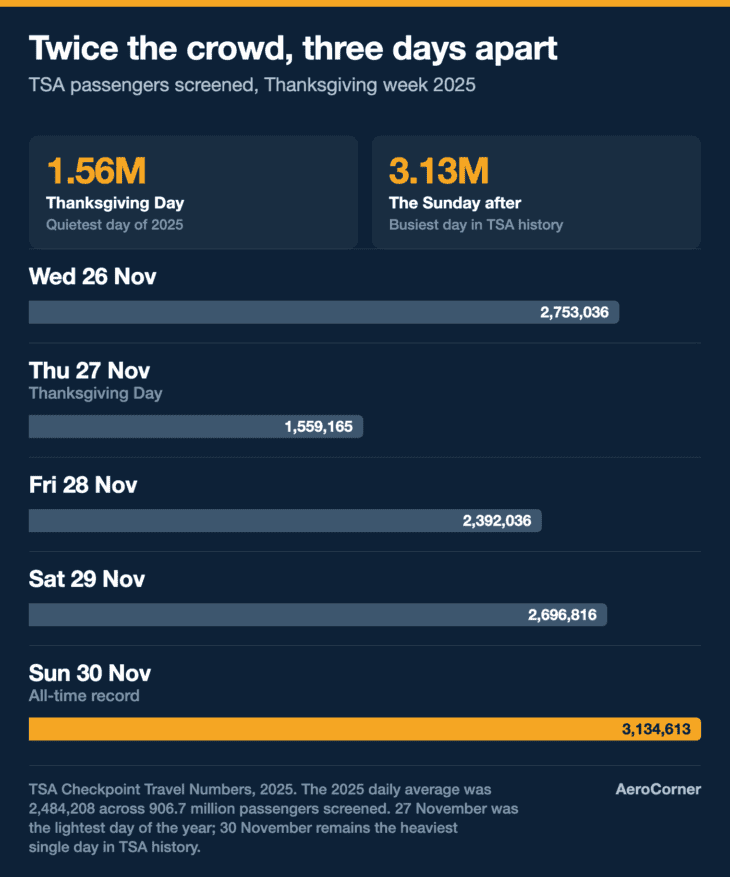
Twice the crowd, three days apart
On Thanksgiving Day, 27 November 2025, the TSA screened 1,559,165 people, the lightest day of the whole year. On the Sunday three days later it screened 3,134,613, the heaviest single day in the agency’s history. Exactly twice as many travellers, at the same airports, in the same week. Any arrival rule that gives you one number for both of those days is not really answering the question.
Day of the week does the same thing on a smaller scale. Across 2025, Sundays averaged about 2.74 million passengers and Tuesdays about 2.16 million, a difference of roughly a quarter of the entire national queue.
Two other things have changed the maths recently. The TSA stopped requiring shoes off at domestic checkpoints in summer 2025, which speeds the standard lane, and from 1 February 2026 passengers who arrive without an acceptable ID are offered a $45 alternative identity check rather than a quick wave through.
PreCheck remains the single largest lever on the security half of the problem. The TSA’s own figure is that about 99% of PreCheck passengers wait less than 10 minutes, and unlike everything else on this list, that is a number you can buy in advance.
The Myth: “Airport Theory” and the People It Works For
The myth
That because someone made a 15-minute airport run work on video, 15 minutes is a viable plan. What the video proves is that the best case is short. It says nothing at all about the worst case, and the worst case is the only one that can cost you a day.
“Airport theory” went viral in early 2025: arrive around 15 minutes before departure, film the sprint, post the result. Enough people tried it that airlines and the TSA publicly discouraged it, and Delta and United both tightened their check-in cutoffs the same spring.
The uncomfortable part is that it does sometimes work, and for a legible reason. A passenger with PreCheck, no checked bag and a gate near the checkpoint has collapsed three of the four deadlines to almost nothing.
What that passenger has not done is buy any margin. They are running a plan with no slack at all, in a system where the thing most likely to break is the one part they do not control.
The real argument against it is not the average, it is the shape of the risk. Arriving 45 minutes earlier than you needed to costs you 45 minutes in a chair. Arriving 5 minutes late can cost you the rest of the day, and on a full aircraft it can cost you the next one too.
If you do lose the race, ask about late-arrival standby rather than assuming the ticket is dead. American publishes a policy putting passengers who reach the airport within two hours of departure on standby for the next flight with no change fee, and United applies something similar.
Delta handles it case by case at the agent’s discretion. The informal “flat tire rule” other travellers talk about is not published policy at most carriers, so treat it as goodwill rather than a right.
None of that is a plan. It is what you fall back on when the plan fails.
Building Your Own Number
Start at the gate deadline, 15 minutes before departure, and add backwards. Add the walk or the train to your concourse, then a realistic security wait for that airport at that hour, then the bag drop if you have one.
For a carry-on-only passenger with PreCheck at a mid-size airport on a Tuesday, that arithmetic lands closer to an hour than to two. For a family checking three bags at one of the country’s biggest hubs on the Sunday of a holiday weekend, two hours is the floor, not the target.
That is why the published rule sounds so unsatisfying. It is one answer to a question with two very different versions, and it is deliberately sized for the harder one.
So the next time someone in the kitchen insists on three hours, they are not wrong, exactly. They are quoting a number built for the worst day of the year, on a day that probably is not it.
Sources and references used for research and fact-checking.
- Transportation Security Administration, TSA Checkpoint Travel Numbers, 2025
- Delta Air Lines, U.S. Domestic Check-In Time Requirements
- Transportation Security Administration, TSA PreCheck
- Transportation Security Administration, TSA prepares for holiday travel season to cap record year
- AFAR, Airlines Issue New Check-In Policies as 'Airport Theory' TikTok Trend Goes Viral
- The Points Guy, Airline Flat Tire Policies: What Happens If You Miss Your Flight
Get the Newsletter
The latest aviation news and stories sent to your inbox.
About the Author

Tim is the owner and lead editor of AeroCorner since 2019, overseeing aviation content covering aircraft, airlines, airports, and the broader aviation industry. Through years of researching, writing, editing, and publishing aviation-focused content, he has developed extensive practical knowledge of commercial aviation and air travel. Based in Asia and a frequent traveler himself, Tim also brings firsthand passenger experience to AeroCorner’s coverage. Outside of publishing, he has also explored aviation firsthand through hands-on flight training in New Zealand.