


Table of Contents
The FAA counts 19,445 airports in the United States in 2026. That is the figure the Bureau of Transportation Statistics published in September 2026, from data the FAA supplied on September 24.
You could never land at most of them. 14,275 are private-use, 5,170 are open to the public, and only 518 hold the FAA certificate an airport needs to handle scheduled airline flights.
How Many Airports Are in the US?
The official answer is 19,445 for 2026. “Airport” in that count means any registered landing facility: runways, heliports, seaplane bases, gliderports, balloonports and ultralight fields, in the 50 states and the US territories. It includes 315 military-owned sites.
The FAA’s own airport master file gives a tighter number. Its October 1, 2026 edition lists 292 US facilities as closed and 147 more outside US territory, from Canada and the Bahamas to the Marshall Islands. Count only the ones that are open on US soil and you get 18,988.
The count at a glance
19,445 landing facilities in the official FAA count for 2026. 18,988 open in the US and its territories in the FAA’s October 1, 2026 data. 5,170 open to the public. 518 certified for airline service. 390 primary airports handle 99 percent of airline passengers.
What the 19,445 Actually Are
Split the open facilities by type and by who may use them, and the picture changes fast. Only about two in three are runway airports, and nearly three in four are private.
| Facility type | Public use | Private use | Total |
|---|---|---|---|
| Airports (runways) | 4,722 | 7,860 | 12,582 |
| Heliports | 56 | 5,636 | 5,692 |
| Seaplane bases | 225 | 334 | 559 |
| Ultralight fields | 3 | 104 | 107 |
| Gliderports | 4 | 32 | 36 |
| Balloonports | 1 | 11 | 12 |
| Total | 5,011 | 13,977 | 18,988 |
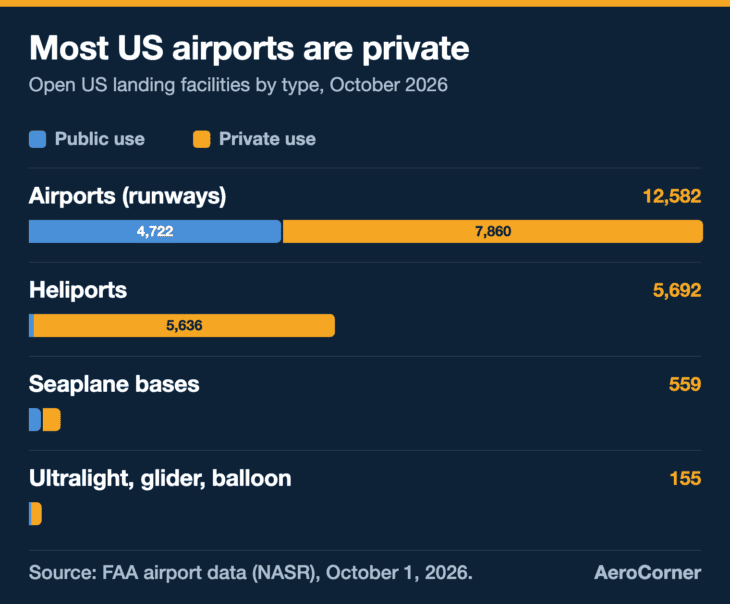
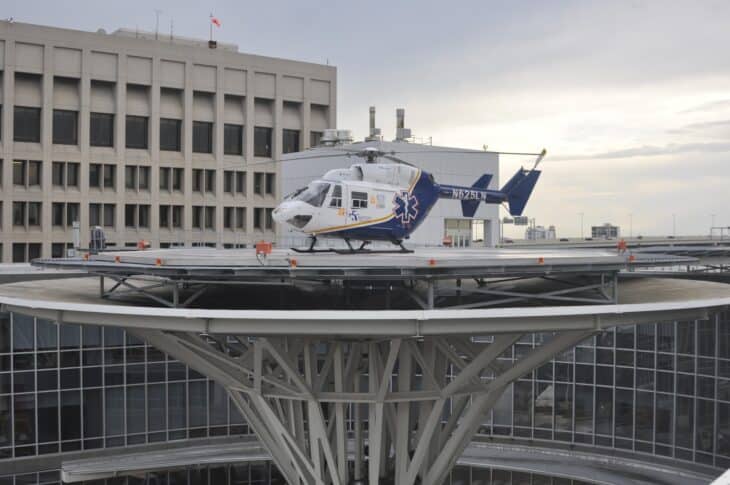
Heliports are the surprise. They make up 30 percent of the total, and 5,636 of the 5,692 are private. About half of them, 2,795 by a search of the FAA’s facility names, carry the name of a hospital or medical center.

Even among runway airports, 62 percent are private. They are registered with the FAA but closed to the public, usable only with the owner’s permission. Our guide to the different types of airports explains how each class works.
Seaplane bases are an Alaska story. The state alone has 131 of the 559, more than any other, which says a lot about how much seaplanes and floatplanes still matter there.
How Many US Airports Have Airline Flights?
Far fewer than the headline suggests. An airport serving scheduled passenger flights on aircraft with more than 9 seats needs an FAA operating certificate under 14 CFR Part 139, with some exceptions in Alaska. Unscheduled charters need one from 31 seats up.
518 airports held that certificate in 2026. The certificate comes with standing obligations: aircraft rescue and firefighting, signs, lights and markings, snow and ice control, fueling safety and wildlife hazard management.
The passengers are even more concentrated. The FAA classes 390 airports as primary, meaning they board 10,000 or more passengers a year, and together they handle 99 percent of all US boardings. Just 31 of them are large hubs, each with at least 1 percent of the national total.
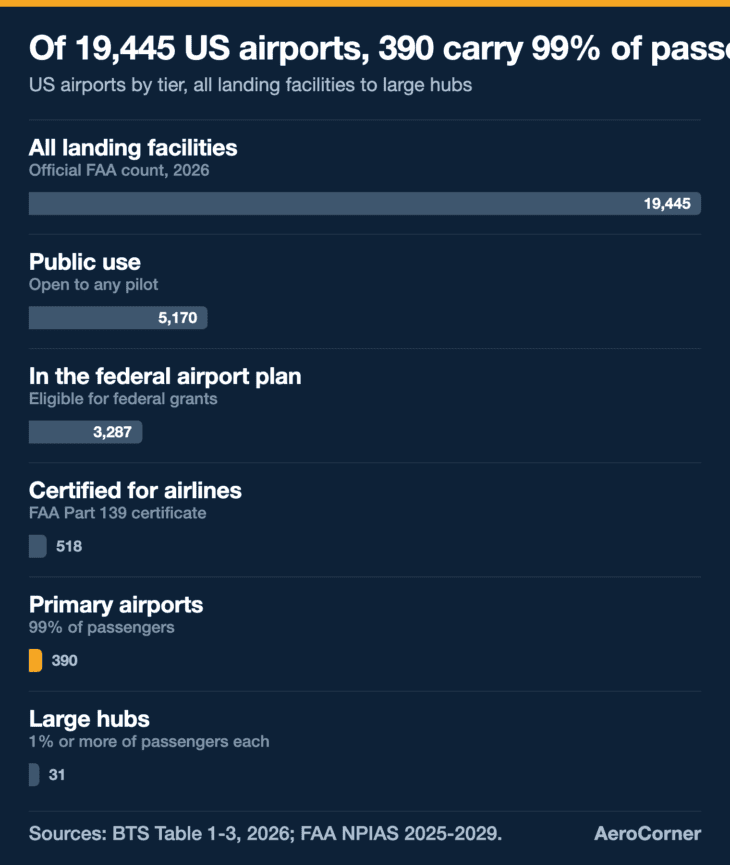
Between those tiers sits the federal airport plan, the NPIAS. Its 2025 to 2029 edition covers 3,287 public-use airports, the ones eligible for federal improvement grants. That leaves 1,581 public airports outside the plan, open to anyone who flies in but not eligible for those grants.
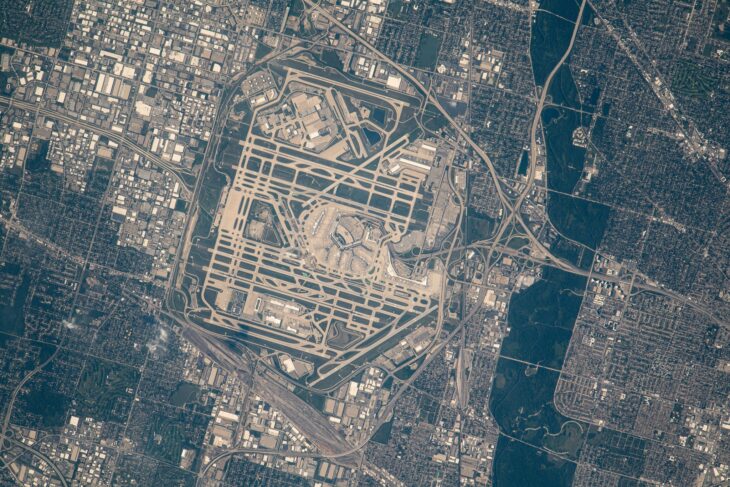
At the top of the pyramid, the gap is enormous. Chicago O’Hare averages 1,483 departing flights a day in AeroCorner’s ranking of the busiest US airports by flights per day, updated October 9, 2026.

Why Other Sites Give a Different Number
Search the question and you will see 19,919, 19,969, 20,031, 19,869 and 16,116. None of them is invented. Each is a real count from a different year or a different method.
The most repeated number is from 2022
19,969 airports, with 5,193 public and 14,776 private, is the FAA count for 2022. It still turns up near the top of search results in 2026. The 2026 count is 19,445, and the 19,919 that circulates on social media is the 2020 figure.
20,031 is the count for both 2023 and 2024, and the FAA used it in its 2025 to 2029 airport plan. 19,869 comes from an FAA safety magazine editor, who quoted the agency’s data as of February 2024.
16,116 is the US figure from the CIA World Factbook’s country comparison, a separate tally from the FAA’s register. The CIA has since retired the Factbook, so that number will not be updated.
The official total also appears to count every record in the FAA’s file, open or not. It sits close to the 19,427 records in the October 2026 edition, which include the closed and overseas facilities. That is why our open count, 18,988, comes in lower.
The total is falling. It peaked at 20,341 in 2007, slipped to 19,829 in 2025 and fell another 384 in 2026. Heliports account for most of the recent drop: the FAA counted 6,185 in April 2024 and its October 2026 file lists 5,711.
Public airports have been disappearing for much longer. Their count peaked at 5,858 in 1985 and has drifted down to 5,170, while private facilities grew from 10,347 in 1980 to 14,275 today. Some of the lost public fields live on as abandoned airports.
Which States Have the Most Airports?
Texas, by a distance. It has 1,857 open landing facilities in the October 2026 FAA data, including 1,377 runway airports, more than twice the 584 in Alaska. Florida (927), California (864) and Alaska (772) follow on total facilities.
Alaska wins on the facilities anyone can use. It has 392 public-use sites against 388 in Texas, and half of the state’s 772 facilities are public: 283 runway airports and 105 seaplane bases.
Every state has an airline airport
All 50 states have at least one airport certified for airline service. Rhode Island has exactly one, T.F. Green International in Providence, and the fewest landing facilities of any state: 22, of which seven are open to the public.
For the biggest airports by land area rather than by count, see America’s biggest airport, which isn’t its busiest one.
FAQ
Sources and references used for research and fact-checking.
- Bureau of Transportation Statistics, National Transportation Statistics, Table 1-3: Number of U.S. Airports
- Federal Aviation Administration, NASR 28-day subscription: airport data (APT CSV), effective October 1, 2026
- Federal Aviation Administration, National Plan of Integrated Airport Systems (NPIAS) 2025-2029
- Federal Aviation Administration, National Plan of Integrated Airport Systems (NPIAS) - Current
- Federal Aviation Administration, Part 139 Airport Certification
- FAA Safety Briefing on Medium, Airports By the Numbers
- Bangladesh Monitor, 2025: Top five countries with most airports, and where Bangladesh stands
- Central Intelligence Agency, Spotlighting The World Factbook as We Bid a Fond Farewell
- Delaware LIVE, Avelo Airlines Extends Wilmington Schedule Through Fall 2026
Get the Newsletter
The latest aviation news and stories sent to your inbox.
About the Author

Tim is the owner and lead editor of AeroCorner since 2019, overseeing aviation content covering aircraft, airlines, airports, and the broader aviation industry. Through years of researching, writing, editing, and publishing aviation-focused content, he has developed extensive practical knowledge of commercial aviation and air travel. Based in Asia and a frequent traveler himself, Tim also brings firsthand passenger experience to AeroCorner’s coverage. Outside of publishing, he has also explored aviation firsthand through hands-on flight training in New Zealand.