

Table of Contents
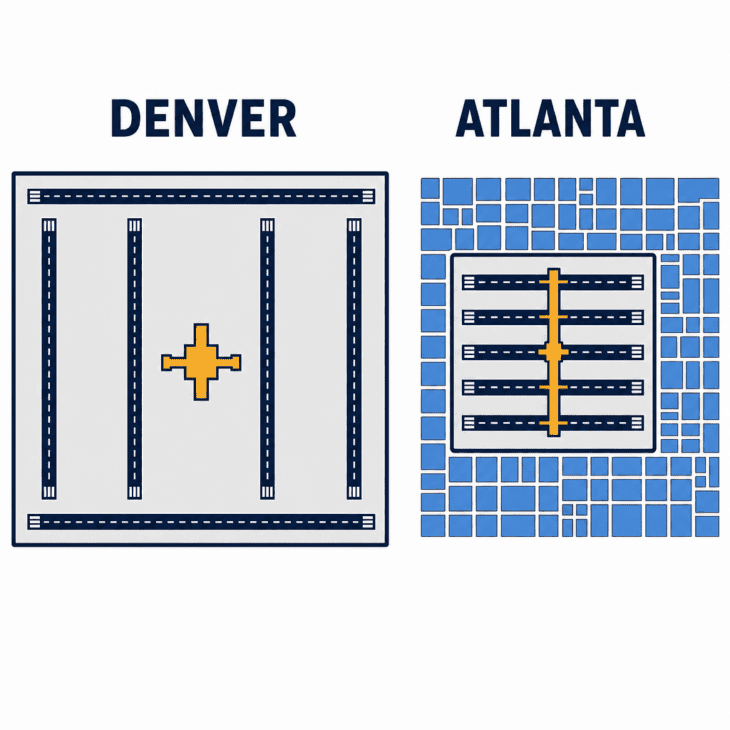
Fly into Denver on a clear day and the approach tells you something odd is happening. The runways appear, then more runways, then a white tented terminal sitting alone in the middle of empty prairie, with the nearest neighborhood still miles away in every direction.
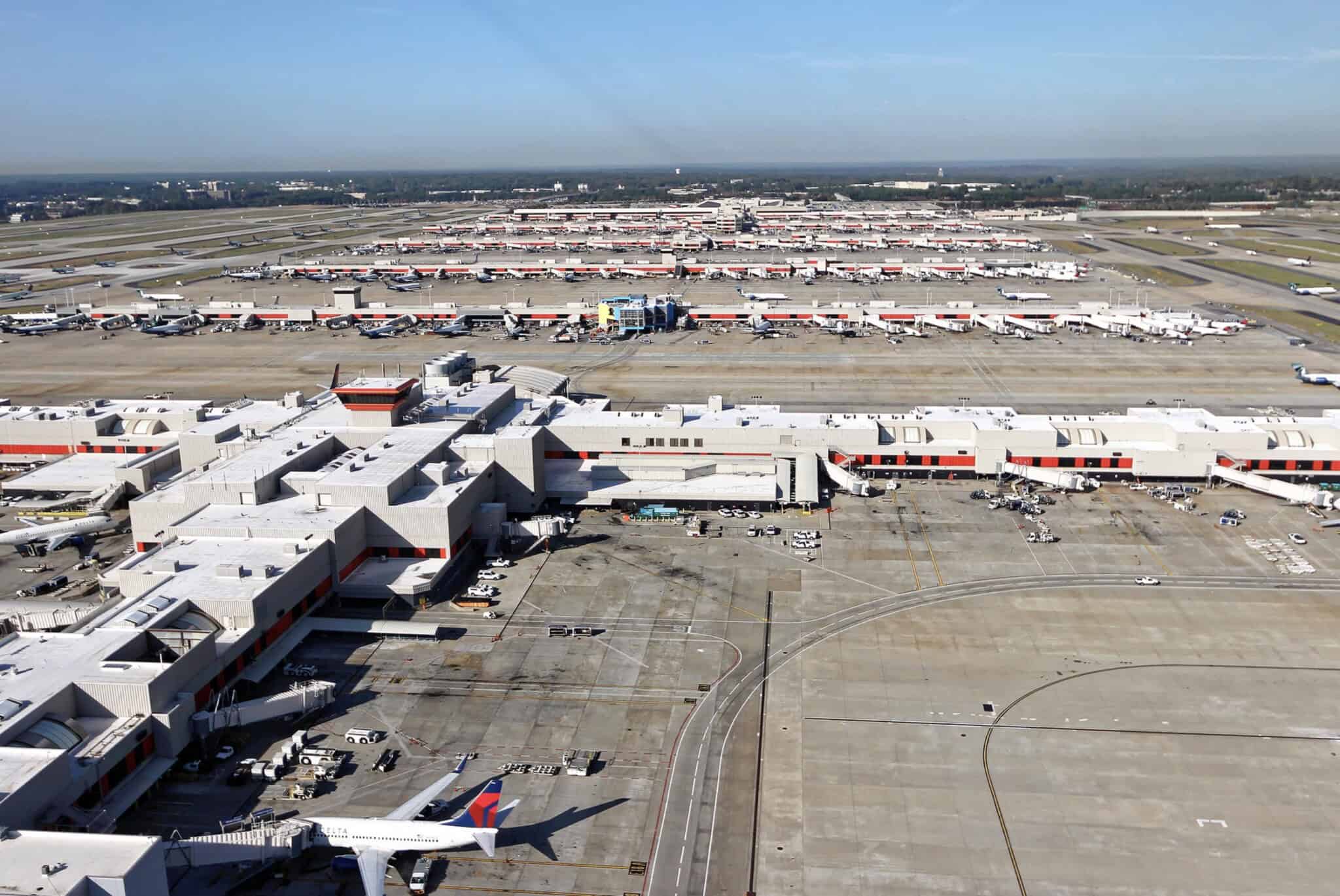
Fly into Atlanta and you get the opposite. Suburbs press right up against the fence line, five runways run side by side in a tight east-west block, and the whole operation feels squeezed into a space it long ago outgrew.
Atlanta is the one that moves more passengers than any airport on Earth. Denver is the one that owns more land than the city of San Francisco. Both are correctly called America’s biggest airport, and the reason they can both be right is the most useful thing to understand about airport rankings.
The “Biggest” Airport: Three Different Winners
There is no single biggest airport in the United States, because “big” is at least three separate questions. Ask about land, and Denver wins by a mile. Ask about people, and Atlanta wins. Ask about aircraft, and Chicago O’Hare wins.
These are not close calls or ties. Each measure has a clear champion, and none of the three champions is the same airport.
The answer in one box
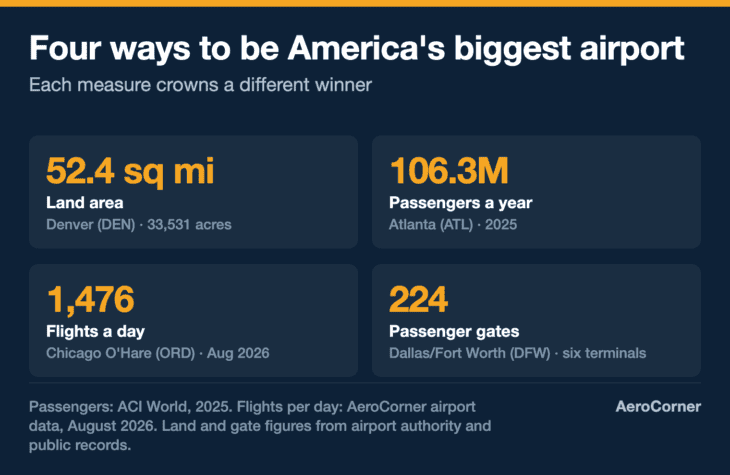
By land area, Denver International is the biggest US airport at 33,531 acres, or 52.4 square miles (135.7 km2). By passengers, Hartsfield-Jackson Atlanta is the biggest at 106.3 million in 2025, which also makes it the busiest airport in the world. By aircraft movements, Chicago O’Hare is the biggest, and it leads the world there too.
| What “biggest” measures | US winner | Figure | Runner-up |
|---|---|---|---|
| Land area | Denver (DEN) | 33,531 acres / 52.4 sq mi (135.7 km²) | Dallas/Fort Worth, 17,207 acres |
| Passengers per year | Atlanta (ATL) | 106.3 million (2025) | Dallas/Fort Worth, 85.7 million |
| Flights per day | Chicago O’Hare (ORD) | 1,476 | Atlanta, 1,231 |
| Passenger gates | Dallas/Fort Worth (DFW) | 224 across six terminals | Chicago O’Hare, 215 |
Land area: Denver owns more ground than San Francisco
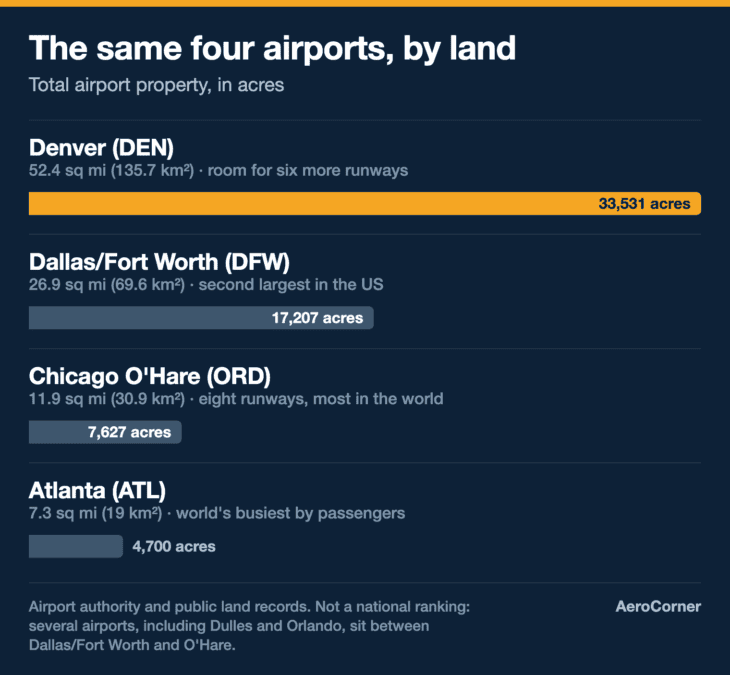
Denver International sits on 33,531 acres, which works out to 52.4 square miles (135.7 km²). The city of San Francisco covers about 46.9 square miles (121 km²) of land. Manhattan covers roughly 22.8 square miles (59 km²).
So one American airport is larger than a major American city, and more than twice the size of Manhattan. It is the largest airport in the Western Hemisphere by land area and the second largest anywhere on the planet.
The reason is a land purchase, not a traffic figure. When Denver replaced Stapleton in 1995 it bought open prairie 25 miles from downtown, deliberately taking far more ground than the airport would need for decades. The full story of that decision is worth reading on its own, and it involves a lot less conspiracy than the internet suggests: why Denver built an airport bigger than a city.

What that space bought is room to spread out. Denver runs six runways today and has physical room for six more, and its widely spaced layout lets controllers keep landing traffic flowing in snow and low visibility that would choke a tighter field.
It also bought length. Runway 16R/34L measures 16,000 feet, over three miles of pavement, and is the longest commercial runway in North America. At 5,431 feet of elevation, thin air means jets need more runway to get airborne, so the extra length is a working requirement rather than a flourish. See how it compares in our roundup of the longest runways in the US.
Second place on land is Dallas/Fort Worth at 17,207 acres, or 26.9 square miles (69.6 km²), which is still bigger than Manhattan. After the top two, published acreage figures start to disagree between sources, because airports do not all count leased cargo land, hotels, and undeveloped buffer the same way.
Passengers: Atlanta does more on one seventh of the land
Hartsfield-Jackson Atlanta International handled 106.3 million passengers in 2025 according to ACI World, more than any other airport on Earth. It has held the world’s busiest title for 26 of the past 27 years.
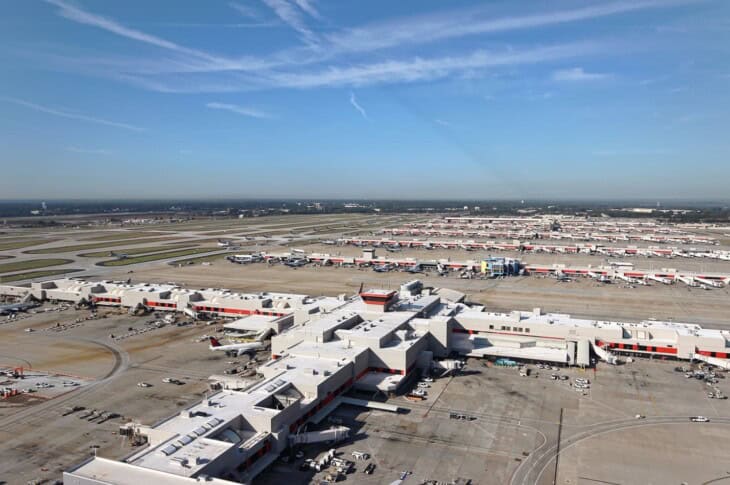
It does that on 4,700 acres, about 7.3 square miles (19 km²). Denver’s footprint is roughly seven times larger and moves a little over 80 million passengers a year.
Seven times the land, fewer passengers
Denver International occupies 52.4 square miles (135.7 km2) and Atlanta occupies 7.3 square miles (19 km2). Atlanta still moves about 25 million more passengers a year. Land area and passenger volume are not just different measures, they run in opposite directions here.
Atlanta’s density is not an accident. Five parallel east-west runways feed a single straight-line terminal spine with an underground train running its length, which keeps connecting passengers moving between concourses in minutes rather than shuttle rides.
Most of those passengers are not going to Atlanta at all. It is Delta’s fortress hub, and its geography puts a large share of the US population within a short flight, which is the real engine behind the ranking. We unpack that in why the world’s busiest airport is in Atlanta, of all places.
Behind Atlanta, the US passenger ranking runs through Dallas/Fort Worth at 85.7 million and Denver, with the order shifting slightly year to year. Our current list of the busiest airports in the US tracks where each one sits.
Flights: O’Hare wins the measure nobody quotes
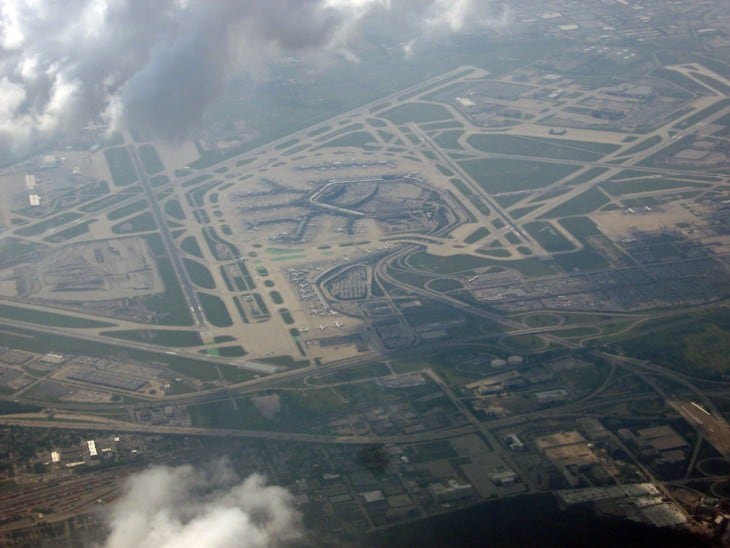
There is a third answer, and it belongs to Chicago. Measured by aircraft movements rather than people, O’Hare is the biggest airport in the United States and the busiest in the world, with more than 857,000 takeoffs and landings in 2025.
AeroCorner’s own US airport ranking by flights per day shows the same picture from a different angle: O’Hare runs 1,476 daily flights against Atlanta’s 1,231 and Denver’s 1,157, as of August 2026.
The gap between the two measures is aircraft size. O’Hare handles a heavier mix of regional jets on short domestic hops, so it needs more flights to carry fewer people than Atlanta’s 1,231 daily flights deliver.
To move that many aircraft, O’Hare operates eight runways, the most of any civilian airport in the world, on 7,627 acres. That is 11.9 square miles (30.9 km²), less than a quarter of Denver’s land.
If you count buildings instead of ground, you get a fourth winner. Dallas/Fort Worth has 224 passenger gates across six terminals, ahead of O’Hare’s 215 and Atlanta’s roughly 200, and DFW’s Terminal F will add more when it opens in 2027.
The myth: that the biggest airport must be the busiest
Most people assume the rankings should line up, that the airport with the most land is the one with the most planes and the most passengers. It is a reasonable assumption and it is wrong almost everywhere you check.
Big does not mean busy
King Fahd International near Dammam, Saudi Arabia, is the largest airport on Earth by land area at roughly 300 square miles (780 km2), larger than the neighboring country of Bahrain. It handles a small fraction of Atlanta’s passenger traffic. Land area measures what an authority once bought, not what flies today.
Land area is a decision made decades before the traffic shows up, and often in a place with cheap open ground and no neighbors to object. Passenger volume is a decision made by airlines choosing where to build a connecting hub, and those two decisions rarely happen at the same airport.
Atlanta got its ranking because Delta built a hub there and the geography rewarded it, not because anyone gave it room. Denver got its ranking because a city bought prairie in the 1980s, and the traffic is still filling in the space.
There is a second trap in the wording. “Largest airport” is often quoted with no measure attached, which is how the same headline can name Denver, Atlanta, Dammam, or Dallas and be defensible every time. Any ranking that does not tell you what it counted is not telling you much.
The honest version of the question is always longer: biggest by land, by passengers, by flights, or by gates. Pick one and the answer becomes clean.
Next time you land in Denver and spend eight minutes taxiing past empty grass, that is a 1980s land purchase you are crossing, sized for an airport that has not fully arrived yet. Next time you connect through Atlanta and the train is packed, that is the opposite bet: a small piece of ground running at the highest passenger volume on the planet.
Both are America’s biggest airport. They are just answering different questions.
Sources and references used for research and fact-checking.
- Airports Council International (ACI World), World's busiest airports revealed in latest global rankings
- AeroCorner, Busiest Airports in the United States by Flights Per Day
- Denver International Airport, Airport Facilities and Grounds
- Washington Dulles International Airport (MWAA), Airport Overview
- Hartsfield-Jackson Atlanta International Airport, ATL Fact Sheet
- Guinness World Records, Largest airport (area)
Get the Newsletter
The latest aviation news and stories sent to your inbox.
About the Author

Tim is the owner and lead editor of AeroCorner since 2019, overseeing aviation content covering aircraft, airlines, airports, and the broader aviation industry. Through years of researching, writing, editing, and publishing aviation-focused content, he has developed extensive practical knowledge of commercial aviation and air travel. Based in Asia and a frequent traveler himself, Tim also brings firsthand passenger experience to AeroCorner’s coverage. Outside of publishing, he has also explored aviation firsthand through hands-on flight training in New Zealand.