

Table of Contents
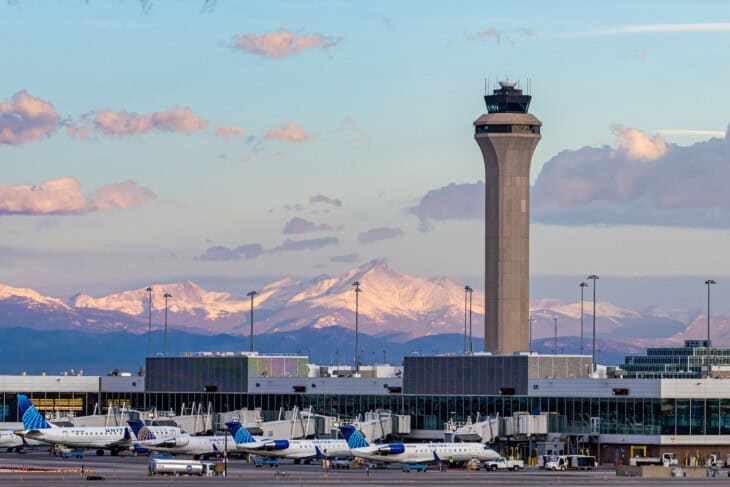
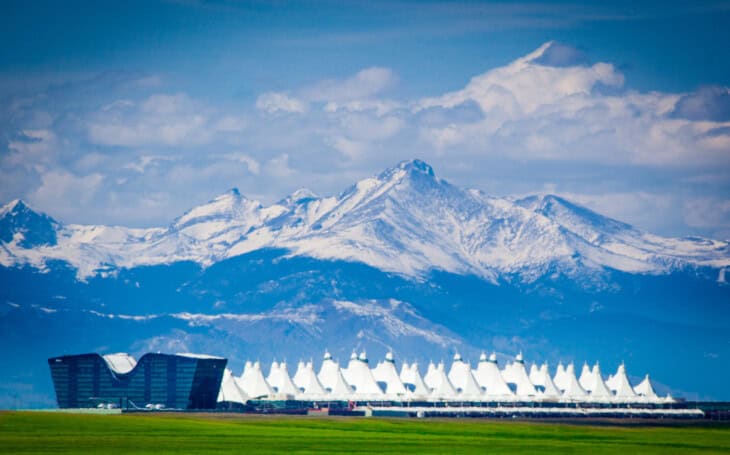
Drive northeast out of Denver on Peña Boulevard and the city runs out long before the airport arrives. There is 25 miles (40 km) of open prairie, then a white peaked roof on the horizon that looks like a range of tents pitched in the middle of nowhere.
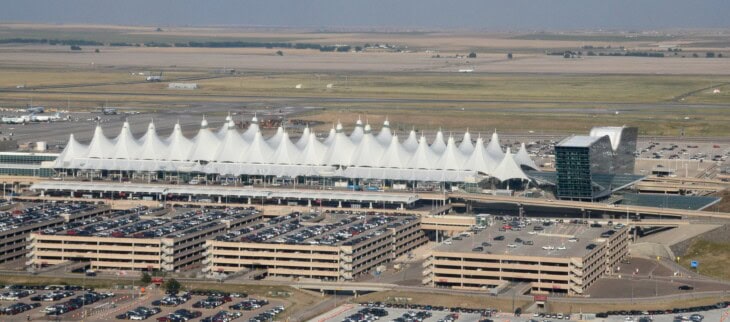
Denver International sits on 33,531 acres, which works out to 52.4 square miles (135.7 sq km). That is more than twice the land area of Manhattan, and it makes DEN the biggest airport in North America by an absurd margin: second-place Dallas Fort Worth covers barely half as much ground.
The internet has a favorite explanation for all that empty acreage, and it involves the Illuminati. The real reason is a story about runway geometry, blizzards, and a city that got tired of being the traffic jam at the center of American aviation.
Why is Denver Airport so big? Denver was buying distance, not land
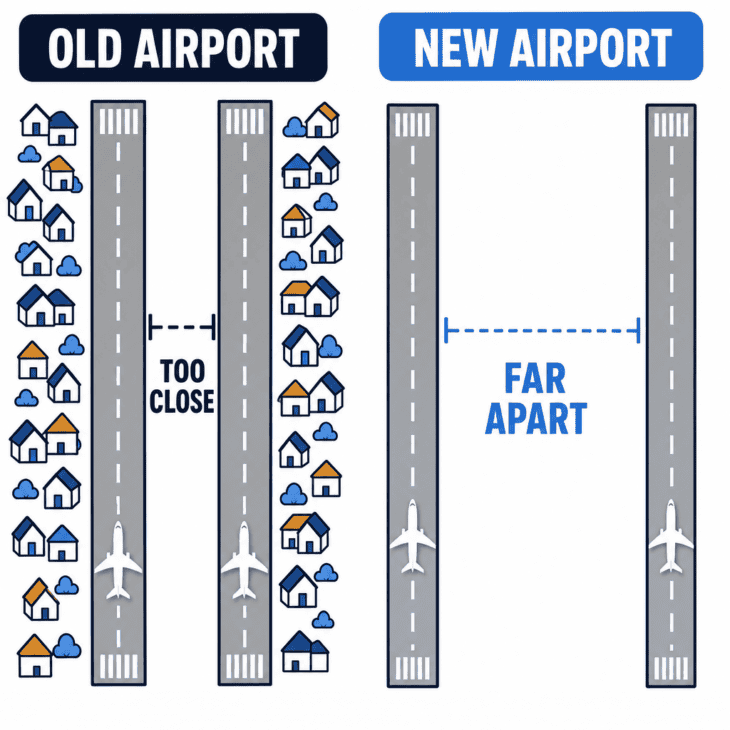
Denver’s old airport failed for one specific technical reason: its parallel runways were built too close together to be used independently in bad weather. The only cure for that is space, and a lot of it.
So when the city started over on empty prairie, it did not buy a bigger airport. It bought enough room to place runways miles apart from each other, plow one while flying off the others, and keep adding more for the next fifty years without ever asking a neighbor for permission again.
The answer at a glance
DEN covers 52.4 square miles because its predecessor, Stapleton, had parallel runways only 900 to 1,600 feet apart, which forced controllers to land aircraft one behind another whenever the weather closed in. Independent parallel approaches need at least 4,300 feet between runway centerlines, and Stapleton was hemmed in by neighborhoods with nowhere to put them. Denver moved 25 miles out, annexed roughly 45 square miles of prairie, and built six widely spaced runways with room for six more.
Stapleton was throttling the entire national air network
Stapleton International opened in 1929 and grew into the fifth busiest airport in the world by the 1980s, all on about 4,700 acres surrounded by houses. It had no room left, and the runways it did have were in the wrong places.
Stapleton’s parallel runways sat roughly 900 to 1,600 feet apart. Under FAA rules, independent simultaneous approaches to parallel runways require at least 4,300 feet between the centerlines, because closer than that a controller cannot treat the two streams of traffic as separate.
On a clear day pilots could see each other and fly visual approaches, so Stapleton coped. The moment cloud or snow arrived, arrivals had to be sequenced one behind another instead of side by side, and the airport’s landing rate collapsed.
Because Denver is a connecting hub in the middle of the country, that collapse did not stay local. The FAA openly described Stapleton as a bottleneck in the national air network, and by 1985 the airport had one of the highest departure delay rates in the United States.
Expanding on site was politically dead. Park Hill residents sued over aircraft noise, and Adams County threatened to block any attempt to push new runways out onto the Rocky Mountain Arsenal land next door. Denver was out of moves, which is how a functioning, busy airport ends up as one of America’s most famous abandoned airport relocations.
The escape route ran through the ballot box. Adams County voters approved letting Denver annex their prairie in 1988, Denver voters approved the bonds in May 1989, and ground was broken that September on a site 25 miles from downtown.
What 52 square miles actually buys you
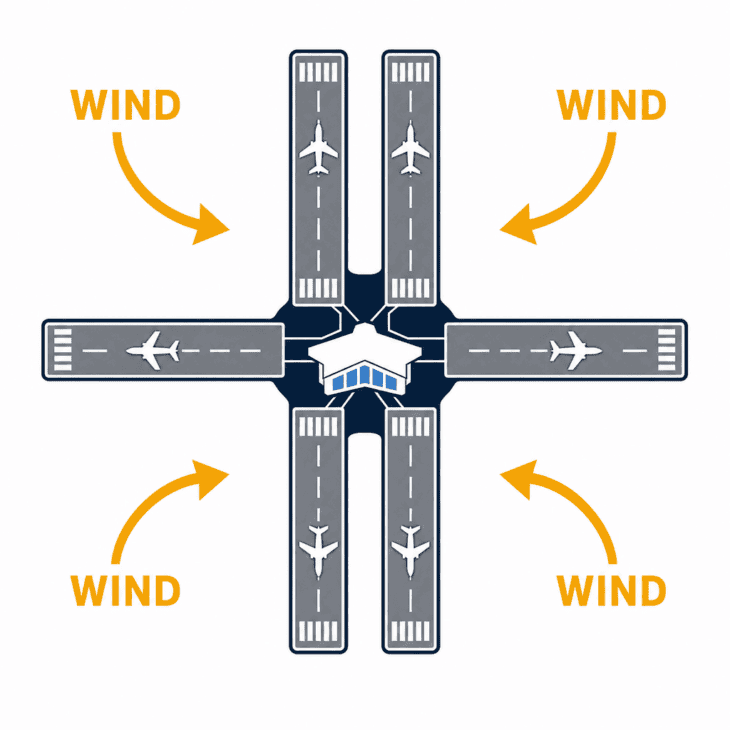
DEN’s runways are laid out in what locals call the pinwheel: four long parallel strips running roughly north to south, plus two more running east to west, arranged around the terminal rather than stacked beside it.
That shape does two jobs at once. The spread between the parallels is wide enough for controllers to run independent approaches to three runways at the same time, pushing the arrival rate as high as 96 aircraft an hour, and the crosswind pair means a wind shift never leaves the airport pointing the wrong way.
Six runways sounds modest until you notice how they are counted. On AeroCorner’s ranking of airports with the most runways, which counts each landing direction separately, Denver’s six strips register as twelve and tie for fifth in the world.
| Airport | Land area (acres) | Square miles |
|---|---|---|
| Denver (DEN) | 33,531 | 52.4 |
| Dallas Fort Worth (DFW) | 17,207 | 26.9 |
| Fort Myers (RSW) | 13,555 | 21.2 |
| Washington Dulles (IAD) | 13,000 | 20.3 |
| Orlando (MCO) | 11,605 | 18.1 |
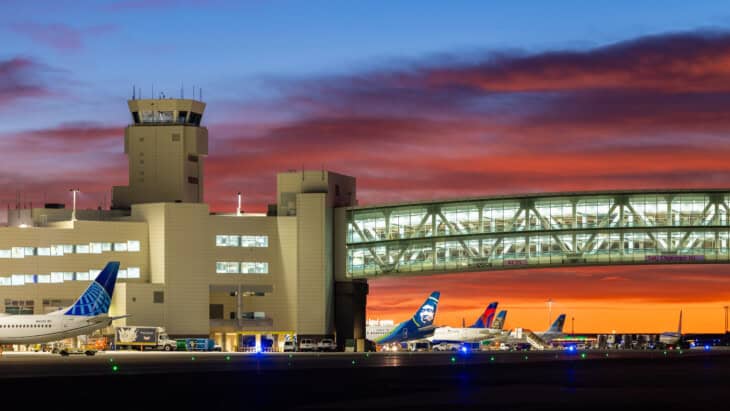
The land also solved an altitude problem. DEN sits at 5,431 feet above sea level, where thin air means wings generate less lift and engines produce less thrust, so aircraft need a longer run to get airborne. Add a hot summer afternoon and the numbers get worse.
Hence runway 16R/34L, opened in 2003 at 16,000 feet (4,877 m) long. It is the longest public-use runway in North America and one of the longest runways in the United States, built so a fully loaded widebody can leave for Asia or Europe on the worst performance day of the year.
The scale is genuinely hard to picture
Four of America’s other major airports could be dropped inside DEN’s boundary at once and there would still be roughly 500 acres left over. The airport’s master plan holds space for six more runways, for a future total of twelve, without buying another square foot of land.
The blizzard math: why spacing beats snowplows
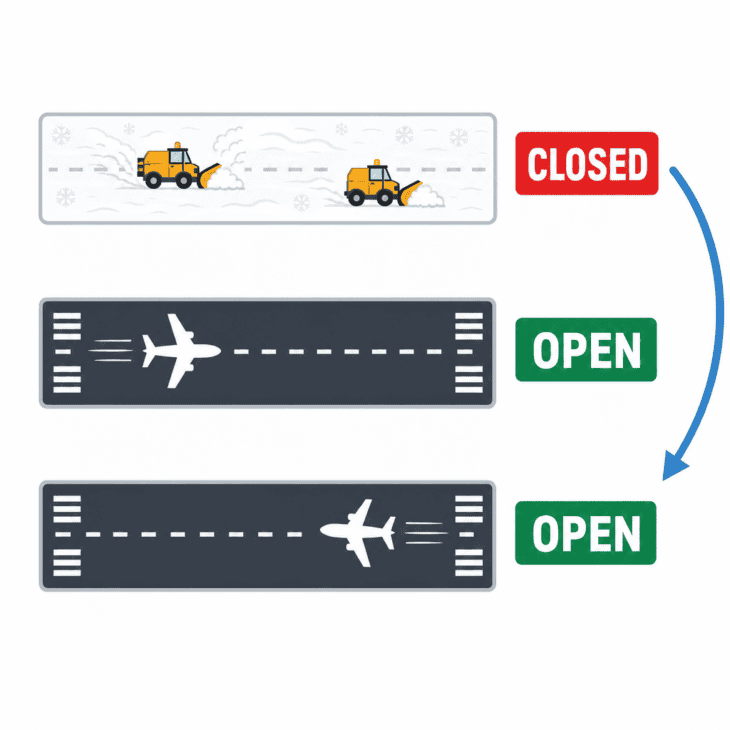
Denver gets serious snow, and a mile of separation between runways turns a shutdown into an inconvenience. Crews are split between the east and west airfields, so one runway can be closed and cleared while traffic keeps using the others.
DEN runs about 325 pieces of snow equipment and puts roughly 330 people on the airfield during a storm. Its multi-function machines, which plow, sweep, blow and de-ice in one pass, have cut the average time to clear a runway from 45 minutes to under 15, against an FAA target of 30.
None of that would matter if the runways were 1,600 feet apart, because a plow on one would put the other out of use. The land is what makes the rolling closures possible.
The payoff shows up in the traffic. Denver International now handles about 1,174 flights a day to 258 destinations on 55 airlines, with Salt Lake City as its single busiest route at 26 daily departures.
In 2025 the airport set an all-time record of 82,427,962 passengers, which put it tenth in the world and near the top of the list of busiest airports in the US. The prairie site that critics called a boondoggle in 1989 is now moving more people than the city of Denver contains a hundred times over.
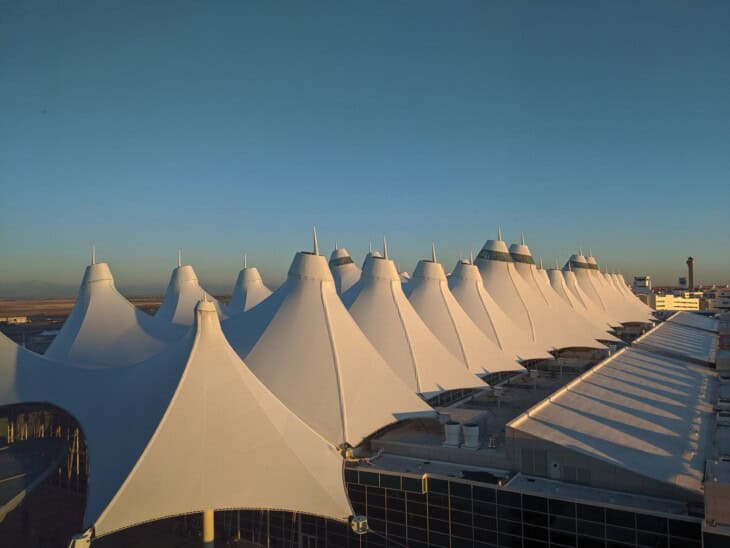
The myth: an airport that big must be hiding something
The myth
An airport this enormous, this far from the city, and this far over budget cannot possibly be just an airport. The extra land hides bunkers, tunnels and a headquarters for the shadowy people who really run things.
The lore is specific and it is fun. There is a capstone in the terminal inscribed with the words New World Airport Commission and marked with a Freemason symbol. There is a 32-foot blue horse with glowing red eyes outside, universally known as Blucifer. There are large murals with unsettling imagery, and there really are tunnels.
Each has a boring answer. The New World Airport Commission was a group of local business and civic boosters formed to organize the opening celebrations, with a name nodding to Dvořák’s New World Symphony, and two Masonic lodges helped fund the time capsule under that stone.
Blucifer is a Luis Jiménez sculpture whose red eyes are a tribute to the neon sign shop his father ran. The artist was killed in 2006 when a section of the horse fell on him in his studio, and the finished piece was installed in 2008, which is exactly the kind of detail that makes a rumor immortal.
The murals are by Leo Tanguma and are, by his own repeated explanation, about war ending and the environment recovering. The dark imagery is the part being left behind, not the prophecy.
The tunnels are the most honest part of the story, because there are miles of them. They carry the underground train between concourses and once housed the automated baggage system, a scheme so ambitious it flung suitcases off its tracks in a live 1994 demonstration.
That baggage system is the actual reason the airport looks suspicious. It pushed the opening from October 1993 to February 28, 1995, contributed to a final bill of about $4.8 billion, nearly $2 billion over projections, and was abandoned entirely in 2005 in favor of conventional belts and human handlers.
Put a vast, remote, 16-month-late, wildly over-budget airport with a secretive underground failure at the center of it in front of the public, and conspiracy theories are not a mystery. They are practically a forecast.
Denver eventually gave up arguing. Since 2022 the airport has fenced its construction zones with signs joking about drilling to the underworld and tidying up the secret tunnels, which has done more for the legend than any denial ever could.
So the next time you are 15 minutes into the drive up Peña Boulevard wondering why anyone put an airport out here, the answer is on the ground on either side of you. That emptiness is the product.
It is what lets three streams of arrivals land in a snowstorm, a loaded widebody get off the ground on a hot day at 5,431 feet, and a plow work one runway while the rest of the airport carries on.
Stapleton failed because it ran out of room. Denver’s answer was to buy so much of it that the airport will not run out again this century. The Illuminati would have needed a much smaller site.
Sources and references used for research and fact-checking.
- U.S. Government Accountability Office, New Denver Airport: Impact of the Delayed Baggage System (GAO/RCED-95-35BR)
- Federal Aviation Administration, Aeronautical Information Manual 5-4-13: Simultaneous Approaches to Parallel Runways
- Colorado Encyclopedia, Stapleton International Airport
- Panethos, America's largest commercial airports by acreage (2025 rewrite)
- International Airport Review, Denver International Airport's award-winning winter operations
- Denver International Airport, Denver International Airport Sees Slight Growth in Passenger Traffic Over Previous Year
Get the Newsletter
The latest aviation news and stories sent to your inbox.
About the Author

Tim is the owner and lead editor of AeroCorner since 2019, overseeing aviation content covering aircraft, airlines, airports, and the broader aviation industry. Through years of researching, writing, editing, and publishing aviation-focused content, he has developed extensive practical knowledge of commercial aviation and air travel. Based in Asia and a frequent traveler himself, Tim also brings firsthand passenger experience to AeroCorner’s coverage. Outside of publishing, he has also explored aviation firsthand through hands-on flight training in New Zealand.