

Table of Contents
Get TSA PreCheck first, whoever you are. It costs $76.75 to $85 for five years, works at about 200 airports and changes how you are screened, while CLEAR+ costs $219 a year, works at 62 airports and only moves you to the front of the line.
Add CLEAR+ on top only if you fly often from a CLEAR airport whose PreCheck line backs up, or someone else pays the fee. Never buy CLEAR+ on its own: without PreCheck, you skip the queue and then take the standard screening anyway.
Below, the two are compared on price, reach, screening, enrollment, families and how they held up in the 2026 DHS shutdown. Prices are as listed on tsa.gov and clearme.com in September 2026.
| Criterion | TSA PreCheck | CLEAR+ | Edge |
|---|---|---|---|
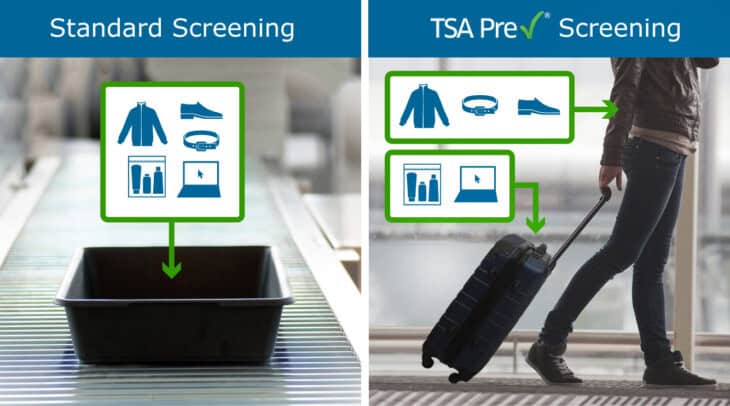
| What it changes | How you are screened: shoes, belt and light jacket stay on; laptop and 3-1-1 liquids stay in the bag | Where you stand: a face scan replaces the ID check, then an escort to the front of the screening lane | PreCheck |
| Price | $76.75 (IDEMIA), $84.95 (CLEAR), $85.00 (Telos) for 5 years | $219 per year | PreCheck |
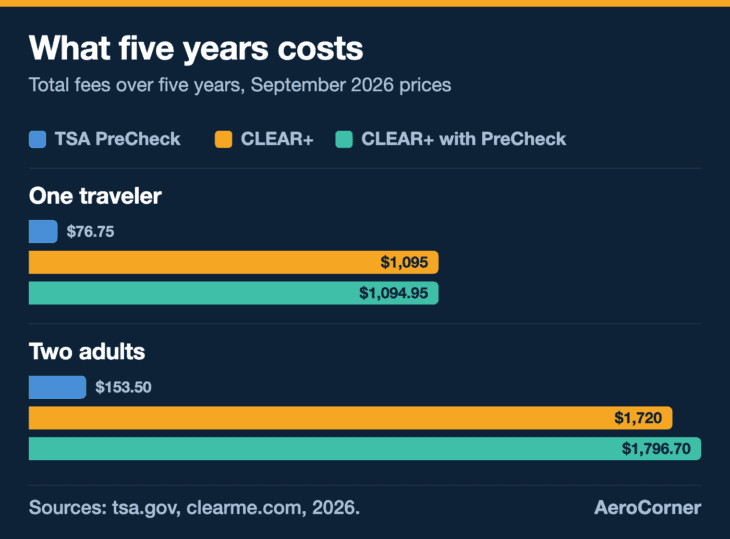
| Five-year cost, one traveler | $76.75 | $1,095 | PreCheck |
| Cost per screening* | 77 cents | $10.95 | PreCheck |
| Airports | About 200 | 62, with 150+ lanes | PreCheck |
| Getting approved | Online form plus a 10-minute visit with fingerprints; most approvals in 3 to 5 days, some up to 60 | Walk up to a CLEAR airport location, no appointment | CLEAR+ |
| Kids | 17 and under free with a member | 17 and under free with a member | Even |
| Extra adults | Each adult enrolls and pays separately | Up to 3 added adults at $125 a year each | PreCheck |
| 2026 DHS shutdown | Lanes closed at times, including Houston and New Orleans | Unavailable at times, including Houston and Atlanta’s domestic terminal | Even |
| Military | Free for service members and DOD civilians, using the DOD ID as the KTN | $125 per year | PreCheck |
How we compared
Prices are the ones listed on tsa.gov/precheck and clearme.com/clear-plus on September 17, 2026. Five-year PreCheck cost uses the cheapest provider, IDEMIA ($76.75). The bundle is CLEAR’s own offer: pay $84.95 for PreCheck through CLEAR, get a code for a $134 first year of CLEAR+, then pay $219 a year for four more years, which is $1,094.95. Two adults means the second adult enrolls in PreCheck at IDEMIA and joins the first adult’s CLEAR+ account at $125 a year. Cost per screening assumes 20 departures a year from U.S. airports. Kids add nothing in either program.
Screening vs skipping the line
The two programs fix different parts of the checkpoint. TSA PreCheck is a government program that decides how much you have to unpack. In its lane, TSA’s fact sheet says you keep on your shoes, belt and light jacket, and leave your laptop and 3-1-1 liquids bag in your carry-on.
CLEAR+ is a private membership sold by Clear Secure. At a CLEAR pod or eGate, your face confirms who you are instead of an officer checking your ID, and a CLEAR ambassador then walks you to the front of the TSA screening lane.
That last step is the catch. Chase says it plainly: a CLEAR+ membership does not give you PreCheck benefits. With CLEAR alone, you reach the front faster and then take off your belt and unpack like everyone else in the standard lane.
TSA also says about 99% of PreCheck passengers wait less than 10 minutes. For the questions of when to leave home and how long a line might run, see how early to arrive at the airport.
Edge: TSA PreCheck. It is the one that changes what happens at the belt, and CLEAR+ is designed to be used with it rather than instead of it.
Price and what five years really costs
PreCheck is sold through three TSA-authorized enrollment providers, and they set different prices. As of September 2026, a new five-year enrollment costs $76.75 with IDEMIA, $84.95 with CLEAR and $85.00 with Telos.
Renewals are cheaper. IDEMIA lists $58.75 online and CLEAR lists $72.95 online, and you can renew up to six months before expiry without losing any time on your current membership.
CLEAR+ costs $219 a year, so five years comes to $1,095. At 10 round trips a year, that is $10.95 each time you pass through security, against 77 cents for PreCheck through IDEMIA.
The bundle is where the math gets interesting. Enroll in PreCheck through CLEAR for $84.95 and CLEAR sends a one-time code for a $134 first year of CLEAR+. After four more years at $219, the total is $1,094.95, five cents less than CLEAR+ alone.
Put another way, if you are going to pay for CLEAR+ anyway, PreCheck comes free inside it. The code has to be used within seven days of paying for PreCheck, and it does not apply if you used a discount on the PreCheck fee.
CLEAR’s own figure lends itself to one more sum. It says members save 4 hours a year on average, which at $219 means you pay about $54.75 for each hour saved, by CLEAR’s own number.
Edge: TSA PreCheck. It costs less over five years than one year of CLEAR+.
Where you can use them
TSA says PreCheck runs at approximately 200 airports. Your airline has to take part too, and TSA’s participating list held 97 carriers in September 2026, from Delta, United, American and Southwest to Emirates and ZIPAIR.
PreCheck also covers outbound international flights from participating U.S. airports, and domestic connections after you land from abroad. It does nothing at arrivals, which is Global Entry’s job.
CLEAR reported 62 CLEAR+ airports as of June 30, 2026, after adding Northwest Arkansas and Indianapolis in the second quarter. Its site lists more than 150 CLEAR+ lanes across those airports.
Before you pay, check that CLEAR serves your home airport and your terminal on clearme.com. That matters most if you fly from a smaller airport rather than one of the busiest airports in the US.
Edge: TSA PreCheck. Roughly three times as many airports, and outbound international flights included.
Getting approved
PreCheck is open to U.S. citizens, U.S. nationals and lawful permanent residents, and it involves a TSA background check. TSA says the online form takes about five minutes and the in-person visit about 10, during which the provider checks documents, takes fingerprints and a photo, and collects payment.
Most applicants hear back within 3 to 5 days, though some wait up to 60. The three providers run more than 1,300 enrollment locations between them, so you cannot get PreCheck on the day you fly if you have not already enrolled.
CLEAR+ is quicker to start. You can walk up to any CLEAR airport location and enroll with an ambassador, no appointment needed, or begin online and finish on your next trip.
The trade is data. CLEAR is a for-profit company, and joining means handing it biometric identifiers so its pods can recognize your face.
Edge: CLEAR+. Enrollment is faster and can happen at the airport, if you are comfortable giving a private company your biometrics.
Families and travel partners
Both programs let kids 17 and under come through free with a member, with one PreCheck rule to watch. Children 12 and under can simply walk through with you, but teens 13 to 17 need the PreCheck indicator on their own boarding pass, which means booking them on the same reservation as you.
Adults are where the costs split. In PreCheck, every adult enrolls and pays separately, so two adults pay $153.50 for five years through IDEMIA.
CLEAR+ lets you add up to three adults at $125 a year each. Two adults on one account pay $1,720 over five years, or $1,796.70 with PreCheck for both.
The fine print on bringing the kids
A teen on a separate booking with no Known Traveler Number of their own will not get PreCheck, even when their parent does. TSA also says to leave the KTN field blank for a child who has no number of their own, rather than entering the parent’s.
Edge: TSA PreCheck. Kids are free in both programs, and a second adult costs $76.75 for five years in PreCheck against $625 in CLEAR+.
When the checkpoint breaks down
The DHS funding lapse that began on February 14, 2026, and ran 75 days until it ended on April 30, tested both programs. TSA officers worked without pay, callouts spiked, and neither lane was a guarantee.
According to NewsNation, reporting in The Hill, PreCheck lanes closed at 10:30 a.m. on March 23 at Houston’s George Bush Intercontinental, and CLEAR was not available there either. PreCheck was also unavailable one Sunday at New Orleans, and the Atlanta Journal-Constitution reported the CLEAR line in Atlanta’s domestic terminal closed.
Even so, PreCheck stayed faster at many airports. At Orlando, the same report found standard lines of up to 45 minutes against about 10 minutes for PreCheck.
“Anywhere someone has paid for a service such as TSA PreCheck or Clear and they are not getting the services they paid for, we would have concerns about that.”
Teresa Murray, Consumer Watchdog Director at PIRG, speaking to CNN in March 2026
Edge: Even. Both depend on TSA staffing, and both failed at some airports when it collapsed.
Where Global Entry fits
If you fly abroad even once a year, look at Global Entry before either one. CBP charges $120 for five years, and membership includes TSA PreCheck access along with faster re-entry at U.S. airports.
That works out to $24 a year for both programs. Global Entry has a longer vetting process: CBP says most applications are reviewed within two weeks, but some take 12 months or longer.
You cannot upgrade PreCheck to Global Entry. TSA says a PreCheck member has to apply as a new Global Entry applicant and pay the full fee.
Who should pick which
| If you… | Pick | Because |
|---|---|---|
| Fly a few times a year | TSA PreCheck | $76.75 covers five years of lighter screening |
| Fly abroad at least once a year | Global Entry | $120 for five years, with PreCheck included |
| Fly weekly from a CLEAR airport with long PreCheck lines | CLEAR+ with PreCheck | The bundle costs the same as CLEAR+ alone and covers both steps |
| Travel as two adults with kids | TSA PreCheck for both adults | $153.50 for five years, and kids ride free |
| Serve in the military | TSA PreCheck | Your DOD ID already works as a Known Traveler Number, while CLEAR+ still costs $125 a year |
| Want CLEAR but have no PreCheck | PreCheck first | With CLEAR alone, you reach the front of the standard lane and still unpack |
| Have a card or employer that pays for CLEAR+ | Both | The fee is covered, and PreCheck adds the lighter screening for $76.75 to $85 over five years |
Myth: PreCheck is how you keep your shoes on
It used to be. Since July 8, 2025, DHS lets every passenger keep their shoes on at TSA checkpoints, and TSA says lanes with CT scanners let anyone leave laptops and 3-1-1 liquids in their bag. PreCheck still keeps belts and light jackets on and still has its own shorter lane, but at a CT-equipped checkpoint its screening edge is smaller than most comparison pages suggest.
The shoe rule has a longer backstory, covered in why TSA let you keep your shoes on before its shoe scanner was ready.
FAQ
Sources and references used for research and fact-checking.
- Transportation Security Administration, TSA PreCheck
- Transportation Security Administration, TSA PreCheck FAQ
- Transportation Security Administration, TSA PreCheck fact sheet
- Transportation Security Administration, TSA PreCheck Participating Airlines
- Transportation Security Administration, TSA PreCheck for Families
- Transportation Security Administration, Free TSA PreCheck for Uniformed Service Members and DOD Civilians
- Transportation Security Administration, DHS to End 'Shoes-Off' Travel Policy
- Transportation Security Administration, TSA installs new computed tomography screening technology at Juneau International Airport
- U.S. Customs and Border Protection, Global Entry
- CLEAR, CLEAR+
- CLEAR, CLEAR vs. TSA PreCheck: What Are the Differences?
- Clear Secure (SEC filing), CLEAR Announces Second Quarter 2026 Financial Results
- Chase, CLEAR vs. TSA PreCheck: What to Know
- The Hill (NewsNation), Are TSA PreCheck and CLEAR affected by long security lines?
- CNN, What to know about TSA PreCheck and Clear during the DHS shutdown
- TIME, The DHS Shutdown Is Over, But Its Impact on the TSA May Persist
Get the Newsletter
The latest aviation news and stories sent to your inbox.
About the Author

Tim is the owner and lead editor of AeroCorner since 2019, overseeing aviation content covering aircraft, airlines, airports, and the broader aviation industry. Through years of researching, writing, editing, and publishing aviation-focused content, he has developed extensive practical knowledge of commercial aviation and air travel. Based in Asia and a frequent traveler himself, Tim also brings firsthand passenger experience to AeroCorner’s coverage. Outside of publishing, he has also explored aviation firsthand through hands-on flight training in New Zealand.