

Table of Contents
It is the night before a flight, and your hand stops on the razor in your toiletry bag. Somewhere in the back of your mind is the idea that razors are banned on planes, a leftover from the years when airport security seemed to confiscate anything with an edge.
Then you remember watching a disposable razor ride through the X-ray in someone else’s bag without anyone blinking. Both memories are right. The TSA does not really care about razors. It cares about one thing that some razors have and others do not.
Here is what that thing is, which razors can go in your carry-on, and why this one rule has survived 25 years of the checkpoint loosening up around it.
Can You Bring a Razor on a Plane?
Yes, in most cases. Disposable razors and electric razors are both allowed in carry-on bags, according to the TSA’s What Can I Bring tool, and so are razors whose blades sit in a cartridge. What is banned from the cabin is the loose blade: a razor blade that is not sealed inside a cartridge.
That single distinction decides everything. It is why a plastic disposable sails through and a heavy chrome safety razor gets pulled aside, even though both are built to do exactly the same job.
The answer at a glance
Carry-on: disposable razors, cartridge razors and spare cartridges, electric razors, and a safety razor handle with the blade taken out. Checked bag only: loose razor blades, a safety razor with its blade in, and straight razors. Every type of razor is allowed in checked luggage, as long as sharp edges are sheathed or wrapped.
The Rule Is About the Blade, Not the Razor
The TSA files razors under sharp objects, and its entry for razor-type blades is two sentences long. “Box cutters, razor blades not in a cartridge are prohibited in carry-on,” the first one reads. The second tells you how to pack them in a checked bag instead.
Notice the company razor blades keep. They share a line with box cutters for a reason. Take the handle away from a box cutter and what is left is a flat, bare, very sharp blade, which is exactly what a loose razor blade already is.
A cartridge changes that. The blades in a disposable or cartridge razor are fixed inside a plastic housing, with only a sliver of edge facing the skin. There is no bare blade to take out and hold.
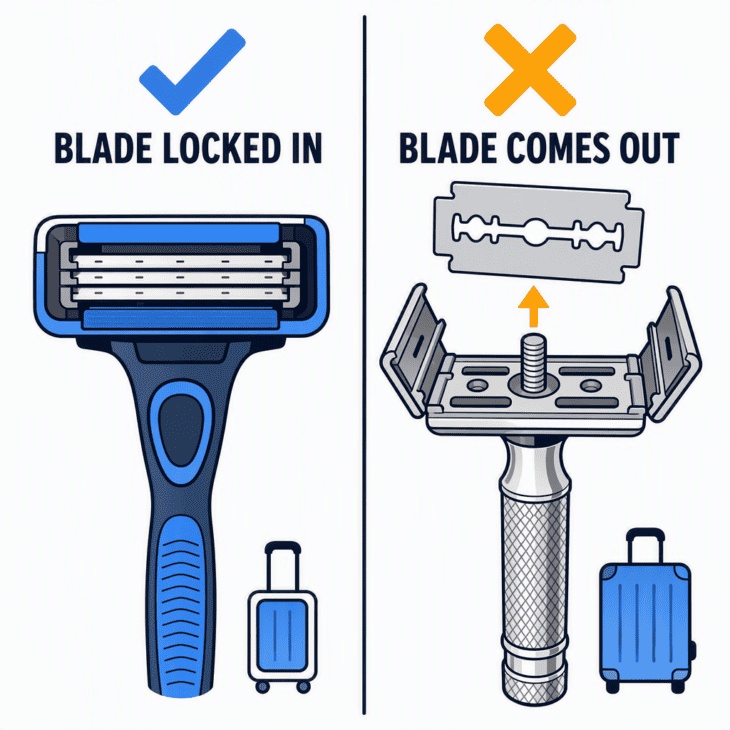
Run every common razor through that one test and the TSA’s rulings fall into place.
| Razor | Carry-on | Checked bag |
|---|---|---|
| Disposable razor | Yes | Yes |
| Cartridge razor and spare cartridges | Yes | Yes |
| Electric razor | Yes | Yes |
| Safety razor, blade removed | Yes | Yes |
| Safety razor with blade in | No | Yes |
| Loose razor blades | No | Yes |
| Straight razor or shavette | No | Yes |
Why the Safety Razor Gets Stopped and the Disposable Does Not
Here is the irony. Technically, almost every razor in your bathroom is a safety razor. The term means any razor with a guard between the blade and the skin, and it first appears in an 1880 patent by Frederic and Otto Kampfe of Brooklyn.
King Camp Gillette applied for a patent on his disposable double-edge blade in 1901, granted in 1904. That design became the classic safety razor: a metal handle, a head that opens, and a thin steel blade you swap yourself. Cartridge razors followed in 1970 and 1971, and Bic’s fully disposable razor in 1974.
The TSA uses the phrase in its narrow, modern sense. Its entry is titled “Safety Razor With Blades (allowed without blade).” The handle can fly, but “the blade must be removed prior to entering the screening checkpoint.”
Prior to, not at. “TSA officers are not authorized to remove the blades from the holder,” the entry adds. Arrive with a blade still loaded and the officer will not take it out for you.
The TSA’s tool has no separate entry for straight razors, and it does not need one. A straight razor is a blade that folds into its handle, which makes it a razor blade not in a cartridge. So is a shavette, the barber’s straight razor that takes disposable blades.
Electric razors are the easy case, allowed in both carry-on and checked bags. The only thing the TSA flags is the battery, and for that it sends travelers to the FAA’s rules on electronics, the same rules behind the most dangerous cargo on your flight.
Size is not the issue either. The TSA allows scissors in a carry-on if the blades are less than 4 inches (10 cm) from the pivot point. A razor blade is much smaller than that and still has to go in the hold, because it is a bare edge with nothing attached.
Why the Blade Rule Has Never Budged
The rule makes more sense once you know what the checkpoint looked like on September 10, 2001. Under a checkpoint guide the airlines wrote and the FAA approved, pocket utility knives with blades under 4 inches (10 cm) were allowed on board. Box cutters were listed as restricted items, not permitted in the cabin.
The line between the two was blurry. The 9/11 Commission’s staff found that the guide “provided no further guidance on how to distinguish between ‘box cutters’ and ‘pocket utility knives.'” Their best working hypothesis was that “a number of the hijackers were carrying permissible utility knives or pocket knives.”
One checkpoint supervisor at Boston’s Logan airport recalled that on that day, a box cutter could not pass through without its blade removed. The idea that the blade, not the tool, is the threat is older than the TSA itself.
September 2001
Short knives are allowed. Pocket utility knives with blades under 4 inches (10 cm) pass the checkpoint. Box cutters are restricted.
February 2003
TSA publishes its prohibited items list. Knives of any length are banned, along with razor-type blades such as box cutters, utility knives and razor blades not in a cartridge.
December 2005
Scissors and small tools return. Scissors with blades of 4 inches (10 cm) or less and tools of 7 inches (18 cm) or less are allowed again. Razor blades, box cutters and knives stay banned.
March 2013
TSA moves to allow small knives. Non-locking knives with blades up to 2.36 inches (6 cm) are due back on April 25. Razors and box cutters stay banned.
June 2013
The knife plan is dropped. After a backlash led by flight attendants, TSA keeps knives on the prohibited list.
The legal hook is one sentence of federal regulation, 49 CFR 1540.111, which bars anyone from having a weapon “on or about the individual’s person or accessible property” at screening, in the secure area, or while boarding. In February 2003, TSA published its formal interpretation of what counts as one.
That list banned knives of any length, except round-bladed butter knives and plastic cutlery. It also banned “razor-type blades, such as box cutters, utility knives, and razor blades not in a cartridge, but excluding safety razors.”
Those last three words are worth a second look. The 2003 list carved safety razors out of the ban, while today’s entry makes you take the blade out first. On this one item, the rule has become stricter, not looser.
Everything around it loosened. From December 22, 2005, TSA let scissors with blades of 4 inches (10 cm) or less and tools of 7 inches (18 cm) or less back into the cabin, arguing that these low-threat, high-volume items were soaking up screener attention better spent looking for explosives.
The agency leaned on what had changed since 2001: hardened cockpit doors, Federal Air Marshals and armed pilots on the flight deck. Razor blades, box cutters and knives stayed on the list anyway.
1.76 million sharp objects in one year
In fiscal year 2005, TSA officers found 1.76 million sharp objects and 468,033 tools at checkpoints, according to the Federal Register notice that let small scissors and tools back on board. That volume was a big part of the case for stopping the hunt for them.
The closest the blade rule came to moving was 2013. On March 5 that year, TSA announced it would allow non-locking knives with blades no longer than 2.36 inches (6 cm) and narrower than half an inch, to align more closely with International Civil Aviation Organization standards.
Even that plan kept razors and box cutters banned, and it still collapsed. Flight attendants’ unions called it “a poor and shortsighted decision,” the start date was postponed days before it arrived, and on June 5, 2013, TSA announced knives would stay on the prohibited list.
That episode is why the razor-blade rule is so durable. If a small folding pocketknife could not get back on board, a bare blade was never going to.
The Myth vs. the Reality
Myth: TSA bans razors
It does not. Disposable, cartridge and electric razors are all allowed in carry-on bags. What TSA bans from the cabin is the loose blade, whether it sits in a safety razor, a straight razor or a packet of spares.
The mirror-image myth is that blades are banned from checked luggage too. They are not. Every razor on the TSA’s list is allowed in checked bags, and the only condition is that sharp objects are “sheathed or securely wrapped to prevent injury to baggage handlers and inspectors.”
The other trap is the flight home from abroad. The European Union’s common list of prohibited cabin items also bans razor blades and box cutters, alongside knives with blades longer than 6 cm (2.36 inches), the very line TSA tried to adopt in 2013.
So the blade rule travels well. On an international trip, the safe assumption is that loose blades go in the hold in both directions.
What Happens If You Forget the Blade
If the X-ray finds a loaded safety razor or a pack of blades in your bag, you get a choice. A TSA spokesperson told Travel + Leisure that passengers can hand the item to someone who is not flying, take it back to their car, check it with the airline, or voluntarily abandon it.
Checking it means leaving the line and going back to the counter, which only works if you are still ahead of the airline’s bag cutoff. That is one of the deadlines behind how early you really need to get to the airport.
Abandoned items do not simply vanish. TSA says it typically turns voluntarily abandoned property over to state surplus agencies, which often auction it off in bulk lots.
And whatever the website says, the TSA is clear on who decides: “The final decision rests with the TSA officer on whether an item is allowed through the checkpoint.”
So the next time you pack, look at the blade, not the brand. If it is sealed in plastic, it goes in your carry-on. If you can lift it out with your fingers, it goes in your checked bag or stays at home.
That test predates the TSA. It survived the return of scissors and tools, and it outlasted the only serious attempt to bring knives back on board.
Sources and references used for research and fact-checking.
- Transportation Security Administration, Razor-Type Blades
- Transportation Security Administration, Safety Razor With Blades (allowed without blade)
- Transportation Security Administration, Disposable Razor
- Transportation Security Administration, Electric Razors
- Transportation Security Administration, What Can I Bring? Scissors
- Federal Register, Prohibited Items (interpretive rule, 68 FR 7444)
- Federal Register, Prohibited Items; Allowing Small Scissors and Small Tools
- Legal Information Institute, Cornell Law School, 49 CFR 1540.111, Carriage of weapons, explosives, and incendiaries by individuals
- National Commission on Terrorist Attacks Upon the United States, The Aviation Security System and the 9/11 Attacks, Staff Statement No. 3
- CBS New York, TSA: Small Knives, Sporting Equipment To Be Allowed In Carry-On Luggage
- American Knife and Tool Institute, TSA Will Permit Pocket Knives Back on Passenger Planes
- Bryan on Scouting, Update: TSA delays policy to allow small pocketknives in flight
- American Knife and Tool Institute, TSA Will Now NOT Allow Knives
- legislation.gov.uk, Commission Implementing Regulation (EU) 2015/1998, Attachment 4-C
- Wikipedia, Safety razor
- Wikipedia, Straight razor
- Travel + Leisure, This Is What Happens to the Items You Leave at Airport Security, and Where They End Up
Get the Newsletter
The latest aviation news and stories sent to your inbox.
About the Author

Tim is the owner and lead editor of AeroCorner since 2019, overseeing aviation content covering aircraft, airlines, airports, and the broader aviation industry. Through years of researching, writing, editing, and publishing aviation-focused content, he has developed extensive practical knowledge of commercial aviation and air travel. Based in Asia and a frequent traveler himself, Tim also brings firsthand passenger experience to AeroCorner’s coverage. Outside of publishing, he has also explored aviation firsthand through hands-on flight training in New Zealand.