

Table of Contents
Before an airliner pushes back, everything on board that could start a fire is supposed to be accounted for. Hazardous cargo is declared, labeled, and loaded in a specific position. The fuel is in the wings, the oxygen bottles are secured, and the crew knows where all of it is.
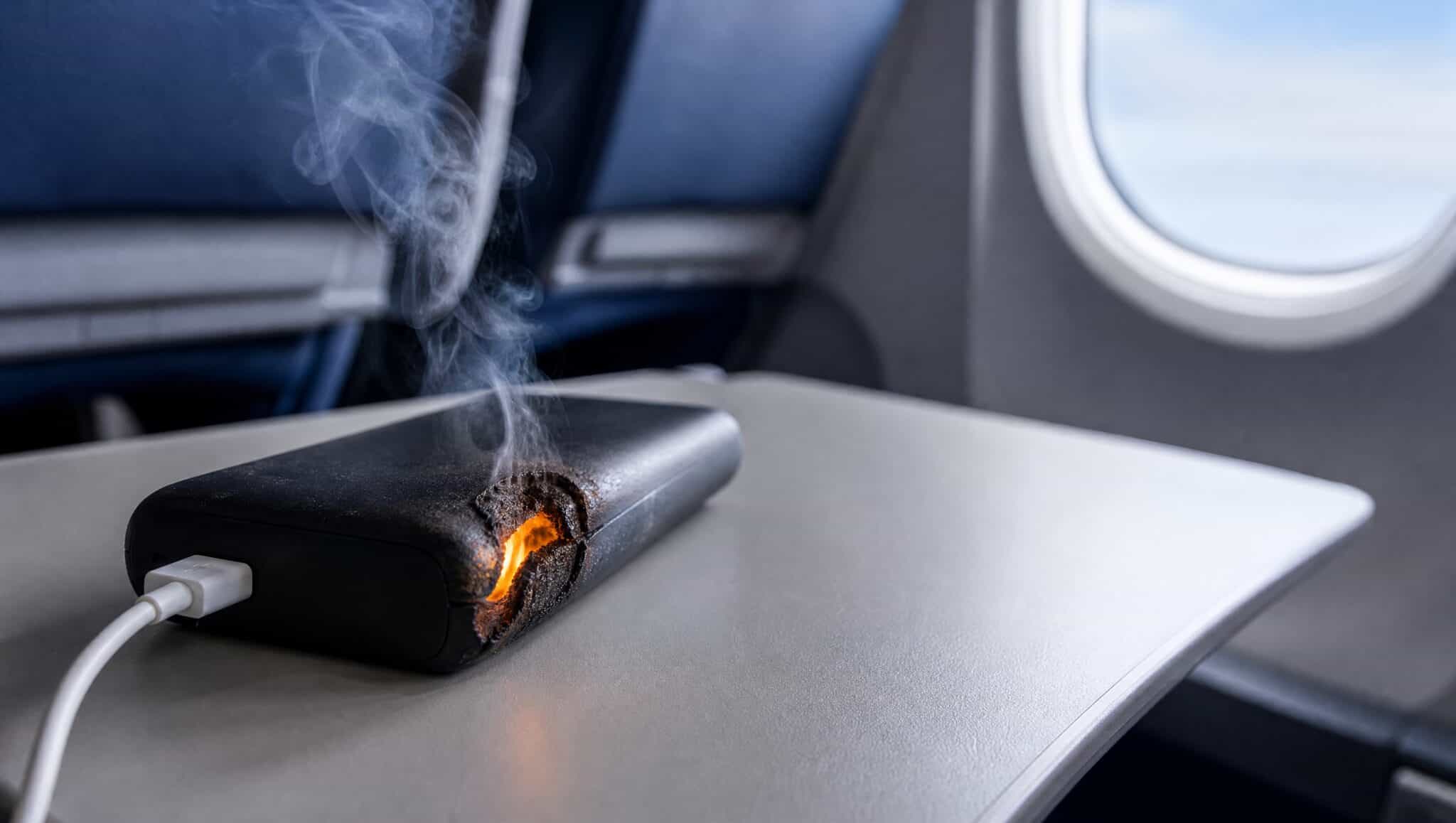
Then the passengers board, carrying as many as four battery powered devices each by the industry’s own estimate, and nobody has a manifest for a single one of them.
That mismatch is now the fastest growing fire hazard in commercial aviation. The FAA verified 93 lithium battery events involving smoke, fire, or extreme heat on US flights in 2025, and the global rulebook was rewritten in 2026 because of them.
Here is what actually happens inside a failing battery, why it cannot ride in the hold, and why your power bank is no longer welcome in the overhead bin.
Why lithium batteries are not allowed in checked bags
An airliner is engineered against threats from outside. It can absorb a lightning strike without anyone in the cabin noticing much beyond the flash.
A failing lithium ion cell is a different problem, because it generates its own heat and its own oxygen. Smothering it does almost nothing, and it relights.
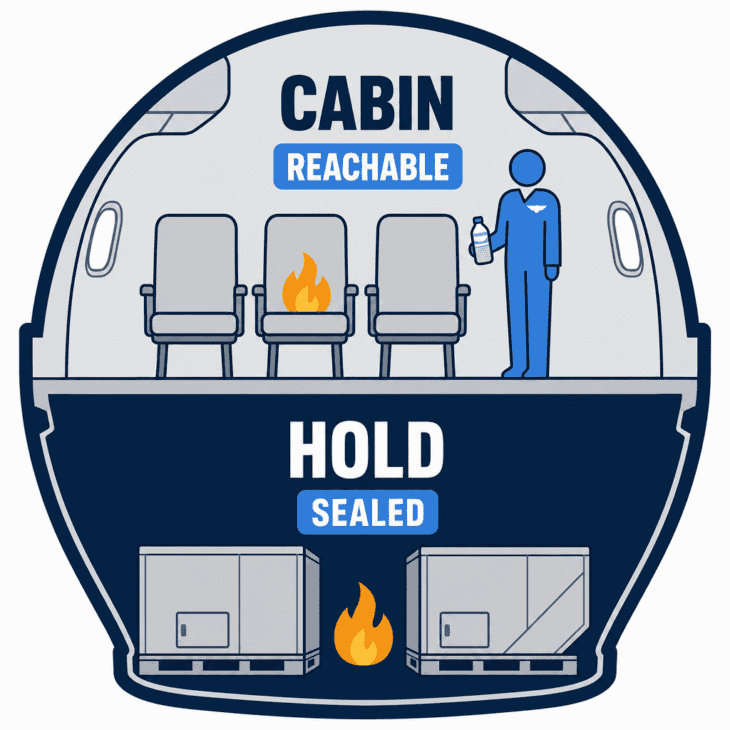
That is manageable in the cabin, where a crew member can see smoke and pour water on it within seconds. It is a serious problem in a sealed cargo hold, where nobody can. That one difference explains nearly every battery rule you have ever been handed at an airport.
No lithium batteries in checked luggage
A failing lithium cell makes its own heat and its own oxygen, so it cannot be smothered, only cooled. Every rule you have been given exists to make sure a human being is standing next to it when it fails.
What actually happens inside a failing battery
Thermal runaway starts small. An internal short circuit, a manufacturing flaw, a cell crushed inside a bag, or a pack that has been overcharged can all push one cell past the temperature where its own chemistry produces heat faster than the cell can shed it.
From there it accelerates without any outside help. The cell vents flammable gas, the cathode material begins breaking down and releasing oxygen inside the casing, and temperatures can pass 1,000°F (540°C).
The oxygen is the part that matters. A burning cell is not drawing on cabin air, so cutting off its air supply does not stop it. A halon extinguisher can knock down the visible flames, but the reaction underneath keeps running and the flames come back.
In a pack made of several cells, the heat then reaches the neighbouring cell, and the one after that. Each one lights the next, which is why a power bank fire builds in stages instead of burning out in a single flash.
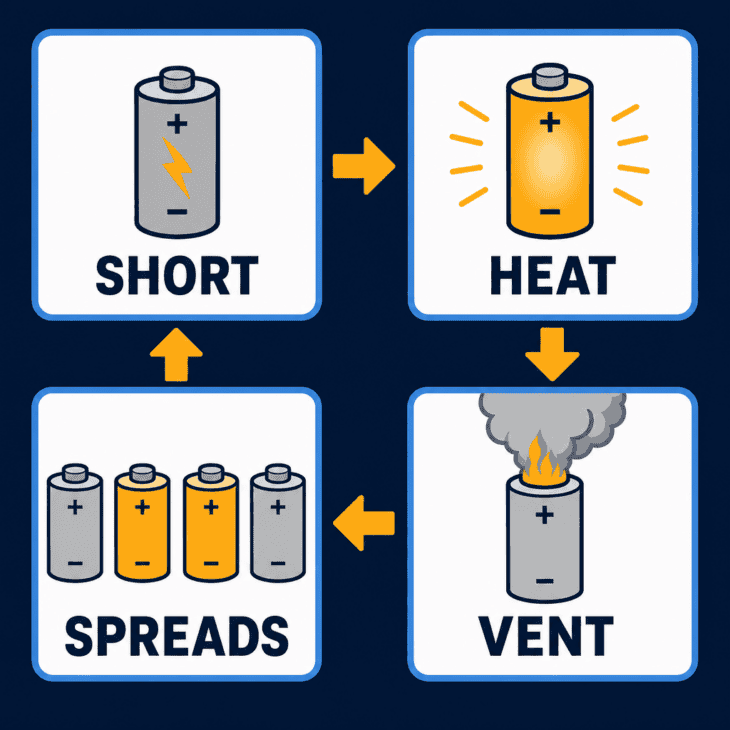
This is why FAA guidance tells crews to cool the device rather than smother it. The recommended response is large amounts of water, or any other non-alcoholic liquid on board, kept up for at least 15 minutes after the flames and smoke have stopped.
How often this actually happens
Often enough that it is no longer a freak event. The FAA verified 93 lithium battery incidents involving smoke, fire, or extreme heat on US aircraft in 2025, up from 89 in 2024, which was itself around 16 percent above the year before.
Eighty of those 93 happened on passenger aircraft, the other 13 on freighters. On US passenger flights alone that is roughly one event every four or five days, and a share of them end in an unscheduled landing. Battery smoke is one of the more common reasons a modern flight diverts to the nearest suitable airport.
The devices responsible are not exotic. They are the things sitting in your bag right now.
| Device involved | Verified US events, 2025 |
|---|---|
| Battery packs and spare batteries | 31 |
| E-cigarettes and vaping devices | 22 |
| Cell phones | 21 |
| Other electronic devices | 11 |
| Laptops | 8 |
Vaping devices are the striking line. They make up a tiny fraction of the electronics carried on board and account for close to a quarter of verified events.
That number is a floor, not a ceiling
The FAA states plainly that its list covers only the incidents it was able to verify, and should not be read as the full count of battery events on aircraft. A device that gets hot in a seat pocket and is quietly dealt with often never generates a report at all.
The upward trend is not really a story about batteries getting worse. It is a story about how many of them are in the cabin, and how many are cheap, uncertified, or quietly damaged.
A power bank lives a hard life. It gets dropped, packed under heavier things, and charged with whatever cable is nearby, and internal damage from any of that is invisible from the outside.
China’s regulator made the point bluntly. From 28 June 2025 the CAAC barred passengers on domestic flights from carrying power banks that lack a valid China Compulsory Certification mark, or that belong to a recalled batch, after a run of manufacturer recalls.
Why spare batteries are banned from the hold
The cargo hold of a passenger jet is a Class C compartment. It is sealed, smoke detected, and flooded with halon 1301 when a fire is sensed, and the whole design rests on starving a fire of oxygen until the aircraft lands.
Against lithium, that design is close to useless. FAA fire safety testing found halon knocks down the flame but cannot cool the cells, so thermal runaway keeps propagating through the pack and keeps producing flammable gas.
In the worst case that gas accumulates in a sealed compartment and finds an ignition source. The result is an explosion the compartment liner was never built to contain.
This is not theoretical. UPS Airlines Flight 6, a Boeing 747 freighter carrying a large consignment of lithium batteries, was brought down near Dubai in September 2010 by a cargo fire that killed both pilots.
Bulk shipments of lithium ion cells as cargo on passenger aircraft were banned outright from April 2016. Freighters can still carry them under stricter packing rules, which is why 13 of 2025’s events happened on cargo aircraft.
The passenger rules follow the same logic in miniature. A loose or spare battery goes in the cabin where somebody can reach it. A device with its battery installed may still be checked if it is switched fully off and protected from damage, although a growing number of airlines would rather you did not.
Electronic cigarettes are the exception with no room for interpretation. The US Department of Transportation banned them from checked baggage entirely in 2016 and prohibited charging them on board, after a series of fires in bags.
What changed in 2026
For decades the rules governed where a battery could travel. In 2026 they started governing where it could sit.
The turning point was Air Busan Flight 391 on 28 January 2025. The Airbus A321 was preparing to depart Gimhae International Airport in South Korea when fire broke out in an overhead bin. All 176 people on board evacuated, 27 were injured, and the aircraft was destroyed.
South Korea’s National Forensic Service traced the fire to a short circuit inside a passenger’s power bank, caused by a failure of the battery’s internal insulation. The device was above head height behind a closed bin door, which is close to the worst possible location for a fire nobody has noticed yet.
The problem with the overhead bin
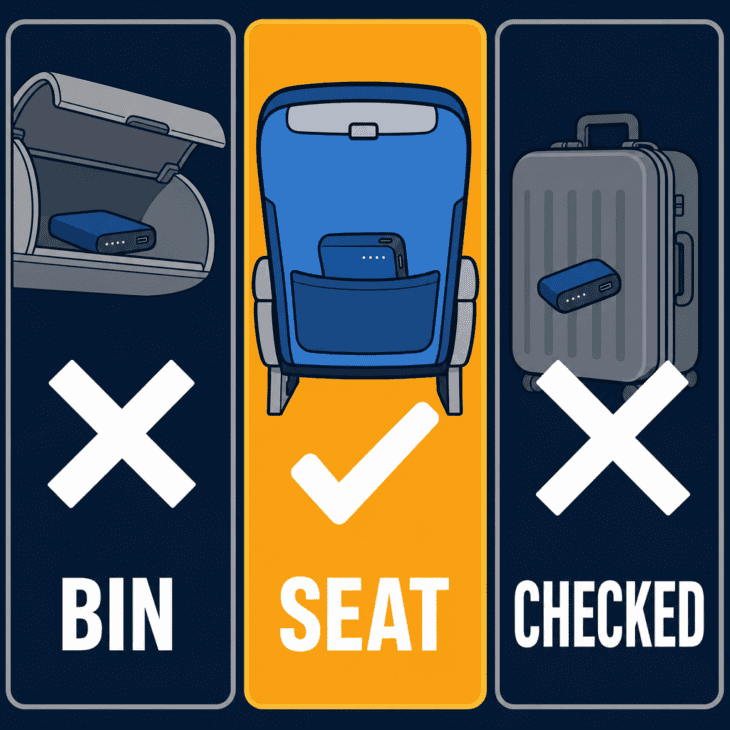
By the time smoke from a closed bin reaches the cabin, the pack inside has usually had a minute or more to propagate from cell to cell. On the seat beside you, the same failure is spotted in seconds.
The FAA made the same argument in August 2025 with a safety alert, SAFO 25002, telling operators to reassess how passengers stow batteries. Devices in overhead bins or buried in carry-on bags are obscured, hard to reach, and being watched by nobody.
ICAO then rewrote the global baseline. An addendum to its Technical Instructions took effect on 27 March 2026, approved by the 36 states of the ICAO Council and issued to all 193 member states.
The core of it is short. A maximum of two power banks per passenger, cabin only, and no recharging them from the aircraft’s own power once the doors close. Crew members are exempt where the operation of the aircraft requires it.
The overhead bin ban most travelers have run into is not in that ICAO text. It has come from national regulators and individual airlines layering their own rules on top, which is why the specifics now vary by carrier.
American Airlines, from 1 May 2026, limits passengers to two portable chargers rated 100 watt-hours or less, requires them within easy reach, and requires them visible while they are charging something. Southwest went further on 20 April 2026: one power bank of 100 watt-hours or less, stored in a personal item under the seat in front of you.
The one number worth memorising is the watt-hour rating, printed on the battery itself. It decides everything else.
| Rating | What you can do with it |
|---|---|
| 100 Wh or less | Carry-on only, no airline approval needed. Covers phones, laptops, and nearly every consumer power bank. |
| 101 to 160 Wh | Carry-on with airline approval, normally a maximum of two spares. |
| Over 160 Wh | Not permitted in the cabin or the hold on a passenger flight. |
Most people never have to think about the middle row. It mainly catches professional camera rigs, mobility aids, and the larger batteries that come with flying a drone to your destination, all of which need a phone call to the airline before you turn up.
The myth: the crew has an extinguisher for that
The extinguisher is real, and it does help, just not in the way most passengers assume. It puts out the flames in the cabin. It does not touch the chemistry inside the cell, which is still running and will relight.
That is why FAA guidance moved to water as the primary response rather than a suppressant. Any non-alcoholic liquid on the aircraft will do the job, because the point is removing heat, not chasing flames.
Fire containment bags are the other common assumption. Plenty of airlines carry them, and they are genuinely useful for isolating a device that has already been cooled and has to spend the next six hours somewhere.
But FAA guidance has cautioned against treating the bag as the first move. Getting a burning device into one means picking it up and carrying it through an occupied cabin, and opening a bin to retrieve it can hand the fire a fresh supply of air.
The honest version is undramatic. The best outcome for a lithium battery fire on an aircraft is that somebody notices it in the first few seconds, which is precisely what the 2026 rules are engineered to produce.
Commercial flying stays as safe as it is by finding hazards before they find a way to matter. Lithium batteries are the current example, arriving in the cabin faster than the rules written to cover them.
So the next time a flight attendant asks you to keep the power bank out of the bin and somewhere you can see it, it is not a fussy new rule invented to annoy you. It is the airline making sure that if the most dangerous thing on the aircraft is in your pocket, somebody is looking at it.
Sources and references used for research and fact-checking.
- Federal Aviation Administration, Lithium Battery Incidents
- Federal Aviation Administration, SAFO 25002: Managing the Risks of Lithium Batteries Carried by Passengers and Crewmembers
- International Civil Aviation Organization, New power bank restrictions will safeguard international aviation
- Aviation Week Network, Air Busan Fire Likely Caused By Power Bank, Investigators Say
- FAA Fire Safety Branch, Hazards and Risks Incurred When Shipping Lithium Batteries as Cargo by Air
- PHMSA, US Department of Transportation, DOT Bans E-Cigarettes From Checked Baggage
Get the Newsletter
The latest aviation news and stories sent to your inbox.
About the Author

Tim is the owner and lead editor of AeroCorner since 2019, overseeing aviation content covering aircraft, airlines, airports, and the broader aviation industry. Through years of researching, writing, editing, and publishing aviation-focused content, he has developed extensive practical knowledge of commercial aviation and air travel. Based in Asia and a frequent traveler himself, Tim also brings firsthand passenger experience to AeroCorner’s coverage. Outside of publishing, he has also explored aviation firsthand through hands-on flight training in New Zealand.