

Table of Contents
Yes, many airplanes have power at the seat, especially at the big US airlines, but not every seat on every jet gets a full wall outlet. Alaska Airlines says every flight it operates has USB and power outlets in the main cabin. United’s 737 MAX 8 interior, launched in 2021, gives every seat a USB port but shares two outlets between three economy seats.
The low-cost end of the market is different. Frontier has no seat power today and, according to an internal memo reported in October 2026, plans to add it during 2027. Allegiant advertises outlets only in its Allegiant First seats.
The bigger surprise is that the aircraft matters as much as the airline. The same carrier can fly one jet with power at every seat and another with none, so the reliable check is the aircraft type on your booking.
Seat Power on US Airlines at a Glance
This is what each airline’s own pages, or the most recent reporting, say about power at the seat. “Varies” means the answer changes with the aircraft and cabin.
| Airline | What you get at the seat | Coverage |
|---|---|---|
| Alaska Airlines | USB ports and power outlets in the main cabin | All Alaska-operated flights, per the airline |
| Delta Air Lines | USB and AC outlets depend on the cabin and subfleet; some jets have none | Varies (one 737-900ER layout has AC outlets only in First) |
| JetBlue | AC, USB-A and USB-C ports at the seat on the A220 | Varies by aircraft |
| United Airlines | USB-A at every seat; two outlets per three economy seats | The 737 MAX 8 interior launched in 2021 |
| American Airlines | USB-C at every seat as new seatback screens arrive | New 737 MAX 10 and A321neo jets first, then A319 and A320 retrofits |
| Southwest Airlines | 60W USB-C and 10.5W USB-A per seat (USB only) | Retrofitted and new 737 MAX jets; 737-700 upgrades from late 2026 |
| Allegiant Air | USB-A, USB-C and a 120V outlet | Advertised for Allegiant First |
| Frontier Airlines | None today, per reporting on the memo | Seat power planned during 2027, per an internal memo |
Two rows need context. United’s figures come from its 2021 737 MAX 8 cabin launch, and American’s row covers the USB-C seats it says are coming with new screens on its next narrowbodies, not every jet it flies today.

Why the Aircraft Matters More Than the Airline
Airlines fit power when a cabin is built or refurbished, so a fleet carries several generations of seats at once. Delta shows this on a single aircraft type: its 737-900ER flies in three layouts.
One layout lists USB power and power outlets in every cabin. A second lists outlets only in Delta First, with USB-only seats in Comfort and Main. Delta’s page for the third lists Wi-Fi and no seat power at all.
Finnair makes the split even plainer. Every seat on its A350 and A330 has power, though economy gets USB only, while its A320-family jets, Embraers and ATRs have none. The same ticket on the same airline can put you on either.
The quickest way to check your seat
Find the aircraft type on your booking, then open that aircraft’s page on the airline’s website. Delta, Alaska and JetBlue list seat power by aircraft and cabin. If a layout shows two outlets per row of three, someone in that row goes without a socket.
Southwest is the clearest example of a fleet changing mid-stream. In 2022 it ordered seat power from Astronics for 475 Boeing 737 MAX 7 and MAX 8 jets.
Its Independence One MAX 8, which entered service on April 29, 2026, has USB-C and USB-A ports at each seat. More than half of its older 737-700s get seat power starting in late 2026, so for now a Southwest flight can still come with no seat power at all.
How Much Power Does an Airplane Outlet Give?
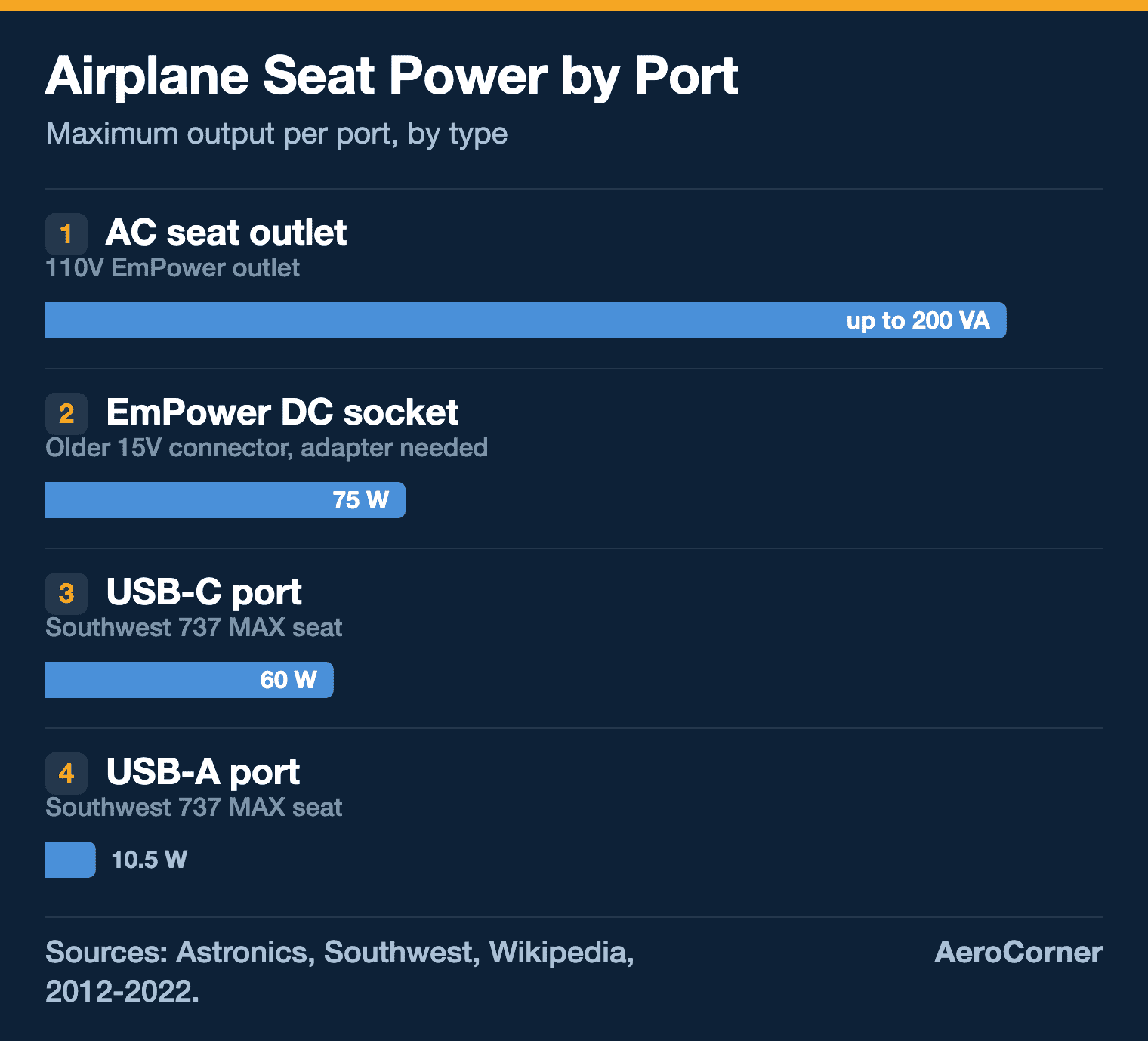
Less than a wall socket at home, and it depends on the port. Southwest’s Astronics hardware delivers 60 watts from the USB-C port and 10.5 watts from the USB-A port at every seat.
An AC seat outlet on Astronics’ EmPower system is rated at up to 200 VA per passenger device. The older EmPower DC socket, a 15-volt connector that needed a special adapter, was limited to 75 watts.
For a phone, any of these will do; a 10.5-watt USB-A port just charges more slowly. A laptop is the real test, because a big laptop charger can be rated for more than the seat supplies, so a power-hungry laptop may charge slowly or not at all.
Bring a USB-C cable if your laptop charges over USB-C. On a seat with a 60-watt USB-C port, that can be the more useful plug.

What Plug Fits an Airplane Outlet?
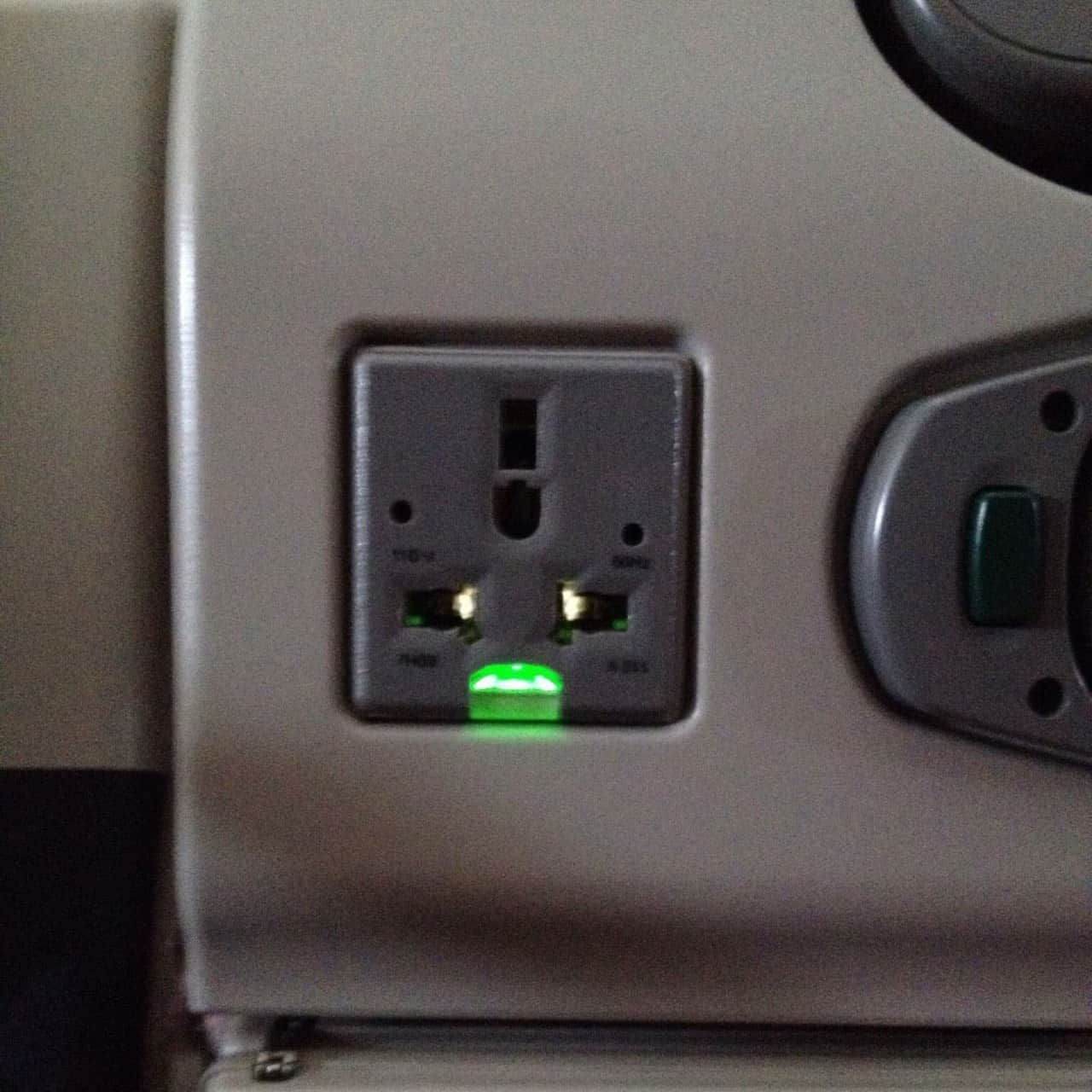
Seat AC outlets on US jets supply 110 to 120 volts, the US household standard, so a normal US charger plugs straight in. Many are universal sockets shaped to take several plug styles, like the ones pictured in this article.
USB ports need only your cable. Older seats tend to carry USB-A, while newer cabins add USB-C: JetBlue’s A220 has AC, USB-A and USB-C at the seat, and Southwest’s new seats are USB only.
The one plug that caught travelers out was the old EmPower DC socket. It ran at 15 volts rather than the 12 volts of a car lighter socket, and it needed a special adapter.
Long-haul economy can be USB only. Finnair, for example, gives every economy seat on its A350 and A330 a USB-A port, while Business and Premium Economy seats also get a universal socket.
Do Airplane Outlets Work Before Takeoff?
Often not, and you should not count on it. Most airlines announce that nothing may be plugged in during takeoff and landing, so treat seat power as something for the flight itself, not the taxi.
Rules are not uniform, and international carriers tend to be stricter. If the outlet is dead at the gate, wait until the crew says devices can be used in flight before deciding it is broken.
Using your phone itself is a separate question from charging it. Our explainer on what airplane mode is really for covers why the rules on devices relaxed.
Power Banks: The Rules Changed in 2026
A power bank is the backup when the seat has no outlet, and it now comes with tighter rules. Under the US hazardous materials regulations, spare lithium batteries go in carry-on bags only, up to 100 watt-hours each.
Batteries from 101 to 160 watt-hours need the airline’s approval, and you may carry no more than two of them. Anything larger stays home.
On March 27, 2026, ICAO, the UN aviation agency, added a new rule to its international dangerous goods instructions. Passengers may carry no more than two power banks for personal use and may not recharge a power bank in flight, according to IATA’s guidance to airlines.
Some airlines go further. Southwest requires a power bank to stay visible while it is in use, never inside a bag, and does not allow it to be charged from the seat’s power supply.
The reason is fire risk. In October 2026 a power bank in a bag under a seat smoked on an HK Express flight to Jeju and burned its owner’s thumb, and our piece on lithium batteries on planes explains why crews treat them so seriously.
Do not charge the power bank from the seat
Charging your phone from a power bank is allowed on US airlines. Plugging the power bank itself into the seat outlet to top it up is banned on international flights under the 2026 ICAO rule, and Southwest bans it on its own flights as well.
How to Stay Charged on Any Flight
- Charge everything to full at the gate, where terminal outlets are free and fast.
- Look up your aircraft type on the airline’s website to see whether your cabin has AC, USB-A or USB-C.
- Pack both a USB-A and a USB-C cable, since many seats have only one kind.
- Carry a power bank of 100 watt-hours or less in your carry-on, and no more than two.
- Lower screen brightness and download shows before boarding, so streaming over in-flight Wi-Fi does not drain the battery.
If your row shares two outlets between three seats, check the seat map for which seats sit nearest the plugs. Our guide to types of airplane seats covers the other trade-offs.
FAQ
Sources and references used for research and fact-checking.
- Alaska Airlines, Main Cabin seating
- Delta Air Lines, Boeing 737-900ER Seat Maps, Specs and Amenities
- Delta Air Lines, Boeing 717-200 Seat Maps, Specs and Amenities
- JetBlue, JetBlue Introduces Its New Airbus A220-300
- The Points Guy, United's new 737 MAX 8 cabin
- Runway Girl Network, Astronics to supply Southwest with in-seat power
- FOX 5 Atlanta, Southwest Airlines unveils new Boeing 737 with redesigned cabin featuring in-seat power
- InsideFlyer, Southwest's Independence One debuts with new cabin features
- Allegiant Air, Allegiant First
- View from the Wing, Leaked memo reveals Frontier Airlines seat power and refreshed interiors
- Finnair, Can I charge my laptop or mobile phone on the aircraft?
- Wikipedia, EmPower (aircraft power adapter)
- Power Systems Design, Carriers select Astronics 110 VAC and USB in-seat power systems
- SmarterTravel, Rules around charging your phone in-flight
- Cornell Law School LII, 49 CFR 175.10, Exceptions for passengers, crewmembers, and air operators
- IATA, Changes Regarding Power Banks: Guidance Document for Operators (March 2026)
- Your Mileage May Vary, Flying with a power bank? Here are the rules for every U.S. airline
Get the Newsletter
The latest aviation news and stories sent to your inbox.
About the Author

Tim is the owner and lead editor of AeroCorner since 2019, overseeing aviation content covering aircraft, airlines, airports, and the broader aviation industry. Through years of researching, writing, editing, and publishing aviation-focused content, he has developed extensive practical knowledge of commercial aviation and air travel. Based in Asia and a frequent traveler himself, Tim also brings firsthand passenger experience to AeroCorner’s coverage. Outside of publishing, he has also explored aviation firsthand through hands-on flight training in New Zealand.