

Table of Contents
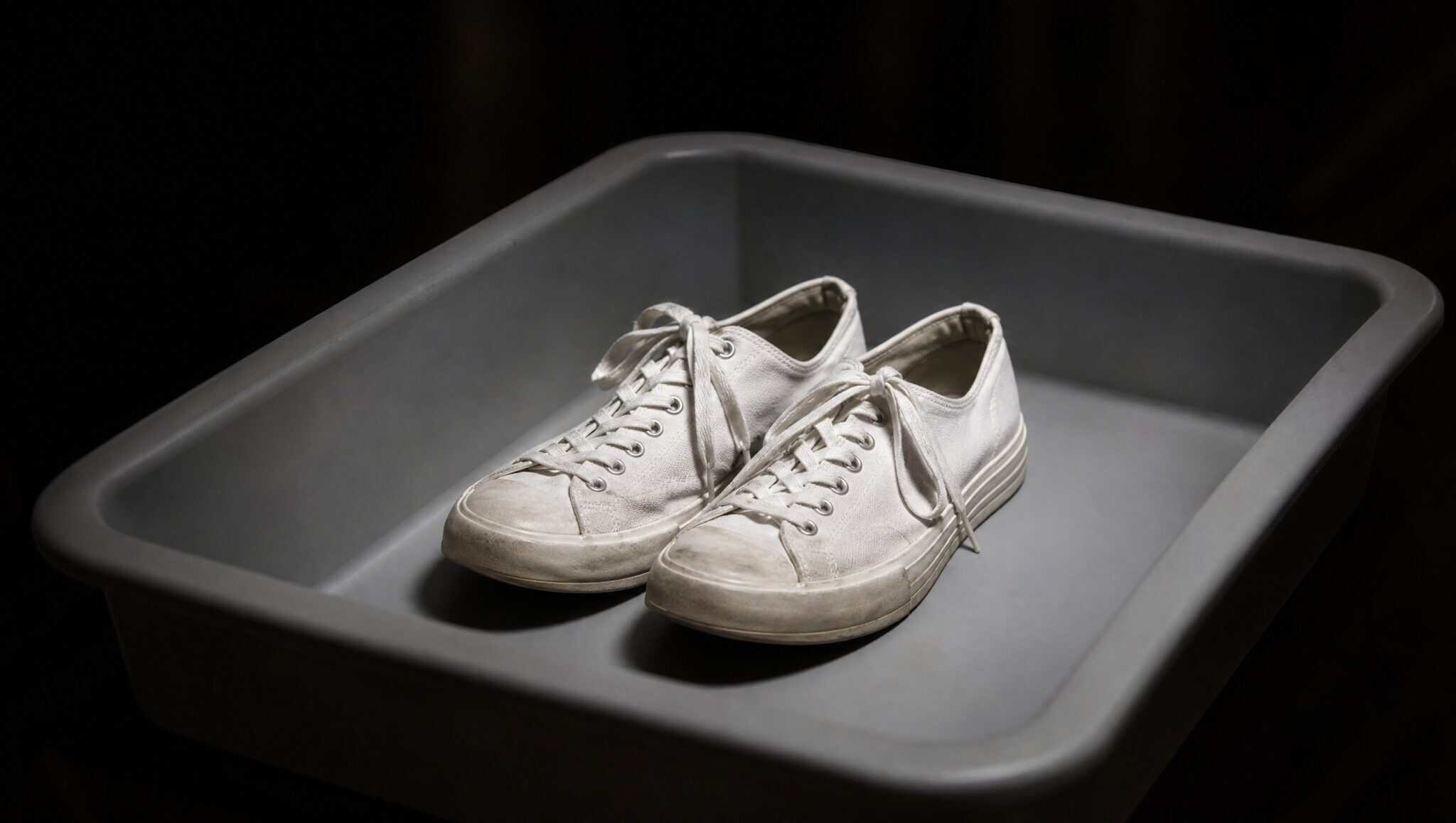
For almost 19 years, it was the most American moment in air travel. You reached the front of the security line, balanced on one foot, and dropped your shoes into a grey plastic bin to ride through the X-ray while you shuffled on in your socks.
On July 8, 2025, that ritual ended. Most travelers assumed the machines had finally caught up, and that some new scanner could now see inside a sneaker.
The real story is odder than that. Here is why shoes came off in the first place, why the rule took five years to arrive, and what actually replaced it when it went.
Do You Have to Take Your Shoes Off at TSA?
No. Since July 8, 2025, passengers going through TSA checkpoints at US airports have been able to keep their shoes on, under a policy announced by then-Homeland Security Secretary Kristi Noem. She said the change applied nationwide and took effect immediately.
Shoes can still cause trouble. TSA’s own advice is to avoid shoes with a high metal content, because an alarm at the checkpoint can end in a pat-down.
Some travelers were already exempt before the change. Children 12 and under, passengers 75 and over, and TSA PreCheck members could all keep their shoes on.
DHS sold the change on speed. “We expect this change will drastically decrease passenger wait times,” Noem said, and wait time is one of the variables behind how early you really need to get to the airport.
The answer at a glance
Shoes stay on at TSA checkpoints for all travelers since July 8, 2025, though shoes with a lot of metal can still set off an alarm. The shoes-off rule dated from August 2006, not 2001. The scanner built to check shoes on your feet had not reached an airport when the rule ended, and a classified watchdog audit reportedly found some body scanners cannot scan shoes.
Why Shoes Came Off in the First Place
The rule traces back to December 22, 2001, just over three months after the 9/11 hijackings. Richard Reid boarded American Airlines Flight 63 from Paris to Miami, a Boeing 767 with 197 people aboard, carrying homemade bombs in his shoes.
Over the Atlantic, passengers complained of a smell of smoke. A flight attendant, Hermis Moutardier, found Reid trying to light a match, and when she checked on him again, a fuse was running into the shoe in his lap.
Crew and passengers wrestled him down and tied him up with plastic handcuffs, seatbelt extensions and headphone cords. The flight diverted to Boston Logan, escorted by two F-15 fighters, and Reid was arrested on the ground.
FBI bomb technicians later found about 10 ounces of explosive material in the shoes. An FBI agent told a preliminary hearing that the bomb would have blown a hole in the fuselage and caused the plane to crash.
Why it failed is the detail people remember. According to accounts of the case, sweat from Reid’s own feet had dampened the explosive and kept it from igniting. He pleaded guilty in October 2002 and was sentenced to life in federal prison.
The Rule Took Five Years to Arrive
Here is the part most people get wrong. Taking your shoes off did not become mandatory after Reid. TSA began encouraging shoe removal in February 2002, but it stayed voluntary for four and a half years.
What changed that was a different plot. In August 2006, a scheme to detonate liquid explosives aboard transatlantic flights was foiled, and TSA made shoe removal mandatory, citing “intelligence pointing to a continuing threat.”
The same month produced the 3-1-1 liquids rule. The two checkpoint habits Americans complained about most were born together, and they went on to live very different lives.
December 2001
The shoe bomb. Richard Reid fails to ignite explosives hidden in his shoes on American Airlines Flight 63 from Paris to Miami.
February 2002
Shoes off, encouraged. TSA starts urging travelers to remove their shoes, but does not require it.
August 2006
Shoes off, required. After a foiled plot to bomb transatlantic flights with liquid explosives, TSA makes shoe removal mandatory. The 3-1-1 liquids rule arrives the same month.
September 2011
Children keep their shoes on. TSA rolls out new screening for travelers 12 and under that lets them leave their shoes on.
July 2025
Shoes on for everyone. DHS ends the shoes-off policy at TSA checkpoints nationwide.
August 2025
A watchdog warning. The DHS inspector general sends a Seven-Day Letter on a significant finding from covert checkpoint testing.
April 2026
A call to reverse it. Senator Tammy Duckworth demands that TSA rescind the policy, citing the classified audit.
Over time, the rule collected exceptions. Children 12 and under got to keep their shoes on in 2011, passengers 75 and over could too, and PreCheck members had long been spared, which made the universal rule look less universal every year.
What Replaced the Shoes-Off Rule?
Not a shoe scanner. DHS credited its “cutting-edge technological advancements and multi-layered security approach,” and Noem pointed to newer scanners and more officers.
“In those 20 years since that policy was put in place, our security technology has changed dramatically,” she said. “It’s evolved. TSA has changed.”
Some of those layers start before you reach the airport. DHS said identity verification, Secure Flight vetting and its other layered security processes all remain mandatory, and it noted that REAL ID enforcement, which began that May, had reached 94% compliance.
The machine actually designed to replace shoe removal is a different story. The DHS Science and Technology Directorate and the Pacific Northwest National Laboratory built a shoe scanner that passes harmless millimeter waves through the sole while you stand on it.
The prototype scans footwear in about two seconds and processes the image in about five. It has been licensed to Liberty Defense for commercial development, and DHS says it could one day be built into the floor of the body scanner, so you and your shoes are screened at once.
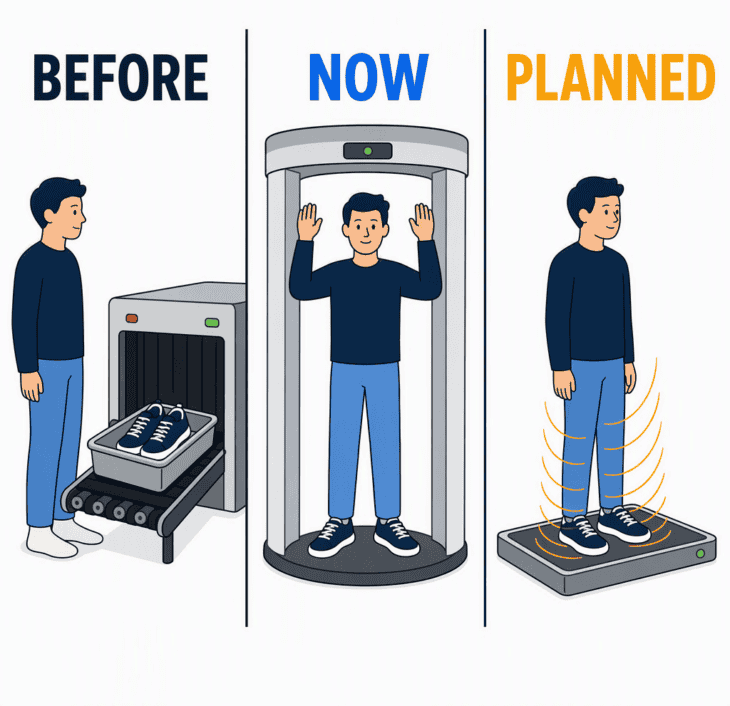
Its first airport test was scheduled for two years after the rule ended. A DHS fact sheet from January 2025 set planning with TSA for the third quarter of fiscal 2026 and the airport demonstration itself for the fourth quarter of fiscal 2027, which is summer 2027.
We found no report of the scanner screening passengers at an airport as of September 2026. Officials had been promising this for a long time: as Slate put it, “since at least 2011, officials at DHS have promised a shoes-on future.”
Almost 30,000 years of life
That is how much time economist Bryan Caplan estimated the shoe rule consumed in the United States, assuming a conservative one minute per passenger and roughly 700 million US air travelers a year.
The Watchdog Warning That Followed
Within seven weeks, the policy hit a problem. DHS’s Office of Inspector General had been running covert tests of airport checkpoints, sending undercover investigators to try to slip simulated weapons or explosives past screeners.
On August 26, 2025, Inspector General Joseph Cuffari sent Noem a rare Seven-Day Letter, flagging a time-sensitive, significant finding that required swift corrective action. The final report, which is classified, followed on November 1, 2025.
According to The Wall Street Journal, as quoted in a letter from Senator Tammy Duckworth, the testing found that certain TSA full-body scanners “can’t scan shoes.” The inspector general concluded that the shoes-on move “had inadvertently created a new security vulnerability in the system.”
Noem told Congress under oath that “all of the recommendations” had been implemented, according to CBS News. A March 4, 2026 memo from the inspector general said his office had received no such information, “written or oral,” from DHS or TSA.
On April 3, 2026, Duckworth, the top Democrat on the Senate Commerce Committee’s aviation subcommittee, demanded that TSA rescind the policy. By then Noem had left DHS, and the policy stayed.
In July 2026, a TSA spokesperson told Travel + Leisure that ending the shoes-off policy “has increased hospitality for travelers and streamlined the TSA security checkpoint process, leading to lower wait times.”
What the public still does not know
The inspector general’s report is classified. The public account comes from news reports and a senator’s letter, and neither says which scanners cannot read shoes, how many of them are in service, or what corrective action TSA has taken since.
As of September 2026, we found no announcement reversing the policy. Your shoes stay on.
The Myth vs. the Reality
Myth: Everyone in the world takes their shoes off at security
They never did. Unlike limits on liquids, the shoe rule was never adopted by the rest of the world, as Slate put it. For almost 19 years, it was a largely American ritual.
“You don’t take your shoes off anywhere but in the U.S.,” MIT’s Yossi Sheffi told The Washington Post, “not in Israel, in Amsterdam, in London.”
That is the real irony of August 2006. The liquids limit and the shoe rule were born the same month, but only one spread around the world, while the other stayed an American habit until 2025.
The second myth is that the rule started because of the shoe bomber. Reid was the reason shoes became suspect, but the mandate came nearly five years later, on the back of an entirely different plot.
Plenty of post-9/11 checkpoint rules have outlived their origin stories, like the ban on loose blades behind which razors you can bring on a plane. The shoe rule is one that finally went.
So the next time you walk through the scanner in your sneakers, know what is doing the work. It is not a machine that reads your soles, which is still waiting for its first airport test, but a stack of other layers, from your ID to vetting that happens before you reach the airport.
The rule that began with one man’s shoes over the Atlantic lasted almost 19 years. What ended it was not the technology finally arriving, but a decision that the rest of the checkpoint could carry the load.
Sources and references used for research and fact-checking.
- U.S. Department of Homeland Security, DHS to End 'Shoes-Off' Travel Policy
- NBC News, You can leave your shoes on at airport security, TSA says
- CNN, TSA will no longer require all passengers to take shoes off at airport security checkpoints
- View from the Wing, You Can Finally Keep Your Shoes On
- Federal Bureau of Investigation, Richard Reid's Shoes
- Wikipedia, American Airlines Flight 63 (2001)
- Transportation Security Administration (UNT CyberCemetery archive), TSA Blog, September 14, 2011: screening changes for children 12 and under
- Transportation Security Administration, Screening for Passengers 75 and Older
- Transportation Security Administration, Frequently Asked Questions
- DHS Science and Technology Directorate, High Definition-Advanced Imaging Technology Shoe Scanner
- DHS Science and Technology Directorate, Feature Article: Reimagining Imaging at the Airport
- Slate, The TSA ends airport shoe removal after 19 years
- Bet On It (Bryan Caplan), America's Most Successful Terrorist
- Reason, Federal officials won't admit the real reason for ditching the TSA's shoe rule
- Office of U.S. Senator Tammy Duckworth, Duckworth Demands DHS Rescind Noem's Reckless 'Shoes On' Airport Screening Policy
- CBS News, DHS watchdog warned of risks in airport shoes-off policy. The report got buried.
- CBS News, Senate Democrat demands that TSA lift its "shoes-on" policy, calling it a "reckless" safety risk
- Travel + Leisure, TSA No Longer Requires Travelers to Remove Their Shoes, But These Footwear Choices Could Trigger Extra Screenings
Get the Newsletter
The latest aviation news and stories sent to your inbox.
About the Author

Tim is the owner and lead editor of AeroCorner since 2019, overseeing aviation content covering aircraft, airlines, airports, and the broader aviation industry. Through years of researching, writing, editing, and publishing aviation-focused content, he has developed extensive practical knowledge of commercial aviation and air travel. Based in Asia and a frequent traveler himself, Tim also brings firsthand passenger experience to AeroCorner’s coverage. Outside of publishing, he has also explored aviation firsthand through hands-on flight training in New Zealand.