

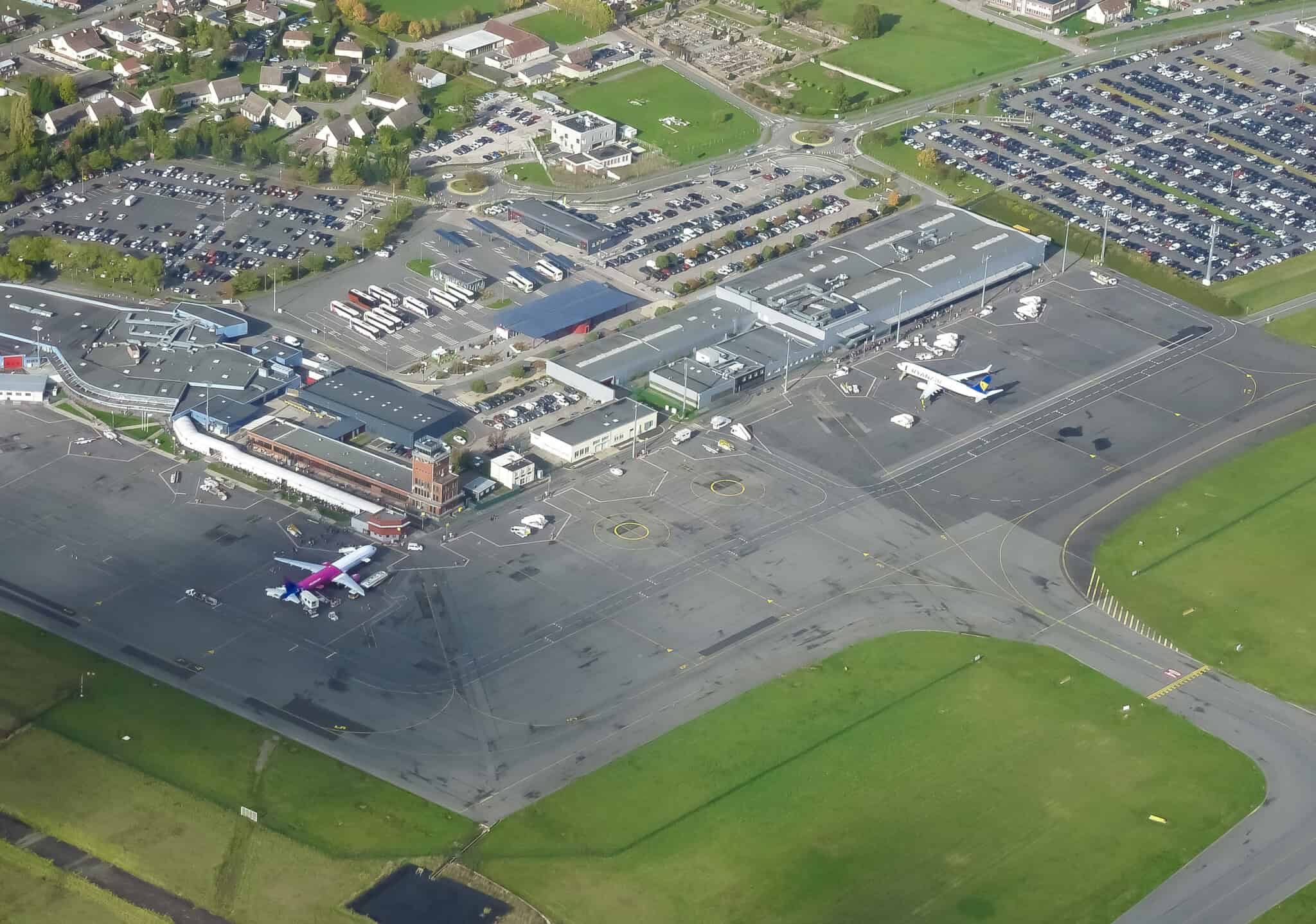
Your boarding pass says Paris. The aircraft doors open at Beauvais, a cathedral town about 53 miles (85 km) north of the city, and the only way in is a coach that takes well over an hour. You booked a flight to one of the most famous cities on earth and landed in a place most Parisians have never been.
It is not a mistake, and it is not rare. Frankfurt, Stockholm, Oslo, Barcelona and dozens of other cities have an airport carrying their name that sits an hour or more away, sometimes in a different region entirely.
There are actually two very different reasons this happens, and the airport name almost never tells you which one you are dealing with. Here is what is really going on.
The short answer
Some distant airports are small secondary fields that budget airlines market under a big city’s name because the name sells tickets. The airport is often closer to a modest town you have never heard of than to the city on the departure board.
Others are genuine major airports that were deliberately built far from the city, because a crowded metro area has neither the space for a huge airport nor the tolerance for its noise. Both end up far away, for opposite reasons.
Two different things are going on
One kind of far-flung airport is a secondary field wearing a big city’s name for marketing. The other is a major airport pushed to the edge of the region by a lack of land and a surplus of noise complaints. The name on your ticket rarely reveals which you have booked.
The marketing name: a city you land near, not in
The biggest reason for the surprise is low-cost carriers, and Ryanair in particular. For years the airline has flown into cheap regional airports and marketed them under the name of the nearest big city, even when that city is a long drive away.
Frankfurt-Hahn is the classic case. It is a former United States Air Force base roughly 75 miles (120 km) from Frankfurt, in the Hunsrück hills of a different German state. A traveler expecting the banking capital instead finds a quiet airfield closer to Luxembourg than to the Frankfurt skyline.
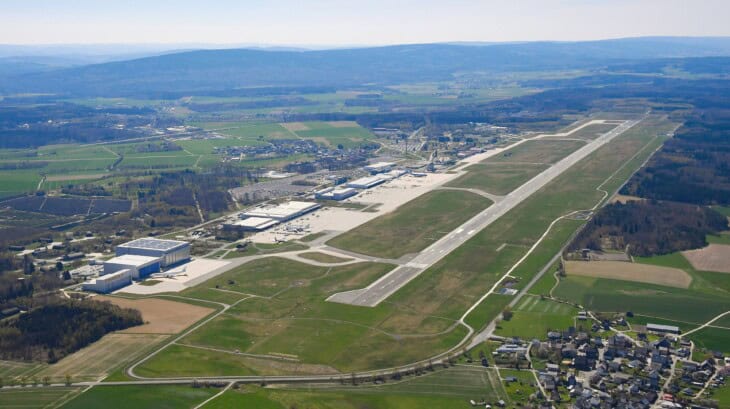
This became a legal fight. A German court ruled that the “Frankfurt-Hahn” name misled customers, calling it “a purely artificial creation” that existed for economic reasons “without any historical or geographical basis.” Ryanair was told to disclose the distance, though a later ruling in 2002 restored its right to use the name.
The pattern repeats across Europe. The label is the marketing; the geography is an afterthought.
| Marketed as | Actual airport | Really nearest to | Distance to the big city |
|---|---|---|---|
| Paris | Beauvais-Tillé (BVA) | Beauvais | 53 mi (85 km) |
| Frankfurt-Hahn | Hahn (HHN) | Kirchberg / Lautzenhausen | 75 mi (120 km) |
| Stockholm | Skavsta (NYO) | Nyköping | 62 mi (100 km) |
| Oslo | Torp (TRF) | Sandefjord | 68 mi (110 km) |
| Barcelona | Girona-Costa Brava (GRO) | Girona | 56 mi (90 km) |
Distances are approximate straight-line figures to the central city, rounded. Actual travel time is usually longer.
Why the cheap airports are out there in the first place
The marketing name explains the label. It does not explain why the airfield exists so far from anywhere. That comes down to money and history.
Many of these secondary airports are converted military bases. Frankfurt-Hahn and Germany’s Weeze both began as air bases, which meant they already had a long runway and plenty of land, in exactly the sort of rural location the military preferred and the airlines could get cheaply.
Cost is the rest of the story. A quiet regional airport charges far less to land than a congested hub, often waives fees or pays incentives to win a new route, and lets an airline turn a jet around fast because there is no queue. Regional governments chase these deals hard, because a based aircraft brings jobs and tourists to an area that has neither.
Those low costs are the whole point of the business model, and they are what make the headline fares possible in the first place. The reader who wants the mechanics of that fare will find them in our guide to how airline ticket pricing actually works, and the fast turnaround it depends on in how airlines turn an aircraft around in under an hour.
A base, not a hub
Frankfurt-Hahn sits about 75 miles (120 km) from Frankfurt, in a different federal state, and began life as a US Air Force base. It is closer to the Luxembourg border than to the skyline printed on the boarding pass, which is exactly why an airline could operate there so cheaply.
The other kind of far: big airports built out on purpose
Not every distant airport is a marketing trick. Some of the world’s major airports are genuinely far from downtown, and they were built that way deliberately.
The reason is simple: a modern airport needs an enormous amount of flat, open land, and a dense city has none to spare. Runways two miles long, terminals, taxiways and room to grow do not fit inside a built-up metro area, so planners go looking for space at the edge.
Noise pushes them further still. Jets are loud, they fly lowest near the airport, and no city wants approach paths over its neighborhoods, so a new airport is sited where the noise footprint falls on fields instead of houses.
Tokyo Narita is the textbook example, roughly 37 miles (60 km) from central Tokyo and the product of years of land disputes with local farmers. Munich, Denver and Washington Dulles were all built well outside their cities for the same mix of space and noise. These airports keep the city’s name honestly, but the drive is still long.
The myth vs. the reality
The instinct most travelers have is that an airport’s name tells you where it is. For a secondary airport, the name tells you almost nothing about geography and everything about who the airline wants to sell to.
The myth
That an airport named after a city is in, or near, that city. For a budget-airline secondary field, the name is a marketing label chosen to sell seats, not a statement of where you will actually land.
This matters for one practical reason: the transfer can erase the saving. A fare that looks 40 euros cheaper stops looking cheap once you add a coach ticket and 90 minutes each way to a town in the next region.
The fix is boring but reliable. Before you book a suspiciously cheap fare, look up the airport’s three-letter code and check how far it actually is from where you are going. Different airports serving one city can vary enormously, a distinction we unpack in our overview of the different types of airports.
So the next time a boarding pass promises one city and delivers a coach ride to another, you will know which of the two forces you are looking at. Either a budget airline borrowed a famous name to sell you a seat, or a real airport was simply too big and too loud to sit any closer to town.
Both are worth knowing before you book. The saving is real, but only if you count the journey that starts the moment the doors open. For a case study in why one city ends up with several airports at very different distances, see why London has six airports.
Sources and references used for research and fact-checking.
- The Irish Times, Court rules Ryanair misled customers
- The Irish Times, German court restores Ryanair's right to use 'Frankfurt-Hahn' name in advertising
- Travel And Tour World, How Can Ryanair and Wizz Air Passengers Prevent Travel Disruptions by Checking Airport Locations
- Britain Travel Deals, 15 airports that are located way farther from the city they serve than you think
Get the Newsletter
The latest aviation news and stories sent to your inbox.
About the Author

Tim is the owner and lead editor of AeroCorner since 2019, overseeing aviation content covering aircraft, airlines, airports, and the broader aviation industry. Through years of researching, writing, editing, and publishing aviation-focused content, he has developed extensive practical knowledge of commercial aviation and air travel. Based in Asia and a frequent traveler himself, Tim also brings firsthand passenger experience to AeroCorner’s coverage. Outside of publishing, he has also explored aviation firsthand through hands-on flight training in New Zealand.