


Table of Contents
A jet bridge is the enclosed, movable tunnel that connects an airport gate to the door of an airplane. Its official name is a passenger boarding bridge (PBB), and many people call it a jetway, which began as a brand name.
One end pivots on the terminal building. The other end rides on powered wheels, so a trained operator can stretch it, swing it, raise it and lower it until its cab meets the aircraft door.
Once it is docked, the bridge keeps working. The airplane sinks as passengers and bags come aboard, and a small wheel resting on the fuselage tells the bridge to follow it down.
| Part | Where it sits | What it does |
|---|---|---|
| Rotunda | At the terminal wall, on a fixed column | The pivot. Lets the whole bridge swing left and right. |
| Tunnels | Between rotunda and cab | Two or three sections that slide inside each other to lengthen or shorten the bridge. |
| Lift columns and wheel bogie | Under the outer tunnel | Raise and lower the bridge and drive it across the apron. |
| Cab | At the aircraft end | Rotates to face the door and holds the operator’s control station. |
| Canopy and bumper | Around the cab opening | The folding canopy seals against the fuselage; a soft bumper protects it. |
| Autolevel wheel | On an arm in the cab floor | Rests on the fuselage and keeps the floor level with the door sill. |
How Does a Jet Bridge Work?
Most jet bridges are apron drive bridges, which ADELTE, one of the big manufacturers, calls the most popular type worldwide. The design starts with the rotunda, a round room fixed on a column next to the terminal, which is the pivot the rest of the bridge swings around.
From the rotunda run two or three telescopic tunnels, each slightly smaller than the one before, so they slide into each other like a spyglass. Under the outer tunnel stand two lift columns on a wheel bogie, which carries the drive motors and moves the bridge across the apron.
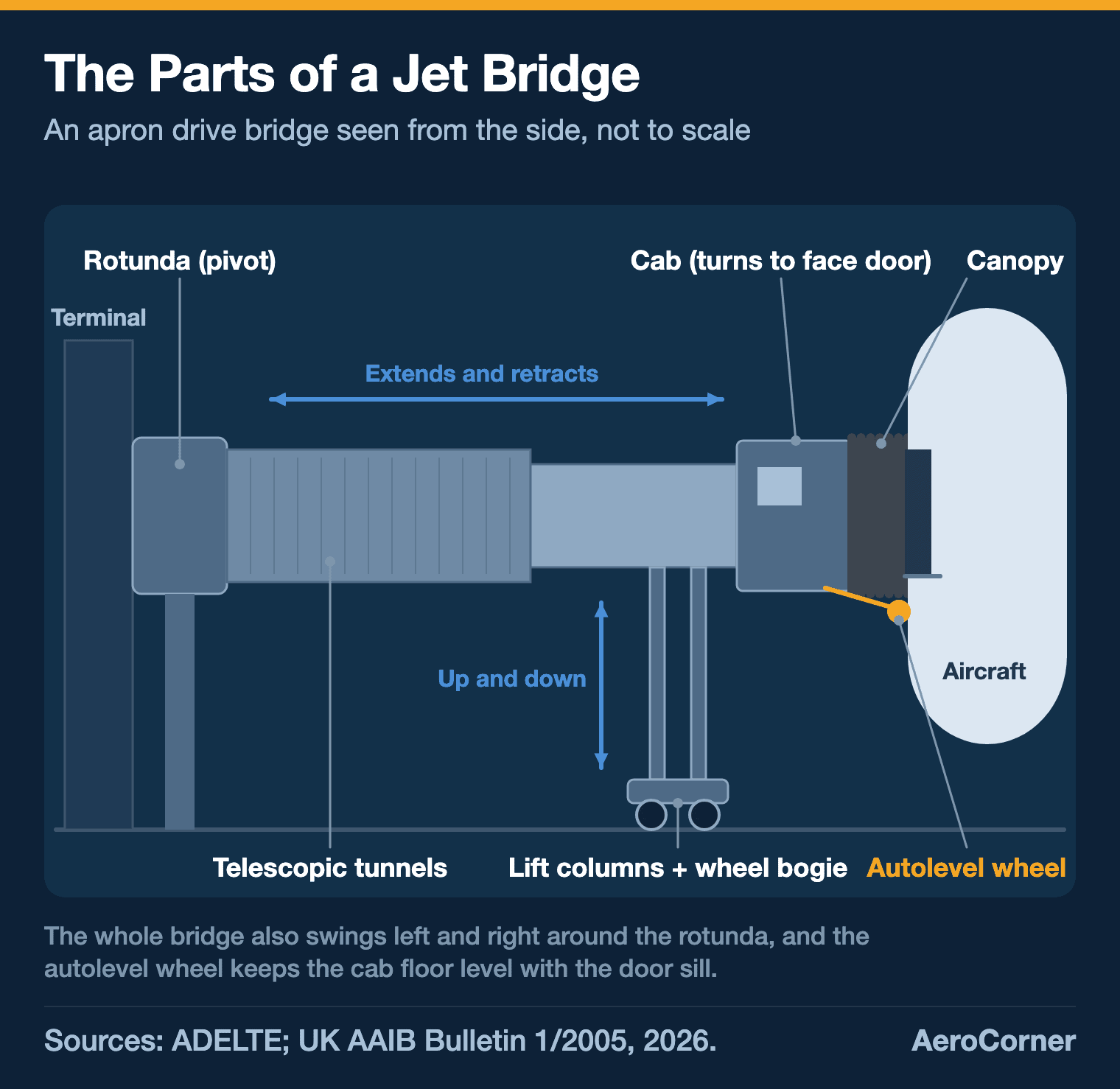
At the far end is the cab, which rotates on its own so its opening can face the door squarely. A folding, accordion-like canopy closes around the fuselage, so it can seal against aircraft of different shapes.
The operator drives all of it from a control station in the cab. The panel pairs a joystick with rows of buttons, and modern bridges add proximity sensors and cab cameras to protect the aircraft and the operator.


Drawn back to its stored position, a bridge leaves the gate clear so the next aircraft can taxi in under its own power, as the first prototype was designed to do in 1958. Newer bridges can also dock themselves: Oshkosh AeroTech sells an automated system that finds the door and docks at the touch of a button, with no markings needed on the fuselage.
Why the Floor of a Jet Bridge Keeps Moving
An airliner does not sit still at the gate. It settles lower as it takes on weight and rises again as passengers get off, and a fixed floor would soon be out of line with the door sill.
The fix is the autolevel system. A wheel and sensor sit on a retractable arm in the cab floor, the wheel rests against the fuselage, and it turns as the aircraft moves up or down, so the bridge raises or lowers itself to match.
Some bridges add a safety shoe, a plate the operator places under the open door. If the door touches it, the bridge head is driven down and an alarm sounds, which protects the door from being pried upward.
When the autolevel failed
On March 17, 2004, at Birmingham Airport in England, an Airbus A320 sank while about two-thirds of its passengers boarded. The autolevel wheel had jammed at full travel and the safety shoe had been removed eight days earlier after it was found damaged, so the bridge floor pressed on the forward left door and damaged its hinges. After the incident, which the UK Air Accidents Investigation Branch reported on, the airport ruled that a docked bridge on autolevel must never be left unattended.
Who Operates the Jet Bridge?
Someone has to be licensed to drive it. At Birmingham Airport in England, for example, the bridges were run by the handling agent’s staff, trained for that bridge, and it is one of the roles covered in our guide to airport jobs.
At Birmingham in 2004, the airport set the rules and the handling agent did the training, and operators held a license from the airport valid for three years. After the A320 door damage, the handler cut refresher training to once a year.
ACI Asia-Pacific & Middle East, a regional branch of Airports Council International, now recommends that standard. Its 2025 guidelines call for a permit system like an airside driving permit, refresher training preferably once a year, and an operator in the cab during boarding and deplaning.
Docking and undocking the bridge are also part of the tight schedule described in how airlines turn an aircraft around.
Types of Jet Bridges
The apron drive bridge described above does most of the work, but manufacturers build several variations for different gates and aircraft.
| Type | How it differs | Where you see it |
|---|---|---|
| Apron drive | Telescopic tunnels on a wheeled drive unit that can travel across the apron | Most gates worldwide |
| Nose loader | Anchored to the building, extends straight out and moves up and down | Gates with restricted parking space |
| Multiple bridges per gate | Two or three bridges serving different doors of one aircraft | Widebody gates, such as for the Boeing 747 and 777 |
| Upper deck bridge | A taller bridge that reaches the second deck | Airbus A380 gates |
| Over-wing bridge | Hung from an overhead structure so it can pass above the wing | Amsterdam Schiphol’s original widebody gates |
| Low-range (regional) bridge | Lower rotunda and an adjustable, retractable cab floor | Regional aircraft and terminals with low floor heights |
Big aircraft get more than one bridge so passengers board through several doors at once. The Airbus A380 is unusual because both of its passenger decks have outside doors, so a gate can feed the upper and lower decks in parallel.
Regional bridges need extra tricks. Oshkosh AeroTech’s low-range line uses lower rotundas and adjustable, retractable cab floors, so the cab can work around the doors, built-in steps and handrails of many regional aircraft.

Why Airports Use Jet Bridges, and Why Some Airlines Avoid Them
Jet bridges give passengers dry, all-weather access to the aircraft. They also keep passengers off the apron, away from aircraft fumes, noise and other dangers on the ramp, and they enhance the security of terminal operations.
They matter for accessibility too. Passengers with reduced mobility can board without climbing stairs or using a special wheelchair lift.
The catch is cost. Airports often charge more for a stand with a bridge than for one served by mobile stairs, so low-cost airlines such as Ryanair avoid bridges wherever they can and board by stairs.
A bridge serves one door, so most narrowbody passengers file through the front. Why that shuffle takes as long as it does is a story of its own, told in why boarding takes so long.
When Was the First Jet Bridge?
There is no single first. The idea goes back to the 1930s, the first true prototype was tested in 1958, and three airlines had working bridges installed within weeks of each other in the summer of 1959.
1931
Croydon’s movable walkways. London’s Croydon Airport uses open walkways to shield passengers from propeller wash, not weather. They do not reach the building.
1936
Gatwick’s Beehive. The round terminal at London Gatwick has six gates with telescopic canopies that roll out to the aircraft on steel rails.
1955
The Loadair Dock. Idlewild Airport in New York tests a system that pulls aircraft sideways to a covered dock on tracked dollies. It serves more than 1,500 flights before it is dismantled in 1956.
March 28, 1958
The Aero-Gangplank. Lockheed Air Terminal’s fully enclosed bridge for United goes into trials at Chicago O’Hare. It extends from 55 to 107 feet (17 to 32 m) and swings and rises to the door.
July 14, 1959
American at San Francisco. American Airlines puts the first fully operational boarding bridge into service at SFO for its Boeing 707s. One of its two bridges is a Jetway built by Pacific Iron and Steel.
July 1959
Delta at Atlanta and United at SFO. Delta docks its first DC-8 to two Jetway prototypes in Atlanta, and United installs the first four of ten bridges on Concourse B in San Francisco on July 29.
August 7, 1961
The first bridge outside the US. The Aviobridge prototype opens at Amsterdam Schiphol to serve KLM DC-8s.
The concept is credited to Frank Der Yuen, an aeronautical engineer whose design Lockheed licensed to build the Aero-Gangplank. The O’Hare prototype took 90 seconds to position at a United DC-7, according to Airporthistory.org’s account of the trials.
Why it is called a jetway
Jetway was the product name of the bridges Pacific Iron and Steel of Los Angeles built for American and Delta in 1959. The name stuck so firmly that it became the everyday word for any boarding bridge, and Jetway is still a registered trademark, used today by Oshkosh AeroTech for its bridges.
American’s 1959 setup at San Francisco International had a bridge for the front door and one for the rear. Trials with the Boeing 707 showed the rear bridge saved only a few minutes, so American dropped it and kept front loading only.
That choice, with aircraft parked nose-in to save space, is the layout most gates still use. The newest bridges have glass walls and sensors, but the basic design has changed only a little since then.
Why Do Planes Board on the Left?
Airliners have doors on both sides, but passengers almost always use the left. The reasons usually given are practical and historical.
The captain sits on the left, which made it easier to judge wing clearance and stop the door in front of the terminal in the days when aircraft taxied right up to the building. Keeping passengers on the left also leaves the right side free for the ground crew, including fueling, which is covered in how airplanes store fuel in their wings.
The third explanation comes from ships. “Starboard” comes from the steering board once mounted on the right side of a ship, so ships loaded from the left, or port, side, and aircraft designers are said to have kept the habit.

How Much Does a Jet Bridge Cost?
A new jet bridge costs roughly $1.5 million to $2 million, judging by a recent US project. Cincinnati/Northern Kentucky International replaced all 28 bridges on its Concourse B between June 2023 and May 2024 at $1.5 million to $2 million per bridge.
The bridges they replaced were nearly 30 years old. Oshkosh AeroTech, which builds the Jetway line, quotes more than 20 years of life for its bridges, so an airport buys each bridge expecting it to serve for decades.
For scale, American’s first two bridges at San Francisco in 1959 were installed for $100,000, and Delta’s order for 17 Jetways for Atlanta came to $265,000.
FAQ
Sources and references used for research and fact-checking.
- Airporthistory.org, A History of the Boarding Bridge, Part 1
- Flightradar24, A brief history of the jet bridge
- Wikipedia, Jet bridge
- ACI Asia-Pacific & Middle East, Guidelines on Safe Operations of Passengers Boarding Bridge (2025)
- UK Air Accidents Investigation Branch, AAIB Bulletin 1/2005: Airbus A320-231, G-JOEM
- Core77, What Gains 50,000 Pounds in 15 Minutes?
- ADELTE, Passenger Boarding Bridges
- Oshkosh AeroTech, Jetway Passenger Boarding Bridges
- Oshkosh AeroTech, Jetway Passenger Boarding Bridges: Low-Range Bridges for Regional Aircraft
- Airport Improvement, Cincinnati Int'l Improves Boarding Efficiency, Other Ground Handling Systems in Concourse B
- Business Insider, Why you board an airplane on the left side
Get the Newsletter
The latest aviation news and stories sent to your inbox.
About the Author

Tim is the owner and lead editor of AeroCorner since 2019, overseeing aviation content covering aircraft, airlines, airports, and the broader aviation industry. Through years of researching, writing, editing, and publishing aviation-focused content, he has developed extensive practical knowledge of commercial aviation and air travel. Based in Asia and a frequent traveler himself, Tim also brings firsthand passenger experience to AeroCorner’s coverage. Outside of publishing, he has also explored aviation firsthand through hands-on flight training in New Zealand.