

Table of Contents
The fare on the search results page says $39. By the time you have a seat you chose, a bag in the overhead bin and a boarding pass that did not cost extra to print at the airport, you have paid something closer to $130.
The usual reaction is that the airline lied to you. It did not. That $39 fare is a real, bookable price, and if you fly with nothing but the clothes you are wearing, $39 is genuinely what you pay.
What is going on is stranger and more deliberate than a bait and switch. An ultra low cost carrier prices the seat below what the flight costs to operate, on purpose, and then makes its money back on everything that is not the seat.
Here is how that actually works, and why the model has proved so much more fragile than its economics suggest.
Why Are Frontier Flights So Cheap?
Because the fare is not the product. It is the price of one unbundled item: a seat, on a plane, going somewhere. Every other thing a traditional airline includes in the ticket has been stripped out and repriced separately.
The numbers make this unusually concrete. Across all of 2025, the average Frontier passenger handed over $112.17.
Only $44.60 of that was the fare. The other $67.57 was bags, seat assignments, bundles, change fees and everything else.
Read that again, because it is the whole article in one line: the extras were worth more than the flight. That is not a side business. That is the business.
The short version
An ultra low cost carrier deliberately sells the base fare below its own cost, then earns the difference on fees, bundles and the sale of frequent flyer miles to a bank. To make that arithmetic work it packs more seats into the same airframe, flies one aircraft type, and keeps those aircraft in the air as many hours a day as it can. The cheap fare is real. It was simply never intended to pay for the flight.
The Fare Is the Loss Leader
Unbundling is not unique to the budget carriers. Every large US airline now sells a basic economy fare that strips out seat choice and the overhead bin, and the industry’s whole pricing architecture has been rebuilt around selling pieces rather than tickets, as we cover in our look at how airfare is actually built today.
The difference is one of degree so extreme it becomes a difference in kind. At the big network carriers, fees and other non-ticket revenue run in the low teens as a share of the total. At Frontier it has been running around 60 percent.
Look at what happened to that split after Spirit Airlines stopped flying in May 2026 and a large chunk of cheap domestic capacity vanished overnight.
| Frontier, revenue per passenger | Full year 2025 | Q2 2026 |
|---|---|---|
| Fare | $44.60 | $63.04 |
| Non-fare (bags, seats, bundles, fees) | $67.57 | $68.42 |
| Total | $112.17 | $131.46 |
| Non-fare share of the total | 60% | 52% |
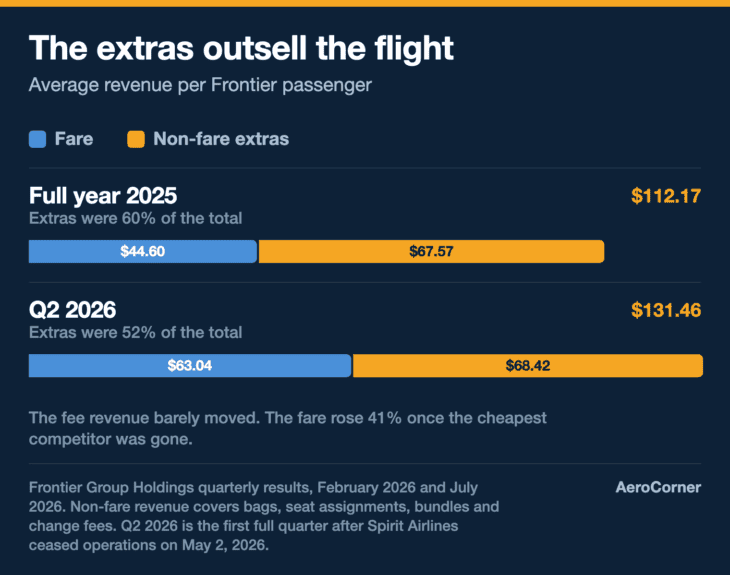
The fee revenue barely moved. The fare jumped 41 percent, because the cheapest competitor was gone and Frontier could finally charge something closer to what the flight is worth.
That is the clearest evidence you will get that the low fare was never a cost outcome. It was a competitive one, set by what the airline had to charge to win the click, not by what it cost to fly you.
How the Cost Side Gets Low Enough to Survive That
Selling a seat below cost only works if your cost is genuinely, structurally lower than everybody else’s. The ultra low cost model attacks that in four places at once.
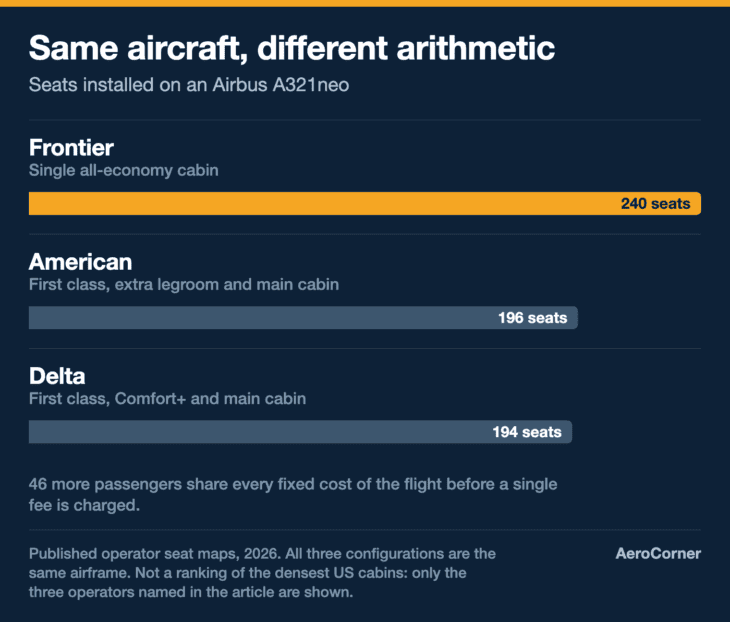
The first is seat density. Frontier’s Airbus A321neo carries 240 seats. The same airframe at Delta carries 194, and at American 196.
Nothing about the aircraft changed, only how many people are asked to share the cost of flying it.
Same aircraft, 46 more people
A Frontier A321neo seats 240. A Delta A321neo of the identical type seats 194, and an American one 196. Every fixed cost of the flight, the fuel, the crew, the landing fee, the maintenance reserve, is divided across roughly 23 percent more paying passengers before a single fee is charged. That is the single largest reason a budget airline can quote a fare a legacy carrier cannot match.
The second is fleet commonality. Flying one family of aircraft means one set of spare parts, one maintenance program, and pilots who can be assigned to any aircraft on the property. Frontier ended 2025 with 176 Airbus single-aisle jets and nothing else.
The third is utilization, which is simply how many hours a day an aircraft is actually flying rather than sitting at a gate. An aircraft on the ground earns nothing and costs the same, so the model depends on turning each aircraft around fast and sending it straight back out.
The fourth is what the airline chooses not to do at all. No lounges, no interline agreements with other carriers, no complex hub built to feed connections, and a heavy lean toward secondary airports where the fees are lower and the gate is free at the hours nobody else wants.
Put together, that gets Frontier’s non-fuel cost per available seat mile down to 7.41 cents for 2025. It is the lowest in the country by a comfortable margin, and it is the entire reason a $44 average fare is survivable at all.
The Bank Is a Bigger Customer Than You Are
There is a third revenue stream that almost no passenger thinks about, and at some airlines it is the most profitable thing they do. Airlines create frequent flyer miles at essentially zero cost, then sell those miles in bulk to a bank, which hands them to you as credit card rewards.
At Delta, that arrangement with American Express was worth $8.2 billion in 2025, against total operating revenue of $63.4 billion. One card partner accounts for roughly an eighth of the airline’s entire top line.
Frontier runs a smaller version of the same machine with Barclays, and in June 2026 the two extended the partnership out to 2037. As part of it, Frontier raised the facility under which Barclays buys miles in advance from $200 million to $375 million.
That last detail is worth sitting with. A bank pre-paying for a loyalty currency the airline can print is, in practical terms, a loan secured against future miles. For a carrier with thin margins, it is a genuine source of cash independent of whether the planes are full.

The Efficiency Is Also the Fragility
Here is the part that gets left out of most explanations, and it is the most interesting thing about the model. Every lever that makes an ultra low cost carrier cheap also makes it brittle.
High utilization means there is no slack. An airline that keeps its aircraft flying 12 hours a day has no spare airframes parked and waiting, and no gap in the schedule to absorb a delay, so a single morning problem cascades through the rest of the day in a way a network carrier can usually break.
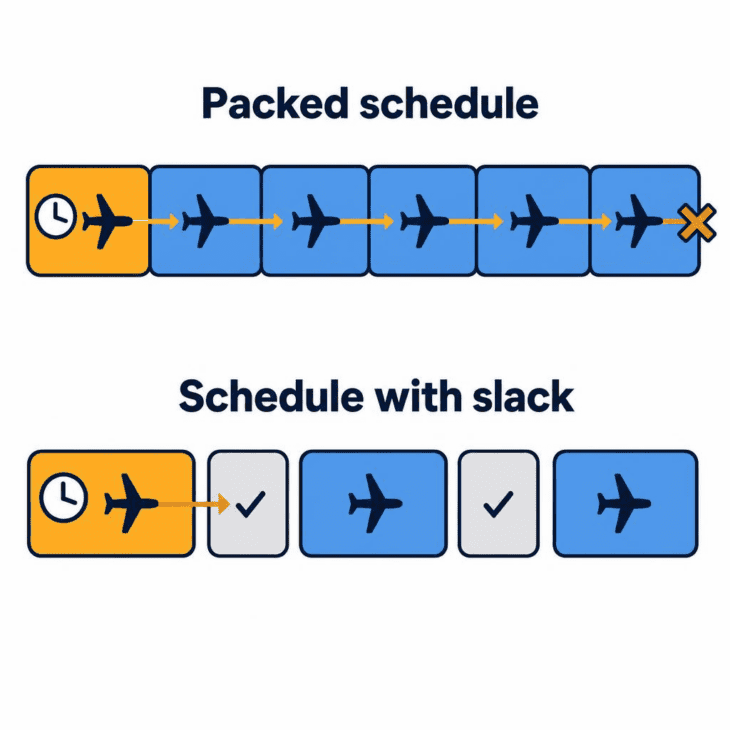
No interline agreements means there is no escape hatch. When a legacy airline cancels on you it can put you on a rival’s aircraft; when a budget carrier cancels on you, your options are its own next available seat or a refund. If that seat is two days out, that is the offer.
And razor-thin margins mean no cushion against the one cost nobody controls. Fuel is roughly a quarter of the operating cost, and when a fare is set at $44 there is no room in it to absorb a spike.
Spirit Airlines is the case study. It filed for Chapter 11 in November 2024, emerged in March 2025, filed again that August, and then, on May 2, 2026, stopped flying altogether at three in the morning after 34 years.
Its own court filing blamed a sustained jet fuel price surge that made the reorganization plan unworkable, and the estate moved to auction the remaining aircraft within days.
Frontier survived the same fuel environment and is still not comfortable. It lost $137 million in 2025, and even with record revenue of $1.3 billion in the second quarter of 2026, boosted by all the passengers Spirit is no longer carrying, it posted a $90 million net loss.
Notice too that utilization, the model’s supposed engine, has quietly eroded. Frontier averaged 12.2 hours a day per aircraft in 2019. In 2025 it averaged 9.2.
The Myth: It Is a Bait and Switch
The common assumption
That the advertised fare is a fake number designed to lure you in, and the real price is revealed only at checkout. It is the most widely held belief about budget airlines, and it is the wrong way round.
The advertised fare is not fake. It is a real, honoured price for a real, narrowly defined product, and a passenger who travels with a personal item and takes whatever seat they are assigned pays it and nothing more.
What is misleading is not the number. It is the assumption you bring to it, which is that a fare includes a bag and a seat because that is what a fare has always included.
This matters because it changes what a fair comparison looks like. Set against a legacy carrier’s basic economy fare, which increasingly strips out the same things, the budget airline’s advantage is real but far narrower than the headline suggests, and it is worth understanding how airlines set those fares in the first place.
The honest rule is simple. If you are travelling light and flexible, an ultra low cost carrier is genuinely, substantially cheaper. If you need a bag, a specific seat and the ability to be rebooked when something goes wrong, you are buying the expensive version of a cheap airline, and that is often the worst deal on the page.
Where the Model Goes From Here
The purest form of this business is in retreat. Frontier began installing first class seats in 2026, two rows of them at the front in a two-by-two layout, which is a strange thing for an airline whose entire identity was that it did not have a front.
The reasoning is straightforward. When the legacy carriers copied unbundling, the budget airlines lost their monopoly on the cheap fare, so they started climbing back up toward the paying customer they had spent 20 years designing themselves away from.
Meanwhile the capacity Spirit took with it has not come back. Across the routes Spirit flew in the summer of 2025, rivals replaced only about 48 percent of its seats the following summer, and the total number of seats on those routes was still down 8.8 percent year on year.
So the next time you see a $39 fare and feel the reflex that it must be a trick, it is worth remembering what you are actually looking at. It is a real price for a genuinely stripped-down thing, offered by an airline that has spent decades engineering its costs down to the point where the offer is nearly sustainable.
Nearly. The gap between that fare and what the flight really costs has to be closed somewhere, and it gets closed at the bag drop, at the seat map, and by a bank buying miles a decade in advance.
You are not being tricked. You are being itemized.
Sources and references used for research and fact-checking.
- Frontier Group Holdings, Frontier Airlines Reports Fourth Quarter 2025 Financial Results
- Frontier Group Holdings, Frontier Airlines Delivers Record Second Quarter 2026 Revenue of $1.3 Billion
- Chapter11Cases, Spirit Airlines Seeks Court Authorization to Sell or Abandon Remaining Owned Fleet Following Cessation of All Passenger Operations
- Aviation Week, Analysis: Spirit's Exit Drives Growth For Frontier And JetBlue
- Delta Air Lines, Delta Air Lines Announces December Quarter and Full Year 2025 Financial Results
- American Banker, What Barclays gets from its Frontier Airlines extension
Get the Newsletter
The latest aviation news and stories sent to your inbox.
About the Author

Tim is the owner and lead editor of AeroCorner since 2019, overseeing aviation content covering aircraft, airlines, airports, and the broader aviation industry. Through years of researching, writing, editing, and publishing aviation-focused content, he has developed extensive practical knowledge of commercial aviation and air travel. Based in Asia and a frequent traveler himself, Tim also brings firsthand passenger experience to AeroCorner’s coverage. Outside of publishing, he has also explored aviation firsthand through hands-on flight training in New Zealand.