


Table of Contents
Book a round-trip flight from Charlotte to New Orleans and back, and a recent search returned $259 in standard economy. Book the exact same outbound flight on its own, as a one-way, and it cost $454. Nearly double, for half the travel.
That math offends common sense. You are buying less, so it should cost less. For a stretch of the 2010s, it often did: two one-way tickets on a US domestic route usually added up to the round-trip price, and sometimes beat it. Then, quietly, that changed.
The one-way that costs more than a round trip is not a glitch, and it is not the airline charging you for the “extra” flight you are not taking. It is a visible symptom of how airfare is actually built in 2026, and of a much bigger shift in how airlines set every price. This is the real story behind the number on the screen.
The short answer
Airlines never priced a round trip as “two flights.” They priced it as a product aimed at a leisure traveler, who is flexible and price-sensitive, and they deliberately made the one-way expensive to catch the business traveler, who is not. The cheap round trip was the bait; the pricey one-way was the trap.
For years, low-cost carriers forced the legacy airlines to abandon that trap and sell honest one-way fares. Now, with those low-cost rivals weakened, the legacy carriers are rebuilding it, and doing it with far more precise tools than they had in 2005.
The answer in one line
A one-way is not half a round trip. Airlines price each fare to separate flexible leisure travelers from inflexible business travelers, and modern pricing engines now do it in real time, leg by leg, so the old round-trip discount is fading.
How airfare was actually built
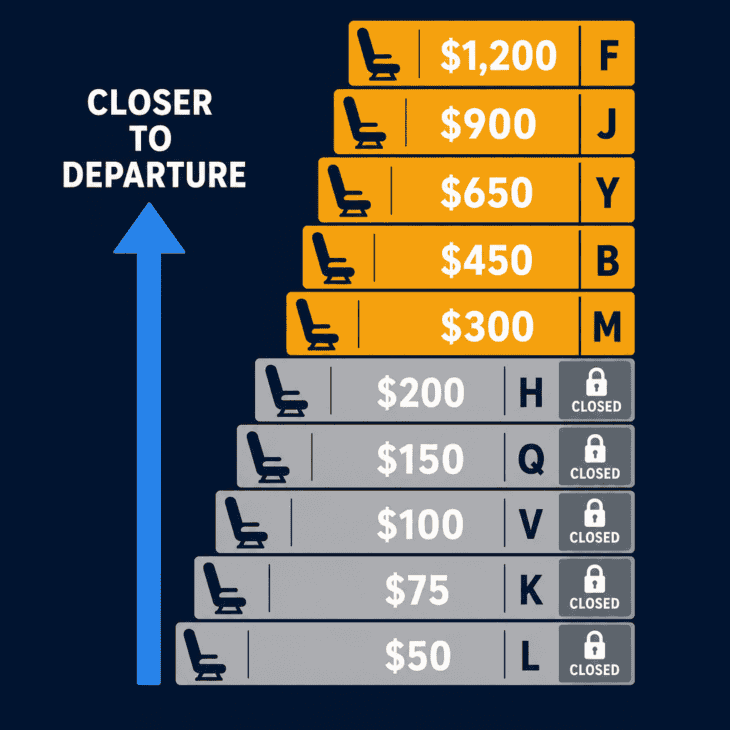
For most of the jet age, an airline did not set one price for a seat. It filed a ladder of fares for the same cabin, each with its own rules, and revenue management software decided how many seats to sell at each rung. A single economy cabin might be sold at a dozen different prices on the same flight.
Those rungs are called fare classes, or booking classes: single-letter codes that sit behind the price you see. Cheap seats live in the lower classes and sell out first; as departure nears and the plane fills, the airline closes those classes and only the expensive ones remain. That is the machinery behind why the same seat costs more the closer you book. Our guide to how often flight prices change walks through that mechanism in detail.
The cheapest fares came with strings attached, and the strings were the point. A low round-trip fare might require you to buy weeks ahead, accept no refund, and stay over a Saturday night at your destination. That last rule, the Saturday-night stay, was the cleverest fence airlines ever built.
The logic was simple. A businessperson flying out Monday and home Thursday will not sit in a hotel over the weekend just to save money, but a vacationer almost always stays the weekend anyway. By tying the discount to a Saturday night, the airline let the leisure traveler have the low fare and quietly charged the business traveler far more, without ever asking who was who. Economists call this price discrimination, and airfare is its most refined example. Our deeper look at how airline ticket pricing works unpacks the full toolkit.
The one-way ticket was the other half of that fence. Business travelers with rigid, last-minute plans are the people most likely to need a single leg, so the one-way fare was priced high on purpose. It was never meant to be half a round trip. It was meant to be the full-fare product for the customer who could not shop around.
Why the round-trip discount is fading
Two things broke the old system, and then a third rebuilt it into something stranger.
The first was the low-cost carrier. Southwest, and later the ultra-low-cost airlines, sold flights as simple one-way prices with no Saturday-night trickery. To compete on the same routes, the legacy carriers had to match them, so through the 2010s the one-way penalty on domestic flights largely vanished and two one-ways reliably equalled a round trip.
The second was unbundling. The single “ticket” split into fare families: basic economy, main economy, and up, each a different bundle of legroom, bags, and change rights. Once a fare is a menu of parts rather than one product, the neat round-trip discount has less to hold onto, because the airline is now pricing flexibility itself, in either direction, one leg at a time.
The third change is the big one: continuous, or dynamic, pricing. Instead of filing a fixed ladder of fare classes, airlines increasingly let an algorithm generate a price at the exact moment you ask, using live demand, the seats left, the day of week, how close departure is, and what it can guess about you. By 2026, industry analysts estimate that more than half of all passengers boarded are priced this way in some form.
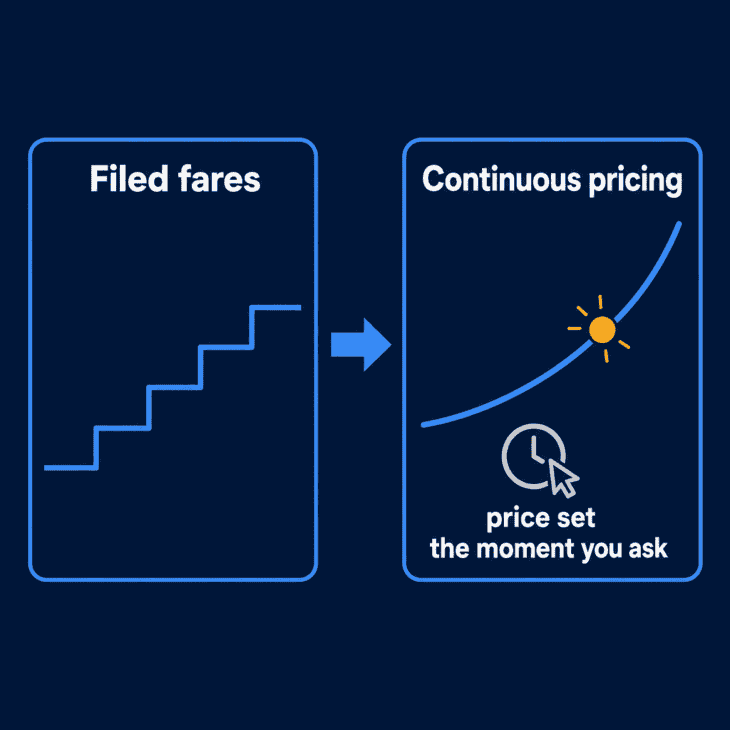
This runs on a plumbing upgrade called NDC, or New Distribution Capability, the modern data pipe that lets an airline send a custom offer straight to the booking screen rather than publishing a fixed fare to the old shared systems. When each leg can be priced on its own, in real time, the round trip stops being a single discounted product and becomes two independent prices that happen to appear together.
The penalty came back in 2025
A 2025 analysis of 2,000 US domestic itineraries found more than half of one-way flights on the five largest carriers were priced higher per segment than the same trip booked round-trip. Delta penalized nearly two-thirds of one-way bookings; Southwest, the old disruptor, penalized the fewest.
The penalty is not uniform, and that is the tell. It is heaviest exactly where the old fence used to sit: close to departure and on business travel days. The same 2025 study found one-way fares ran higher on 91% of flights booked within two weeks of departure, but on only 47% of flights booked 60 or more days out.
The typical extra you pay for a one-way still varies a lot by airline. Here is where the median one-way penalty landed in that analysis, per segment.
| Carrier | Median one-way penalty (per segment) |
|---|---|
| Delta | ~$50 |
| American | ~$48.50 |
| Southwest | ~$18 |
So the discount did not simply disappear. It got smarter. The airline no longer needs a blunt Saturday-night rule to find the inflexible traveler, because a pricing engine watching the calendar and the clock can spot that traveler in real time and quote them accordingly.
The myth, and the reality
The myth
A one-way costs more because you are only buying half the trip, so the airline charges extra to make up the difference. A round trip is a package deal and packages are always cheaper.
None of that is how it works. The airline is not subsidizing your return leg or punishing you for skipping it. Each fare is priced for the customer most likely to buy it, and the customer most likely to buy a single expensive leg at short notice is exactly the one an airline most wants to charge more.
The practical reality is that no single rule holds anymore, and that is the useful takeaway. On a leisure route booked well ahead, two one-ways often still match or beat a round trip, and booking two one-ways can even let you mix airlines or grab a cheaper fare in one direction only. On a business route booked at the last minute, the round trip is now frequently the better deal, which reverses the advice travelers spent a decade following.
This same fluidity is why travelers keep discovering odd fare tricks, from booking a round trip and simply not flying the return to the hidden-city routing behind skiplagging. Those quirks exist because the price of a ticket has almost nothing to do with the cost of flying you, and everything to do with what the airline thinks you will pay.
The honest answer is that airlines have not agreed on one rule, and they never will, because the whole point of dynamic pricing is that there is no fixed rule to game.
Next time you are booking, the move is no longer “always buy the round trip.” It is to price the round trip, then price the two one-ways separately, and take whichever the engine happens to be quoting cheaper that minute. The gap between them is not an accident. It is the airline reading how flexible you are, and charging you for the answer.
That is the quiet trade of modern airfare. The round-trip discount that felt like a law of nature was only ever a marketing fence, and the software that replaced it can rebuild that fence, or tear it down, for every single search.
Sources and references used for research and fact-checking.
Get the Newsletter
The latest aviation news and stories sent to your inbox.
About the Author

Tim is the owner and lead editor of AeroCorner since 2019, overseeing aviation content covering aircraft, airlines, airports, and the broader aviation industry. Through years of researching, writing, editing, and publishing aviation-focused content, he has developed extensive practical knowledge of commercial aviation and air travel. Based in Asia and a frequent traveler himself, Tim also brings firsthand passenger experience to AeroCorner’s coverage. Outside of publishing, he has also explored aviation firsthand through hands-on flight training in New Zealand.