

Table of Contents
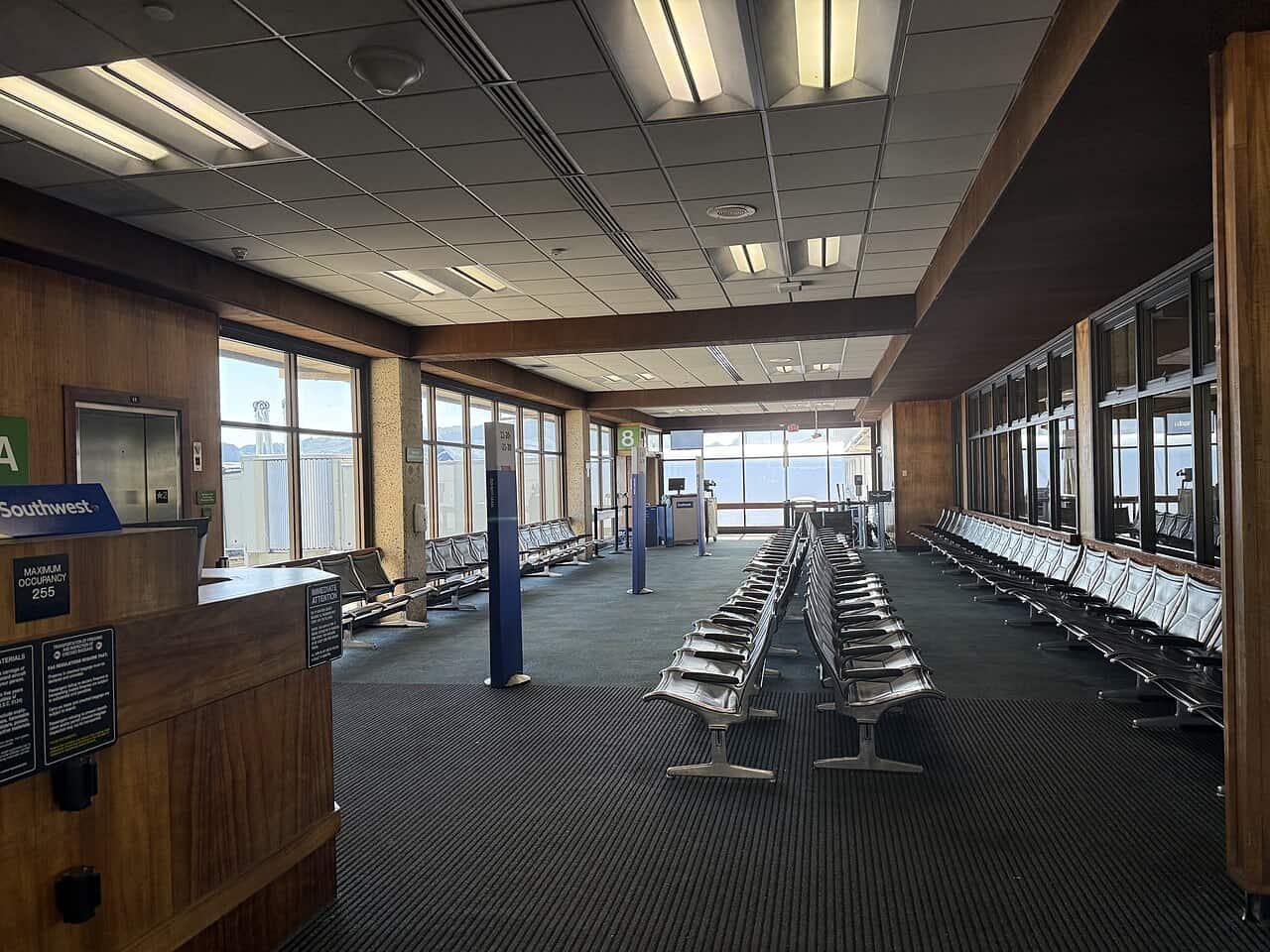
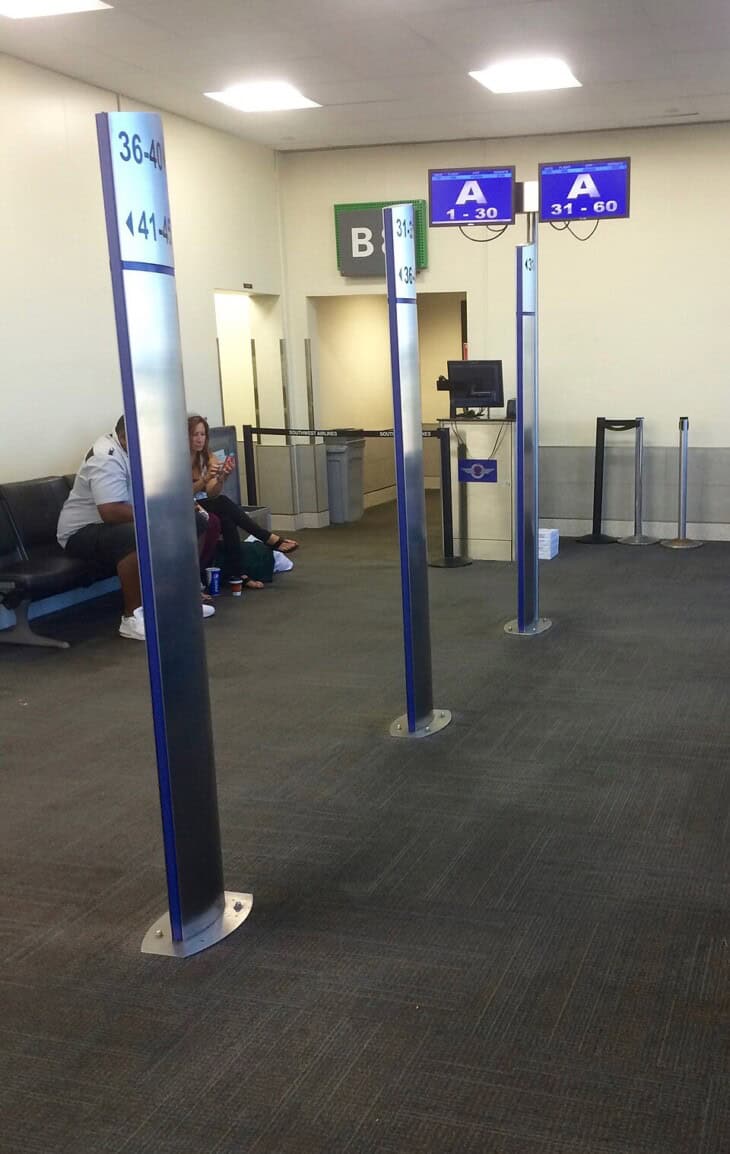
For decades, a Southwest gate had a look no other airline’s did. Rows of numbered silver posts, and passengers lining up beside the number printed on their boarding pass, waiting to walk on and claim whatever seat they liked.
That gate no longer exists. On January 27, 2026, Southwest assigned seats on every flight for the first time since its founding, and the lettered A, B and C groups went with it.
Search the question today and you will still get plenty of confident answers describing the old system. Here is what actually replaced it, why the airline walked away from the thing that made it famously fast, and the problem the new design created within three weeks of launch.
How Does Southwest Boarding Work?
Every passenger now has an assigned seat and a numbered boarding group from 1 to 8, both printed on the boarding pass. Groups are called in order, and there is no scramble for a seat once you are aboard.
What trips people up is how that number is decided. Southwest says your group is based on “fare type, seat type and location, Rapid Rewards status, and Rapid Rewards Credit Card benefits,” which means your fare alone does not determine when you board.
The short version
Assigned seats, eight numbered boarding groups, and no more lining up by a numbered post. Extra Legroom seats and top-tier status board first, Basic fares board last, and everything in between depends on which seat you picked as much as which fare you bought.
The gate furniture changed too. The numbered stanchions were pulled out over roughly 60 days from January 26, replaced by two alternating boarding lanes and digital screens showing the group currently boarding.
Your Boarding Group Is Not Really About Your Fare
Southwest now sells four fare bundles: Basic, Choice, Choice Preferred and Choice Extra, the renamed descendants of Wanna Get Away, Wanna Get Away Plus, Anytime and Business Select.
Sitting across those fares are three seat types. Extra Legroom seats at the front of the cabin and by the exit rows, Preferred seats with standard legroom near the front, and Standard seats toward the back.
The seat is what does the heavy lifting. Buy an Extra Legroom seat on an ordinary Choice ticket and you board in Group 2, ahead of passengers who paid for a higher fare bundle but chose a seat further back.
This is why the published order overlaps rather than running cleanly from 1 to 8. A plain Choice fare can land anywhere from Group 3 to Group 7 depending on the seat attached to it.
| Boarding group | Who is in it |
|---|---|
| Preboard | Passengers with disabilities or who need extra time, unaccompanied minors |
| Priority Boarding | Purchased within 24 hours of departure, plus active duty US military with ID |
| Before Group 1 | Rapid Rewards A-List Preferred members |
| Group 1 | Rapid Rewards A-List members, Choice Extra fare |
| Group 2 | Extra Legroom seats on Choice and Choice Preferred fares |
| Groups 3 to 4 | Choice Preferred fare in Standard or Preferred seats |
| Group 5 | Rapid Rewards Credit Cardmembers not already placed in an earlier group |
| Groups 3 to 7 | Choice fare in Standard or Preferred seats |
| Group 8 | Basic fare |
A few rules cut across all of it. Everyone on the same reservation boards in the same group, and A-List, A-List Preferred and Cardmember boarding benefits extend to up to eight passengers on one booking.
Basic is the fare that gives up the most. There is no seat selection at booking at all: the seat is assigned at check-in, and Basic passengers board dead last in Group 8. If you are weighing those trade-offs, the same unbundling logic drives the whole ultra low cost carrier model.
Why Southwest Gave Up the System That Made It Fast
Open seating was not a quirk. It was a tool, and it existed because Southwest once had to turn aircraft faster than anyone thought possible.
In the early 1970s the airline sold one of its four Boeing 737s to stay solvent, then had to fly the same schedule with three. The answer was the ten minute turn, at a time when an hour was standard.
Letting passengers take any open seat suited that perfectly. Nobody walked past an empty row to find a specific number, and anyone who dawdled simply got a worse seat, so the line kept moving. The economics of the fast aircraft turnaround have not changed since.
The ten minute turn is long gone anyway
Southwest’s average turn time was about 49 minutes when it presented its transformation plan to investors, with a target of cutting it to 44. The airline that invented the ten minute turn now takes roughly five times that long.
So why abandon it? Southwest announced the end of open seating in July 2024, under pressure to lift profits, and assigned seating is straightforwardly easier to sell.
An open cabin has nothing to charge for. A cabin split into Extra Legroom, Preferred and Standard has a price for the front, a price for the aisle you want, and a reason to buy up from the cheapest fare, which is the same revenue management logic every other carrier already ran.
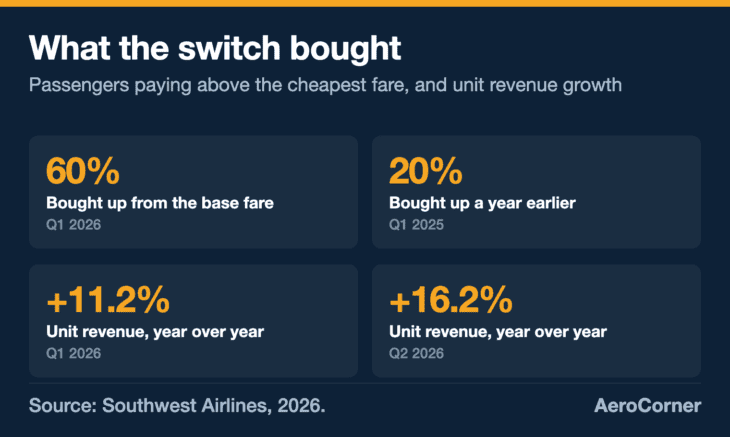
It worked. Southwest reported that roughly 60% of customers upgraded from the base product in the first quarter of 2026, against about 20% a year earlier, with unit revenue up 11.2% year over year.
The second quarter was stronger still: unit revenue rose 16.2%, and 20.1% on an adjusted basis, on essentially flat capacity. Loyalty still matters at the gate too, and Rapid Rewards status buys real boarding position, though what the points themselves are worth is a separate question.
The Overhead Bin Problem Nobody Modeled
Within three weeks of launch, Southwest was rewriting the boarding order it had just introduced.
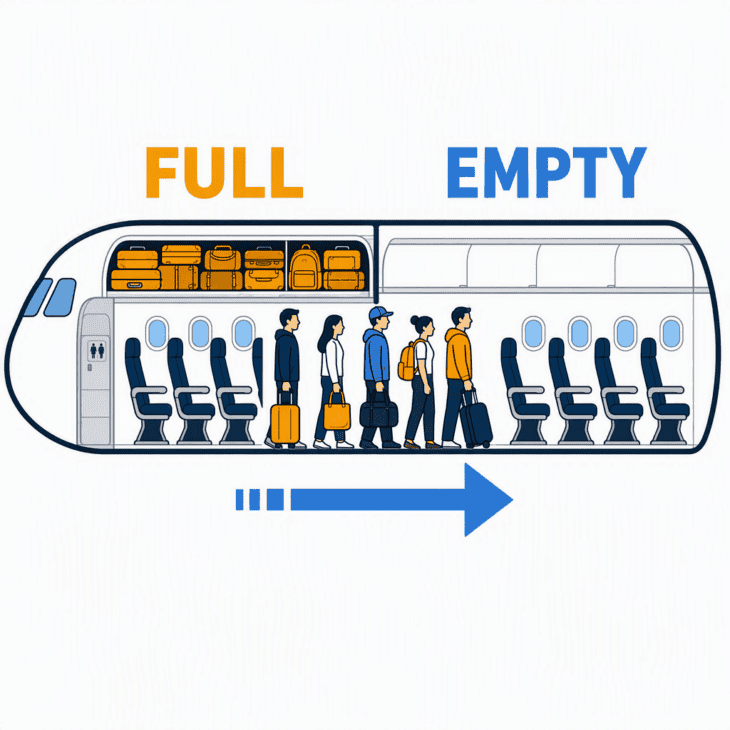
The cause was the overhead bins. Under open seating, passengers spread themselves and their bags through the cabin as they found seats, but an assigned seat makes the bin above it feel like private property.
Board everyone with a front-cabin seat first and they fill the front bins immediately. Passengers seated further back then find nothing above them, and the aisle stops moving while people hunt for space.
May 28, 2025
Checked bags stop being free. Southwest starts charging most passengers to check a bag, and more of them start carrying everything into the cabin instead.
January 27, 2026
Assigned seating begins. Eight numbered groups replace A, B and C, with all Extra Legroom passengers boarding early to spread bags through the front of the cabin.
February 18, 2026
The order is rewritten. An internal memo narrows the first group, citing congestion in the jet bridge and bin space problems from the previous week.
March 2026
Signage and bigger bins. Southwest adds markings reserving the bins above Extra Legroom seats and commits to larger bins holding up to 50% more bags across most of the fleet by the end of 2026.
August 1, 2026
Boarding starts earlier. Boeing 737-800 and MAX 8 flights begin boarding about 35 minutes before departure instead of 30, with crews reporting five minutes earlier to match.
That last step is the telling one. Faced with boarding that took longer than the old system, Southwest did not speed up boarding. It started boarding sooner.
The root cause sits one decision upstream. Southwest began charging for checked bags on May 28, 2025, and a passenger who has to pay to check a bag brings it onboard instead, which is the same reason boarding takes so long across the whole industry.
The Myth: Assigned Seating Made Boarding Better
The common assumption
That Southwest switched to assigned seating because the old free-for-all was slow and chaotic, and that numbered groups are the more efficient way to fill an aircraft. Neither half holds up.
Boarding researchers have studied this for years, and the block methods airlines actually use are the weak performers. Random boarding, where people simply walk on without a prescribed order, beats back-to-front block boarding.
The genuinely fast method is not in use anywhere. The sequence devised by astrophysicist Jason Steffen in 2005 boards passengers in a precise alternating pattern and runs about twice as fast as front-to-back, and roughly 30% faster than random boarding.
Airlines do not adopt it, and one reason is commercial: a strictly optimal sequence has no room in it for selling early boarding. The order at the gate is partly a product, not purely an efficiency exercise. The same tension explains why planes do not just board from the back.
So the honest verdict is that Southwest did not trade a slow system for a fast one. It traded a fast system for a sellable one, and the numbers say the trade is paying off handsomely.
Passengers got something real in return, which is knowing where they will sit. Southwest said the day-one operation held up, reporting best in class on-time performance and the highest completion factor among large domestic peers on launch day.
Next time you are at a Southwest gate, the thing worth watching is the jet bridge. Everything about the new system, the eight groups, the bin signage, the five extra minutes, is an attempt to keep that narrow tunnel moving now that every passenger is walking toward one particular seat.
And if your boarding pass says Group 6 while the person beside you paid less and got Group 3, check their seat. They almost certainly picked one nearer the front.
Sources and references used for research and fact-checking.
- Southwest Airlines, Assigned Seating
- Southwest Airlines Investor Relations, Southwest Airlines Reports First Quarter Results; Business Transformation Initiatives Deliver Meaningful Margin Expansion
- Southwest Airlines Investor Relations, Southwest Airlines Reports Second Quarter 2026 Results; Earnings Power on Full Display
- Paddle Your Own Kanoo, Southwest Airlines Is Tinkering With its New Boarding Process Again As it Attempts to Solve Bin Space Dramas
- Paddle Your Own Kanoo, Southwest Airlines Will Officially Board Planes Earlier In Response To Passengers Bringing More Hand Luggage On Board
- Simple Flying, Customer Uproar Forces Southwest To Rethink Assigned Seating Policy: Here's What's Changing
- Simple Flying, Why Southwest Airlines' New Assigned Seating System Created Problems It Didn't Anticipate
- Simple Flying, This Is How Short Southwest Airlines' Turnarounds Used To Be
- One Mile at a Time, Southwest's Optimistic Plan To Reduce Turn Times, Speed Up Boarding
- Scientific American, There Are Quicker Ways to Board a Plane, So Why Don't Airlines Use Them?
- TravelPulse, Southwest Airlines Shares New Gate Experience, Boarding Process for 2026
- NPR, Travelers will no longer be able to choose open seats on Southwest Airlines flights
Get the Newsletter
The latest aviation news and stories sent to your inbox.
About the Author

Tim is the owner and lead editor of AeroCorner since 2019, overseeing aviation content covering aircraft, airlines, airports, and the broader aviation industry. Through years of researching, writing, editing, and publishing aviation-focused content, he has developed extensive practical knowledge of commercial aviation and air travel. Based in Asia and a frequent traveler himself, Tim also brings firsthand passenger experience to AeroCorner’s coverage. Outside of publishing, he has also explored aviation firsthand through hands-on flight training in New Zealand.