


Open the Southwest app, search Dallas to Denver on a Tuesday in February, and the award price comes back as something like 7,412 points. Not 7,500. Not a round number at all.
That oddly specific figure is the whole story. It is not a price anyone chose for that route. It is arithmetic, run against the cash fare sitting next to it.
Almost every large US airline now works this way, and the change happened quietly enough that most people still search for a number that stopped existing years ago. Here is what actually determines the points price of a seat, and where the old fixed pricing survives.
How Many Points for a Flight?
There is no fixed answer, because on Southwest and every other major US carrier the points price is derived from the cash fare rather than published in advance. A cheap fare is a cheap award, and an expensive fare is an expensive award.
As a working range in 2026, a domestic one-way that sells for around $99 tends to cost somewhere near 6,000 to 8,000 points. A peak holiday fare of $450 or more will run 30,000 points and up on the same airline, on the same aircraft, between the same two cities.
The answer in one line
On Southwest, Delta, United, JetBlue and American’s own flights, the number of points required is calculated from the cash fare at the moment you search. There is no chart to look it up in, so the only way to know the price is to run the search. Fixed, published award charts now survive mainly on partner airline redemptions.
Southwest Killed Its Award Chart First, in 2011
Southwest is usually cast as the follower in loyalty program changes. On this one it led by four years.
On 6 January 2011 the airline announced a rebuilt Rapid Rewards, live from 1 March that year. Points would be earned per dollar spent and redeemed against the price of the ticket you wanted, replacing the old system of flight credits.
The sales pitch was availability. Southwest promised “every seat, every day, on every flight with absolutely no blackout dates or seat restrictions,” which was a genuine improvement over the capacity-controlled award seats every other program rationed.
That was the trade, and it is worth naming plainly. Members gained the certainty that a seat would be bookable, and gave up the certainty of what it would cost.
The rest of the industry took most of a decade to follow. Delta stopped publishing an award chart in 2015. United announced the end of its charts in April 2019 and applied it to travel from 15 November that year, and American moved its own flights to dynamic pricing over the same period.
March 2011
Southwest goes revenue-based. Rapid Rewards is rebuilt so points are earned per dollar and redeemed against the fare, in exchange for no blackout dates and no capacity-controlled award seats.
2015
Delta drops its chart. SkyMiles stops publishing award pricing altogether, the first of the legacy carriers to do it.
November 2019
United follows. MileagePlus award charts are withdrawn for travel from 15 November, with no published minimum or maximum mileage price. American moves its own flights to dynamic pricing in the same period.
April 2021
Southwest quietly raises the rate. The multiplier moves from roughly 76 to 78 points per dollar of base fare to 81 to 83, about a 6 percent devaluation.
March 2025
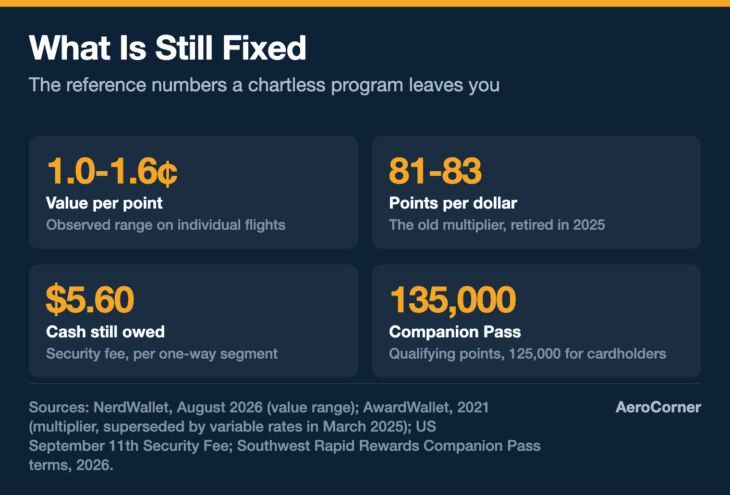
The multiplier itself starts moving. Southwest introduces variable redemption rates, so points no longer track the fare at a near-constant cents rate. Value now ranges from about 1.0 to 1.6 cents per point.
January 2026
The fare names go too. Wanna Get Away, Wanna Get Away Plus, Anytime and Business Select become Basic, Choice, Choice Preferred and Choice Extra alongside assigned seating from 27 January.
What Replaced the Chart: A Multiplier, Then Not Even That
For most of the period between 2011 and 2025, Southwest awards were predictable even without a chart, because the conversion ran at a near-constant rate. The airline stripped the taxes out of the fare and charged points against what was left.
Until 2021 that rate sat at roughly 76 to 78 points per dollar of base fare on the cheapest bucket. In April 2021 it moved to 81 to 83, which is a devaluation of about 6 percent and worth roughly 1.2 to 1.3 cents per point.
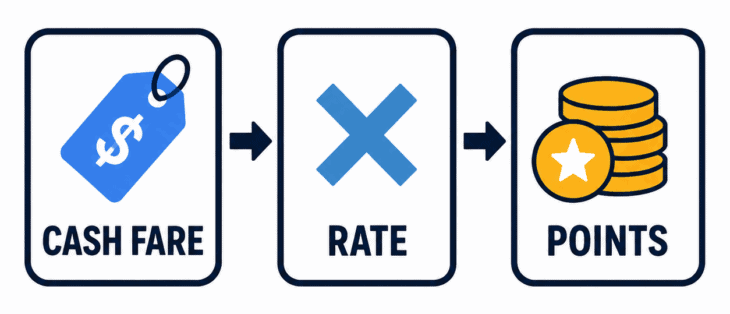
Then in March 2025 Southwest introduced variable redemption rates across higher and lower demand flights. The multiplier stopped being a constant, which means the fare no longer tells you the points price even if you know the formula.
Independent pricing snapshots taken when the change went live show what that looks like in practice. The same currency returned wildly different value depending on which flight it was spent on.
| Route and fare | Cash fare | Points | Value per point |
|---|---|---|---|
| San Francisco to Los Angeles, off-peak, cheapest bucket | $99 | 6,500 | ~1.5 cents |
| San Francisco to Los Angeles, off-peak, top bucket | $189 | 17,000 | ~1.1 cents |
| Los Angeles to Honolulu, Memorial Day weekend | $452 | 40,000 | ~1.1 cents |
| Los Angeles to Honolulu, Memorial Day weekend | $582 | 52,000 | ~1.1 cents |
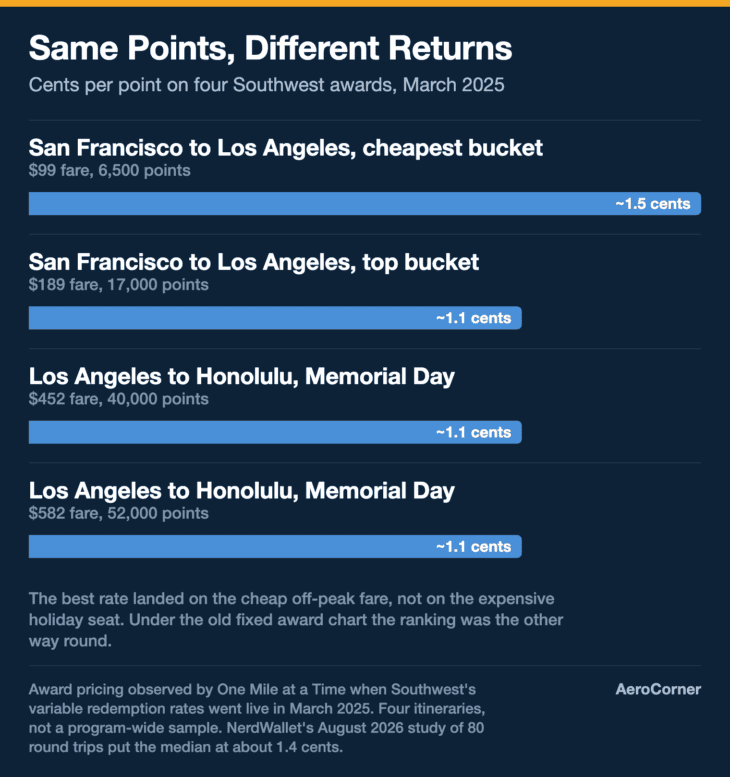
Averaged across a large sample the picture is steadier. NerdWallet’s August 2026 study of 80 round trips put the median Southwest point at about 1.4 cents, with individual flights landing anywhere between 1.0 and 1.6.
One detail catches people out: a points booking is not a cash-free booking. You still owe the September 11th Security Fee of $5.60 per one-way segment, so a connecting round trip costs points plus $22.40.
What This Killed for the Deal Hunters
Under a fixed chart, the whole game was finding the expensive ticket. A last-minute walk-up fare and a fare booked six months out cost the same 25,000 miles, so the smart move was always to spend points on the seat with the highest cash price.
Revenue-based pricing deletes that arbitrage entirely. When the points price tracks the cash price, you can no longer beat the airline on a given seat. At best you match it.
The peak-day trap
Points buy the least on exactly the flights people save them for. When Southwest’s variable rates went live, a Memorial Day weekend Los Angeles to Honolulu award returned about 1.1 cents per point, while a $99 off-peak hop between San Francisco and Los Angeles returned a little over 1.5. The high-demand seat is where a chart used to pay off and where dynamic pricing pays off least.
This is why the advice around what airline miles are actually worth has shifted from hunting sweet spots to a simple sanity check. Work out the cents per point of the redemption in front of you, and compare it to what you would pay in cash.
It also makes award pricing behave like fare pricing, which means the same forces apply. Ask when the points number will move and the honest answer is the one you would get about cash: it changes with demand, and it can move several times a day.
Our guides to how often flight prices change and whether fares drop closer to departure now describe award pricing just as well.
One Southwest benefit does still compound, and it is the reason the program keeps a devoted following. The Companion Pass lets a chosen person fly with you for taxes only, and it is earned at 135,000 qualifying points in a calendar year, or 125,000 for cardholders who get the 10,000-point boost.
Earn it early in a year and it runs through the end of the following one. That is a fixed benefit sitting on top of a floating price, and it is worth more than any redemption rate.
Where Fixed Award Charts Still Survive
The published chart is not extinct. It has retreated to one specific corner: redemptions on partner airlines rather than on the program’s own metal.
Alaska’s Atmos Rewards prices partner awards off a published distance chart. A business class seat in the 1,501 to 3,500 mile band on the Europe, Middle East and Africa chart costs 45,000 points, whatever the cash fare happens to be that day. Alaska and Hawaiian’s own flights are priced variably.
Air Canada’s Aeroplan runs the same split. Most Star Alliance partners are priced off a fixed distance-and-zone chart, while Air Canada itself and a handful of partners including United, Emirates and Etihad are dynamic.
American keeps a fixed partner chart too, unchanged as of mid-2026, alongside dynamic pricing and “starting at” anchors on its own flights. Avianca LifeMiles, Turkish Miles&Smiles and ANA also still publish real charts.
A chart is a published price, not a promise
Fixed pricing is not frozen pricing. On 1 June 2026 Aeroplan revised its chart and business class between the US and Europe in the 4,001 to 6,000 mile band went from 70,000 points each way to 75,000. The advantage of a chart is that you can see the price before you commit, not that the price cannot change.
The other survivor is the flat cash-rate redemption. Delta’s Pay with Miles converts at exactly 1.0 cent per mile in 5,000-mile blocks against $50 of fare, which is a poor rate but a guaranteed one.
JetBlue’s TrueBlue never had a chart to lose. It has been revenue-based from the start and lands consistently around 1.3 to 1.5 cents per point, which is arguably the most honest version of the model.
The Myth: 25,000 Points Equals a Free Flight
The number almost everyone carries around is 25,000. That was the standard domestic round-trip award across US programs for decades, and it is where the mental model of a “free flight” came from.
It is not a price any more. On a revenue-based program, 25,000 points is a budget of roughly $300 to $350 of airfare, and what that buys depends entirely on when you want to fly.
The same 25,000 points might cover a round trip and change in February, and cover one leg of a Thanksgiving trip. Neither outcome is a glitch. Both are the system working exactly as designed.
The second half of the myth is the word free. Even a full points booking carries the security fee, and on the programs that levy carrier-imposed surcharges the cash component of an “award” can run into the hundreds. Points reduce a fare. They rarely erase it.
Once the price of a seat in points is just its price in dollars wearing a different hat, loyalty currency stops being a separate economy and becomes a discount mechanism. That is the same logic that governs how airline ticket pricing works on the cash side, applied to the balance in your account.
So the next time an app quotes you 7,412 points for a flight, you are not looking at an arbitrary number. You are looking at that day’s fare, run through a multiplier the airline no longer publishes, rounded to nothing at all.
Which means the only reliable way to answer “how many points for a flight” is to search the flight. The chart that used to answer it in advance is, for your own airline’s seats, gone.
Sources and references used for research and fact-checking.
- Southwest Airlines Investor Relations, Southwest Airlines Introduces the All-New Rapid Rewards Program
- One Mile at a Time, Southwest Rolls Out Dynamic Award Pricing, Devalues Points
- AwardWallet, Ugh! Southwest Devaluation of Rapid Rewards Points
- NerdWallet, What Is the Value of Southwest Rapid Rewards Points?
- AwardFares, Atmos Rewards Guide: Award Charts and Status
- Southwest Airlines, Assigned Seating and New Fare Products
Get the Newsletter
The latest aviation news and stories sent to your inbox.
About the Author

Tim is the owner and lead editor of AeroCorner since 2019, overseeing aviation content covering aircraft, airlines, airports, and the broader aviation industry. Through years of researching, writing, editing, and publishing aviation-focused content, he has developed extensive practical knowledge of commercial aviation and air travel. Based in Asia and a frequent traveler himself, Tim also brings firsthand passenger experience to AeroCorner’s coverage. Outside of publishing, he has also explored aviation firsthand through hands-on flight training in New Zealand.