


Table of Contents
Somewhere in your inbox there is a balance you have not looked at in a while. Sixty-two thousand miles, maybe 140,000, sitting in an account you opened for a trip you have already taken.
The obvious question is what that pile is worth. The airline will not tell you. There is no exchange rate on the account page, no balance in dollars, no line saying these are worth $840.
That silence is not an oversight. A mile has no fixed value at all, and what you eventually get for one is decided almost entirely by the single transaction you spend it on. Here is how to work out your own number, and why the published ones disagree with each other.
How Much Are Airline Miles Worth?
As of September 2026, the major published valuations put US airline miles somewhere between 1.2 and 1.7 cents each. A 62,000 mile balance is therefore worth roughly $740 to $1,050, depending on whose number you use.
That range is useful, but it is not a price. It is an average of what other people got, and averages hide the thing that actually matters: the same mile can be worth under a cent on Tuesday and more than five cents on Wednesday.
The answer in one line
Published 2026 valuations put US airline miles at 1.2 to 1.7 cents each, but a valuation is a benchmark for deciding, not a rate you can cash out at. The only figure that matters is the cents per mile of the specific redemption in front of you.
The Only Number That Actually Matters: Cents Per Mile
Every honest comparison in this hobby runs on one calculation, and it takes about fifteen seconds. Find the cash price of the exact flight you want. Then find the award price of that same flight in miles, plus whatever cash the airline still charges on top.
Subtract the award ticket’s cash component from the cash fare, then divide by the number of miles required. Multiply by 100 and you have your cents per mile.
Say the cash fare is $412 round trip. The same seat as an award costs 25,000 miles plus $11.20 in taxes. That is $400.80 of avoided spending across 25,000 miles, which works out to 1.6 cents per mile.
Now you have something to judge. Above the published valuation for your program, the redemption is a good use of miles. Well below it, you are better off paying cash and keeping the balance.
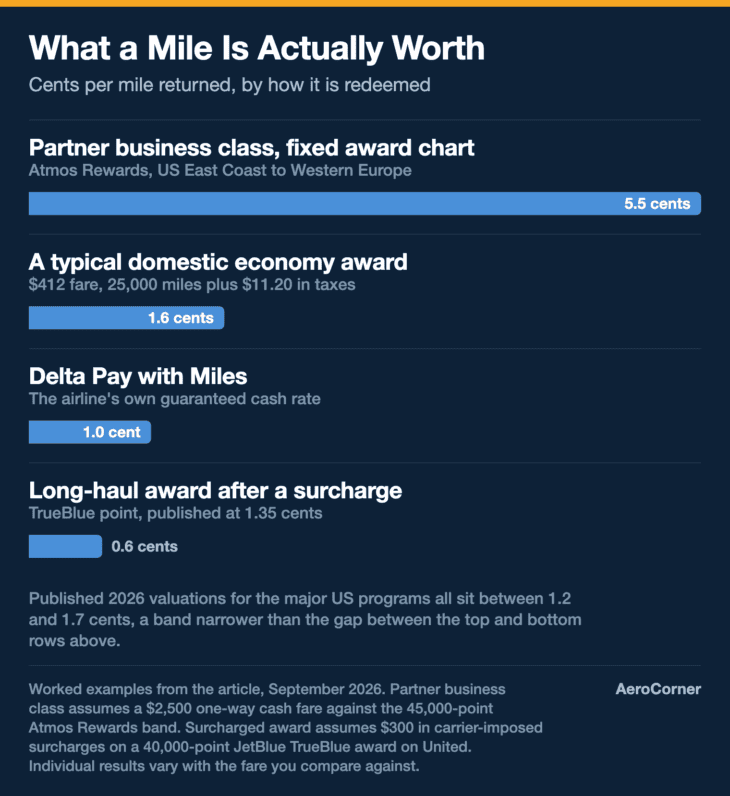
The subtraction step is the part people skip, and it is the part that moves the answer most. An award that looks free can carry several hundred dollars of fees, and every one of those dollars comes straight off the top.
Two Respected Sources Priced the Same Mile Last Month. They Disagreed.
If a mile had a real value, the people who publish valuations would broadly agree on it. They do not, and the gap is not small.
The Points Guy’s September 2026 valuations and NerdWallet’s August 2026 study cover the same six US programs in the same market conditions. They disagree on which currency is the most valuable in the country.
| Program | TPG, Sept 2026 | NerdWallet, Aug 2026 |
|---|---|---|
| American AAdvantage | 1.45 cents | 1.7 cents |
| Alaska Atmos Rewards | 1.55 cents | 1.4 cents |
| JetBlue TrueBlue | 1.35 cents | 1.4 cents |
| Southwest Rapid Rewards | 1.25 cents | 1.4 cents |
| Delta SkyMiles | 1.2 cents | 1.2 cents |
| United MileagePlus | 1.2 cents | 1.2 cents |
TPG has Alaska on top at 1.55 cents and American at 1.45. NerdWallet has American on top at 1.7 cents and Alaska a fifth of a cent lower. Same currencies, same month, opposite conclusions.
Neither is wrong, because they are measuring different things. TPG weights the redemption type it considers most valuable, which for airline miles means award flights and especially premium cabins, drawn from millions of searched itineraries.
NerdWallet takes a median instead, comparing point bookings against the cash price of equivalent flights across the board. Weight the front of the plane and Alaska wins. Take the middle of everything and American does.
The disagreement is the useful finding. A valuation is a description of a methodology, not a property of the mile.
Why Delta Prices a SkyMile at Exactly One Cent
There is one place where an airline does publish a hard number, and it is lower than every valuation above. Delta’s Pay with Miles lets you knock cash off a fare at a flat rate of 1 cent per mile, in blocks of 5,000 miles for $50.
That is the airline’s own answer, and it is a floor rather than a target. Any redemption that comes in under a cent is worse than the guaranteed option sitting in the same booking flow.
The floor exists because the big US programs are now revenue based. The number of miles an award costs is pinned to the cash fare rather than to a printed chart, so the cents per mile lands in a narrow band by design.
Southwest went the same way in March 2025, when Rapid Rewards moved to dynamic award pricing. A cheap fare became a cheap award and a peak fare stopped being a bargain, which is the whole point of the model and the reason its valuation barely moves.
This is the same machinery that sets what you pay in cash, and it behaves the same way. If you have read how airline ticket pricing actually works, a revenue based award program is simply that system with the answer denominated in miles.
Where the Outsized Value Still Hides
The exception is the partner award chart, and it is the reason the hobby still exists. A handful of programs still price partner awards from a fixed table rather than from today’s fare.
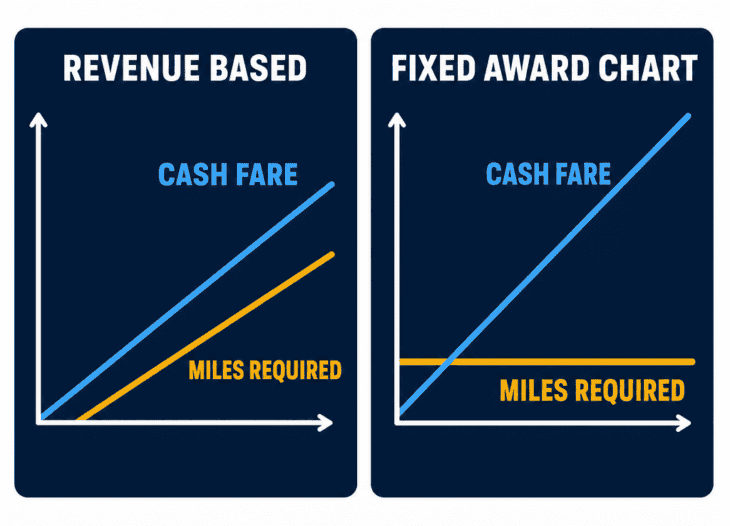
Alaska’s Atmos Rewards is the clearest surviving example in the US. Partner awards price off total itinerary distance, so a business class seat from the US East Coast to Western Europe sits at 45,000 points each way regardless of what the cash fare has done that week.
Run the arithmetic on that and the picture changes completely. Against a $2,500 one way business fare, 45,000 points plus the partner fee returns about 5.5 cents per mile, roughly four times the published valuation.
The gap between the floor and the ceiling
Spend a SkyMile through Delta’s Pay with Miles and it is worth exactly 1 cent. Spend an Atmos point on a fixed-price partner business class seat to Europe and the same kind of currency can return five cents or more. Nothing about the mile changed. Only the transaction did.
That is why every serious guide says premium cabins and partner airlines are where the value is. It is not snobbery about legroom. It is that a fixed chart does not follow the cash fare upward, so the more expensive the seat, the better the mile performs.
These charts are also the most fragile thing in the loyalty world, which is why anyone holding a large balance watches them closely. Miles mostly no longer expire, but the chart they redeem against can be rewritten overnight, a distinction covered in our piece on why airlines stopped expiring your miles.
The Cash Side of the Equation Can Ruin a Good Redemption
A fixed chart only helps if the airline is not clawing the value back in cash. In 2026 several programs did exactly that, and it barely registered with casual members.
JetBlue added carrier imposed surcharges to award tickets on United, its newer partner. A long haul economy award that once cost points plus about $5 in tax now carries a few hundred dollars, with roughly $260 on New York to Rome and about $305 on San Francisco to Seoul.
Put that through the formula and the damage is obvious. Three hundred dollars of surcharge on a 40,000 point award strips about 0.75 cents per point off the result, dragging a TrueBlue point from its published 1.35 cents down to roughly 0.6.
Smaller changes stack up in the same direction. Alaska raised its partner award fee from $12.50 to $20 per person each way on tickets issued from July 1, 2026.
Air France and KLM’s Flying Blue went further. From September 8, 2026 awards are sold in Light, Standard and Flex bundles, and the fare most travellers actually want is no longer the cheapest one. Paris to New York in business went from a single price to 60,000 miles for Light, 75,000 for Standard and 90,000 for Flex.
Nobody devalued a mile in either case. They raised the price of the thing you wanted to buy with it, which has the same effect and attracts less attention.
The Myth: A Valuation Tells You What Your Balance Is Worth
Here is the part the valuation tables tend not to dwell on. Even the published numbers are probably too high as a measure of what a mile is worth to hold.
The trap in every valuation table
A valuation measures how much travel a mile can buy. That is not the same as what a mile is worth, because the comparison is usually against a cash fare you would never have paid. Score a $6,000 first class seat for 80,000 miles and you did not save $6,000. You bought a flight you were never going to buy.
Aviation writer Gary Leff has made this argument for years, and the logic is hard to dismiss. Cash buys anything and can be invested; miles buy what one airline permits, and only when it has a seat to sell you.
Miles also carry devaluation risk that dollars do not, and they sit idle earning nothing while you wait for the right redemption. Each of those is a reason to discount the headline figure.
Then there is the substitution problem, which is the biggest one. Award inventory is limited, so you take the awkward connection or the Tuesday departure, and the trip you get is not quite the trip the cash fare would have bought.
Leff’s own approach applies something like a 40 percent discount to published figures to reach a number he would genuinely trade cash for. Whether or not you accept that exact haircut, the direction is right, and TPG says something similar in its own methodology: the valuations are a practical benchmark, not a maximum and not a guarantee.
The practical version is simple. Value your miles at the published number when deciding between miles and cash on a specific booking, and at rather less than that when deciding whether the balance is worth chasing in the first place.
It also explains the one habit that reliably beats the average. Spend miles on the expensive seat and cash on the cheap one, because the cheap seat is where a mile is worth the least and your dollars stretch furthest. It is the mirror image of the logic that makes two one way fares sometimes beat a return.
So the balance sitting in your account has no single value, and anyone who gives you one without asking what you plan to do with it is guessing. Sixty-two thousand miles is $620 through Delta’s own cash rate, around $900 at the published averages, or a lie-flat seat to Europe worth several times that.
Next time you are staring at that number, do the fifteen second calculation before you spend it. Cash price, minus the fees, divided by the miles. That is the only valuation that was ever about your miles.
Sources and references used for research and fact-checking.
- The Points Guy, What are points and miles worth? TPG's September 2026 valuations
- The Points Guy, How TPG calculates points and miles valuations
- NerdWallet, How Points and Miles Values Changed in 2026
- View from the Wing, Most Miles And Points Valuations Are Wrong: Why All The Published Numbers Are Too High
- One Mile at a Time, JetBlue TrueBlue Adds Surcharges On United Awards, Setting Bad Precedent
- Frequent Miler, Alaska Airlines Atmos Rewards Complete Guide (2026)
Get the Newsletter
The latest aviation news and stories sent to your inbox.
About the Author

Tim is the owner and lead editor of AeroCorner since 2019, overseeing aviation content covering aircraft, airlines, airports, and the broader aviation industry. Through years of researching, writing, editing, and publishing aviation-focused content, he has developed extensive practical knowledge of commercial aviation and air travel. Based in Asia and a frequent traveler himself, Tim also brings firsthand passenger experience to AeroCorner’s coverage. Outside of publishing, he has also explored aviation firsthand through hands-on flight training in New Zealand.