


Table of Contents
Somewhere in your inbox is a confirmation from a flight you took three or four years ago. It credited a few thousand miles to an account you have not logged into since, on an airline you may not have flown again.
Whether those miles are still sitting there depends almost entirely on which logo was on the tail. In one program they are untouched and will still be untouched in 2040. In another they were quietly zeroed out eighteen months ago and nobody told you.
The rules changed a great deal over the last decade, and they changed in the passenger’s favor far more than most people realize. Here is who still expires miles, what actually resets the clock, and the commercial reason almost every large US airline stopped bothering.
Do Airline Miles Expire?
For most large US programs, no. Delta SkyMiles, United MileagePlus, Southwest Rapid Rewards, JetBlue TrueBlue and Alaska’s Atmos Rewards points all sit in your account indefinitely, with no inactivity clock at all.
The one big exception is American Airlines. AAdvantage miles expire after 24 months with no earning or redeeming activity on the account, and that rule is still in force in 2026.
The strictest policies belong to the low-cost carriers, where twelve quiet months are enough to wipe a balance. Sun Country is stricter still, and in a way you cannot argue with.
The short version
Delta, United, Southwest, JetBlue and Alaska do not expire miles at all. American expires them after 24 months of inactivity, unless you hold its credit card or are under 21. Frontier and Spirit expire them after 12 months. Sun Country expires them 36 months after you earn them no matter what you do.
| Program | Expiration policy, September 2026 |
|---|---|
| Delta SkyMiles | Miles do not expire |
| United MileagePlus | Miles do not expire |
| Southwest Rapid Rewards | Points do not expire |
| JetBlue TrueBlue | Points do not expire |
| Alaska Atmos Rewards | Points do not expire |
| American AAdvantage | Expire after 24 months of inactivity. Primary co-branded cardholders and members under 21 are exempt |
| Allegiant Allways Rewards | Expire after 24 months of inactivity. Active cardholders are exempt |
| Frontier Miles | Expire after 12 months of inactivity |
| Spirit Free Spirit | Expire after 12 months of inactivity. Cardholders are exempt |
| Sun Country Rewards | Expire 36 months after they are earned, whatever you do in between |
The only clock that matters is the activity clock
In every US program that still expires miles, with one exception, the trigger is inactivity rather than age. Individual miles do not quietly turn 24 months old and drop off the bottom of your balance.
The whole account carries a single expiration date. Any qualifying transaction pushes that date out again, and it pushes it out for every mile you hold, including the ones you earned years earlier.
Qualifying activity is much broader than flying. Earning through a shopping portal, a dining program, a hotel or car rental partner, a survey, a mileage purchase or a co-branded credit card all count, and so does spending miles on anything at all.
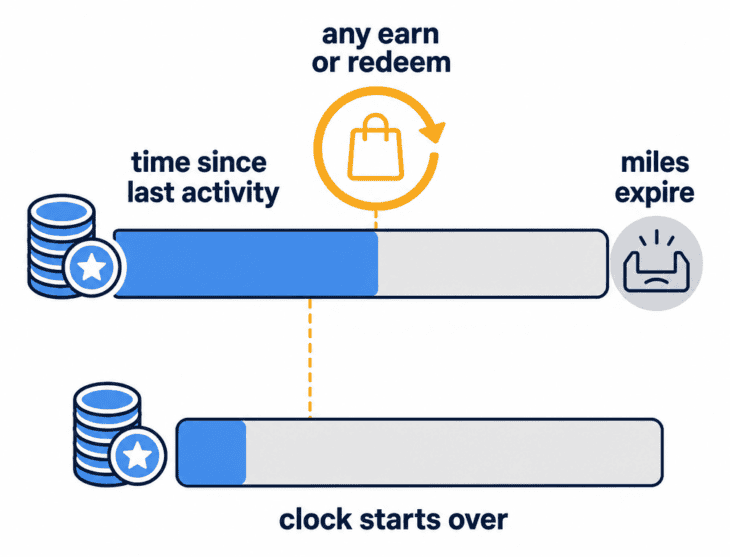
The practical effect is that expiry is close to optional for anyone paying attention. A single purchase through American’s shopping portal that earns one mile resets a balance of 200,000 for another two years.
American also exempts two groups outright: the primary cardholder on an AAdvantage co-branded credit card, and any member under 21. Between the exemptions and the one-mile reset, the 24-month rule catches almost nobody except people who have genuinely walked away.
Even the no-expiry programs have a dormancy quirk worth knowing. Alaska will lock an account that has sat untouched for two years as a security measure, but the points are still there, and a phone call restores access to the full balance.
Closing the account is the one thing that really deletes miles
Southwest’s program terms are blunt about it: should a member close their account, the points in the account will be forfeited. The same is true across most programs. Miles survive years of neglect far better than they survive a tidy-up.
Why airlines stopped expiring miles
The dates cluster tightly. United dropped its 18-month inactivity rule in August 2019, and Southwest ended its 24-month rule that October.
Delta and JetBlue had already gone first, years earlier. Within a few months of each other, the four largest loyalty currencies in the country stopped having a shelf life.
On the face of it that looks like the airlines giving something away. Every unredeemed mile is a liability sitting on the balance sheet, and expiring it lets the airline book the money as revenue. The industry calls that breakage, and it is free.
The problem is that a mile is not really a reward any more. It is a product the airline manufactures and sells in bulk to a bank, and the bank hands it to you when you buy groceries.
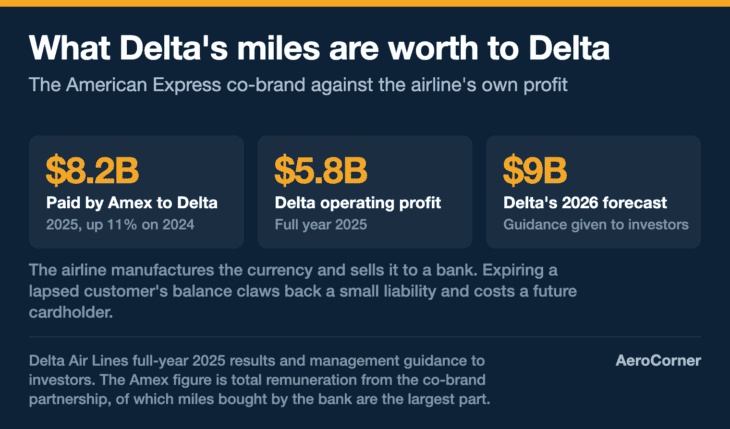
The scale of that trade is easy to underestimate. American Express paid Delta $8.2 billion in 2025 for the SkyMiles co-brand partnership, an 11 percent increase on the year before, and Delta has told investors to expect around $9 billion in 2026.
The miles are worth more than the flying
Delta’s full-year operating profit for 2025 was $5.8 billion. The cheque from American Express for that same year was $8.2 billion. The loyalty currency is not a marketing cost at Delta’s scale, it is one of the largest profit centers in the company.
That business only works if people believe the currency is worth holding. Expiring the balance of a lapsed customer claws back a small liability and destroys the single best reason that customer might come back and start putting a mortgage payment on the card.
It is the same logic that governs the cash side of the business, where airline ticket pricing is built around squeezing the most out of each seat while keeping the customer coming back. Expiry was a small win that cost a large one.
American’s behavior gives the game away. It will sell you back miles that expired within the last 24 months, for a fee. Expiry there is not housekeeping, it is a revenue lever with a reinstatement price attached.
Two kinds of expiry, and one of them you cannot beat
Almost every US program uses activity-based expiry, and activity-based expiry is beatable. Hard expiry is not.
A mile with a hard expiry has a fuse lit on the day it lands in your account. Flying, shopping and redeeming do nothing to it. Thirty-six months later it is gone regardless of how active you have been.
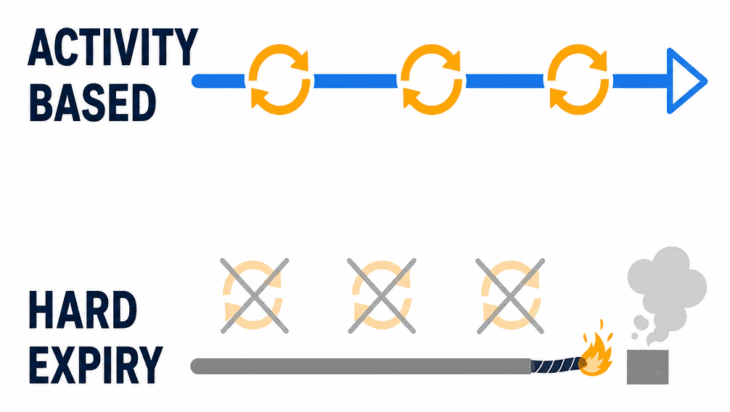
Sun Country is the only US program on that model, at 36 months from the earning date. Overseas it is common. Lufthansa Miles & More, Singapore KrisFlyer and ANA Mileage Club all run a 36-month fuse, and Emirates Skywards runs a similar three-year clock that ends in your birthday month.
The foreign programs that do use an activity clock generally run it shorter than the American one. Air Canada Aeroplan, Qantas, Cathay and Etihad all sit at 18 months, and Etihad only counts flights, so shopping portal activity will not save you.
Air France-KLM’s Flying Blue uses 24 months with a wrinkle that catches people out: earning miles resets the clock, but spending them does not.
This is not an academic distinction for US travelers. You can credit a flight on a US airline to a partner program overseas, and plenty of people do it once, for a better redemption rate, then forget the account exists.
The myth: “never expire” means your miles are safe
It does not. It means one specific failure mode has been switched off, and that is all it means.
Read the terms of any program and the ownership question is answered with unusual clarity. Southwest’s are typical: members do not acquire property rights in accrued points and rewards, the airline can amend or suspend the program at any time without notice, and it can end the program outright on six months’ notice.
Points and miles also have no cash value, which is why you cannot sell them and why they are not treated like money you have deposited somewhere. A mile is a promise, revocable, made by a company that reserves the right to change what it is worth.
Which is where the real erosion happens. Most large US programs now price award seats dynamically against the cash fare, so the seat that cost 25,000 miles this year can cost 45,000 next year with no announcement and no rule change.
That is the same machinery that decides how airfare is actually built, now pointed at the loyalty currency. Nothing expired. Your balance simply bought less.
An award seat is also a seat the airline would rather sell for cash, which is why availability tightens on exactly the dates you want. It is the same inventory calculus behind deliberate overbooking, run one step further back in the process.
Regulators have looked at this. In September 2024 the US Department of Transportation opened an inquiry into the loyalty programs of the four largest US carriers, covering devaluation of earned rewards, hidden pricing and fees, after a joint hearing with the Consumer Financial Protection Bureau earlier that year.
It has not produced a rule. As of September 2026 nothing in US law requires an airline to honor a mile at any particular value, or on any particular timetable, or at all.
So the honest reading of “our miles never expire” is that the airline has removed the crude way of taking value back, because it was bad for business, and kept the sophisticated one.
Go and look at the dormant account. If it is Delta, United, Southwest, JetBlue or Alaska, the balance is still there, and it will still be there whenever you get round to it.
If it is American, a low-cost carrier, or a foreign program you credited a single flight to once, check the date on the account. One small transaction will usually buy you another year or two.
Then spend them. A mile is the only currency you hold that the issuer can quietly reprice whenever it likes, and in the long run hoarding it has never once paid.
Sources and references used for research and fact-checking.
- TheStreet, Delta Air Lines Made $8.2 Billion From Your Credit Card Last Year
- Southwest Airlines, Rapid Rewards Terms and Conditions
- AwardWallet, Do American Airlines Miles Expire?
- Your Mileage May Vary, Do Airline Miles Expire? US Expiration Policies by Program
- One Mile at a Time, Do Airline Miles Expire? Policies By Airline, Plus How To Extend Miles
- NerdWallet, DOT's Frequent Flyer Program Inquiry: What's Being Investigated
Get the Newsletter
The latest aviation news and stories sent to your inbox.
About the Author

Tim is the owner and lead editor of AeroCorner since 2019, overseeing aviation content covering aircraft, airlines, airports, and the broader aviation industry. Through years of researching, writing, editing, and publishing aviation-focused content, he has developed extensive practical knowledge of commercial aviation and air travel. Based in Asia and a frequent traveler himself, Tim also brings firsthand passenger experience to AeroCorner’s coverage. Outside of publishing, he has also explored aviation firsthand through hands-on flight training in New Zealand.