

Table of Contents
Pick United if reliability matters most: from January to August 2026 it arrived on time more often than American (76.1% to 73.0%), canceled a smaller share of flights (1.86% to 3.22%), and bumped 107 passengers against American’s 5,247 in the first half of the year.
Pick American if you live near one of its hubs, such as Dallas/Fort Worth, Charlotte, Philadelphia, Miami or Phoenix, or if you want free Wi-Fi on nearly every flight today.
On bag fees and lounge prices the two are now identical. The differences that remain show up in how often your flight leaves, and on whose plane.
The figures come from the DOT’s Air Travel Consumer Reports through the October 2026 edition, both airlines’ SEC filings, and their own announcements as of October 2026. For Delta as a third option, see our Delta vs United vs American comparison.
| Criterion | United | American | Edge |
|---|---|---|---|
| On-time arrivals, Jan to Aug 2026 | 76.1% (3rd) | 73.0% (5th) | United |
| Flights canceled, Jan to Aug 2026 | 1.86% | 3.22% | United |
| Bags mishandled per 100 checked, Jan to Aug 2026 | 0.71 | 0.68 | American |
| DOT complaints per 100,000 flights, Jan to Aug 2026 | 646 | 911 | United |
| Passengers involuntarily bumped, Jan to Jun 2026 | 107 | 5,247 | United |
| Size, Jan to Sep 2026 | 140.7 million passengers, 253.5 billion seat-miles | 169.0 million passengers, 234.5 billion seat-miles | Even |
| Mainline fleet, Dec 2025 | 1,066 jets, 15.3 years, 230 wide-bodies | 1,013 jets, 14.3 years, 137 wide-bodies | United |
| Free Wi-Fi for loyalty members | Starlink, about half of flights | Every narrow-body, two-class regional jet and 787 | American |
| Airfare needed for entry-level status | $5,000 to $6,000 (Silver) | About $8,000 (Gold) | United |
| Lounge membership, no status | $750 single, $1,400 All Access | $750 single, $1,400 standard | Even |
How we compared
The DOT publishes on-time rates for January to August 2026 directly, and we used them as printed. It publishes cancellations, bags and complaints only by month or for January to June, so we added the January to June totals from the August 2026 report to the July and August figures in the September and October reports. Cancellations: United 19,129 of 1,025,802 scheduled flights, American 44,257 of 1,375,517. Bags: United 375,278 mishandled of 53,134,443 checked, American 503,489 of 74,476,790. Complaints: United 6,631 cases, American 12,535, divided by the same flight counts. The airfare cost of status converts each entry threshold at the airline’s own earning rate: United awards 1 Premier Qualifying Point per dollar, so Silver takes 5,000 points plus 15 flights or 6,000 points alone, and American members earn 5 Loyalty Points per dollar, so 40,000 points is about $8,000. Credit card spending counts toward status at both airlines and changes that math for cardholders.
Arriving on time
United’s network arrived on time on 76.1% of flights from January to August 2026, third among US airline networks behind Alaska and Delta. American’s managed 73.0% and ranked fifth.
United beat American in all eight months of the year so far. The gap was widest in January, 77.3% against 70.8%, and narrowest in April, 79.3% against 78.4%.
A 3.1-point gap works out at roughly one extra late arrival every 32 flights on American. For a once-a-year traveler that is noise, for a weekly commuter it is a late night every couple of months.
Edge: United. A better on-time rate in every month of 2026.
Cancellations, and who actually flies you
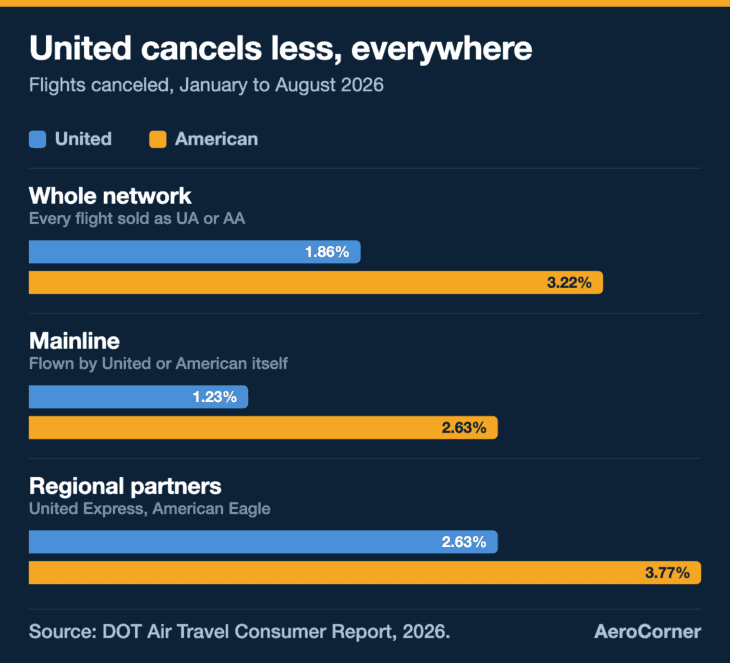
By our count from the DOT’s monthly tables, United canceled 1.86% of its network flights between January and August 2026. American canceled 3.22%, which makes a cancellation about 1.7 times as likely on an American booking.
Both got worse this year. In the first half of 2025 United canceled 1.35% and American 2.69%, and in the first half of 2026 those rates rose to 1.76% and 3.32%.
The bigger difference is who operates the flight. From January to August, 51.5% of the flights sold under American’s code were flown by American Eagle regional partners, against 45.5% of United’s by United Express carriers.
Partners cancel more at both airlines, 3.77% at American Eagle and 2.63% at United Express. But the gap holds on the mainline too: United’s own jets canceled 1.23% of flights, American’s 2.63%, more than twice as often.
Edge: United. Lower cancellation rates on its network, its mainline and its regional partners alike.
Bags, complaints and bumping
This is the one reliability measure American wins. It mishandled 0.68 bags per 100 checked from January to August 2026, against 0.71 at United, a gap of about one bag in every 3,300.
Wheelchairs and scooters go the other way. In the first half of 2026 United mishandled 1.13 of every 100 it carried, American 1.24.
Complaints favor United clearly once you adjust for size. American drew 911 DOT complaint cases per 100,000 scheduled flights and United 646, so American drew about 41% more complaints per flight.
Bumping is where the two are furthest apart. United’s network denied boarding to 107 passengers against their will in the first half of 2026, while American’s bumped 5,247, a pattern we explain in why American bumps more passengers than everyone else combined.
Edge: United. Fewer complaints and far fewer bumps, while American loses slightly fewer bags.
49 bumps on American for every one on United
Between January and June 2026, United’s network carried 81.4 million passengers and involuntarily denied boarding to 107 of them, according to the DOT. American’s network carried 101.3 million and bumped 5,247. That is 0.01 per 10,000 passengers at United against 0.52 at American.
Which airline is bigger
It depends on what you count. American carried 169.0 million passengers in the first nine months of 2026 against United’s 140.7 million, and ended September with 1,624 aircraft against United’s 1,575.
United flew more seats further. It sold 253.5 billion available seat-miles over the same nine months, about 8% more than American’s 234.5 billion, because its average flight ran 1,464 miles (2,356 km) against American’s 859 miles (1,382 km).
Which one is the world's largest airline? Both say they are
United’s October 2026 earnings release calls it “now the largest airline in the world”, and American’s calls itself “the world’s largest airline”. Both are true by their own measure: American carries more passengers on more aircraft, about 20% more passengers from January to September 2026, while United flies about 8% more seat-miles on longer routes.
For most travelers the hub map decides this. American’s hubs are Charlotte, Chicago, Dallas/Fort Worth, Los Angeles, Miami, New York, Philadelphia, Phoenix and Washington, D.C., and it serves more than 350 destinations in more than 60 countries.
United’s US mainland hubs are Chicago, Denver, Houston, Los Angeles, Newark, San Francisco and Washington, D.C., plus a Pacific hub on Guam. Abroad it leans on Star Alliance, while American leans on oneworld and its joint businesses with British Airways, Aer Lingus, Iberia, Finnair, Japan Airlines and Qantas.
Edge: Even. American is bigger by passengers and aircraft, United by seat-miles, and your home airport matters more than either.
Fleet and long-haul flying
United flew 1,066 mainline jets at the end of 2025, averaging 15.3 years old, and its full fleet count adds 424 United Express regional aircraft. American flew 1,013 mainline jets averaging 14.3 years, plus 567 American Eagle aircraft.
United’s average is pulled up by its oldest types. It still flies 37 767-300ERs averaging 29.8 years, 40 757-200s averaging 28.9 and 19 777-200s averaging 28.5.

United also has new jets at the other end. Its 120 Boeing 737 MAX 9s averaged 2.9 years and its 59 A321neos under a year, and it has 150 more 787s on firm order.
The bigger split is wide-bodies. United flies 230 of them, including 81 Dreamliners and 22 777-300ERs, against American’s 137, which gives it more long-haul seats from its hubs.

Edge: United. More wide-bodies for long-haul trips, though American’s fleet is a year younger on average.
Wi-Fi
Both now give loyalty members free Wi-Fi, and joining either program is free. They are at different stages, though.
American’s free Wi-Fi, sponsored by AT&T, launched in January 2026 for AAdvantage members on every narrow-body, every two-class regional jet and its Boeing 787s. On October 8 it said it would also fit Starlink across its whole mainline fleet, more than 1,000 aircraft.
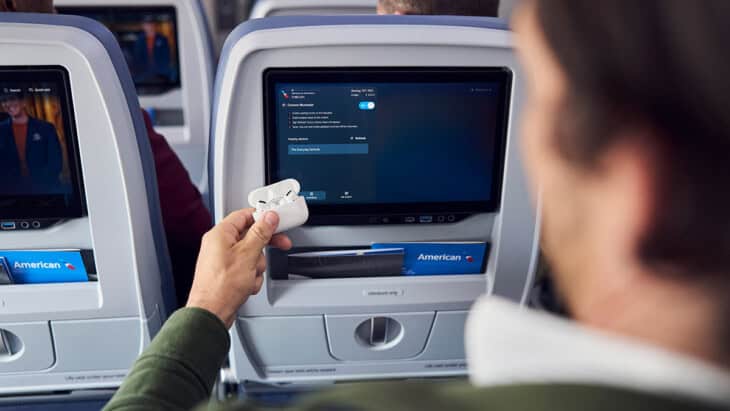
United’s Starlink service is free for MileagePlus members and was on more than 640 aircraft by October 2026, about half of all United flights. United expects 61% of flights by the end of 2026 and the whole fleet by the end of 2027.
Edge: American, for now. Its free Wi-Fi reaches far more flights today; United’s covers about half, and the gap should close in 2027.
Seats and bag fees
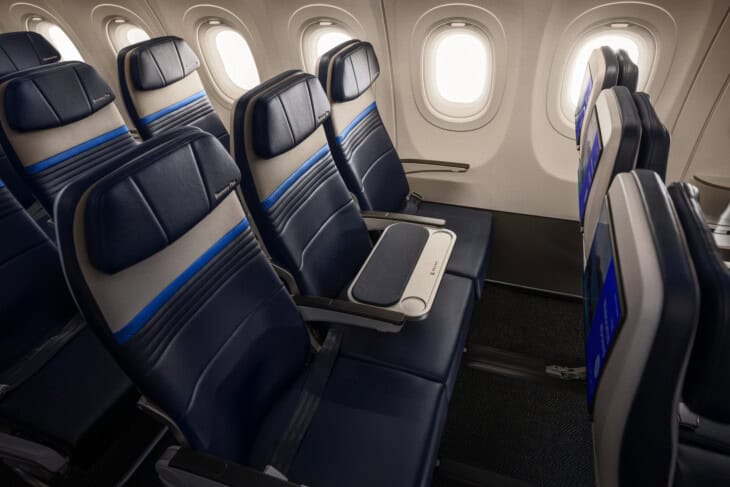
American’s economy seats are slightly roomier on average. Simple Flying’s July 2025 comparison put American’s average economy pitch at 31 inches against United’s 30.2, though on the A321neo and 737-800 both give 30 inches.
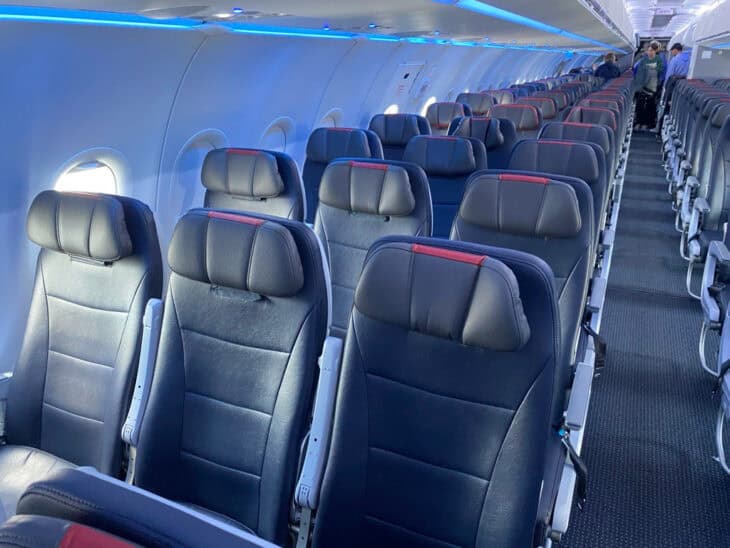

Extra legroom is close too. On the A321neo, United’s Economy Plus runs 33 to 38 inches and American’s Main Cabin Extra 34 to 39, and both give 34 inches on the 737-800, a section we price in United Economy Plus vs Economy.
Bag fees are identical after both raised them in April 2026. Each charges $45 for the first domestic bag and $55 for the second when you prepay, or $50 and $60 at the airport.
American adds $5 a bag on domestic Basic Economy tickets bought from May 18, 2026. Its status members, premium-cabin passengers and most of its cardholders check bags free.
Edge: American, narrowly. Slightly more average legroom, while bag fees tie except on its Basic Economy fares.
Lounges
Since American’s price rise on August 23, 2026, the two lounge memberships cost the same. American’s standard Admirals Club membership is $1,400 a year for members without status, falling to $1,200 for Executive Platinum, and a $750 single membership covers the member alone.
United sells an Individual United Club membership for $750, with no elite discount and $59 guests, and an All Access membership for $1,400. All Access adds two guests and Star Alliance partner lounges, falling to $1,200 for 1K members.


Edge: Even. Same prices, same structure; pick the club at your home airport.
What elite status costs
United’s entry tier, Premier Silver, takes 5,000 Premier Qualifying Points plus 15 flights, or 6,000 points alone, in 2026. Members earn 1 point per dollar spent on United flights, so that is $5,000 to $6,000 of airfare.
American’s entry tier, Gold, takes 40,000 Loyalty Points. Members earn 5 points per dollar on American flights, which puts Gold at about $8,000 of airfare, a third or more above United’s Silver.
| Tier | United (2026) | United (2027 activity) | American (Loyalty Points) |
|---|---|---|---|
| Entry | Silver, 6,000 PQP or 5,000 + 15 flights | Silver, 6,000 PQP | Gold, 40,000 |
| Second | Gold, 12,000 PQP or 10,000 + 30 flights | Gold, 12,000 PQP | Platinum, 75,000 |
| Third | Platinum, 18,000 PQP or 15,000 + 45 flights | Platinum, 18,000 PQP | Platinum Pro, 125,000 |
| Top | 1K, 28,000 PQP or 22,000 + 60 flights | 1K, 32,000 PQP | Executive Platinum, 200,000 |
| Qualification year | January to December | January to December | March to February |
United announced on October 13, 2026 that from 2027 flights no longer count toward status, only points, and that 1K rises to 32,000. Members will still need four flights on United or United Express each year.
American’s points come from credit card spending as well as flying, which suits someone who flies little but spends a lot on its card. Its qualification year also runs March to February, so a January trip counts toward a different year than it would at United.
Edge: United. Entry status costs $2,000 to $3,000 less in airfare.
Who should pick which
| If you… | Pick | Because |
|---|---|---|
| Need to arrive on time | United | 76.1% on time from January to August 2026, against 73.0% |
| Can’t afford a canceled flight | United | 1.86% of flights canceled, against 3.22% |
| Fly long-haul from your home hub | United | 230 wide-body jets, against 137 |
| Live near Dallas/Fort Worth, Charlotte, Philadelphia, Miami or Phoenix | American | They are American hubs, so it has the nonstops |
| Live near Denver, Houston, Newark or San Francisco | United | They are United hubs, so it has the nonstops |
| Want free Wi-Fi on almost every flight now | American | Free on every narrow-body, two-class regional jet and 787 |
| Chase status on modest airfare spending | United | $5,000 to $6,000 for Silver, against about $8,000 for American Gold |
| Earn status mostly through a credit card | American | Card spending earns Loyalty Points toward every tier |
If no row describes you, book on price and schedule. On one trip a nonstop beats either airline’s connection, whatever the averages say.
FAQ
Sources and references used for research and fact-checking.
- US Department of Transportation, October 2026 Air Travel Consumer Report (August 2026 data)
- US Department of Transportation, September 2026 Air Travel Consumer Report (July 2026 data)
- US Department of Transportation, August 2026 Air Travel Consumer Report (June and January to June 2026 data)
- United Airlines Holdings / SEC, United Airlines Holdings Form 10-K for 2025
- United Airlines Holdings / SEC, United Airlines reports third-quarter 2026 financial results (Exhibit 99.1)
- American Airlines Group / SEC, American Airlines Group Form 10-K for 2025
- American Airlines Group / SEC, American Airlines Group third-quarter 2026 results (Exhibit 99.1)
- American Airlines Newsroom, American Airlines launches free high-speed Wi-Fi sponsored by AT&T
- American Airlines, American Airlines updates bag fees and Basic Economy fares
- The Points Guy, United Airlines raises checked bag fees
- One Mile at a Time, United Airlines' Amazing Free Starlink Wi-Fi Rollout
- The Points Guy, United Airlines Premier elite status shakeup
- Loyalty Lobby, United MileagePlus 2026 program changes
- Loyalty Lobby, United Club membership pricing and entry rule changes
- One Mile at a Time, American Admirals Club membership fees increasing
- AwardWallet, Admirals Club membership fee increase
- One Mile at a Time, American AAdvantage Loyalty Points: How Status Qualification Works
- Simple Flying, American Vs. Delta Vs. United: Which Carrier Has The Most Legroom?
Get the Newsletter
The latest aviation news and stories sent to your inbox.
About the Author

Tim is the owner and lead editor of AeroCorner since 2019, overseeing aviation content covering aircraft, airlines, airports, and the broader aviation industry. Through years of researching, writing, editing, and publishing aviation-focused content, he has developed extensive practical knowledge of commercial aviation and air travel. Based in Asia and a frequent traveler himself, Tim also brings firsthand passenger experience to AeroCorner’s coverage. Outside of publishing, he has also explored aviation firsthand through hands-on flight training in New Zealand.