

Table of Contents
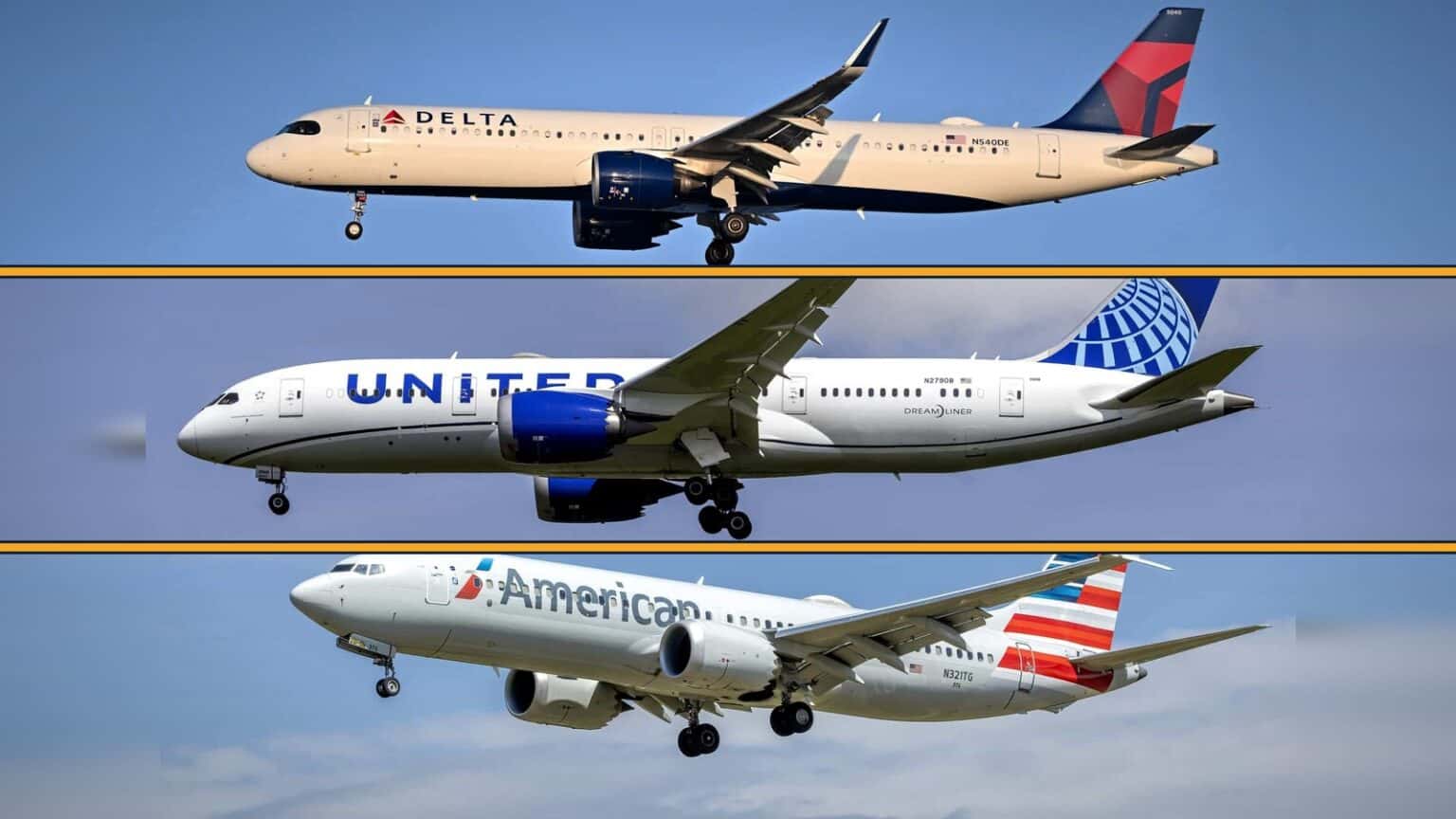
Pick Delta if you want the best odds of arriving on time with your bag, which it led on in the first half of 2026. Pick United if a canceled flight would ruin the trip: its mainline canceled 1.13% of flights against Delta’s 2.09% and American’s 2.94%. Pick American if you live near Dallas/Fort Worth or Charlotte, where it flies about nine in ten arrivals.
That is the whole answer, and the gaps are smaller than the internet suggests. On most routes all three sell you a similar seat at a similar price, and the differences below show up over a year of flying rather than on any one trip.
The figures here come from the Department of Transportation’s Air Travel Consumer Report published in August 2026, covering January to June 2026, plus each airline’s own fee and loyalty pages as of September 2026. For a wider field than these three, see our ranking of the best airlines to fly in the US.
| Criterion | Delta | United | American | Edge |
|---|---|---|---|---|
| On-time arrivals, whole network | 79.33% | 77.60% | 74.38% | Delta |
| Flights canceled, whole network | 2.35% | 1.76% | 3.32% | United |
| Flights canceled, mainline only | 2.09% | 1.13% | 2.94% | United |
| Share of flights flown by regional partners | 37.6% | 45.6% | 51.4% | Delta |
| Bags mishandled per 100 checked | 0.37 | 0.69 | 0.67 | Delta |
| DOT complaints per 100,000 scheduled flights | 556 | 599 | 890 | Delta |
| US flights scheduled, January to June 2026 | 816,084 | 755,299 | 1,016,372 | American |
| Alliance | SkyTeam (founding member) | Star Alliance | oneworld (founding member) | Even |
| Airfare needed for entry-level status | $5,000 (Silver) | $6,000 (Silver) | About $8,000 (Gold) | Delta |
| First checked bag, domestic | $45 prepaid | $45 prepaid, $50 at the airport | $45 prepaid, $50 at the airport | Even |
| Standard economy pitch, A321neo | 31 in | 30 in | 30 in | Delta |
How we compared
Operational figures are the DOT’s own published rates for each marketing carrier’s whole network, January to June 2026, from the Air Travel Consumer Report dated August 2026. Three figures are ours. Partner share divides branded codeshare flights by total scheduled flights: 306,479 / 816,084 for Delta, 344,513 / 755,299 for United and 522,425 / 1,016,372 for American.
Complaints per 100,000 flights divides DOT complaint cases by the same scheduled-flight counts: 4,534 for Delta, 4,524 for United and 9,046 for American. The airfare cost of status converts each entry threshold at the airline’s own earning rate: Delta and United count base fare plus carrier-imposed surcharges dollar for dollar, so $5,000 in MQDs and 6,000 PQP mean $5,000 and $6,000 of fare; American’s 40,000 Loyalty Points divided by the 5 base miles per dollar its own status estimator uses come to about $8,000.
All three also let credit card spending count, which changes the math for cardholders. Hub shares are a fourth calculation, dividing each carrier network’s arrivals at an airport by that airport’s total arrivals; the DOT publishes those by month rather than year to date, so they cover June 2026 alone.
Arriving on time
Delta arrived on time on 79.33% of its flights between January and June 2026, ranking second among all US carriers behind Alaska. United managed 77.60% and American 74.38%.
Five points of on-time rate sounds small until you put it against a year of travel. Across 40 flights it works out at two extra late arrivals on American than on Delta.
The order has been stable rather than lucky. All three improved slightly on the same period in 2025, and they finished in the same order then: Delta 78.70%, United 77.42%, American 73.35%. If your flight does slip, our explainer on why flights get delayed covers what is actually happening behind the gate.
Edge: Delta. It has the best on-time rate of the three, in both halves of the comparison period.
Cancellations, and the half of the airline you did not book
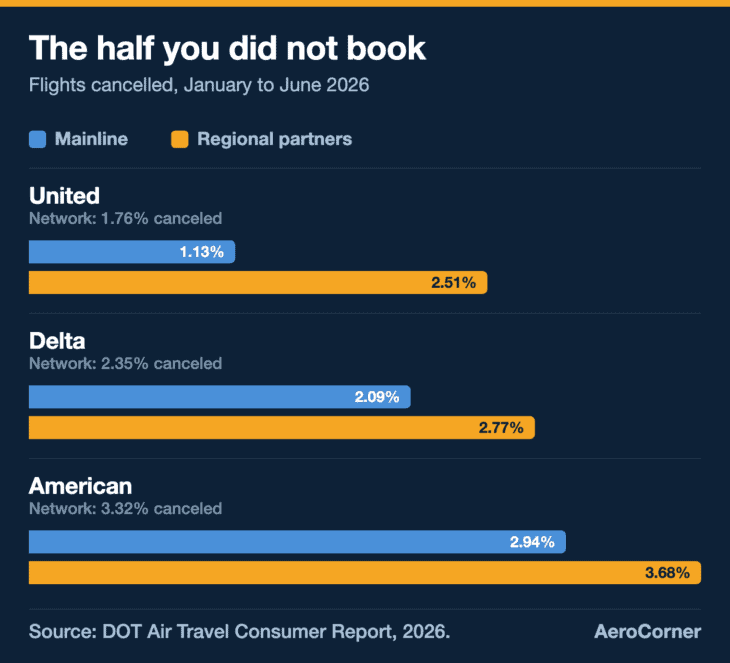
Here the ranking flips. United canceled 1.76% of its network flights in the first half of 2026, Delta 2.35% and American 3.32%.
The reason is the thing nobody on the first page of Google mentions: a large share of the flights sold under these three brands are not flown by these three airlines. They are flown by regional partners under a codeshare, and the DOT counts them separately.
By our calculation from the DOT’s scheduled-flight counts, 51.4% of American’s flights were flown by a partner, against 45.6% at United and 37.6% at Delta. More than half of the flights with an AA code on them are not American Airlines.
That matters because the partner operation is the weaker one at every carrier. United’s mainline canceled just 1.13% of flights, the best figure of the six operations, while its partners canceled 2.51%. Delta ran 2.09% against 2.77%, and American 2.94% against 3.68%.
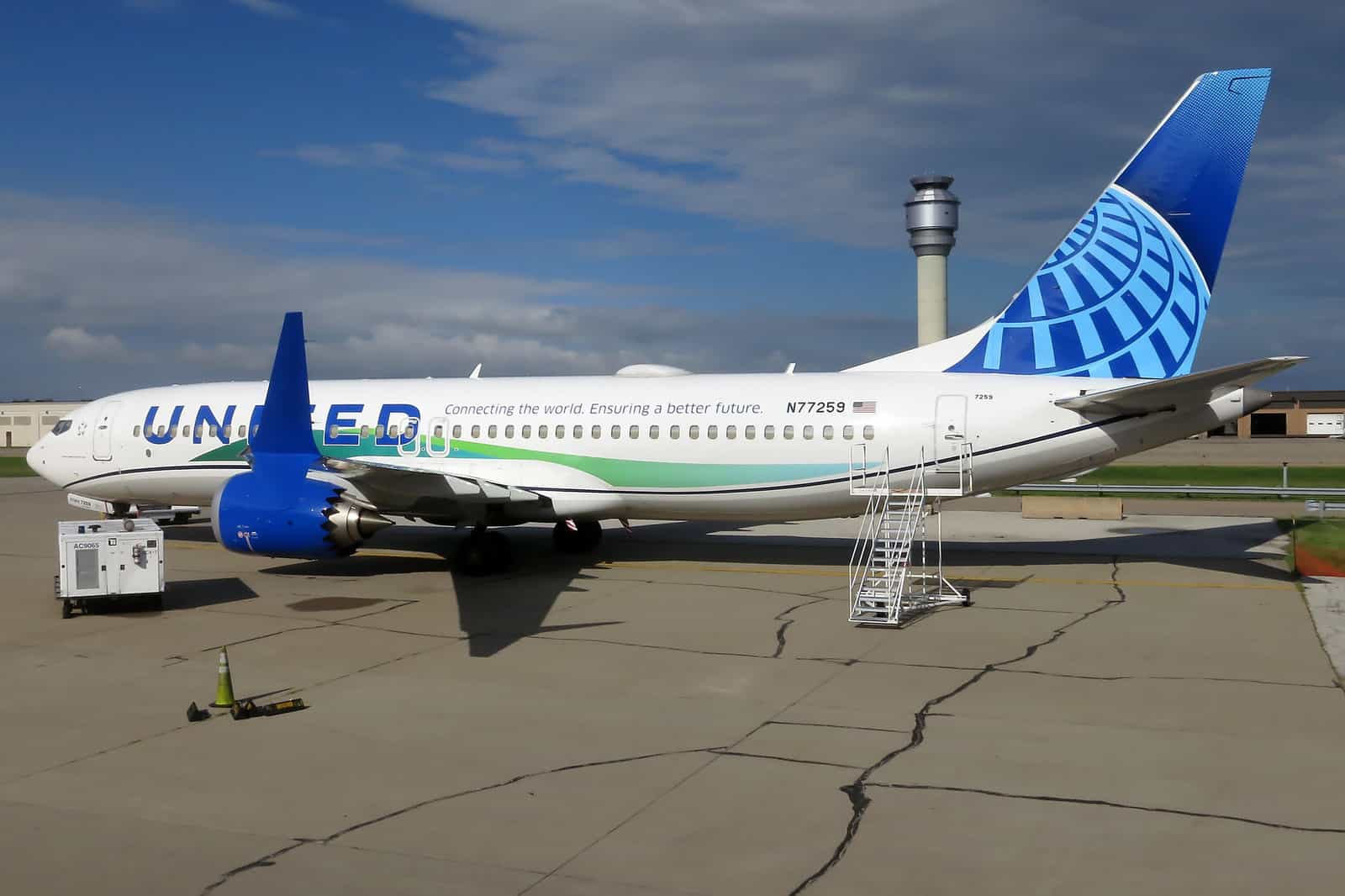
The practical move is the same whichever airline you choose. Before booking, check whether the flight is operated by Delta Connection, United Express or American Eagle, because that one line changes your odds more than the logo on the ticket does.
It usually means a smaller jet too, with a 737 MAX 8 giving way to a regional aircraft that has no real first class and overhead bins that fill before your group is called.
Edge: United. Its mainline is the most reliable operation of the six, and its network rate is the lowest of the three.
American's regional partners beat American
American Eagle carriers arrived on time on 75.64% of flights between January and June 2026. American’s own mainline managed 73.04%. It is the only one of the three where the partners are the more punctual half, though they still cancel more often.
Bags and complaints
Delta mishandled 0.37 bags per 100 checked in the first half of 2026, fourth best of the nine reporting carriers. American came in at 0.67 and United at 0.69, the worst of the nine.
In plain terms, a bag checked with United or American is close to twice as likely to go astray as one checked with Delta. All three numbers are still small, and all three improved or held steady against 2025.
Complaints need normalizing before they mean anything. American drew 9,046 complaint cases at the DOT over the six months against Delta’s 4,534 and United’s 4,524, but American also schedules far more flights.
Divide one by the other and the gap narrows but does not close: 890 complaints per 100,000 scheduled flights at American, 599 at United and 556 at Delta. American still draws about 60% more complaints per flight than Delta does.
Edge: Delta. Best on bags by a wide margin, and lowest complaint rate once you adjust for size.
Where each one actually goes
Reliability decides very little if the airline does not fly your route. This is usually the criterion that settles the choice, and it is settled by your home airport rather than by anything in the table above.
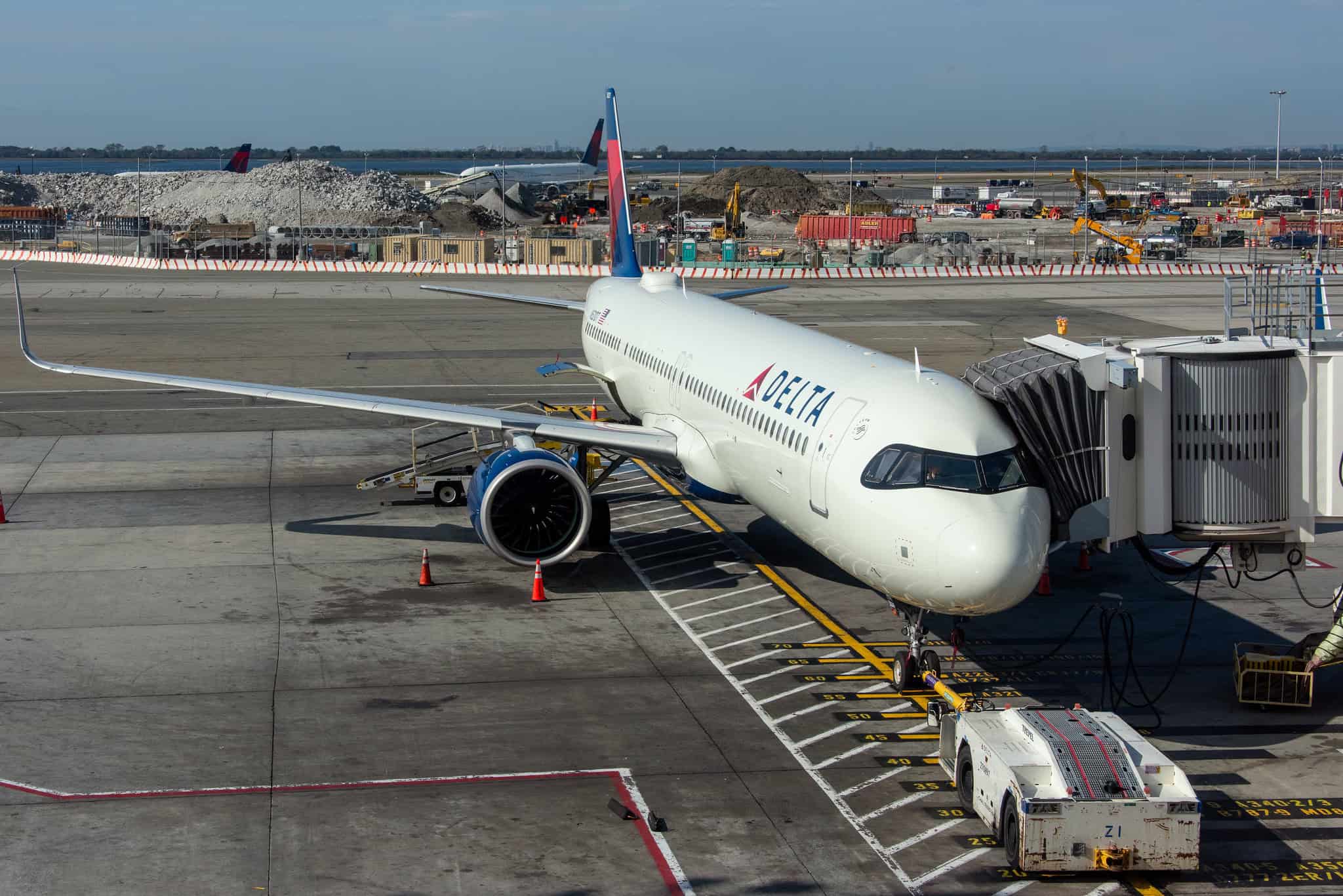
Delta runs up to 5,500 daily flights to more than 300 destinations, with hubs and key markets at Atlanta, Detroit, Minneapolis-St. Paul, Salt Lake City, Boston, Seattle, Los Angeles and both New York airports, plus Amsterdam, Paris and Seoul-Incheon overseas.
The DOT’s airport tables show how lopsided a hub gets. In June 2026 Delta and its partners flew 81.1% of all arrivals at Atlanta, which is also the busiest airport in the world, along with 82.5% at Minneapolis, 80.1% at Detroit and 72.4% at Salt Lake City.
United hubs at Chicago, Denver, Houston, Los Angeles, New York/Newark, San Francisco and Washington, D.C., and describes its own route network as the most comprehensive of any North American carrier. Its grip is tightest at Washington Dulles, with 85.5% of June arrivals, then Houston at 82.5% and Newark at 79.2%.
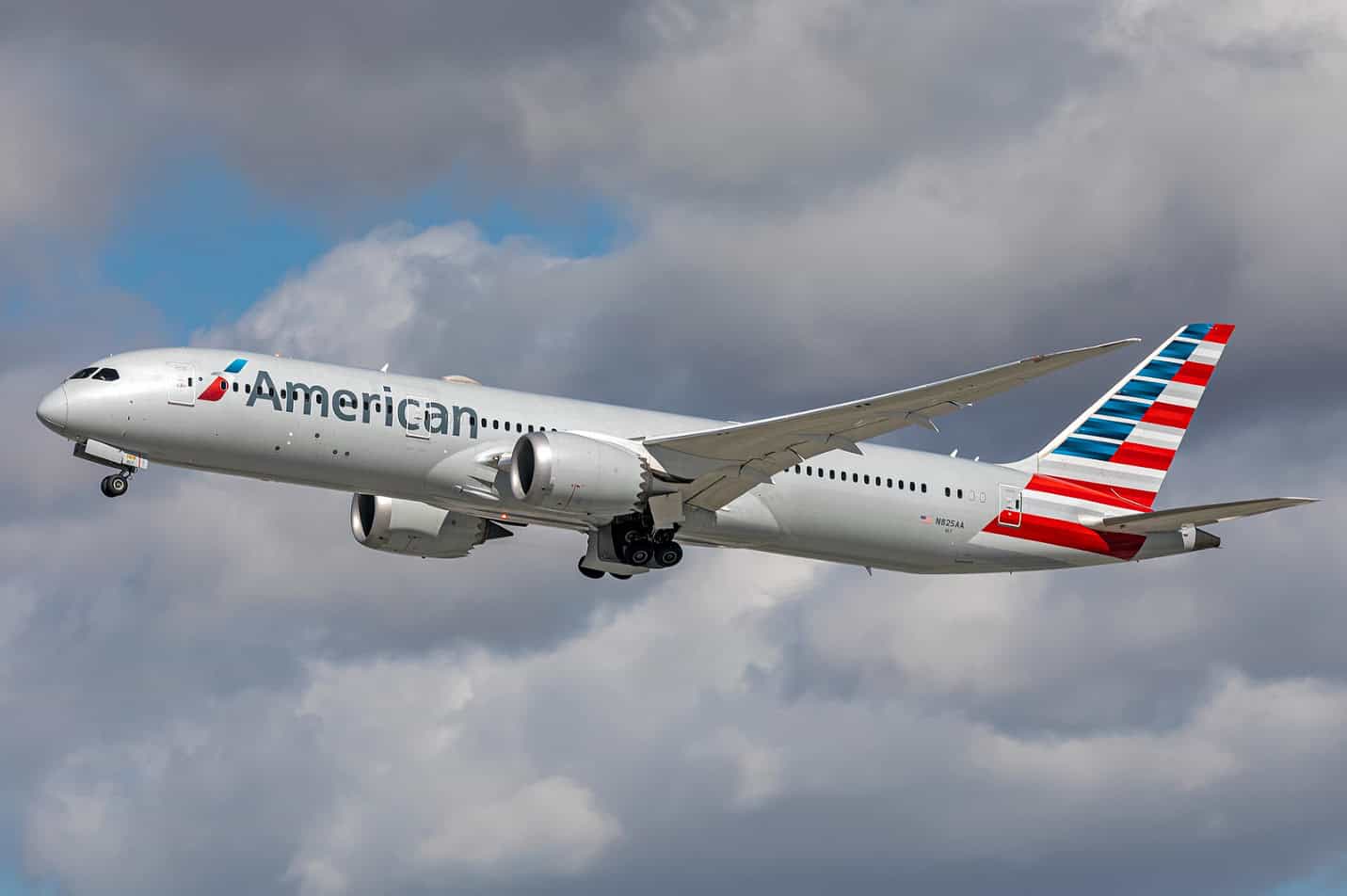
American operates more than 6,000 daily flights to more than 350 destinations in more than 60 countries, the largest schedule of the three. It holds the two most concentrated hubs in the country: 89.8% of arrivals at Charlotte and 88.0% at Dallas/Fort Worth, plus 76.8% at Philadelphia and 74.7% at Miami.
Three big airports are genuinely contested, and they are the ones where a connection is least predictable. Chicago O’Hare splits 51.7% United to 42.1% American, Denver runs 55.6% United against Southwest and Frontier, and Phoenix is only 48.5% American.
The alliances extend all three further than their own metal reaches. Delta founded SkyTeam and partners with Air France-KLM, Korean Air, LATAM and Virgin Atlantic; United sits in Star Alliance; American founded oneworld, whose members serve more than 900 destinations between them.
Edge: American. It schedules the most flights and the most destinations, though “biggest” only helps if it is big where you live.
Two of them claim to be the world's largest airline
American’s own press releases call it “the world’s largest airline.” United’s second-quarter 2026 earnings release says United “is now the largest airline in the world.” Both are using a different yardstick: American schedules more flights and seats, United flies more available seat miles. For a passenger the title settles nothing, because neither measure tells you whether either one flies your route.
What elite status costs
Frequent flyer status is where the three genuinely diverge, and the headline numbers are not comparable until you convert them into airfare.
Delta and United now run almost the same ladder. Delta Silver needs $5,000 in Medallion Qualification Dollars and United Silver needs 6,000 Premier Qualifying Points, and both currencies are earned one for one on base fare plus carrier-imposed surcharges. Their top tiers land on the identical figure: $28,000 for Delta Diamond, 28,000 PQP for United 1K.
American works differently. AAdvantage Gold takes 40,000 Loyalty Points, and American’s own status estimator calculates at 5 base miles per dollar, so the entry tier is about $8,000 of airfare. That is 60% more than Delta asks for its first tier.
| Tier | Delta | United | American |
|---|---|---|---|
| Entry | Silver, $5,000 MQD | Silver, 6,000 PQP | Gold, 40,000 Loyalty Points |
| Second | Gold, $10,000 | Gold, 12,000 PQP | Platinum, 75,000 |
| Third | Platinum, $15,000 | Platinum, 18,000 PQP | Platinum Pro, 125,000 |
| Top | Diamond, $28,000 | 1K, 28,000 PQP | Executive Platinum, 200,000 |
| Qualification year | January to December | January to December | March to February |
One detail catches people out. American’s qualification year runs March to February rather than January to December, so a January flight counts toward a different year than it would at the other two.
Edge: Delta. Cheapest entry tier in airfare terms, and its threshold is a plain dollar figure rather than a points conversion.
Fees and seats
On fees there is almost nothing to choose between them, and that is not a coincidence. All three raised checked bag prices by $10 within six days of each other in April 2026.
United went first, on tickets bought from April 3, at $45 prepaid or $50 at the airport for the first domestic bag. Delta followed on April 8 at $45 and $55 for the first and second bags, and American on April 9 at $45 online or $50 at the counter, with $55 or $60 for the second.
Seats are nearly as close. Simple Flying’s July 2025 comparison put Delta’s average economy pitch at 31.8 inches against American’s 31 and United’s 30.2, and on the A321neo specifically Delta gives 31 inches where both rivals give 30.
All three sell an extra-legroom section at roughly 34 inches, branded Delta Comfort, United Economy Plus and American Main Cabin Extra. If you are weighing a bigger upgrade instead, our guide to first class vs business class covers what the premium cabins actually get you.
Edge: Even. Identical bag fees, and an inch of pitch to Delta that most passengers will not notice.
Who should pick which
| If you… | Pick | Because |
|---|---|---|
| Check a bag on most trips | Delta | 0.37 bags mishandled per 100, against 0.67 and 0.69 |
| Cannot afford a canceled flight | United | Mainline cancellation rate of 1.13%, the best of the six operations |
| Live in Atlanta, Detroit, Minneapolis or Salt Lake City | Delta | It flew 72% to 83% of June 2026 arrivals at all four |
| Live in Dallas, Charlotte, Philadelphia or Miami | American | 89.8% of Charlotte arrivals and 88.0% at Dallas/Fort Worth |
| Live in Houston, Newark or Washington Dulles | United | 82.5%, 79.2% and 85.5% of June arrivals respectively |
| Chase status on modest spending | Delta | $5,000 of airfare for entry status, against about $8,000 at American |
| Fly mostly short regional hops | Delta | Lowest share of flights handed to regional partners, at 37.6% |
| Want the widest international network | United | It calls its own network the most comprehensive of any North American carrier |
If no row above describes you, book on price and schedule. Across a single trip the measured differences between these three are smaller than the difference between a nonstop and a connection.
FAQ
Sources and references used for research and fact-checking.
- US Department of Transportation, August 2026 Air Travel Consumer Report (June and January - June 2026 Data)
- Delta Air Lines, How to Qualify for Medallion Status
- United Airlines, How to Earn Premier Status
- American Airlines, Status overview, AAdvantage program
- American Airlines, Loyalty Points and status
- American Airlines, Checked baggage policy
- Delta Air Lines, Baggage Policy and Fees
- Upgraded Points, Delta Raising Checked Bag Fees
- VCU Procurement Services, United Airlines Checked Bag Fee Increase
- Delta Air Lines, Corporate Stats and Facts
- United Airlines Holdings, United Airlines Announces Second-Quarter 2026 Financial Results
- American Airlines Newsroom, American Airlines maintains AAdvantage status and reward levels for third year in a row
- Simple Flying, American Vs. Delta Vs. United: Which Carrier Has The Most Legroom?
Get the Newsletter
The latest aviation news and stories sent to your inbox.
About the Author

Tim is the owner and lead editor of AeroCorner since 2019, overseeing aviation content covering aircraft, airlines, airports, and the broader aviation industry. Through years of researching, writing, editing, and publishing aviation-focused content, he has developed extensive practical knowledge of commercial aviation and air travel. Based in Asia and a frequent traveler himself, Tim also brings firsthand passenger experience to AeroCorner’s coverage. Outside of publishing, he has also explored aviation firsthand through hands-on flight training in New Zealand.