

Table of Contents
Pick Delta if you can: it beat American on every reliability measure the Department of Transportation published for January to August 2026, from on-time arrivals (78.0% to 73.0%) to lost bags. Pick American if you live near one of its hubs, such as Dallas/Fort Worth, Charlotte, Philadelphia or Miami, or if you want a lounge membership without holding elite status.
The gap is real but not dramatic. On a single trip both sell a similar seat at a similar fare, and the differences below show up over a year of flying.
The figures come from the DOT’s Air Travel Consumer Reports through the October 2026 edition, both airlines’ SEC filings, and their own fee, Wi-Fi, lounge and loyalty pages as of October 2026. For United as a third option, see our Delta vs United vs American comparison.
| Criterion | Delta | American | Edge |
|---|---|---|---|
| On-time arrivals, Jan to Aug 2026 | 78.0% | 73.0% | Delta |
| Flights canceled, Jan to Aug 2026 | 2.42% | 3.22% | Delta |
| Bags mishandled per 100 checked, Jan to Aug 2026 | 0.37 | 0.68 | Delta |
| DOT complaints per 100,000 flights, Jan to Aug 2026 | 573 | 911 | Delta |
| Passengers involuntarily bumped, Jan to Jun 2026 | 0 | 5,247 | Delta |
| Network size | Up to 5,500 daily flights, 300+ destinations | 6,000+ daily flights, 350+ destinations | American |
| Mainline fleet and average age | 1,005 jets, 14.9 years (Sep 2026) | 1,013 jets, 14.3 years (Dec 2025) | American |
| Airfare needed for entry-level status | $5,000 (Silver) | About $8,000 (Gold) | Delta |
| Annual lounge membership | $695, Medallion members only | $1,400, or $750 for a solo membership | Delta, with status |
| Free Wi-Fi for loyalty members | Nearly all domestic and international flights | Narrow-bodies, two-class regional jets, select 787s | Delta |
How we compared
The DOT publishes on-time rates for January to August 2026 directly, and we used them as printed. It publishes cancellations, bags and complaints only by month or for January to June, so we added the January to June totals from the August 2026 report to the July and August figures in the September and October reports. Cancellations: Delta 26,929 of 1,110,523 scheduled flights, American 44,257 of 1,375,517. Bags: Delta 261,064 mishandled of 70,247,902 checked, American 503,489 of 74,476,790. Complaints: Delta 6,362 cases, American 12,535, divided by the same flight counts. The airfare cost of status converts each entry threshold at the airline’s own rate: Delta counts base fare and carrier surcharges dollar for dollar, and American’s estimator assumes 5 Loyalty Points per dollar, so 40,000 points is about $8,000. Credit card spending counts toward status at both airlines and changes that math for cardholders.
Arriving on time
Delta’s network arrived on time on 78.0% of flights from January to August 2026, second among US airline networks behind Alaska. American’s network managed 73.0% and ranked fifth.
The lead was not a one-month fluke. Delta beat American in all eight months of the year so far, and in August it ranked first of every network the DOT tracks, at 77.0% against American’s 70.6%.
Five points sounds small until you apply it to a year of travel. Over 40 flights it works out at two more late arrivals on American than on Delta.
Edge: Delta. A better on-time rate in every month of 2026.
Cancellations, and who actually flies you
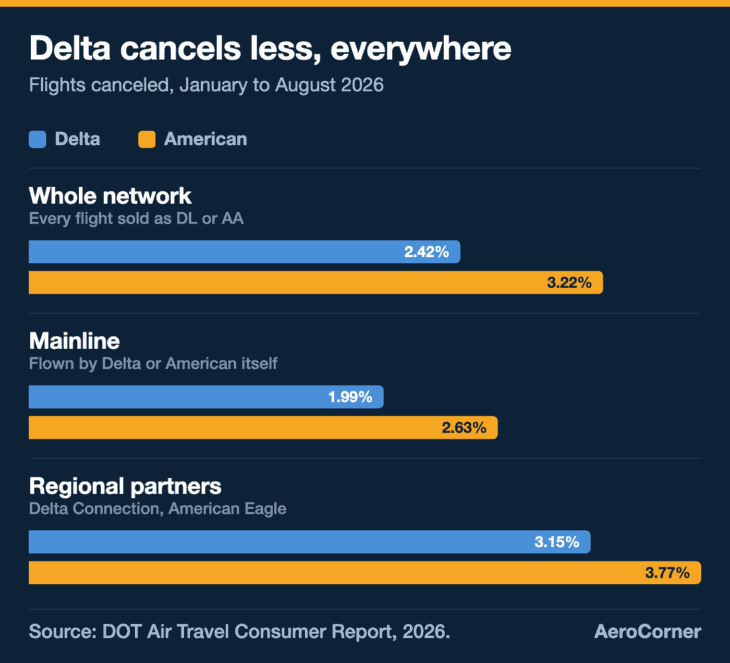
By our count from the DOT’s monthly tables, Delta canceled 2.42% of its network flights between January and August 2026. American canceled 3.22%, which makes a cancellation about a third more likely on an American booking.
Both were worse than a year earlier. In the first half of 2025 Delta canceled 1.22% and American 2.69%, so Delta’s first-half rate roughly doubled to 2.35% in 2026, and in July 2026 alone American edged it, 3.20% to 3.31%.
The bigger difference is who operates the flight. From January to August, 51.5% of the flights sold under American’s code were flown by American Eagle regional partners, against 37.4% of Delta’s by Delta Connection carriers.
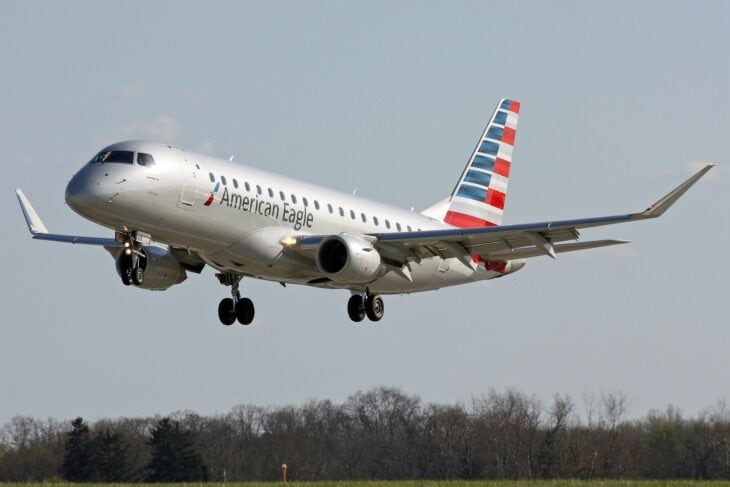
That matters because the partners cancel more often at both airlines: 3.77% at American Eagle and 3.15% at Delta Connection, against 2.63% and 1.99% for the two mainlines. Before you book, the “operated by” line tells you more about your odds than the logo does.
Edge: Delta. Lower cancellation rates on its network, its mainline and its regional partners alike.
Book American, fly American? Half the time, no
Between January and August 2026, 708,099 of the 1,375,517 flights sold as American Airlines, or 51.5%, were flown by regional partners such as Envoy, PSA, Piedmont, Republic and SkyWest under the American Eagle name. Those flights canceled 3.77% of the time, against 2.63% for American’s own jets. Delta hands 37.4% of its flights to partners.
Bags, complaints and bumping
Delta mishandled 0.37 bags per 100 checked from January to August 2026. American mishandled 0.68, so a checked bag was about 1.8 times as likely to go astray with American.
The gap is wider for wheelchairs and scooters. In the first half of 2026 American mishandled 1.24 of every 100 it carried, against 0.36 at Delta.
Complaints follow the same order once you adjust for size. American drew 911 DOT complaint cases per 100,000 scheduled flights, Delta 573, so American drew about 59% more complaints per flight.
Bumping is where the two are furthest apart. Delta’s network denied boarding to no one against their will in the first half of 2026, while American’s bumped 5,247 passengers, a story we covered in why American bumps more passengers than everyone else combined.
American is trying to fix that. An internal memo reported by One Mile at a Time in October 2026 tells gate agents to keep the aircraft door open until every oversold seat has a volunteer.
Edge: Delta. Fewer lost bags, fewer complaints per flight, and zero involuntary bumps.
Delta bumped nobody
Delta’s network carried 91.8 million passengers between January and June 2026 and involuntarily denied boarding to none of them, according to the DOT. American’s network carried 101.3 million and bumped 5,247, a rate of 0.52 per 10,000 passengers.
Where each one flies
Reliability decides little if the airline does not fly your route, and for most people the home airport settles this comparison before anything else.
American is the bigger network. It runs more than 6,000 daily flights to more than 350 destinations in more than 60 countries, from hubs at Charlotte, Chicago, Dallas/Fort Worth, Los Angeles, Miami, New York, Philadelphia, Phoenix and Washington, D.C.
Delta runs up to 5,500 daily flights to more than 300 destinations on six continents. Its largest hub is Atlanta, with Detroit, Minneapolis-St. Paul, Salt Lake City, Boston, Seattle, Los Angeles and both New York airports as its other main US bases.
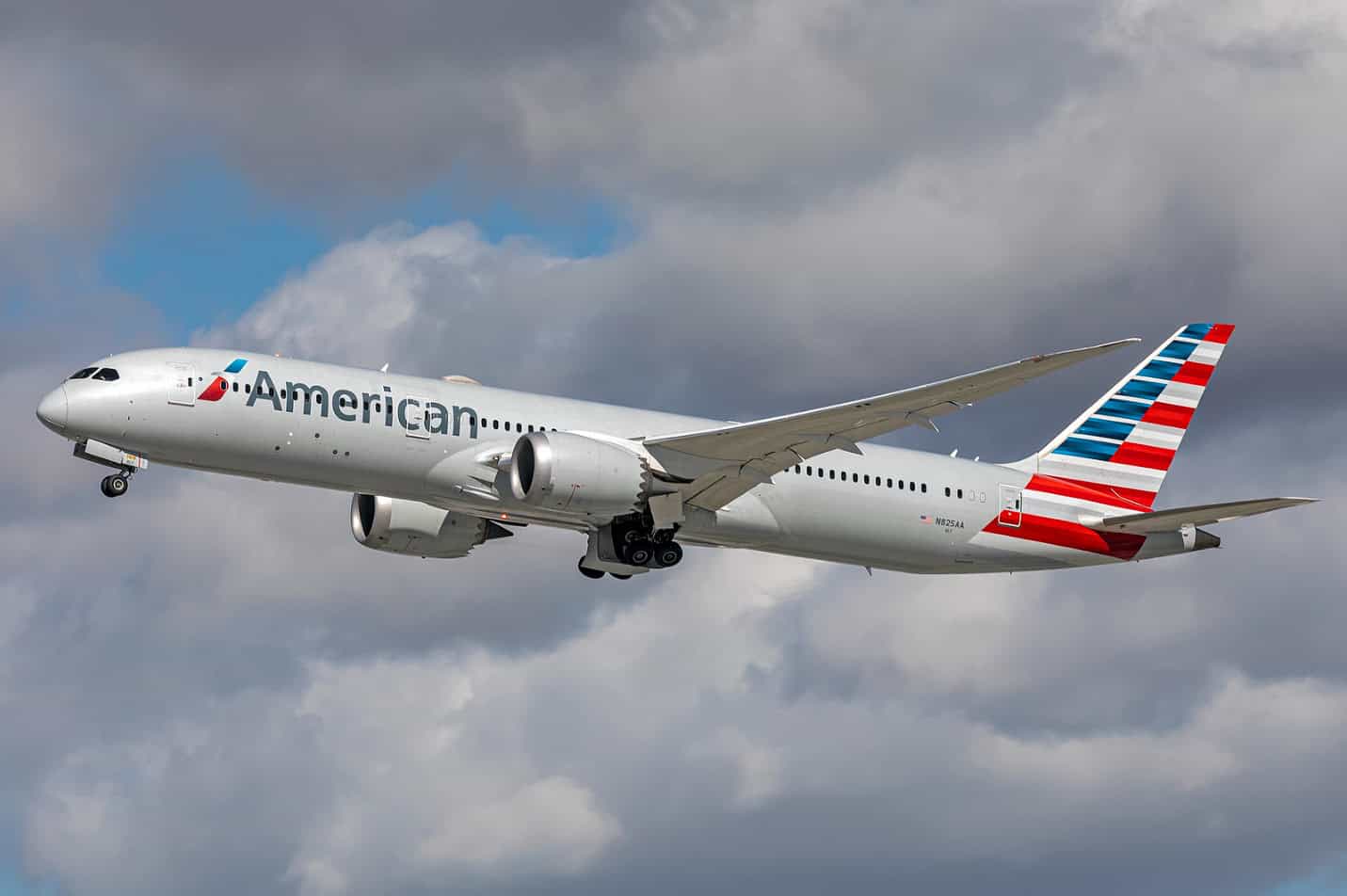
Abroad, both lean on partners. American founded oneworld and runs joint businesses with British Airways, Aer Lingus, Iberia and Finnair across the Atlantic, Japan Airlines across the Pacific, and Qantas to Australia and New Zealand.
Delta founded SkyTeam and lists Amsterdam, Paris-Charles de Gaulle, London-Heathrow, Seoul-Incheon, Tokyo, Mexico City and four South American cities among its hubs and key markets.
Edge: American. More flights and more destinations, though bigger only helps if it is big where you live.
Fleet and Wi-Fi
The two mainline fleets are almost the same size. Delta flew 1,005 mainline jets at September 30, 2026, averaging 14.9 years old, and its full fleet count adds 325 Delta Connection regional jets.
American flew 1,013 mainline jets at the end of 2025, averaging 14.3 years, and 1,030 by June 30, 2026. Its fleet breakdown shows why it is younger: 303 Boeing 737-800s and 89 737 MAX 8s, and no type averaging more than 25 years.
Delta, by contrast, still flies 74 Boeing 717s averaging 24.9 years and 37 767-300ERs averaging 29.7. It also flies more wide-bodies, 181 against American’s 137, which helps on long-haul routes.
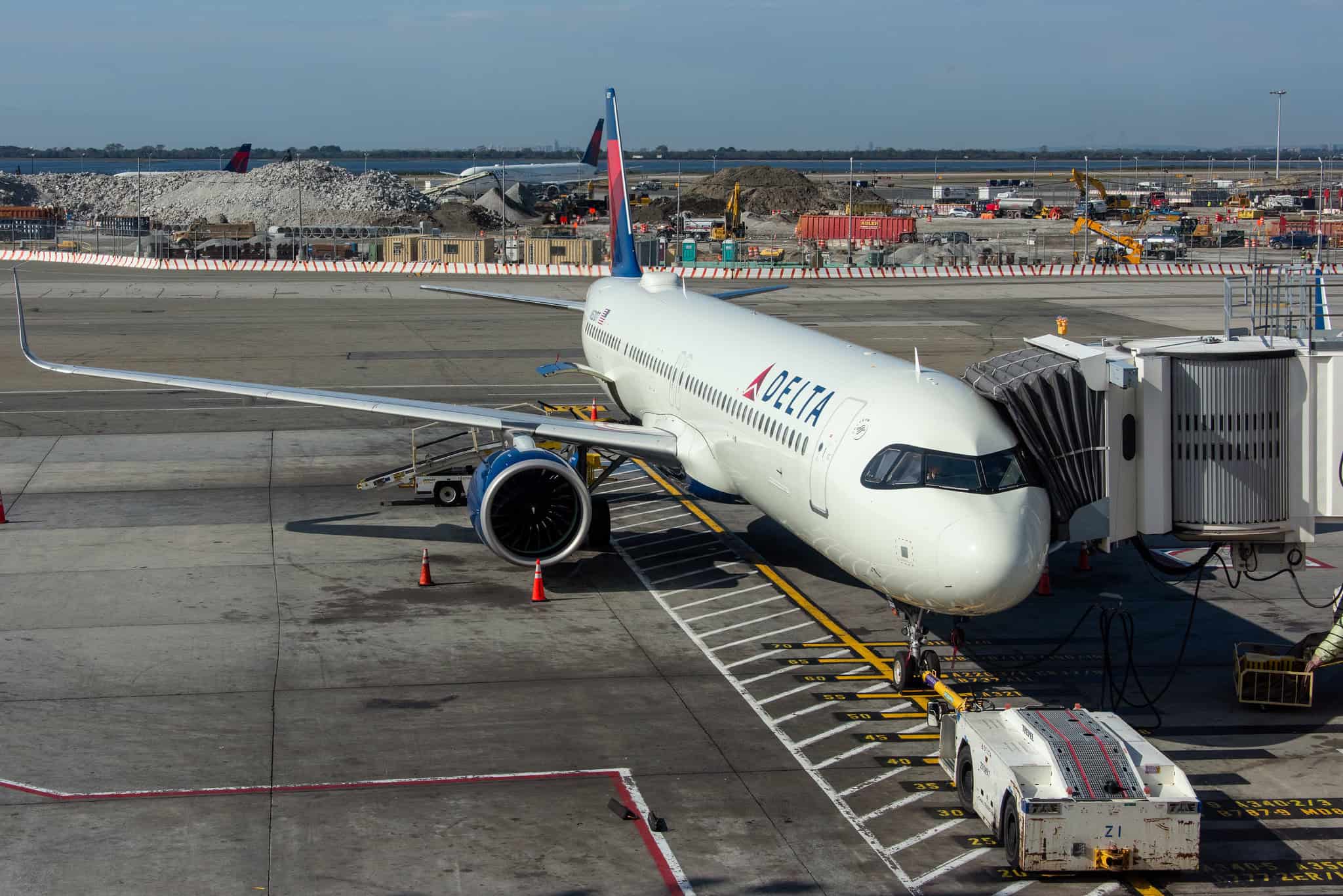
Both now give loyalty members free Wi-Fi. Delta’s, presented by T-Mobile, covers SkyMiles members on nearly all domestic and international flights, while it is still rolling out across Delta Connection regional jets.
American’s, sponsored by AT&T, launched in January 2026 for AAdvantage members on every narrow-body, every two-class regional jet and select Boeing 787-9 and 787-8 aircraft. The rollout does not cover its whole wide-body fleet, which matters on a long-haul trip.
Edge: Even. American’s fleet is younger on average, and Delta’s free Wi-Fi reaches further on long-haul flights.
Seats and bag fees
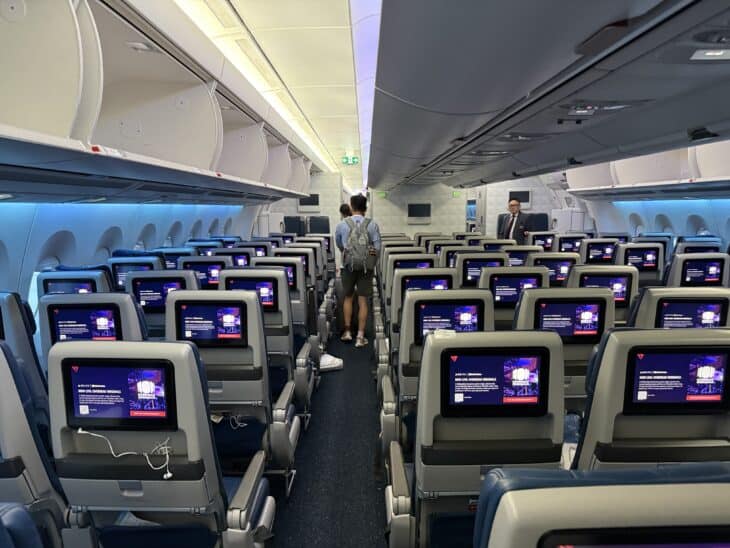
Delta’s economy seats are slightly roomier. Simple Flying’s July 2025 comparison put Delta’s average economy pitch at 31.8 inches against American’s 31, and on the Airbus A321neo Delta gives 31 inches where American gives 30.
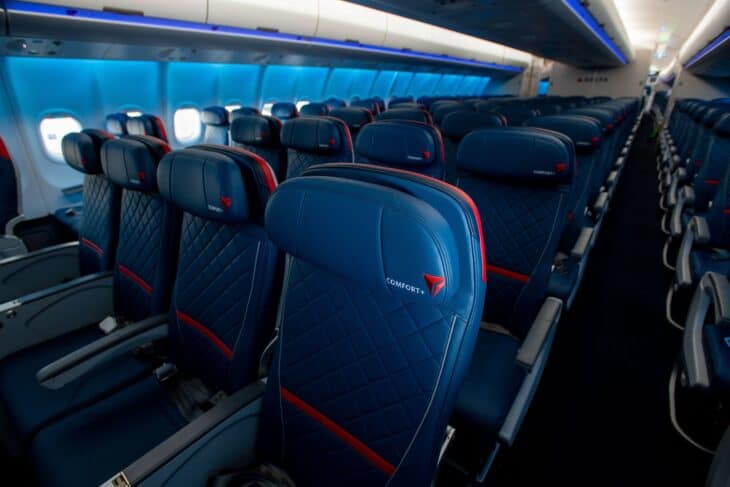
Both sell an extra-legroom section at about 34 inches, branded Delta Comfort and Main Cabin Extra. American’s Main Cabin Extra runs up to 39 inches on some A321neo rows.
Bag fees are close to identical after both raised them in 2026. Delta charges $45 for the first domestic bag and $55 for the second on tickets bought from April 8, 2026.
American charges the same $45 and $55 if you pay online, or $50 and $60 at the airport, and $5 more on Basic Economy tickets.
Edge: Delta, narrowly. An inch more legroom on the same jet, while bag fees tie if you pay online.

Lounges
Here the answer depends on whether you already hold status. Delta sells an Individual Sky Club membership for $695 a year, or $1,495 for an Executive membership with two guests, but only to Medallion members.


American sells Admirals Club memberships to anyone. Since August 23, 2026 the standard one costs $1,400 a year, less for elites, and a new $750 single membership covers the member alone at nearly 50 Admirals Club lounges.
American also still sells $79 One-Day Passes when space allows. Delta’s club has more than 50 locations, and its rules bar Basic Economy tickets even for travelers with a qualifying card.
Edge: Delta, if you hold status. Its $695 membership is the cheapest annual club pass of the two; without status, American is the only one you can simply buy.
What elite status costs
Delta’s entry tier, Silver Medallion, takes $5,000 in Medallion Qualification Dollars for 2027 status. MQDs are earned one for one on base fare plus carrier-imposed surcharges, so that is $5,000 of airfare.
American’s entry tier, Gold, takes 40,000 Loyalty Points. Its own status estimator assumes 5 points per dollar, which puts Gold at about $8,000 of airfare, 60% more than Delta’s Silver.
| Tier | Delta (MQDs) | American (Loyalty Points) |
|---|---|---|
| Entry | Silver, $5,000 | Gold, 40,000 |
| Second | Gold, $10,000 | Platinum, 75,000 |
| Third | Platinum, $15,000 | Platinum Pro, 125,000 |
| Top | Diamond, $28,000 | Executive Platinum, 200,000 |
| Qualification year | January to December | March to February |
American’s points come from credit card spending as well as flying, which suits someone who flies little but spends a lot on its card. Its qualification year also runs March to February, so a January trip counts toward a different year than it would at Delta.
Edge: Delta. Entry status costs about $3,000 less in airfare.
Who should pick which
| If you… | Pick | Because |
|---|---|---|
| Need to arrive on time | Delta | 78.0% on time from January to August 2026, against 73.0% |
| Check a bag on most trips | Delta | 0.37 bags mishandled per 100, against 0.68 |
| Fly mostly short regional hops | Delta | 37.4% of its flights go to regional partners, against 51.5% |
| Live near Dallas/Fort Worth, Charlotte, Philadelphia, Miami or Phoenix | American | They are American hubs, so it has the nonstops |
| Live near Atlanta, Detroit, Minneapolis or Salt Lake City | Delta | They are Delta hubs, so it has the nonstops |
| Want lounge access without elite status | American | Anyone can buy an Admirals Club membership or a $79 day pass |
| Chase status on modest airfare spending | Delta | $5,000 for Silver, against about $8,000 for American Gold |
| Fly often to Britain, Ireland, Spain or Japan | American | Joint businesses with British Airways, Aer Lingus, Iberia and Japan Airlines |
If no row describes you, book on price and schedule. On one trip a nonstop beats either airline’s connection, whatever the averages say.
FAQ
Sources and references used for research and fact-checking.
- US Department of Transportation, October 2026 Air Travel Consumer Report (August 2026 data)
- US Department of Transportation, September 2026 Air Travel Consumer Report (July 2026 data)
- US Department of Transportation, August 2026 Air Travel Consumer Report (June and January to June 2026 data)
- Delta Air Lines / SEC, Delta Air Lines Form 10-Q for the quarter ended September 30, 2026
- American Airlines Group / SEC, American Airlines Group Form 10-K for 2025
- American Airlines Group / SEC, American Airlines Group second-quarter 2026 results (Exhibit 99.1)
- Delta Air Lines, Corporate Stats and Facts
- American Airlines Newsroom, American Airlines launches free high-speed Wi-Fi sponsored by AT&T
- American Airlines Newsroom, American Airlines maintains AAdvantage status and reward levels for third year in a row
- Delta Air Lines, Onboard Wi-Fi
- Delta Air Lines, Delta Sky Club Membership
- Delta Air Lines, Delta Sky Club access policies
- American Airlines, Admirals Club membership
- Delta Air Lines, How to Qualify for Medallion Status
- American Airlines, Loyalty Points and status
- One Mile at a Time, American AAdvantage Loyalty Points: How Status Qualification Works
- American Airlines, Checked baggage policy
- Upgraded Points, Delta Raising Checked Bag Fees
- Delta Air Lines, Check-In Times at U.S. Airports
- Simple Flying, American Vs. Delta Vs. United: Which Carrier Has The Most Legroom?
- One Mile at a Time, American Airlines Commits To Ending Involuntary Denied Boardings
Get the Newsletter
The latest aviation news and stories sent to your inbox.
About the Author

Tim is the owner and lead editor of AeroCorner since 2019, overseeing aviation content covering aircraft, airlines, airports, and the broader aviation industry. Through years of researching, writing, editing, and publishing aviation-focused content, he has developed extensive practical knowledge of commercial aviation and air travel. Based in Asia and a frequent traveler himself, Tim also brings firsthand passenger experience to AeroCorner’s coverage. Outside of publishing, he has also explored aviation firsthand through hands-on flight training in New Zealand.