

Table of Contents
Open any airline booking page and pick a flight. The economy fare sits in one column, and the first class fare next to it is several times higher, for the same aircraft, the same departure time and the same arrival.
The seat you are paying for is a few inches wider. The meal is better and the drinks are free. None of that looks like it should cost thousands of dollars more.
It doesn’t, and the airline knows it. The price of a first class ticket is set mostly by something you never think about: how much of the aircraft’s floor your seat takes away from everyone else. Here is what first class really costs, and why.
How Much Is a First Class Ticket?
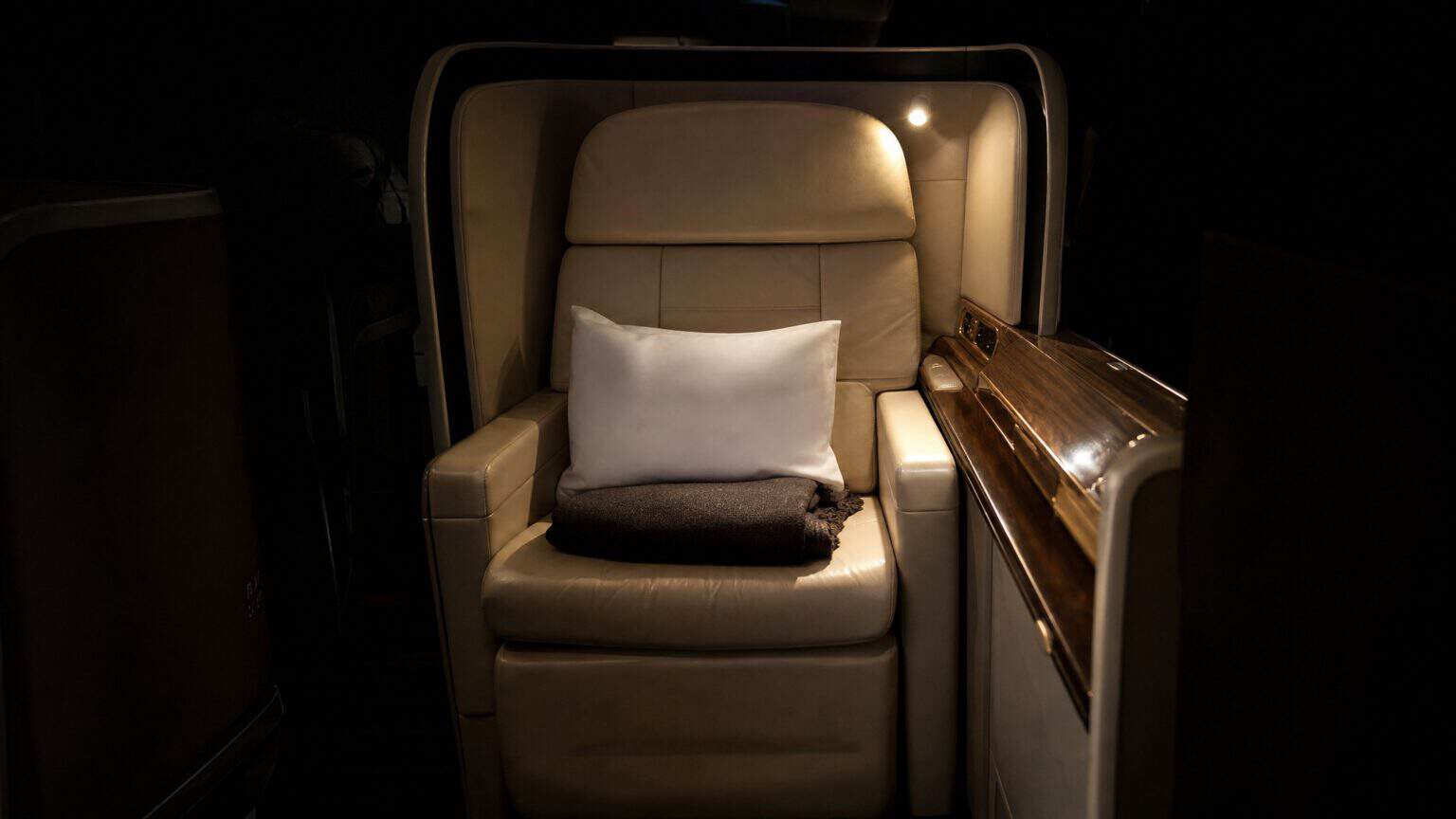
On a US domestic flight, first class usually costs about $300 to $1,000 one way, depending on the airline, the length of the flight and demand on the route. On a long-haul international flight, true first class typically starts around $5,000 round trip and runs to $15,000.
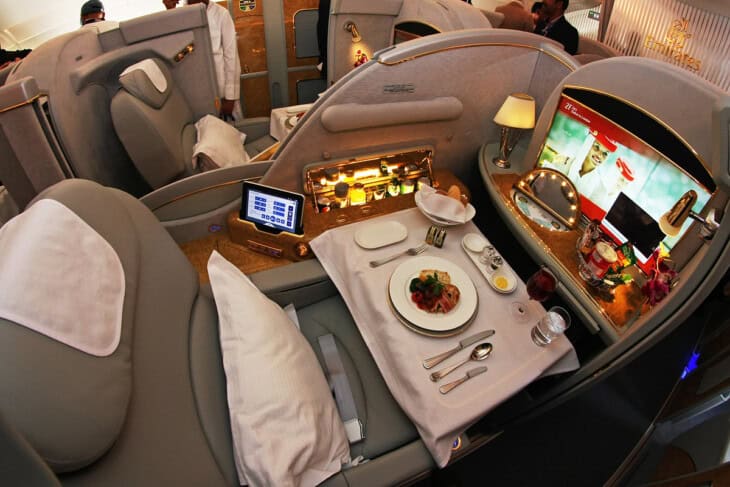
On the world’s longest routes, round-trip first class fares typically run from $15,000 to $28,000. An Emirates first class suite on the 8,824-mile (14,201 km) Dubai to Auckland route can cost more than $20,000.
The answer in one line
Domestic first class is roughly $300 to $1,000 one way; long-haul international first class is roughly $5,000 to $15,000 round trip, and more on ultra-long routes. The fare tracks how much cabin floor the seat occupies, not what the food and service cost.
| What you are buying | What the seat usually is | Typical price range |
|---|---|---|
| US domestic first class | A wide recliner, two on each side of the aisle | About $300 to $1,000 one way |
| Long-haul international first class | A flat bed, often in an enclosed suite | About $5,000 to $15,000 round trip |
| First class on the world’s longest routes | A private suite, sometimes with an onboard shower | About $15,000 to $28,000 round trip |
Those two products share a name and little else. A US domestic first class seat is a wide recliner, closer to an older business class seat than to anything sold as first class on a long-haul flight. International first class is a flat bed, and increasingly a suite with a door. We break down the difference in every type of airplane seat, measured.
The fare is rent on floor space
An airline sells one thing: a seat on a flight, and a seat is really a patch of cabin floor. Every square foot given to first class is a square foot that cannot hold an economy passenger, so the first class fare has to earn back the seats that are not there.
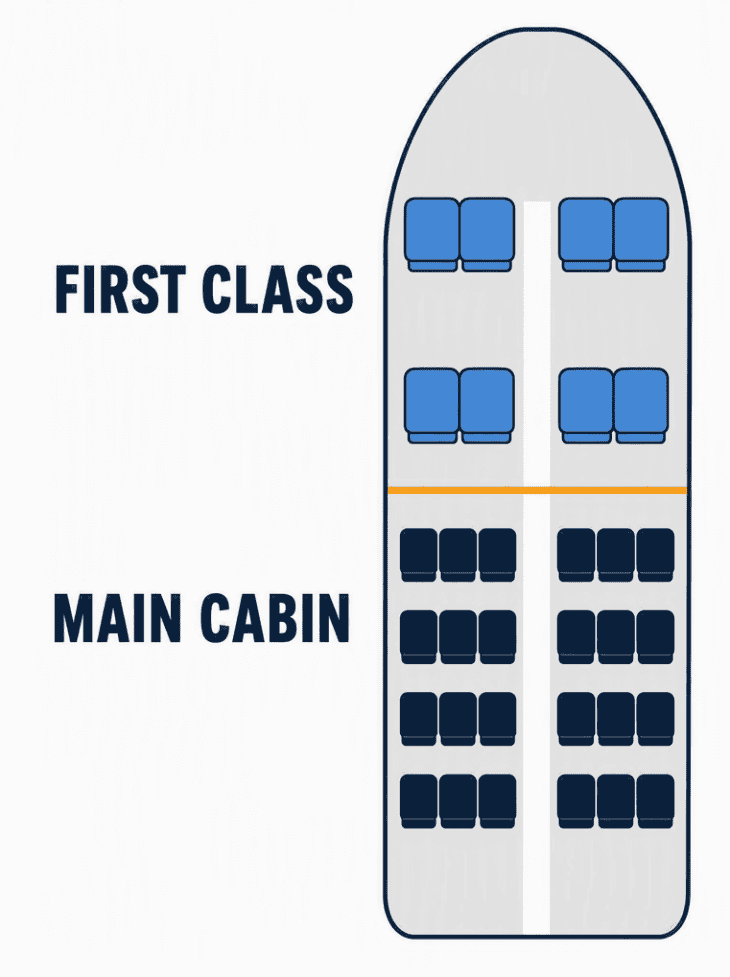
Take Delta’s standard Airbus A321neo. First class has 20 seats, 21 inches (53 cm) wide at 37 inches (94 cm) of pitch, four across. The Main Cabin has 114 seats, 18 inches (46 cm) wide at 31 inches (79 cm) of pitch, six across.
Do the arithmetic. A row of first class uses 37 inches of cabin length to carry four people, about 9.3 inches each. A row of Main Cabin uses 31 inches to carry six, about 5.2 inches each. Each domestic first class passenger takes up roughly 1.8 times the floor of an economy passenger.
On a long-haul jet the gap is far wider. A 2021 analysis in the Michigan Journal of Economics, a University of Michigan student publication, measured seat footprints on long-haul widebodies flying between continents. First class seats took up nearly six times the floor area of economy seats, on average.
The fares in its sample landed in almost the same ratio: an average of $9,289 for first class against $1,444 for economy. Measured per square foot of cabin, business class and first class both brought in about $302.
That is the whole trick. A first class fare is not a markup on a nicer chair. It is the price of the economy seats the suite displaced, and the ratio of the fares roughly follows the ratio of the floor.
Fourteen suites or 56 seats
On Emirates’ three-class Airbus A380s, a 56-seat premium economy cabin fills the front of the upper deck. On its four-class A380s, the same footprint holds just 14 first class suites. Every one of those suites has to earn what four premium economy seats would have.
Air France’s La Première suite gives each passenger almost 38 square feet (3.5 sq m) of personal space. At the Delta Main Cabin dimensions above, an economy seat’s own slice of the floor is under 4 square feet (0.4 sq m).
For years, most first class seats were never sold
Here is the part most flyers never knew. For a long time, the published first class fare was more of a sticker than a price, because airlines filled most of the cabin with free upgrades for their frequent flyers.
At its 2024 investor day, Delta said that in 2011 it sold only 14% of its domestic first class seats. By 2024 it was selling 88%, and just 12% of first class seats went to passengers being upgraded.
Delta’s former president Glen Hauenstein described the shift in 2026. Domestic first class used to be “a loss leader,” he said; “now it’s the giant profit center.” The mechanism was pricing: instead of handing the seats to elite frequent flyers for free, Delta attached prices to the cabin and steadily filled it with paying passengers.
That is why a first class fare can look wildly different from one search to the next. Airlines sell the same cabin under several fare codes, full-fare first under F and discounted first under letters such as A, and they open and close the cheaper ones with demand, the same way they manage economy.
It has worked. In the last three months of 2025, Delta’s premium ticket revenue reached $5.695 billion and passed its Main Cabin ticket revenue of $5.620 billion, the first quarter in the airline’s history when that happened.
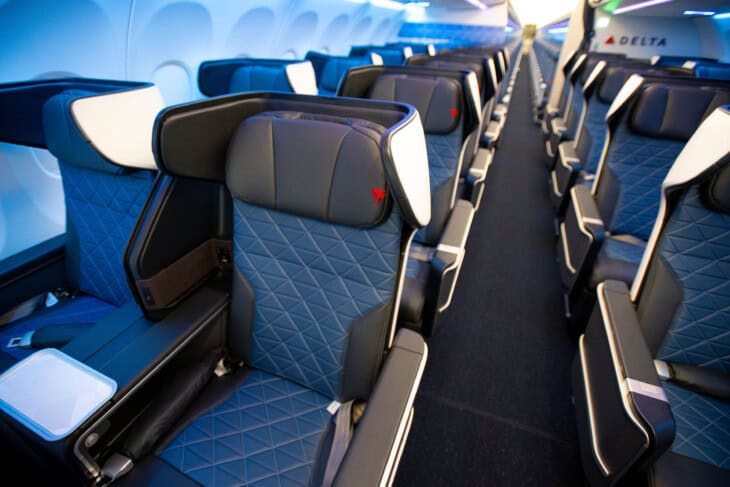
Domestic first class is now growing. Delta’s premium-heavy A321neo, flying from Atlanta to Los Angeles, San Francisco and Seattle since June 7, 2026, carries 44 first class seats at 38 inches of pitch, out of 164 seats in total. Delta’s chief commercial officer, Joe Esposito, said in August 2026 that the cabin was selling at an 80% paid load factor.
The pattern holds far beyond Delta. IATA’s economists found that at full-service airlines between 2011 and 2019, business and first class passengers flew about 7% of all passenger-kilometers but paid about 20% of all passenger revenue. In 2025, 109.7 million international passengers flew in premium cabins, 5.5% of all international travelers.
Why true first class is disappearing into business
If the fare only has to pay for the floor, first class has a problem. The same analysis that found first class earning about $302 per square foot found business class earning the same, from seats that take up less room each, so more of them fit in the cabin.
Once you subtract what each cabin costs to serve, the study found, first class brought in the least revenue per square foot of any cabin. Airlines reached the same conclusion on their own. Delta dropped traditional international first class in 1998, and United followed in 2016, when it launched its Polaris business class.
American Airlines is the last of the big three to let go. It stops selling Flagship First on its Boeing 777-300ER fleet for travel from November 19, 2026, and on its premium transcontinental Airbus A321T flights from March 28, 2027.
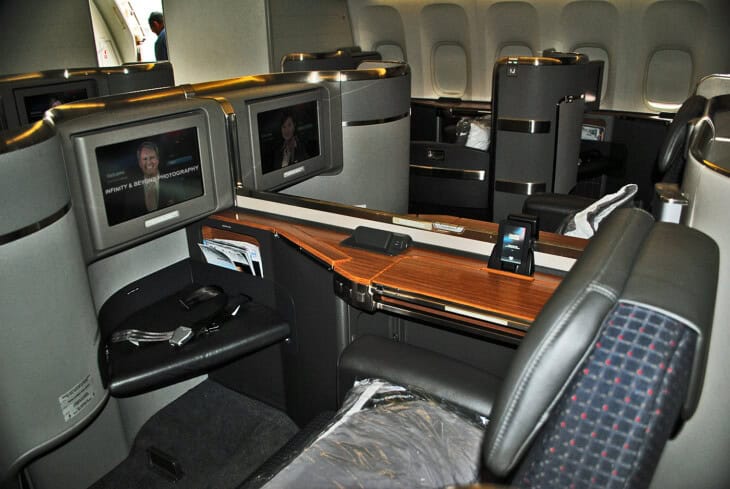
The retrofit shows where the floor goes. American’s 777-300ER used to carry eight first class seats and 52 business class seats among 304 in total. The rebuilt aircraft, which flew its first commercial trip from New York JFK to Buenos Aires on September 2, 2026, has 70 business class suites, 44 premium economy seats and 330 seats overall.
American’s then chief commercial officer, Vasu Raja, gave the reason bluntly in 2022: first class would not exist at the airline “for the simple reason that our customers aren’t buying it.” Business class seats had become so good that removing first class let the airline sell more of what customers were actually willing to pay for.
A few carriers still see it the other way. Lufthansa is fitting enclosed First Class Suites as part of its $2.8 billion (€2.5 billion) Allegris cabin program, and Air France, Emirates and Qatar Airways keep investing in first or top-tier suites. True first class is not extinct; it is becoming rare.
The myth: you are paying for the champagne
The myth
First class costs so much because of the food, the lounge, the bedding and the service. In fact those extras are a small slice of the fare. What you mostly pay for is floor space the airline could have sold to other passengers.
The service is real, and it is not free. The 2021 Michigan analysis put the extra cost of serving a long-haul first class passenger at about $1,007 per ticket, against an average first class fare of about $9,300 in its sample.
That leaves the great majority of the fare paying for space. Take the champagne away and the ticket would barely get cheaper. Take away the floor and the airline could put several more paying passengers where you were sitting.
The same logic explains why domestic first class costs a fraction of international first. A domestic first class seat takes up less than twice an economy seat’s floor, while a long-haul suite takes many times more, and the fares follow. How the rest of the cabin is priced is its own story, covered in how airlines price the seat next to you.
So the next time the first class column on a booking page looks absurd, measure the seat instead of tasting the menu. You are renting a piece of the cabin that several economy passengers could have shared.
And if the gap between the two columns ever looks surprisingly small, the airline is doing the same sum from the other side. A first class seat sold at a modest price still earns more than one flown empty or given away as an upgrade.
Sources and references used for research and fact-checking.
- Simple Flying, How Much Do First Class Seats Cost?
- Simple Flying, How Much Does It Cost To Fly First Class On The World's Longest Routes?
- Delta Air Lines, Airbus A321neo Seat Maps, Specs and Amenities
- Simple Flying, Delta Air Lines Airbus A321neo (20F / 60W / 114M) seat map
- Michigan Journal of Economics, The Death of First Class
- Simple Flying, Only 14 First Class Seats: The Hidden Trade-Offs Behind Emirates' Airbus A380 Cabin Design
- Simple Flying, Airlines Are Now Ripping Out Economy Seats To Make Room For Doored First-Class Suites
- One Mile at a Time, Delta Selling 88% Of First Class Seats, Up From 14% in 2011
- View from the Wing, Delta's Former President Explains How First Class Upgrades Vanished And Paid Premium Seats Took Over
- Aviation A2Z, Delta Sold 87% of First Class Seats And Changed Airline Economics Forever
- Delta Air Lines via PR Newswire, Delta Air Lines Announces December Quarter and Full Year 2025 Financial Results
- Engine Cowl, Delta's premium ticket revenue exceeds Main Cabin ticket revenue for the first time
- Simple Flying, Nearly 40 Inches Of Pitch: Delta Air Lines Unveils Seat Map Of New Premium-Heavy Airbus A321neo
- Live and Let's Fly, Delta Considering Much Larger First Class Cabins After Surprise Success Of 44-Seat A321neo
- IATA Sustainability and Economics, Premium traffic and revenue are back on track
- IATA, IATA Releases 2025 World Air Transport Statistics
- Simple Flying, Why American Airlines Is Quietly Killing The Last International First Class Cabin In The US
- AirlineGeeks, American Sets End Dates for Flagship First
- AirlineGeeks, First Look: American Debuts Its Most Premium Jet Yet
Get the Newsletter
The latest aviation news and stories sent to your inbox.
About the Author

Tim is the owner and lead editor of AeroCorner since 2019, overseeing aviation content covering aircraft, airlines, airports, and the broader aviation industry. Through years of researching, writing, editing, and publishing aviation-focused content, he has developed extensive practical knowledge of commercial aviation and air travel. Based in Asia and a frequent traveler himself, Tim also brings firsthand passenger experience to AeroCorner’s coverage. Outside of publishing, he has also explored aviation firsthand through hands-on flight training in New Zealand.