

Table of Contents
On paper the comparison looks straightforward. An empty leg lists for less than a first class ticket on the same route, you get a private jet instead of a premium airline seat, and the winner seems obvious. In practice, the value equation is more complicated than the headline price suggests, and for many travellers the answer depends less on money than on how they actually travel.
This article breaks down the comparison honestly. The aim is not to sell you on either option but to give you a clear picture of where each one has a genuine advantage and what type of traveller each one actually suits.
The mechanics behind why empty legs are priced the way they are is covered separately. This article focuses on the comparison itself and where it lands for different situations.
Check out our live private jet empty leg flights.
What first class actually gives you
A first class airline ticket is a known quantity. You book a specific seat on a specific aircraft on a specific date, and that booking is extremely unlikely to change. The airline operates the flight regardless of anything else happening that day. You get access to a first class lounge, priority security and boarding, a lie-flat seat or private suite on long-haul routes, full catering service throughout the flight, and arrival at a time you can build commitments around.
The reliability is the point. First class is not just about the seat or the food. It is about predictability. You know when you will leave, where you will land, and what the experience will look like from door to door. That certainty has real value for business travellers with fixed schedules, for trips with tight connections, and for anyone whose commitments at the destination cannot flex.
First class lounges are part of the value
Airport lounge access, fast-track security, and priority boarding are bundled into a first class fare. None of these exist in private aviation — because private aviation already bypasses the commercial terminal entirely. The two experiences are not just different in quality; they are different in kind.
What an empty leg gives you
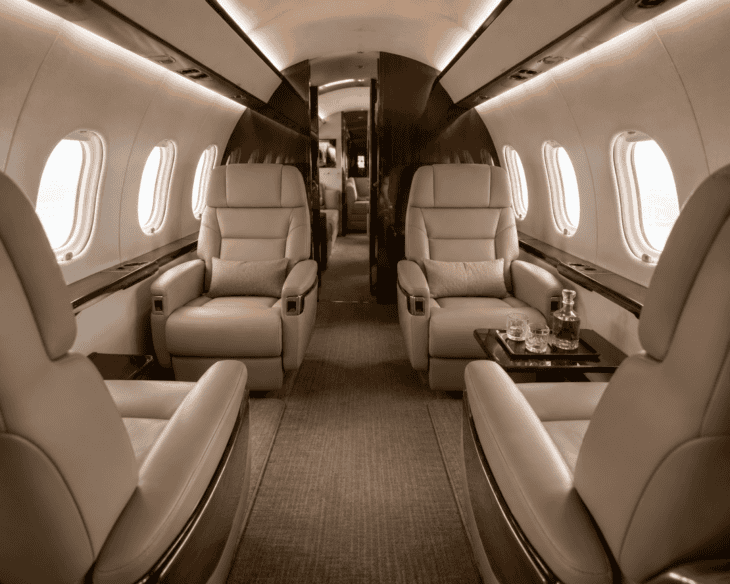
An empty leg gives you a private aircraft for a fraction of the cost of chartering it. Depending on the route and the deal, you might be on a light jet with four or five seats, a mid-size with seven or eight, or occasionally something considerably larger. You travel without other passengers. There are no shared armrests, no neighbour leaning into your space, and no cabin noise from a hundred other people. The flight itself — once you are airborne — is a qualitatively different experience from commercial aviation at any price point.
What an empty leg does not give you is certainty. The flight exists because another booking created it, and if that booking changes, so does yours. The departure time can shift. The route is fixed by where the aircraft needs to reposition. The listing will not appear until close to departure, which makes planning around one in advance genuinely difficult. These are not small trade-offs, and they determine the answer for most travellers more than the price does.
The first empty leg guide covers what the experience actually looks like on the day — from the FBO to boarding to arrival — for anyone approaching it for the first time.
How the costs compare
The price advantage of an empty leg is real. Repositioning flights are priced to recover some cost on a sector the operator was flying regardless, and the discount against full charter is typically substantial. On routes where commercial first class carries a significant fare — transatlantic business routes, premium leisure routes to major resort destinations — an available empty leg on the same corridor can list well below what the airline charges for its front cabin.
The comparison is not always clean, though. First class fares vary enormously based on booking lead time, route, demand, and cabin configuration. An empty leg on a route where first class is already cheap may not represent the saving it first appears. And the empty leg listing will not exist until close to departure, which means it cannot be compared to a first class fare until the window to book that fare has already narrowed considerably.
Private Jet Empty Leg
Airline First Class
When the empty leg wins
The empty leg is the better choice when three conditions align: the route matches where you need to go, your travel dates are flexible enough to respond to a listing with short notice, and the price on offer is meaningfully lower than what you would pay for a premium commercial seat on the same corridor. If all three are true, the case for the empty leg is strong.
It also wins when the value of a fully private experience outweighs the trade-off on reliability. A leisure trip where the flight is part of the experience and the schedule can flex by a day. A family journey with no fixed commitments at the other end. A business trip where the meeting time is flexible and the route is one that regularly generates repositioning flights. In these scenarios, the conditions that would make an empty leg unworkable simply do not apply.
The booking timing guide explains how to position yourself to catch a deal when one appears, which is the practical skill that separates people who regularly fly empty legs from those who keep meaning to.

When first class wins
First class wins whenever reliability matters more than price. If you have a morning meeting that cannot be missed, connecting travel that cannot be rebooked, or passengers joining you who cannot accommodate a last-minute change in departure time, the predictability of a commercial ticket is worth paying for. The empty leg that would have saved money is no longer an option the moment your schedule becomes inflexible.
First class also wins on routes that empty legs simply do not serve. Repositioning flights go where the aircraft needs to go, not where passengers want to travel. On routes where commercial aviation is direct and frequent, finding a matching empty leg at the right time may be unlikely. On niche city pairs with limited commercial service, empty legs sometimes appear — but the connection cannot be planned around.
For a fuller comparison of the private jet experience against commercial premium cabins more broadly, the private jet vs. first class guide covers the full picture beyond the empty leg context.
Price does not change the operational risk
An empty leg that costs the same as a first class ticket still carries the same cancellation and amendment risk as one that costs a fraction of it. The repositioning flight can be pulled or rescheduled with limited notice regardless of what you paid. Review the terms and the catches before booking.
A more useful frame for the decision
The most useful way to approach the comparison is not price-first but flexibility-first. The question is not whether the empty leg is cheaper than first class — it often is, when one is available on your route. The question is whether your travel situation is compatible with what a repositioning flight actually is: a last-minute opportunity on a fixed route, with real cancellation risk attached.
If you travel frequently and flexibly, setting up route alerts on corridors you regularly fly costs nothing and occasionally delivers a deal that makes the comparison straightforward. If your travel is scheduled, high-stakes, and inflexible, first class is not a consolation prize. It is the right product for your situation, and paying for it is the rational choice.
The best way to see whether the empty leg option exists for your next trip is to browse what is currently listed: private jet empty leg flights.

Get the Newsletter
The latest aviation news and stories sent to your inbox.
About the Author

Tim is the owner and lead editor of AeroCorner since 2019, overseeing aviation content covering aircraft, airlines, airports, and the broader aviation industry. Through years of researching, writing, editing, and publishing aviation-focused content, he has developed extensive practical knowledge of commercial aviation and air travel. Based in Asia and a frequent traveler himself, Tim also brings firsthand passenger experience to AeroCorner’s coverage. Outside of publishing, he has also explored aviation firsthand through hands-on flight training in New Zealand.