

Table of Contents
Almost every article in this series is about an aircraft somebody still owns. This one is about an aircraft somebody deliberately got rid of.
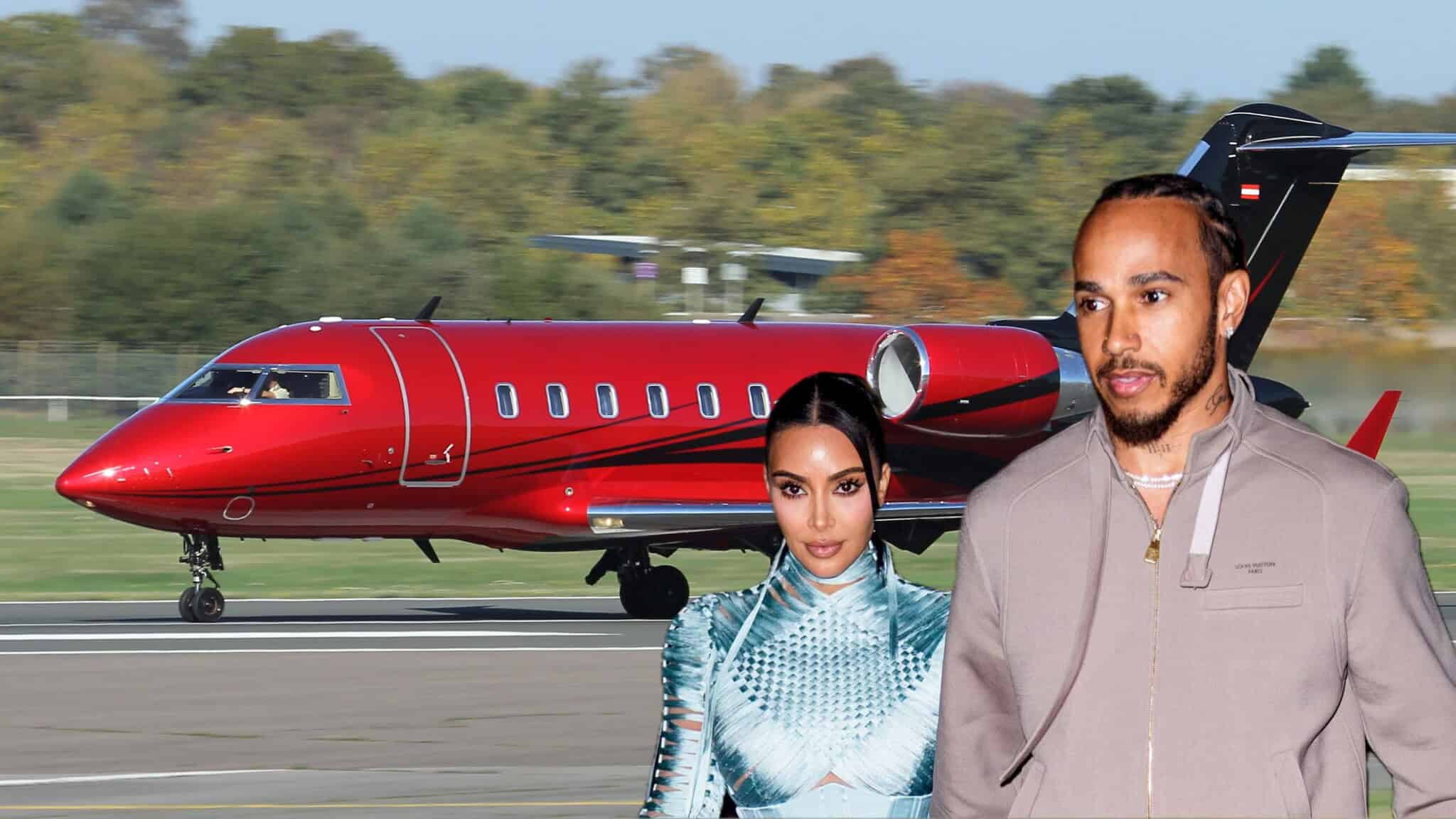
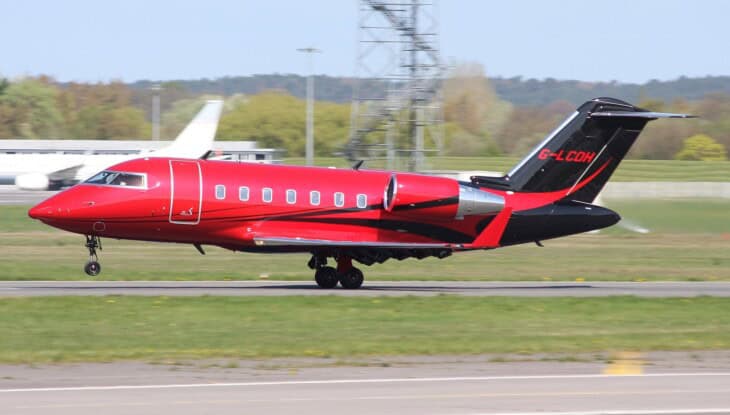
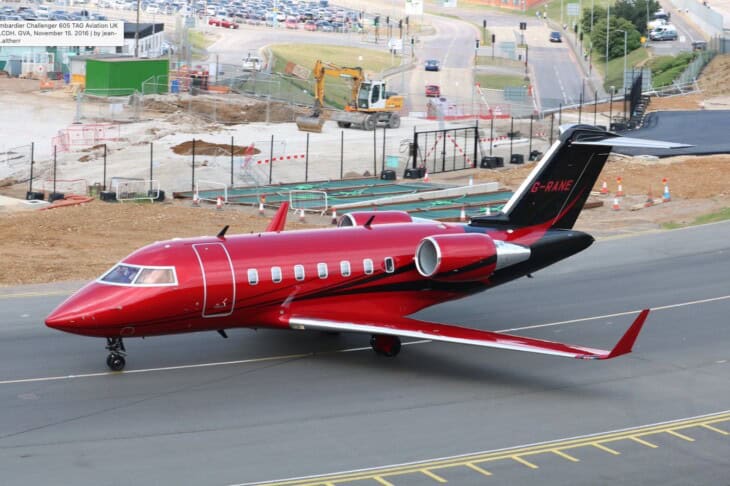
The Lewis Hamilton private jet was a candy apple red Bombardier Challenger 605, registered G-LCDH after Lewis Carl Davidson Hamilton. He bought it in 2013, became the face of a tax story he never wanted, and sold it as his environmental politics hardened.
This article covers the full specification of that airframe, the Isle of Man structure that produced a £3.3 million VAT refund, why he let the jet go, where it flies today, and the awkward arithmetic of his 2026 relationship with Kim Kardashian.
Quick facts about Lewis Hamilton’s private jet
Lewis Hamilton’s Private Jet Fleet
One aircraft, owned for roughly four to five years, and nothing since. Hamilton has never assembled the multi-jet fleet that his net worth would easily support.
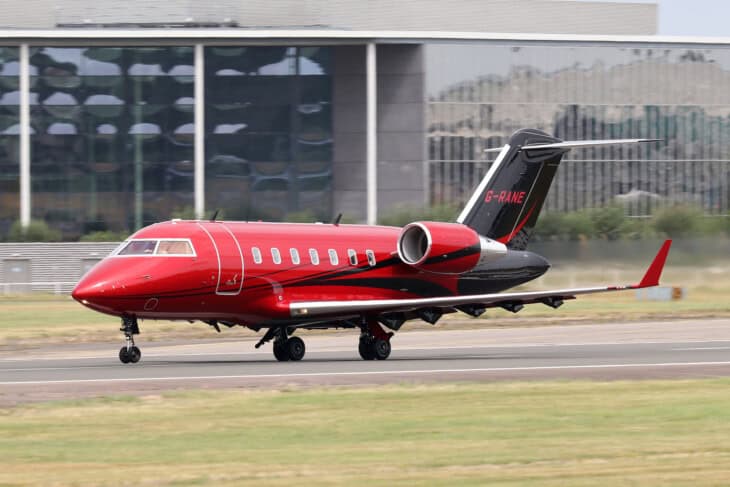
That puts him at the opposite end of this series from Tyler Perry, who runs four aircraft, or Floyd Mayweather, who has owned several at once. Hamilton bought one super-midsize jet and then walked away from ownership entirely.
He is also not one of the celebrity pilots in this series. Hamilton has flown a fighter jet under instruction as part of a watch brand partnership, but he has never publicly held a pilot certificate, and G-LCDH was always flown by professional crews.
The Origin Story: One Airframe, Three Registrations
Serial 5904 has carried three identities in fourteen years. Only the middle one belonged to a Formula 1 champion.
2012
The airframe is built. Bombardier completes Challenger 605 serial 5904 at Montreal, one of several hundred of the type produced between 2006 and the mid-2010s.
2013
Hamilton buys it in his first Mercedes season. The jet is valued at about £16.5 million, painted candy apple red, and registered G-LCDH for Lewis Carl Davidson Hamilton. It is imported through the Isle of Man.
November 2017
The Paradise Papers land. Leaked documents show a £3.3 million VAT refund on the import, routed through an Isle of Man leasing company and a British Virgin Islands owner. Hamilton’s lawyers say the structure was lawful.
2017 to 2018
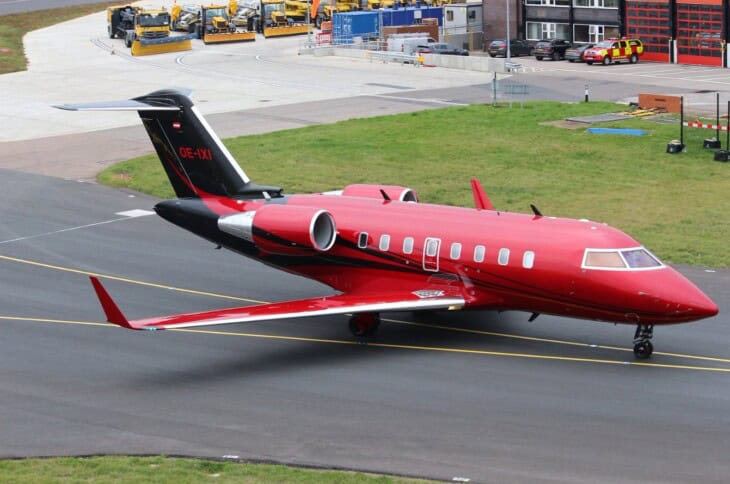
The jet leaves the UK register. The aircraft is re-registered OE-IXI in Austria and spends roughly 22 months operating with LaudaMotion, the airline founded by Niki Lauda.
February 2019
It comes back as G-RANE. The Challenger returns to the UK register with SaxonAir Charter of Norwich. Reported sale figures put the transaction at around $8.95 million, well under half what Hamilton paid.
2025
Hamilton joins Ferrari. The most-watched driver move in a generation, executed by a man who no longer owns an aircraft and travels by charter and airline.
2026
The Kardashian season. Hamilton’s relationship with Kim Kardashian goes public, pairing the driver who sold his jet with the owner of a Gulfstream G650ER.
The purchase price is where most coverage goes wrong. Figures of $23 million and $29 million both circulate widely, and neither is documented.
The £16.5 million valuation is the one that appears in the leaked import paperwork itself, which makes it the only figure with a paper trail behind it. At 2013 exchange rates that is roughly $27 million, which is close to the list price of a new Challenger 605.
Inside the Aircraft: The Bombardier Challenger 605
The Bombardier Challenger 605 is a super-midsize jet with a widebody trick up its sleeve. Its cabin is 8 feet 2 inches across, wider than a Gulfstream G550’s, because the Challenger family descends from a 1970s design that was drawn around an unusually fat fuselage.
Hamilton’s example was a 2012 build, late in the production run, with the 605 update package: larger cabin windows, a redesigned tail cone, and a Rockwell Collins Pro Line 21 flight deck.
Performance
Cabin
Registration
Range is the number that explains the choice. At 4,045 nautical miles the Challenger 605 crosses the North Atlantic comfortably and reaches most of the Formula 1 calendar in a single leg from Europe.
What it will not do is Europe to Melbourne or Europe to Suzuka nonstop. For the long-haul races Hamilton was always going to be stopping for fuel or flying with somebody else, which is a real limitation compared with the longest range private jets.
The interior was described as black leather with red piping, a galley, a lavatory, high speed connectivity, and a rear cabin that converted into a sleeping area. Reports of a “king-sized bed” should be read as marketing language, since the Challenger’s 6 foot 1 inch cabin height does not accommodate a true stateroom.
Why the red paint mattered
Business jets are overwhelmingly white, because white paint is lighter, reflects heat, hides filler and repairs, and protects resale value. A full candy apple red scheme adds weight, costs more, and narrows the pool of future buyers. Hamilton went ahead anyway, which tells you the aircraft was as much a statement as a tool.
The £3.3 Million VAT Refund That Made It Famous
In November 2017 the International Consortium of Investigative Journalists published the Paradise Papers, a leak of 13.4 million documents from offshore service providers. Hamilton’s jet was one of the highest-profile items in it.
The structure worked like this. The aircraft was owned by Stealth Aviation Limited, a British Virgin Islands company, and leased to Stealth (IOM) Limited, a VAT-registered leasing business on the Isle of Man.
That leasing company imported the jet into the Isle of Man, which sits inside the EU VAT area for goods, and then leased it back for Hamilton’s use. Because the importer was nominally a commercial leasing business rather than a private individual, it reclaimed the import VAT: about £3.3 million.
The two-hour touchdown
The leaked correspondence included a condition that reads badly no matter how lawful the scheme was: the jet’s inaugural flight had to physically land on the Isle of Man, with advisers noting the stay would normally be less than two hours. The aircraft was not based there and did not operate from there. The landing existed to satisfy the paperwork.
Hamilton’s lawyers stated at the time that the arrangement was entirely legal and had been reviewed by tax professionals. No finding of wrongdoing against him has ever been made public, and none of the reporting alleged that he broke the law.
Hamilton himself said little. Asked about it during the 2017 season he told reporters he had nothing to add and was focused on racing, which was the last public word he gave on the subject.
The wider consequence outlived the story. The UK Treasury opened a review of aircraft imports through the Isle of Man, and the island’s VAT treatment of business jets was tightened in the years that followed.
Why Lewis Hamilton Sold His Private Jet
The stated reason was emissions. Hamilton went vegan in 2017, began speaking publicly about climate and animal welfare, and sold the Challenger as part of a broader reset of how he lived.
He was blunt about the discomfort in a since-deleted Instagram post from that period, telling followers the world was “a sad place” and that he wanted to change how he was living. Selling the jet was the most visible thing he did about it.
The financial cost was real. He is reported to have taken around $8.95 million for an aircraft valued at roughly $27 million six years earlier, which is a steep loss even allowing for normal depreciation on a used business jet.
Not everyone in the paddock read it as a clean gesture. David Coulthard summed up the skeptical view on the Up to Speed podcast: “It was candy apple red, but in the interest of saving the planet, he got rid of it. It doesn’t mean that he doesn’t fly privately, he just doesn’t have the guilt trip of owning his own.”
Does selling a jet reduce emissions?
Not by itself. The airframe did not stop flying: it went to a charter operator and now carries paying passengers instead. What changes for the seller is personal utilisation. An owner flies more because the marginal cost of a trip feels close to zero once the aircraft is paid for, while a charter customer confronts the full price of every leg. The emissions saving comes from flying less, not from transferring the title.
Where Hamilton’s Jet Is Now: You Can Charter It
Serial 5904 is still working. It returned to the UK register in February 2019 as G-RANE, operated by SaxonAir Charter out of Norwich and based at London Luton.
It appears on public charter marketplaces, which means anybody with the budget can book the aircraft Lewis Hamilton used to own. The red paint is gone, replaced by a conventional corporate scheme.
Charter pricing for a Challenger 605 in Europe typically runs in the low thousands of pounds per flight hour, with repositioning legs sometimes offered far cheaper through empty leg flights. That is the market Hamilton’s old aircraft now serves.
The registration change is also why flight trackers no longer follow it. Once G-LCDH became OE-IXI and then G-RANE, the aircraft dropped out of the celebrity tracking ecosystem entirely, which is the opposite of what happened to Jim Carrey’s Gulfstream when its initials survived the sale.
How Lewis Hamilton Flies Now
He did not stop flying privately. He stopped owning the aircraft that does it.
Hamilton mixes commercial flights with chartered aircraft and rides on other people’s jets. During his Mercedes years he was repeatedly photographed on team principal Toto Wolff’s aircraft alongside other drivers, and he was seen doing the same after the 2026 Chinese Grand Prix.
He has also been publicly candid about flying commercial, which remains unusual for a driver of his standing. For a single passenger on a scheduled airliner the per-head carbon figure is a rounding error next to a chartered jet, a gap covered in our comparison of private jet vs first class.
The Ferrari move for 2025 did not change the pattern. Two seasons into the Maranello era there is still no aircraft registered to Hamilton or to a company associated with him.
The Kim Kardashian Complication
In 2026 the man who sold his jet on climate grounds started dating the owner of one of the most-tracked private jets in the world.
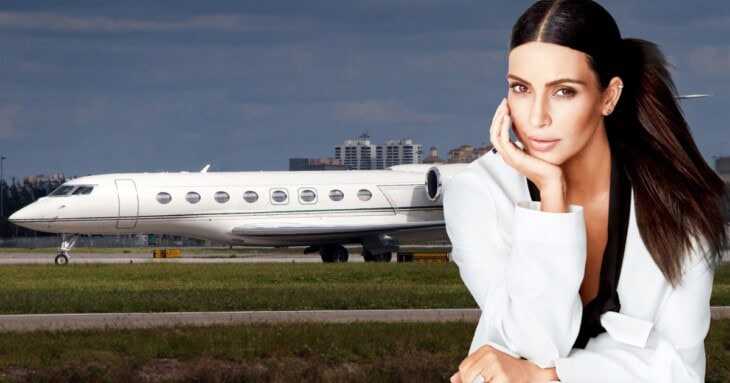
Hamilton and Kim Kardashian had known each other since around 2014, but the relationship turned romantic in early February 2026 after a meetup in Paris. They appeared side by side in a suite at Levi’s Stadium for the Super Bowl on February 8, which is when the story went mainstream.
Kardashian made it official herself on June 1, posting a clip of the two of them cycling through New York. She then travelled to the French Riviera for the Monaco Grand Prix, where Hamilton gave a brief and characteristically guarded comment on the relationship in the post-race press conference.
The aviation angle writes itself. Kim Kardashian’s private jet is a Gulfstream G650ER, tail number N1980K, nicknamed “Kim Air” and held through Noel Air LLC. She acquired it in 2022, the reported all-in figure including its custom interior is around $150 million, and it has drawn sustained criticism in emissions rankings.
One tracking estimate put N1980K at roughly 4,268 tonnes of CO2 across 57 documented flights in a single year. Hamilton’s personal aviation footprint from aircraft ownership over the same period was zero, because he owns none.
Two different theories of the same problem
Hamilton’s position has been that owning an aircraft creates the incentive to overuse it, so he sold his and buys flights as he needs them. Kardashian’s position, stated when she bought the G650ER, was that owning her own aircraft replaced a heavy charter habit and gave her control over an interior and a schedule she uses constantly. Both arguments are coherent. Only one of them produces a tail number in the emissions tables.
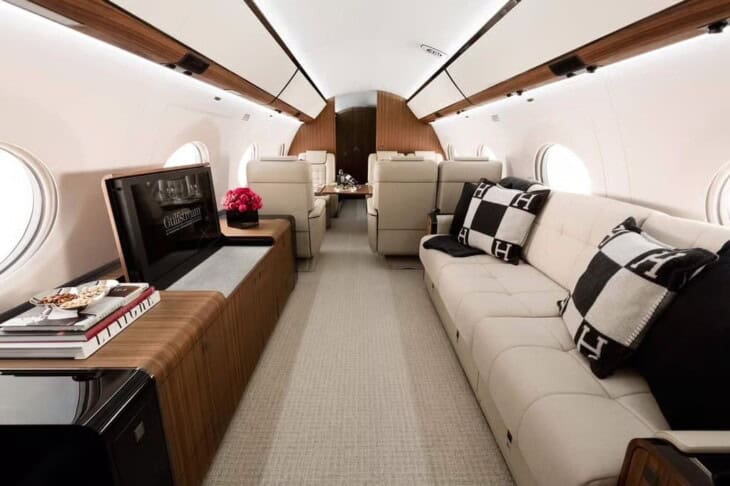
Neither has commented publicly on how they travel together. Reporting through mid-2026 has them moving between Paris, New York, Monaco and the World Cup, a schedule that is difficult to run on scheduled airlines.
It is worth saying plainly that no reporting has placed Hamilton aboard N1980K. The pairing is interesting because of what the two aircraft decisions represent, not because of any documented flight.
Fuel Burn: Where the Challenger Sat
The Challenger 605 was never the problem aircraft in this comparison. It is a super-midsize jet with two modest turbofans, and it burns roughly a third of what a converted airliner does.
Typical cruise fuel burn by type, drawn from operator and tracking estimates. Real-world figures vary with weight, altitude, and stage length.
At roughly 290 gallons an hour the Challenger produces about 2,800 kg of CO2 per flight hour. A G650ER on the same clock is closer to 4,650 kg.
That comparison cuts both ways. Hamilton’s jet was a relatively efficient choice for its class, which is one reason the critics of his sale argue the gesture was symbolic rather than substantial.
How Hamilton Compares to the Rest of the Grid
Formula 1 is a 24-race calendar spread across five continents, so private aviation is close to a professional necessity. Very few drivers actually own the aircraft.
| Driver | Aircraft | Registration | Status |
|---|---|---|---|
| Lewis Hamilton | Bombardier Challenger 605 | G-LCDH | Sold, no aircraft owned |
| Max Verstappen | Dassault Falcon 900EX, then Falcon 8X | PH-DTF | Owner |
| Fernando Alonso | Dassault Falcon 900C | Not public | Owner |
| Most of the grid | Charter and team aircraft | Varies | No ownership |
Verstappen is the clearest contrast. He bought a Falcon 900EX from Richard Branson in late 2020, painted it matt black and orange, gave it the registration PH-DTF for “Down To Fly”, and upgraded to a Falcon 8X in 2025.
Set against the wider field of athletes with private jets, Hamilton is now the outlier in his own sport. He is the only driver of his stature to have owned a jet, sold it on principle, and stayed out of the market for seven years afterwards.
FAQ
Sources and references used for research and fact-checking.
- BBC News, Paradise Papers: Lewis Hamilton avoided taxes on jet
- International Consortium of Investigative Journalists, Offshore Lawyers Help the Rich Avoid Taxes on Jets and Yachts
- RaceFans, Paradise Papers claim Hamilton avoided paying £3.27 million in tax on his jet
- Simple Flying, Why Did Lewis Hamilton Sell His Cherry Red Bombardier Challenger?
- Simple Flying, The Stunning Aircraft Fleet Of Formula 1 Champion Lewis Hamilton
- GPFans, F1 legend Lewis Hamilton ditched private jet 'guilt trip' to 'save the planet'
- People, Kim Kardashian and Lewis Hamilton Confirm Their Relationship at the 2026 Super Bowl
- NBC Los Angeles, Lewis Hamilton gives rare comment on Kim Kardashian romance
- E! News, Kim Kardashian Officially Hard Launches Lewis Hamilton Romance
- Victor, Bombardier Challenger 605 (G-RANE) charter listing
Get the Newsletter
The latest aviation news and stories sent to your inbox.
About the Author

Tim is the owner and lead editor of AeroCorner since 2019, overseeing aviation content covering aircraft, airlines, airports, and the broader aviation industry. Through years of researching, writing, editing, and publishing aviation-focused content, he has developed extensive practical knowledge of commercial aviation and air travel. Based in Asia and a frequent traveler himself, Tim also brings firsthand passenger experience to AeroCorner’s coverage. Outside of publishing, he has also explored aviation firsthand through hands-on flight training in New Zealand.