

Table of Contents
An American-built business jet registered in Beijing broke a 72-hour rule in Iran, according to federal prosecutors, and paid for it 17 months later on a ramp in Alaska.
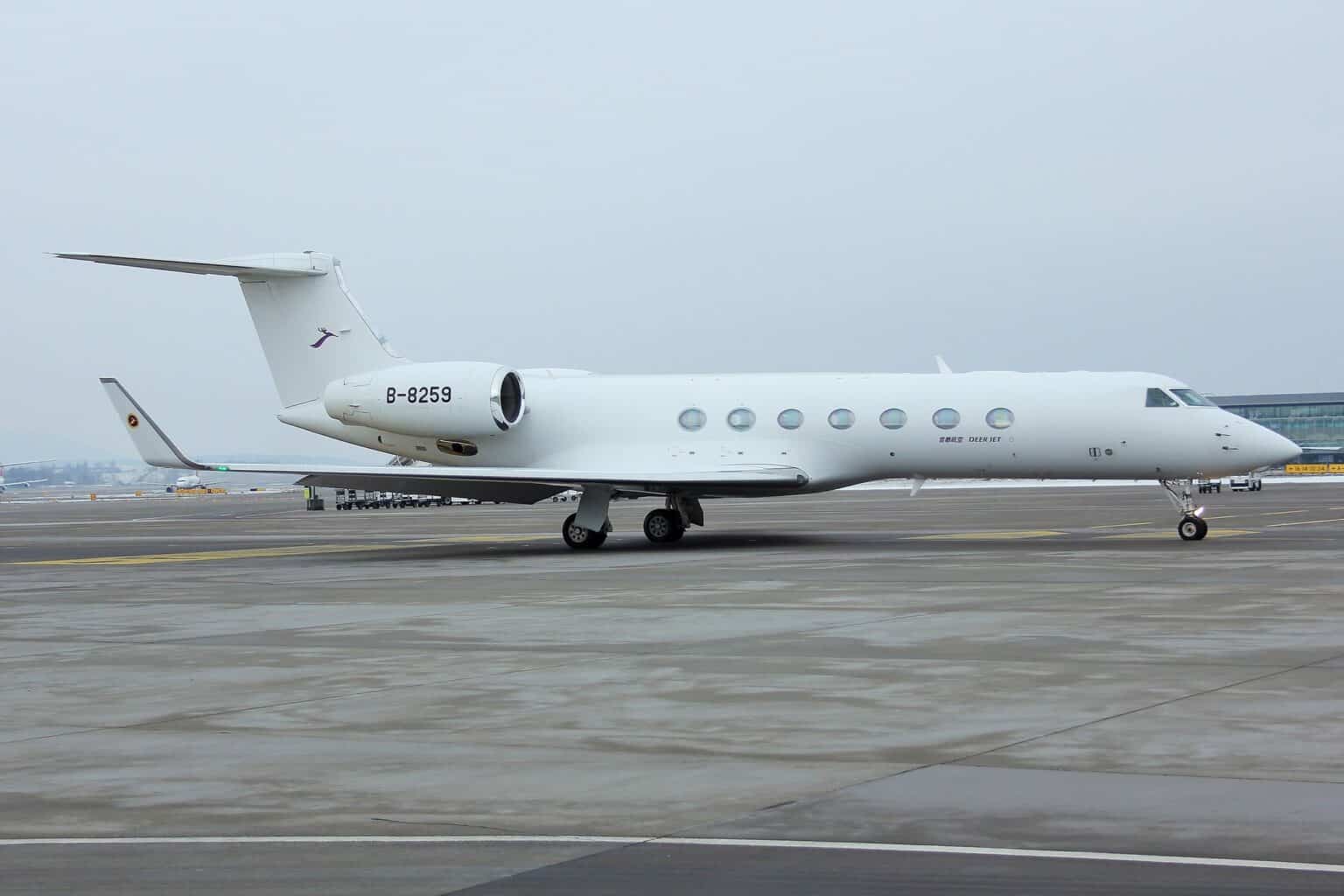
On Oct. 28, 2026, federal prosecutors in Los Angeles filed a civil forfeiture complaint against a 2012 Gulfstream G550, tail number B-8259, registered to Deer Jet (Beijing) Co., Ltd. The government says the jet flew from Beijing to Tehran on Dec. 13, 2024, and stayed until Dec. 19.
The US rule that allowed foreign aircraft to visit Iran capped a stay at 72 hours. The jet stayed six days, with no license from either agency that could have allowed it, the complaint says.
When the G550 landed in Anchorage on May 24, 2026, officers seized it under a federal warrant. The case is against the airplane itself. Nobody has been charged with a crime.
Why a Jet Registered in China Answers to US Export Law
The answer is where the airplane was built. US export rules apply to “all U.S. origin items wherever located,” in the words of the Export Administration Regulations. A Gulfstream does not stop being American when it gets a Chinese registration.
The complaint says this G550 was manufactured in the United States, including in Long Beach, California.
Under those rules, flying a US-built aircraft from one foreign country to another counts as a “reexport.” Commerce lists aircraft like this one under a classification called 9A991, which needs a license for Iran, and the complaint says no exceptions to that license are available.
Treasury runs a second, parallel system. Its Office of Foreign Assets Control (OFAC) issued General License J-1 in December 2016, which let foreign operators fly eligible aircraft into Iran on a “temporary sojourn” without asking first.
That permission came with nine conditions, the complaint says, and one of them was that the aircraft could not stay in Iran for more than 72 hours on each trip. A longer stay needed a specific license from OFAC.
The reach is wider than American airframes. The license covered US-built aircraft and foreign-built ones carrying 10% or more US-controlled content, law firm Holland & Knight noted, a bar it says virtually every commercial aircraft meets.
Six Days, 72 Hours and 17 Months: What the Complaint Says
The nine-page complaint, case 2:26-cv-12609 in the Central District of California, is short on story and long on regulation. Its factual core fits in a handful of paragraphs.
The jet, serial number 5357, left Beijing for Tehran on or about Dec. 13, 2024. It stayed in Tehran “for the entirety of that six day period,” the complaint says, and flew back to Beijing on or about Dec. 19.
Six days is twice the 72-hour ceiling. The complaint makes two separate claims: OFAC issued no license allowing a longer stay, and Commerce’s Bureau of Industry and Security (BIS) issued no license for the reexport from China to Iran at all.
Then nothing happened for about 17 months. On May 24, 2026, the G550 landed in Anchorage, Alaska, and officers seized it there under a federal seizure warrant. The complaint does not say why the jet was in Alaska, who was aboard, or why it went to Tehran.
By the time prosecutors filed on Oct. 28, the airplane was in FBI custody in the Eastern District of Virginia. The legal basis is 50 U.S.C. § 4820(j), the Export Control Reform Act’s forfeiture section.
One more rule explains why a violation from 2024 still clings to the jet in 2026. The regulations’ General Prohibition 10, quoted in the complaint, bars anyone from using, servicing or transporting an item they know was exported or reexported in violation of the rules.
Why the Owner Never Has to Be Charged
The case is titled United States of America v. One 2012 Gulfstream G550 Aircraft. In a civil forfeiture case “in rem,” the defendant is the property itself, and this complaint charges no person with any crime.
Deer Jet appears in the complaint only as the registered owner whose interests “may be adversely affected.” The government asks the court to notify anyone with an interest so they can show why the jet should not be forfeited, then to award it to the United States “for disposition according to law.”
The complaint does not say whether the government would sell the G550 or keep it, AeroTime reported on Nov. 5. Deer Jet is no small operator: in 2013 the Beijing company, part of HNA Group, described its fleet as the largest fleet of business jets in Asia.
The hard part of these cases is usually getting hold of the airplane. In June 2022 a federal judge in Manhattan issued seizure warrants for Roman Abramovich’s Boeing 787 and Gulfstream G650ER, together worth nearly $400 million, over flights to Russia that the government said broke export controls.
Neither jet was in US custody when the warrants were issued. The G550 is the reverse case: the warrant was waiting, and the airplane flew onto US soil.
The closest precedent with an Iran link is a Boeing 747 freighter that Mahan Air sold to Venezuela’s Emtrasur. Argentina detained it in June 2022, and the US took custody on Feb. 11, 2024, saying the sale had violated export control laws.
Other governments have used the same playbook. Canada seized a Volga-Dnepr Antonov An-124 stranded at Toronto Pearson on June 8, 2023, and began a separate forfeiture process in March 2025.
What Happens to B-8259 Now
The case is at its first step. Anyone with an interest in the jet, most obviously Deer Jet, can file a claim and contest the forfeiture before a judge rules on who owns it.
As of Nov. 7, 2026, the coverage we found reported no public response from Deer Jet, and AIN noted that the company may contest the action. The allegations in the complaint have not been tested in court.
The 72-hour window at the center of the case no longer exists. On Sept. 8, 2026, OFAC suspended General License J-1 indefinitely, the same day it sanctioned 27 Iranian airlines.
A short wind-down license, General License DD, ran out on Sept. 23. With J-1 suspended, there is no standing permission left for even a 72-hour visit.
That is the real lesson of B-8259. A US-built airframe carries its export file for life, through every resale and every foreign registration, and the bill for a single trip can arrive at the next landing on American soil.
Sources and references used for research and fact-checking.
- US District Court, Central District of California (via CourtListener), United States v. One 2012 Gulfstream G550 Aircraft, Bearing Tail Number B-8259, Verified Complaint for Forfeiture, Case 2:26-cv-12609
- AeroTime, US seeks to keep Chinese-registered Gulfstream G550 seized after trip to Iran
- AIN, China-registered G550 Faces Forfeiture after Exceeding 72-hour Iran Limit
- eCFR, 15 CFR 734.3, Items subject to the EAR
- US Treasury, Office of Foreign Assets Control, Recent Actions, September 8, 2026
- Holland & Knight, OFAC Suspends General License J-1 and Grounds Iran's Aviation Sector
- Reuters via Cyprus Mail, US wins authority to seize Russian oligarch Abramovich's planes
- Associated Press via News4JAX, US says it's taken possession of a Boeing 747 that Iran illegally sold to a Venezuelan firm
- PR Newswire, After 18 Years of Successful Operation Deer Jet's Future Looks Brighter than Ever
Get the Newsletter
The latest aviation news and stories sent to your inbox.
About the Author

Tim is the owner and lead editor of AeroCorner since 2019, overseeing aviation content covering aircraft, airlines, airports, and the broader aviation industry. Through years of researching, writing, editing, and publishing aviation-focused content, he has developed extensive practical knowledge of commercial aviation and air travel. Based in Asia and a frequent traveler himself, Tim also brings firsthand passenger experience to AeroCorner’s coverage. Outside of publishing, he has also explored aviation firsthand through hands-on flight training in New Zealand.