

Table of Contents
The Learjet 60 that crashed near Greenacres, Florida, on November 1, 2026, killing all nine people aboard, came from a production line that no longer exists. The NTSB has not determined a cause, and nothing here suggests one (our live coverage of the N722BD investigation tracks what is known).
But the crash put a question in front of a lot of people who had never thought about it. If Bombardier stopped making Learjets, who is still making the parts, writing the maintenance manuals and fixing the problems on the ones still flying?
The answer is that an airplane’s support system was never tied to its assembly line. Here is who keeps an out-of-production jet in the air, how many Learjets are still out there, and why so many old ones end up in very different hands from their first owners.
Do They Still Make Learjets?
No. Bombardier announced on February 11, 2021, that Learjet production would end in the fourth quarter of that year, so it could concentrate on its larger Challenger and Global jets. The very last one, a Learjet 75, left the Wichita factory on March 28, 2022, bound for Northern Jet Management in Grand Rapids, Michigan.

That closed a production run that began when the first Learjet 23 left Wichita in 1964. More than 3,000 Learjets were delivered, and about 2,000 were still flying when the last one rolled out.
The answer at a glance
Production ended in 2021 and the last new Learjet was delivered in March 2022. The fleet is still supported: Bombardier keeps the type certificates and their legal duties, runs a Learjet maintenance center in Wichita and has pledged continued parts and service. Independent shops and engine programs fill in the rest. As of November 2026, 1,144 Learjets were on the US register alone.
The Factory Closed. The Type Certificate Did Not
What keeps an aircraft legally airworthy is not the production line but the type certificate, the FAA approval of its design. The Learjet 60 sits on FAA type certificate A10CE, approved on January 15, 1993. The certificate is still held by Learjet Inc., Bombardier’s Wichita-based Learjet company.
Holding that certificate comes with obligations that do not end when the last airplane is sold. Under 14 CFR 21.50, the holder must supply each owner with Instructions for Continued Airworthiness, the maintenance manuals and inspection programs, and make any changes to them available to anyone required to follow them.
Under 14 CFR 21.3, it must report certain failures and defects to the FAA within 24 hours of finding them, including ones in airplanes delivered decades ago. And under 14 CFR 21.99, when the FAA issues an airworthiness directive and decides a design change is needed to fix an unsafe condition, the holder must design that change and make the data available to every operator.
In plain terms, the company that designed the jet stays on the hook for its safety paperwork for as long as the type flies. That is why a 30-year-old business jet still receives service bulletins and airworthiness directives, the same way a new one does.
Who Actually Does the Work
Bombardier itself. When production wound down, the company turned its Wichita site into its Centre of Excellence for Learjet maintenance, adding hangars, expanding parts storage and growing its engine and component repair work. It described its worldwide service network as supporting more than 2,000 Learjets in service.
At the final delivery in 2022, Bombardier executive Paul Sislian promised that service and parts support for the Learjet fleet would continue. Northern Jet’s chief executive said Bombardier CEO Eric Martel had called him personally to say the same thing.
A remanufacturing program. Bombardier’s RACER program, run from the same Wichita site, refurbishes and upgrades used Learjet 45 and Learjet 40 jets, the newest and most numerous members of the family. It is a bet that the fleet has a long working life ahead of it.

Engine makers and other repair stations. The engines are a separate product with their own manufacturer: the Learjet 60, for example, flies on two Pratt & Whitney Canada PW305A turbofans. Maintenance can also be done outside Bombardier’s own network, but always to the instructions the type certificate holder publishes.
The operators. Finally, every owner must actually follow the inspection program and comply with each airworthiness directive. The support system only works if someone pays for it, and that is where the age of a jet starts to matter.
How Many Learjets Are Still Around?
AeroCorner counted every Learjet in the FAA’s aircraft registry database, released November 2, 2026. There were 1,144 on the US register, from 1960s originals to the final Learjet 75s.
| Learjet family | Built (approx.) | On US register, Nov. 2026 | Share |
|---|---|---|---|
| Learjet 60 / 60XR | 430 | 238 | 55% |
| Learjet 31 / 31A | 246 | 119 | 48% |
| Learjet 40, 45, 70, 75 | 944 | 432 | 46% |
| Learjet 55 | 147 | 67 | 46% |
| Learjet 35 / 36 | 739 | 213 | 29% |
| Learjet 23 to 29 (originals) | 738 | 75 | 10% |
| Total | 3,244 | 1,144 | 35% |
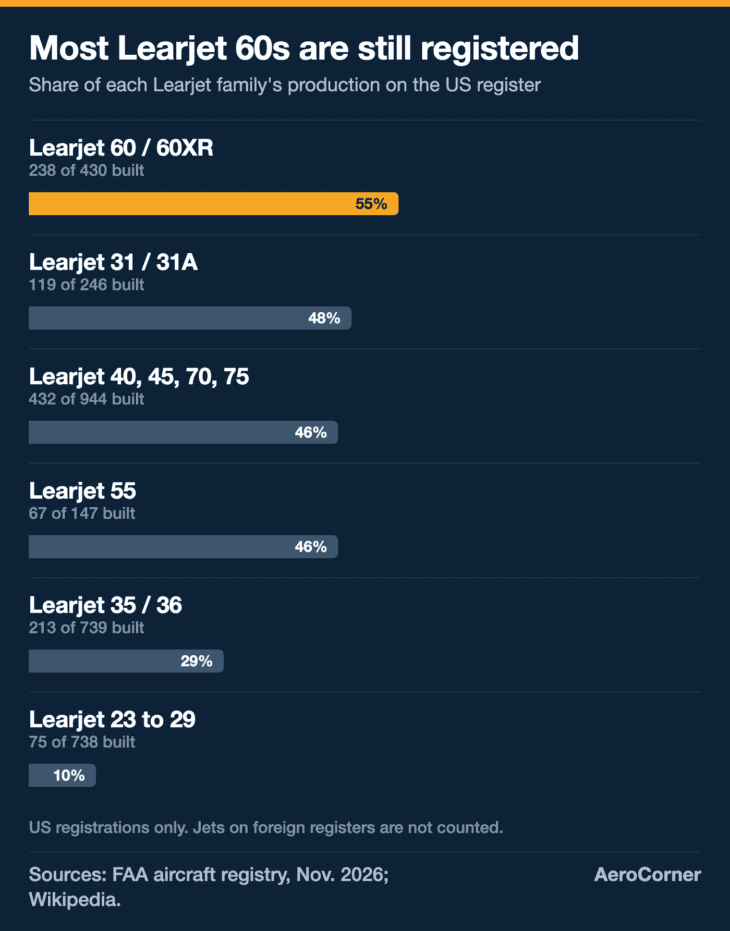
The pattern is roughly what you would expect from age. The Learjet 60, built from the early 1990s to 2013, is the best-preserved family: 238 of about 430 built, more than half, still carry US registrations. The median Learjet 60 on the register was built in 2001.

At the other end, only 75 of the roughly 738 original Learjet 23s, 24s, 25s, 28s and 29s remain, and most of those were built in the 1970s. Two caveats apply: a registration is not proof an airplane still flies, and hundreds of Learjets fly on foreign registrations that this count does not see.
Why Old Learjets Change Hands, and Whose Hands
A business jet loses value fast, but its maintenance bill does not shrink with it. By 2018 a Learjet 60 could be bought for $1 million or less, while each engine on the later 60XR runs on a 6,000-hour overhaul interval with maintenance reserves of about $360 per engine per flight hour.
That arithmetic changes who the buyer is. A first owner buys a new jet for comfort and status, while a later owner buys a fast twin-engine airplane at a low purchase price and puts it to work: charter, cargo or air ambulance flying, where a cheap airframe can make the numbers work.
The 31-year-old upgrade
In late 2024, the New Mexico air ambulance operator AirCare1 retired its last Learjet 35A, a jet 43.2 years old. Its replacement was a Learjet 60 that was 31.3 years old at the time, which left two Learjet 60s, both fitted as flying intensive care units, as the whole fleet.
The same year, Chicago’s Hightail Air Charter added a 41.6-year-old Learjet 35A to its Part 135 charter fleet, alongside a Learjet 55. Older Learjets keep cycling down the market this way, from private owners to small commercial operators, as long as the work pays for the upkeep.

Ownership on paper often looks anonymous, too. Of the 238 Learjet 60s on the US register, 140 are registered to limited liability companies, which is why so many private jets are owned by an LLC rather than a person.
The Myth: Out of Production Means Out of Support
The myth
Once a manufacturer stops building an airplane, owners are on their own, and the jets still flying are somehow unsupported or less safe.
The airworthiness system does not work that way. The certificate holder’s duties under Part 21 continue, airworthiness directives keep coming, and every operator must still follow the same inspection program, whether a jet is two years old or forty.
What actually retires old airplanes is usually money or a new rule, not the end of production. The clearest example came on December 31, 2015, when an FAA rule barred jets weighing 75,000 pounds or less from flying in the contiguous US unless they met Stage 3 noise limits.
The FAA put the number of affected jets at up to 599. Unmodified early Learjets fell into that group, and their owners had to fit a hushkit, find work outside the lower 48 states or park the airplane, one reason the 1960s and 1970s originals are now the rarest Learjets on the register.
The economics work the same way, just more quietly. When an engine overhaul or a major inspection costs more than a 30-year-old jet is worth, the owner has little reason to pay it, and the airplane leaves service for good.
So the next time a Learjet makes the news, or one taxis past at a regional airport, it is worth remembering that it is far from an orphan.
It is one of more than a thousand on the US register alone, still covered by its designer’s legal obligations and still maintained to the same rules as the day it was delivered, often by an owner its first buyer never imagined.
Sources and references used for research and fact-checking.
- AOPA, Learjet to end production run
- AIN, Bombardier Delivers Final Production Learjet
- Bombardier, Building a comprehensive Learjet Centre of Excellence in Wichita
- Cornell Law School Legal Information Institute, 14 CFR 21.50, Instructions for continued airworthiness
- Cornell Law School Legal Information Institute, 14 CFR 21.3, Reporting of failures, malfunctions, and defects
- Cornell Law School Legal Information Institute, 14 CFR 21.99, Required design changes
- Agencia Federal de Aviación Civil (Mexico), Validation of FAA type certificate A10CE, Revision 67, Learjet Inc.
- Civil Aviation Authority of New Zealand, Learjet 35A Type Acceptance Report
- Federal Aviation Administration, Aircraft Registry Releasable Aircraft Database
- Wikipedia, Learjet
- Wikipedia, Learjet 60
- ch-aviation, AirCare1 retires last Learjet 35A, streamlines fleet
- ch-aviation, Hightail Air Charter adds first Learjet 35A to Part 135
- AIN, FAA Finalizes Rule To Ban Stage 2 Bizjets
- Wikipedia, Learjet 24
Get the Newsletter
The latest aviation news and stories sent to your inbox.
About the Author

Tim is the owner and lead editor of AeroCorner since 2019, overseeing aviation content covering aircraft, airlines, airports, and the broader aviation industry. Through years of researching, writing, editing, and publishing aviation-focused content, he has developed extensive practical knowledge of commercial aviation and air travel. Based in Asia and a frequent traveler himself, Tim also brings firsthand passenger experience to AeroCorner’s coverage. Outside of publishing, he has also explored aviation firsthand through hands-on flight training in New Zealand.