


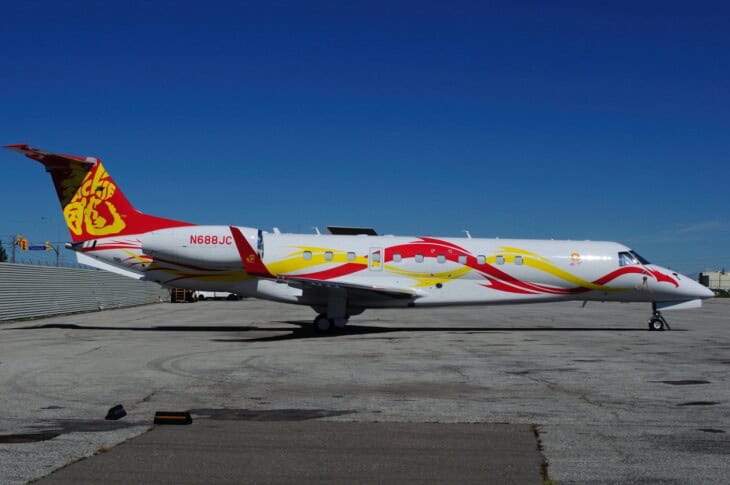
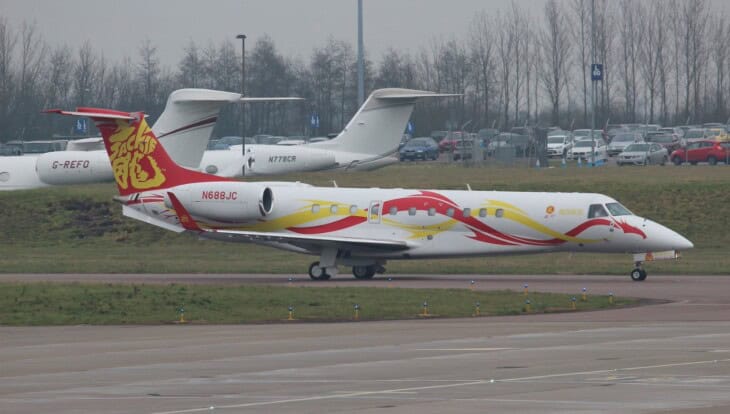
Most celebrity jets are white with a discreet stripe. Jackie Chan’s is wrapped in red and yellow dragons that he designed himself, with his personal logo on the tail and the registration N688JC under the wing.
The Jackie Chan private jet story is also the only one in this series that comes with a job attached. When Embraer handed him the keys to a Legacy 650 in February 2012, he became the Brazilian manufacturer’s global brand ambassador, an arrangement no other celebrity owner on AeroCorner has.
This article covers both of Chan’s aircraft: the Legacy 650 flagship, the Legacy 500 he added in 2016, their full specs and tail numbers, the ownership trust that explains the American registration, and the relief flights that put those cabins to a very different use.
Quick facts about Jackie Chan’s private jets
Jackie Chan’s Complete Private Jet Fleet
Chan’s fleet is small, consistent, and entirely Embraer. Both aircraft were the first of their type delivered in China, and both were bought as part of a working relationship with the manufacturer rather than a one-off purchase.
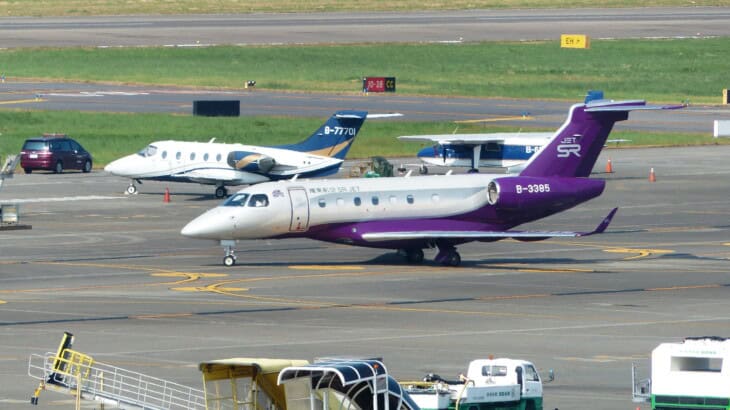
The two aircraft split the work by distance. The Legacy 650 handles the long hauls between Asia, Europe, and Los Angeles, while the smaller Legacy 500 covers the regional flying that fills most of a working actor’s calendar.
The Origin Story: A Late Buyer in a Booming Market
Chan had been talking about buying an aircraft for roughly a decade before he actually did it. His stated reason for waiting was infrastructure, not money.
“The aviation market in China was not mature enough for me to get involved until now,” he told Business Jet Traveler around the time of his first delivery. “I first spoke about owning an aircraft with friends a decade ago.”
December 2011
The airframe is signed off. Embraer Legacy 650 serial 14501139 receives its airworthiness certificate on December 30, built to a specification Chan had personally signed off on.
February 2012
Delivery and a job offer. Chan takes delivery on February 3 as the launch customer for the Legacy 650 in China, and simultaneously agrees to serve as Embraer Executive Jets’ global brand ambassador.
2013
The jet goes on tour. The dragon-liveried Legacy 650 is displayed at the Singapore Airshow, doubling as Embraer’s marketing centerpiece for the Chinese market.
February 2016
A second Embraer. Chan takes delivery of the first Chinese-registered Legacy 500 on February 1, a fly-by-wire midsize jet that had only been certified by China’s regulator seven months earlier.
Present
Both aircraft still flying. The Legacy 650 remains registered in the United States through an owner trust and appears in flight-tracking records under the operator name JC Jet.
The timing mattered to Embraer as much as it did to Chan. China’s business aviation market was expanding fast in 2012, and the manufacturer needed a recognizable face to compete with Gulfstream and Bombardier there.
Inside the Flagship: The Embraer Legacy 650
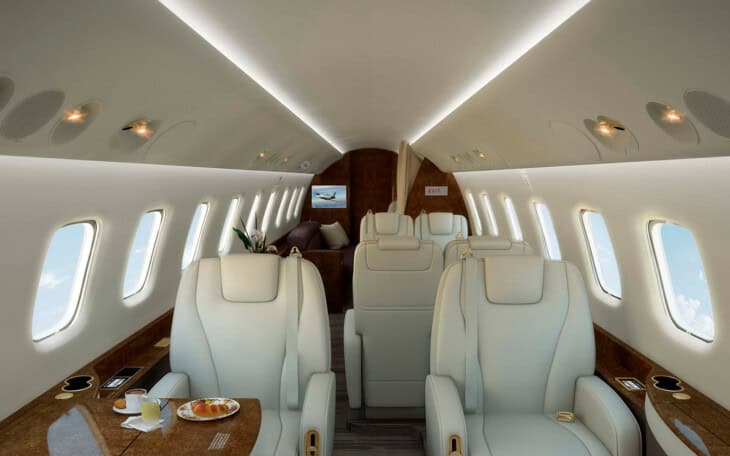
The Legacy 650 is a large business jet built on the same fuselage as the ERJ-135 regional airliner, which is why its cabin is unusually roomy for its price bracket. Chan’s example seats up to 14 across three separate zones designed for working, socializing, and sleeping.
With 3,900 NM of range it will fly Beijing to Dubai or Hong Kong to Australia without a fuel stop. That is enough to connect most of Chan’s film and charity commitments in a single leg, though a Pacific crossing to Los Angeles still requires a technical stop.
Performance
Cabin
Ownership
The interior runs to leather seating, wood veneers, adjustable cabin lighting, satellite internet, and an HD entertainment system. Seats in the rear zone convert to beds, and a four-place conference table in the middle zone doubles as a dining table.
By the standards of the longest-range private jets, the Legacy 650 is a mid-tier performer. What it offers instead is cabin volume per dollar, which is exactly the trade a working actor with a large entourage would want.
The Dragon Livery Chan Designed Himself
The paint scheme is the reason this aircraft gets photographed everywhere it lands. Red and yellow dragons run down both sides of the white fuselage, with Chan’s personal logo on the tail and his name applied near the nose.
Why the colors matter
Red and yellow are the colors of the Chinese national flag, and the dragon is the traditional symbol of imperial power and good fortune. Chan specified the scheme himself, which turned a business jet into a piece of cultural signaling that worked as advertising for both him and Embraer.
Embraer understood exactly what it had. The aircraft was flown to the Singapore Airshow in 2013 and used as a showpiece for the manufacturer’s push into Asia, which is unusual treatment for a privately owned jet.
Why an American Tail Number on a Hong Kong Star’s Jet
N688JC looks out of place on an aircraft based in Asia and owned by a Hong Kong resident. The FAA registry lists the owner as TVPX Aircraft Solutions Inc, acting as trustee, not as Jackie Chan.
That is an owner trust, and it is completely routine. United States law restricts N-registration to US citizens and entities, so foreign owners who want an American registration place the aircraft in a trust with a US trustee holding legal title while the beneficial owner keeps control.
Why owners choose an N-number
An American registration carries a well-understood regulatory framework, strong resale liquidity, and easier acceptance at airports and maintenance facilities worldwide. The trade-off is that the public registry names the trustee rather than the person actually flying in the back.
The number itself is not random. In Cantonese and Mandarin, 8 is the luckiest digit in the language, 6 signifies smooth progress, and JC are Chan’s initials.
The Legacy 500: A Fly-by-Wire First for China
Chan’s second aircraft arrived on February 1, 2016, and it was a genuinely significant delivery. The Legacy 500 was the first midsize business jet with full fly-by-wire flight controls, and Chan’s example was the first one registered in China.
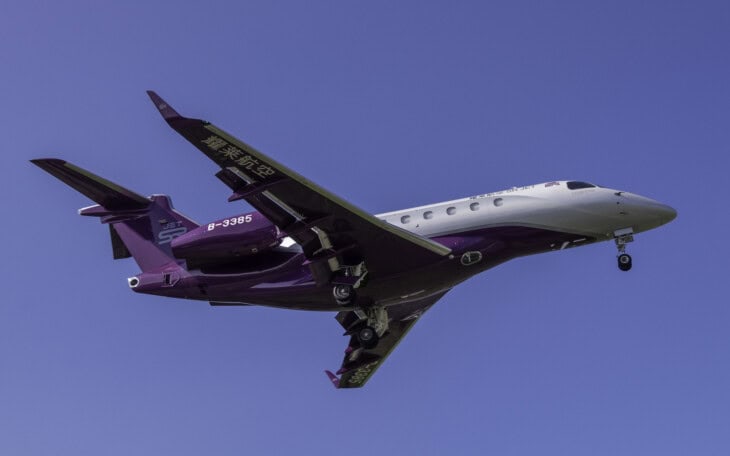
China’s civil aviation regulator had only validated the type certificate in July 2015, so the aircraft went from approval to Chan’s hangar in about seven months.
The cockpit is the interesting part. Side-stick controllers, Rockwell Collins Pro Line Fusion avionics spread across four 15-inch displays, and an available head-up display with Embraer’s enhanced vision system put it a generation ahead of the Legacy 650 it flies alongside.
Behind the cockpit, the six-foot flat-floor cabin holds eight club seats that convert into four beds. Its short-field performance is the practical advantage: it can operate from runways as short as 4,084 feet, which opens up regional airports the Legacy 650 has to skip.
“I’m so thrilled to receive this Legacy 500, a state-of-the-art executive jet,” Chan said at the handover, describing it as a comfortable mobile home and office.
The Brand Ambassador Deal Nobody Else Has
Celebrity jet ownership is usually a purchase and nothing more. Chan’s is a commercial partnership: he agreed to promote Embraer’s entire executive aircraft line in greater China and globally, and the terms were never disclosed.
That relationship is worth keeping in mind when reading the price figures attached to his aircraft. A $30 million Legacy 650 and a $20 million Legacy 500 are list prices, and what an ambassador actually pays is not public.
His choice of aircraft also carried a message. In a market where status was measured in cabin size, one of Asia’s most recognizable stars bought midsize and large-cabin jets rather than a converted airliner, and Embraer’s China leadership said openly that they hoped it would shift buyer preferences.
It is a different posture from the Hollywood norm. Where other Hollywood celebrities with private jets tend to buy the biggest thing their accountant will approve, Chan bought the aircraft that matched the missions he actually flies. Embraer’s standing among the best private jet manufacturers owes a real debt to that endorsement in Asia.
Jackie Chan’s Most Notable Aviation Moments
Flying relief into disaster zones
Chan has repeatedly turned aircraft into aid logistics. After the 2008 Sichuan earthquake he chartered a private jet and later a Boeing 737 carrying 130 tons of food into the affected region, and he has flown supplies to earthquake victims in Qinghai and Yunnan.
He was explicit that this shaped what he wanted from an aircraft. Asked whether he would upgrade to Embraer’s much larger Lineage, he said he was happy with what he had, but noted he could carry more people and more supplies if something like the Japan tsunami happened again.
A three-city premiere in one day
One of the clearest business cases for the jet was a film premiere staged across three cities on the same day. That kind of schedule is impossible on scheduled airlines and is the reason working entertainers buy aircraft in the first place.
Becoming a manufacturer’s showpiece
Few private owners let their aircraft be trucked around the airshow circuit. Chan’s Legacy 650 appeared at Singapore as Embraer’s flagship display, a role normally filled by a factory demonstrator.
How Jackie Chan’s Fleet Compares
Against the rest of this series, Chan is a restrained owner. Two midsize and large-cabin Embraers cost less combined than a single Gulfstream G650ER, which is the default flagship for most of the entertainers and executives profiled here.
| Owner | Flagship aircraft | Range | Aircraft owned |
|---|---|---|---|
| Jackie Chan | Embraer Legacy 650 | 3,900 NM | 2 |
| Jeff Bezos | Gulfstream G650ER | 7,500 NM | 2 |
| Tyler Perry | Bombardier Global 7500 | 7,700 NM | 4 |
| Kim Kardashian | Gulfstream G650ER | 7,500 NM | 1 |
One thing Chan does not share with the actor-aviators in this series is a licence. Unlike John Travolta and the other celebrity pilots who fly themselves, Chan has never publicly held a pilot certificate, and both of his Embraers are flown by professional crews.
That fits the pattern. Chan’s aircraft are tools for a schedule and a charitable operation, not a hobby, and the fleet has stayed the same size for a decade because it does the job.
FAQ
Sources and references used for research and fact-checking.
- Business Jet Traveler, Jackie Chan Takes Delivery of Legacy 650
- Business Jet Traveler, Jackie Chan
- Aviation International News, Jackie Chan Takes Delivery of First Legacy 500 in China
- AOPA, Actor Jackie Chan buys Legacy 500
- Forbes, Inside Jackie Chan's New Private Jet
- FlightAware / FAA registry, N688JC Aircraft Registration
Get the Newsletter
The latest aviation news and stories sent to your inbox.
About the Author

Tim is the owner and lead editor of AeroCorner since 2019, overseeing aviation content covering aircraft, airlines, airports, and the broader aviation industry. Through years of researching, writing, editing, and publishing aviation-focused content, he has developed extensive practical knowledge of commercial aviation and air travel. Based in Asia and a frequent traveler himself, Tim also brings firsthand passenger experience to AeroCorner’s coverage. Outside of publishing, he has also explored aviation firsthand through hands-on flight training in New Zealand.