

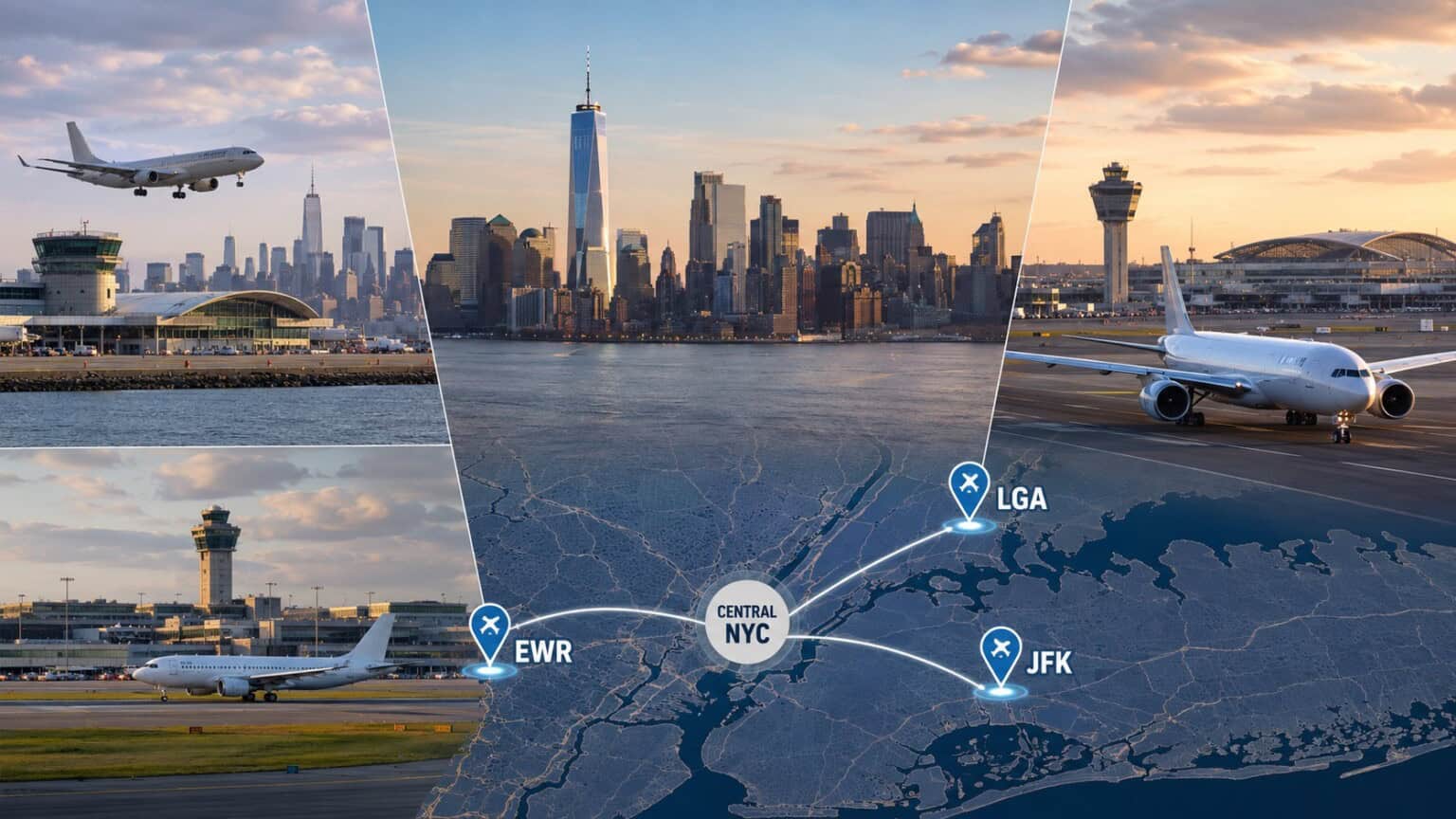
Book a flight to New York and you are quietly asked to make a choice: JFK, LaGuardia, or Newark. Three airports, three separate codes, and one of them is not even in New York State.
Pick on price and you might land at Newark, in New Jersey, on the far side of the Hudson from the skyline you came to see. Pick LaGuardia and you cannot get a nonstop flight from Los Angeles at all.
None of this is an accident. Three airports, in three eras, for reasons that are part geography, part history, and part a set of rules most passengers never notice. Here is why New York ended up with three.
The short answer
New York is simply too big for one airport. The metro area is the largest air travel market in the United States, and no single site could ever absorb all of its traffic.
So the region grew three airports instead, spread around a metro that sprawls across water and two states. History left them in different places, and a layer of federal and regional rules keeps each one doing a different job.
One metro, three jobs
JFK, LaGuardia, and Newark are not three copies of the same airport. Demand and geography created the need for three; history put them where they are; and airport rules keep them specialized, with long-haul at JFK and Newark and short-haul close in at LaGuardia.
One metro too big for a single airport
Start with sheer volume. In 2019, before the pandemic reshuffled traffic, the three airports together handled more than 140 million passengers. That is more than the entire population of Russia passing through one metro’s airport system in a year.
No single airport handles that. Even the world’s busiest, Atlanta, tops out around 100 million on its own, and it does so as a connecting hub rather than a city with this much local demand.
Geography did the rest. The New York metro is enormous and cut through by water, spilling from Long Island across the harbor into New Jersey. An airport that is convenient for Long Island is a long haul from New Jersey, so each field ended up serving a different slice of the region.
| Airport | Location | Opened | Main role today |
|---|---|---|---|
| John F. Kennedy (JFK) | Queens, New York | 1948 | International gateway and long-haul |
| LaGuardia (LGA) | Queens, New York | 1939 | Close-in domestic, short and medium haul |
| Newark Liberty (EWR) | Newark, New Jersey | 1928 | Major hub, domestic and international |
All three are owned and operated by the Port Authority of New York and New Jersey.
How New York ended up with three
The three did not arrive together. They were built decades apart, by different interests, each answering the limits of the one before it.
1928
u0026lt;strongu0026gt;Newark opens first.u0026lt;/strongu0026gt; New Jersey builds the region’s first major airport. For years it is the busiest in the country and New York’s main air gateway.
1934
u0026lt;strongu0026gt;La Guardia’s stunt.u0026lt;/strongu0026gt; Mayor Fiorello La Guardia refuses to leave a plane that landed at Newark, insisting his ticket to u0022New Yorku0022 meant New York. The publicity pushes the city to build its own airport.
1939
u0026lt;strongu0026gt;LaGuardia opens in Queens.u0026lt;/strongu0026gt; A modern field in Flushing finally gives New York City an airport inside its own limits, close to Manhattan.
1948
u0026lt;strongu0026gt;Idlewild opens.u0026lt;/strongu0026gt; A far larger airport rises on Jamaica Bay to handle the long-haul and transatlantic traffic LaGuardia cannot.
1963
u0026lt;strongu0026gt;Idlewild becomes JFK.u0026lt;/strongu0026gt; The airport is renamed for President John F. Kennedy weeks after his assassination.
By the late 1940s all three had come under a single operator, the Port Authority of New York and New Jersey. That is why a New Jersey airport and two New York airports are run as one system, and why they can be managed against each other rather than as rivals.
The rules that keep them apart
Demand and geography explain why there are three. A quieter set of rules explains why they are not interchangeable.
The most striking is LaGuardia’s perimeter rule. Since 1984, most flights leaving LaGuardia cannot travel farther than 1,500 miles, a limit the Port Authority imposed to relieve congestion and push longer flights out to JFK and Newark.
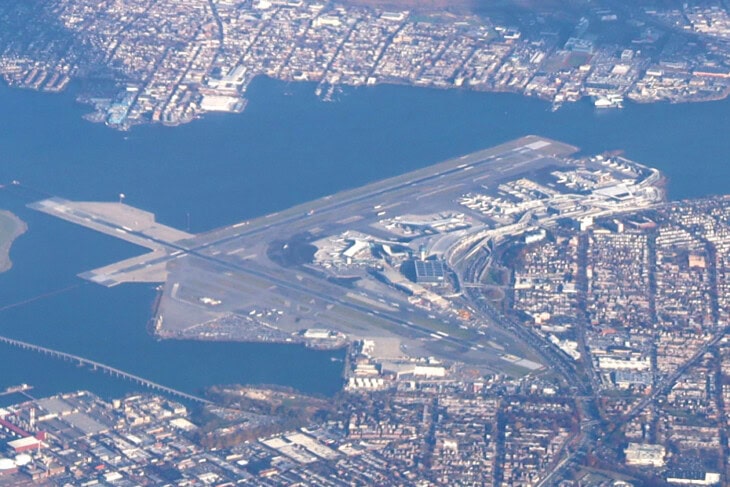
That is why you cannot fly nonstop from LaGuardia to Los Angeles or Seattle on a normal weekday. Denver is the one grandfathered exception, and the rule lifts on Saturdays, when congestion eases.
On top of that, both LaGuardia and JFK are slot-controlled, meaning an airline needs a specific government-approved permission for each takeoff and landing. There are only so many slots, so growth at one airport naturally spills to another.
Those slot systems trace back to a single federal rule from 1968. Facing gridlock, regulators capped the number of flights per hour at five congested airports, including JFK, LaGuardia, and Newark.
Newark’s cap was suspended within a couple of years as traffic there thinned out, which is why only two of the three carry slot limits today. Rules written more than half a century ago still shape which airport your flight can leave from.
The 1,500-mile wall around LaGuardia
A rule from 1984 caps most LaGuardia departures at 1,500 miles. It is the reason a passenger heading to the West Coast is quietly steered to JFK or Newark, and the reason LaGuardia stays a close-in, short-haul airport by design rather than by accident.
Which one is actually closest
Because the region is so spread out, there is no single closest airport. The right answer depends entirely on where in the metro you start.
LaGuardia is the nearest to Midtown Manhattan, roughly 8 miles (13 km) away, which is exactly why the perimeter rule fights so hard to keep it uncongested. Yet for Lower Manhattan and anywhere on the west side, Newark is often just as quick despite sitting in another state.
Transit muddies it further. JFK and Newark both connect to the rail network through their AirTrain people-movers, while LaGuardia, the closest of the three, still has no train link at all and relies on buses. The most convenient airport on a map is not always the easiest to reach.
Three is actually an undercount
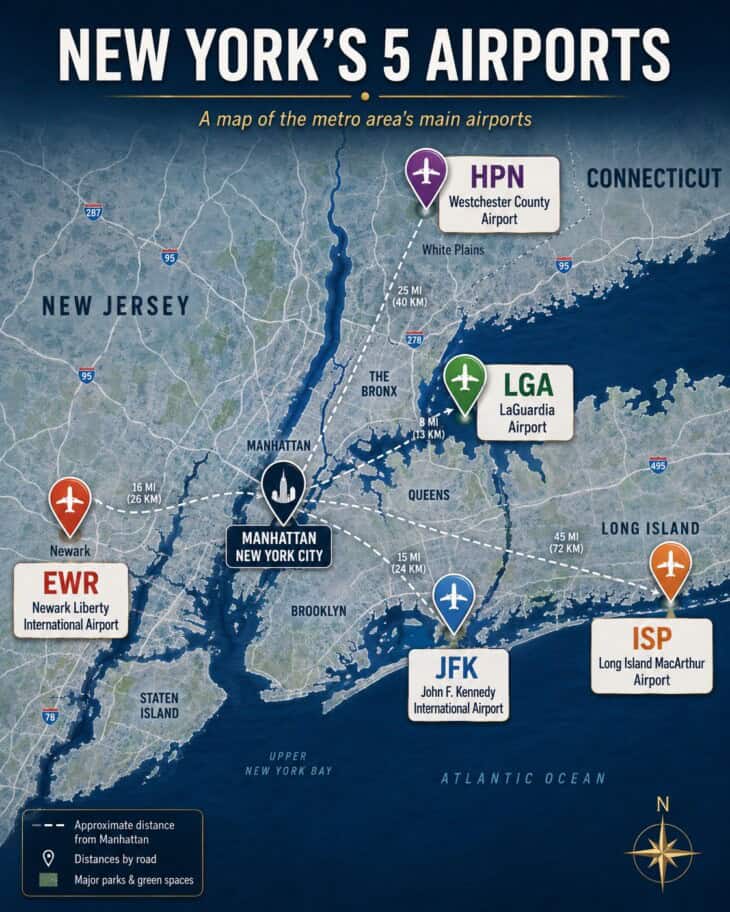
Here is the part that surprises even frequent flyers. The headline number is three, but the same Port Authority quietly runs five airports across the region. The other two just do not sell many ordinary tickets.
The closest is Teterboro, about 12 miles (19 km) from Manhattan in New Jersey. It takes no scheduled airline flights at all and exists almost entirely for private jets, which keeps most corporate and celebrity traffic out of the three big fields.
The other is New York Stewart International, a former Air Force base about 60 miles (97 km) north in the Hudson Valley. The Port Authority took it over in 2007 and put “New York” in its name, hoping to pull long-haul overflow away from JFK and Newark. It never really caught on, and its schedule stays thin.
Beyond the Port Authority’s five, two more airports catch New York traffic without ever claiming the name: Long Island MacArthur in Islip and Westchester County up in White Plains. Each serves a suburban corner that finds JFK or Newark a genuine slog.
Five, not three
The Port Authority runs five airports, not three: JFK, LaGuardia, and Newark, plus private-jet-only Teterboro and New York Stewart up in the Hudson Valley. Add non-Port-Authority fields like Islip and White Plains, and the region leans on more airports still.
The myth vs. the reality
Plenty of travelers assume Newark barely counts, because it sits in New Jersey. That was La Guardia’s whole complaint in 1934, and it was wrong then too.
The myth
That Newark is not really a New York airport because it is in New Jersey. In reality it is one of the three primary airports of the same system, often the busiest of the three for international traffic, and for much of Manhattan it is no farther than JFK.
The deeper misconception is that three airports is wasteful duplication. It is closer to the opposite: the region needs all three, and each is tuned to a different job by geography and rule.
JFK carries the long-haul and international weight. Newark anchors the west side and doubles as one of United Airlines’ largest hubs, feeding connections across the country and the Atlantic. LaGuardia takes the close-in domestic traffic that wants to be near Manhattan. Take any one away and the other two could not absorb it.
So the choice at booking is really a choice of which New York you want. The Long Island gateway, the New Jersey hub, or the short-hop field a taxi ride from Midtown.
New York is not alone in this. The same forces of demand, geography, and history gave London its six airports, and they help explain why so many airports sit nowhere near the city they are named after. For where New York’s three rank against the rest of the country, see the busiest airports in the US.
Sources and references used for research and fact-checking.
- Wikipedia, LaGuardia Airport
- NYCAviation, La Guardia Turns 75: An In-Depth Look at the Airport's Distinguished History
- View from the Wing, Don't Believe Delta: Eliminating LaGuardia's Perimeter Rule Will Reduce Service to Small Cities
- The Port Authority of New York and New Jersey, About the Port Authority
- Wikipedia, Stewart International Airport
- Federal Register, High Density Traffic Airports; Slot Allocation and Transfer Method
Get the Newsletter
The latest aviation news and stories sent to your inbox.
About the Author

Tim is the owner and lead editor of AeroCorner since 2019, overseeing aviation content covering aircraft, airlines, airports, and the broader aviation industry. Through years of researching, writing, editing, and publishing aviation-focused content, he has developed extensive practical knowledge of commercial aviation and air travel. Based in Asia and a frequent traveler himself, Tim also brings firsthand passenger experience to AeroCorner’s coverage. Outside of publishing, he has also explored aviation firsthand through hands-on flight training in New Zealand.