Military Propellor Planes
Lockheed Martin P-3 Orion
ICAO: P3
The modified C-130 Hercules that jammed enemy communications for 43 years.
Updated: by Tim de Vries
The latest aviation news and stories sent to your inbox.
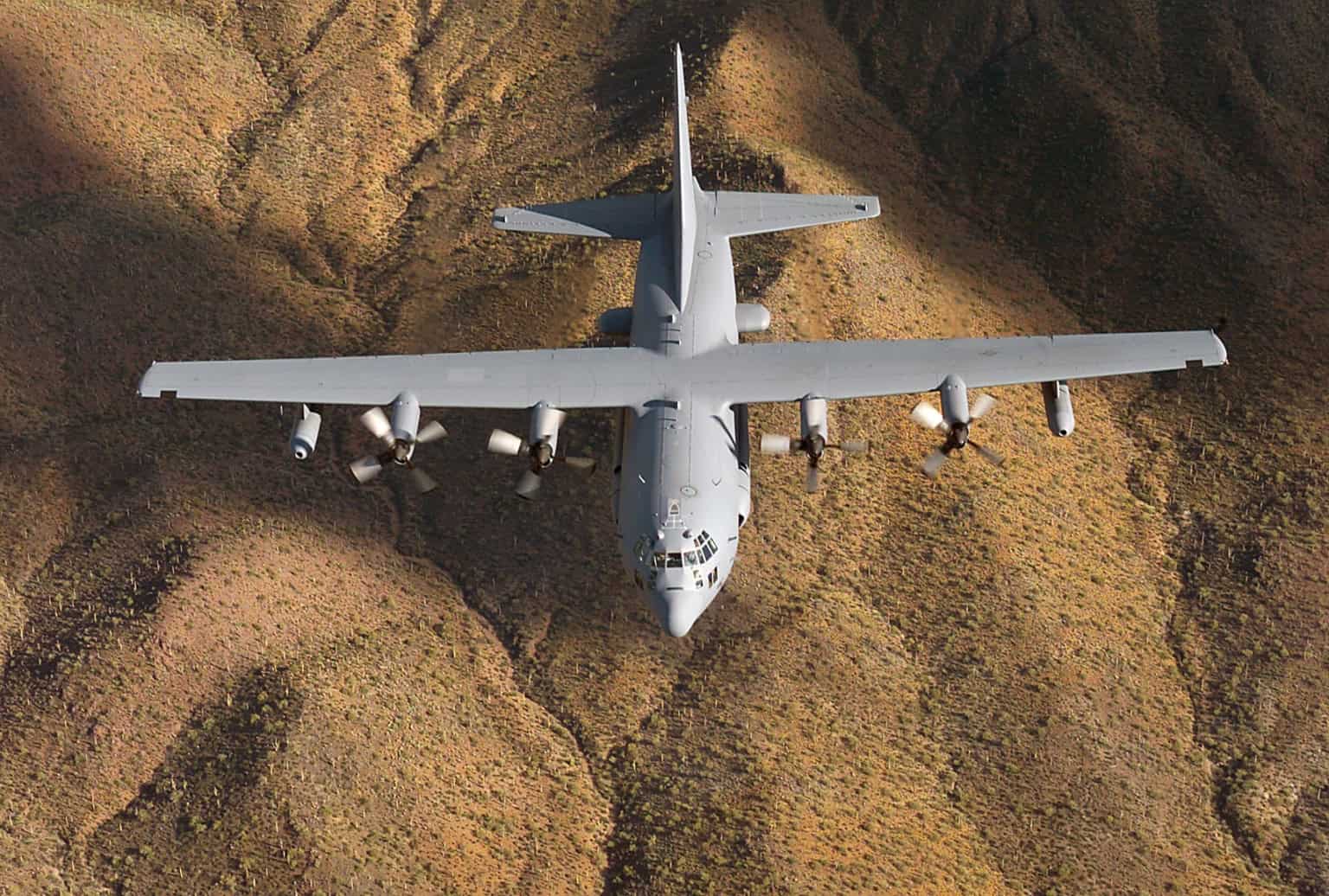
The Lockheed EC-130H Compass Call was the U.S. Air Force’s primary airborne communications jammer for more than four decades. Built by converting standard C-130H Hercules transports, it carried classified electronic attack systems in place of cargo and was used to deny, degrade and disrupt enemy command and control. Fourteen were converted, all flown by the 55th Electronic Combat Group at Davis-Monthan Air Force Base, Arizona. The type first flew in 1981 and made its final flight on September 2, 2026, its mission passing to the Gulfstream-based EA-37B.
Live Fleet Activity (C130)
Fetching live data…


The Lockheed EC-130H Compass Call was the U.S. Air Force’s primary airborne communications jammer for more than four decades. It was a heavily modified C-130 Hercules transport packed with electronic attack equipment instead of cargo.
Its job was to deny, degrade and disrupt enemy command and control by flooding radio, radar and data links with interference. Fourteen airframes were converted, and the last one flew its final mission on September 2, 2026.
Compass Call is an electronic attack weapon system. The aircraft targets the radio links that an enemy uses to command troops, cue air defenses, detonate roadside bombs and pass early warning between radar sites.
By jamming those links, the crew can isolate a commander from their forces without firing a shot. The Air Force calls this offensive counter-information, and it also supports the suppression of enemy air defenses by breaking the communications that tie a missile network together.
The mission equipment is built and sustained by BAE Systems and L3Harris, with the flight platform supplied by Lockheed Martin. A full crew numbered 13: four on the flight deck and nine mission specialists, including cryptologic linguists who listen to what is being jammed.
Compass Call grew out of earlier Air Force jamming programs that used the C-130 as a testbed in the 1970s. The dedicated EC-130H first flew in 1981, the first aircraft was delivered in March 1982, and the type reached initial operational capability in 1983.
Every EC-130H started life as a standard C-130H airlifter. Lockheed and the Air Force stripped the cargo hold, added antenna arrays and trailing-wire antennas, and installed operator consoles, generators and cooling for the mission systems.
The airframe is closely related to the current C-130J Super Hercules, and shares its lineage with other special-mission Hercules variants such as the AC-130 gunship and the MC-130 for special operations.
The reason a 40-year-old aircraft stayed useful is that the mission systems were replaced repeatedly while the airframe stayed the same. The fleet moved through a series of numbered upgrade standards.
Baseline 1, also called Block 35, added more jamming power, a wider frequency range and digital signal processing so the aircraft could attack modern, agile radios. Baseline 2 rebuilt the operator stations, improved satellite communications and multi-aircraft coordination, and was described by the Air Force as a fifth-generation electronic attack capability.
Later work added systems such as the Advanced Radar Countermeasure System, letting Compass Call reach beyond communications and into parts of the radar spectrum.
The full specification table for the aircraft is on this page. A few of the figures in it are worth explaining, because the Compass Call mission is not the one the airframe was designed for.
The EC-130H kept the same four Allison T56 turboprops as the C-130H it was converted from, and that was deliberate. A jamming orbit is a slow, tight racetrack held for hours at the edge of a threat area, and a propeller transport holds that pattern far more efficiently than a jet.
The speed figures are the airframe’s, not the mission’s. Compass Call spent its working life loitering well below the 320-knot maximum, and endurance mattered far more than how fast it could get anywhere.
Endurance came from the boom rather than the tanks. The aircraft was air-refuelable, which stretched a typical mission to seven hours or more on station, so the internal fuel load only set the floor.
The trade was altitude. Holding an orbit at 25,000 feet meant flying closer to the threat than a higher-flying platform would need to, which is one of the reasons the mission moved to a business jet.
Compass Call made its combat debut in December 1989 during Operation Just Cause in Panama, where it jammed the Panamanian Defense Forces’ command net. It went on to serve in Operation Desert Storm in 1991 and over the Balkans during the NATO air campaigns of the 1990s.
After 2001 the aircraft was almost continuously deployed. Crews flew over Afghanistan, Iraq and Syria against the Taliban, insurgent networks and the Islamic State, where jamming was used to cut the radio and cellphone links used to trigger improvised explosive devices.
Between 2002 and 2015 alone, the fleet logged more than 40,000 flight hours across roughly 6,900 combat sorties in Afghanistan. The type continued flying operational missions into 2026, including deployments over the Caribbean, and no EC-130H was ever lost in combat.
All EC-130H aircraft belonged to the 55th Electronic Combat Group at Davis-Monthan Air Force Base, Arizona, under Air Combat Command. The flying squadrons were the 41st and 43rd Electronic Combat Squadrons.
Concentrating the whole fleet at one base kept the small community of aircrew, maintainers and mission-system specialists together. The EC-130H was never exported, so the U.S. Air Force was its only operator.
The Air Force began retiring EC-130H airframes in 2021 and drew the fleet down over the following years. The last aircraft, tail number 73-1590, departed Davis-Monthan under the callsign VOLT01 on September 2, 2026, and a formal retirement ceremony will be held on September 18, 2026.
The mission passes to the EA-37B Compass Call, a modified Gulfstream G550 business jet built by L3Harris and BAE Systems. It carries roughly 70 percent of the EC-130H’s electronic warfare systems, flies higher and faster, and needs a mission crew of only nine.
The first EA-37B arrived at Davis-Monthan in August 2024, and the type made its combat debut in early 2026 before it was formally declared operational. The Air Force has ordered 10 aircraft, with plans to grow the fleet further over the following years.
It is a U.S. Air Force electronic attack aircraft based on the C-130 Hercules. Its job was to jam the radio, radar and data links an enemy uses to command their forces, coordinate air defenses and detonate remote bombs.
Fourteen. Each one was converted from an existing C-130H transport rather than built new, and the whole fleet was operated by a single group at Davis-Monthan Air Force Base in Arizona.
No. The last EC-130H flew its final mission on September 2, 2026, ending 43 years of service, with a retirement ceremony on September 18, 2026. The Air Force retired the first airframes in 2021 and drew the fleet down from there.
The EA-37B Compass Call, a modified Gulfstream G550 jet built by L3Harris and BAE Systems. It carries most of the EC-130H’s electronic warfare equipment, flies higher and faster, and needs a smaller crew. The first example was delivered in August 2024.
It is a program nickname, not an acronym. The Air Force assigns these code names to classified systems, and Compass Call has been the name for the C-130 based jamming mission since the program began in the 1980s.
The Air Force lists a unit cost of about $165 million. Most of that value is in the classified mission systems rather than the airframe, which is why the electronics were upgraded repeatedly while the same aircraft kept flying.
No. Compass Call had no guns, missiles or bombs. Its only weapon was the electromagnetic spectrum, and it relied on fighters and its own orbit position at the edge of a threat area for protection.
Sources and references used for research and fact-checking.