

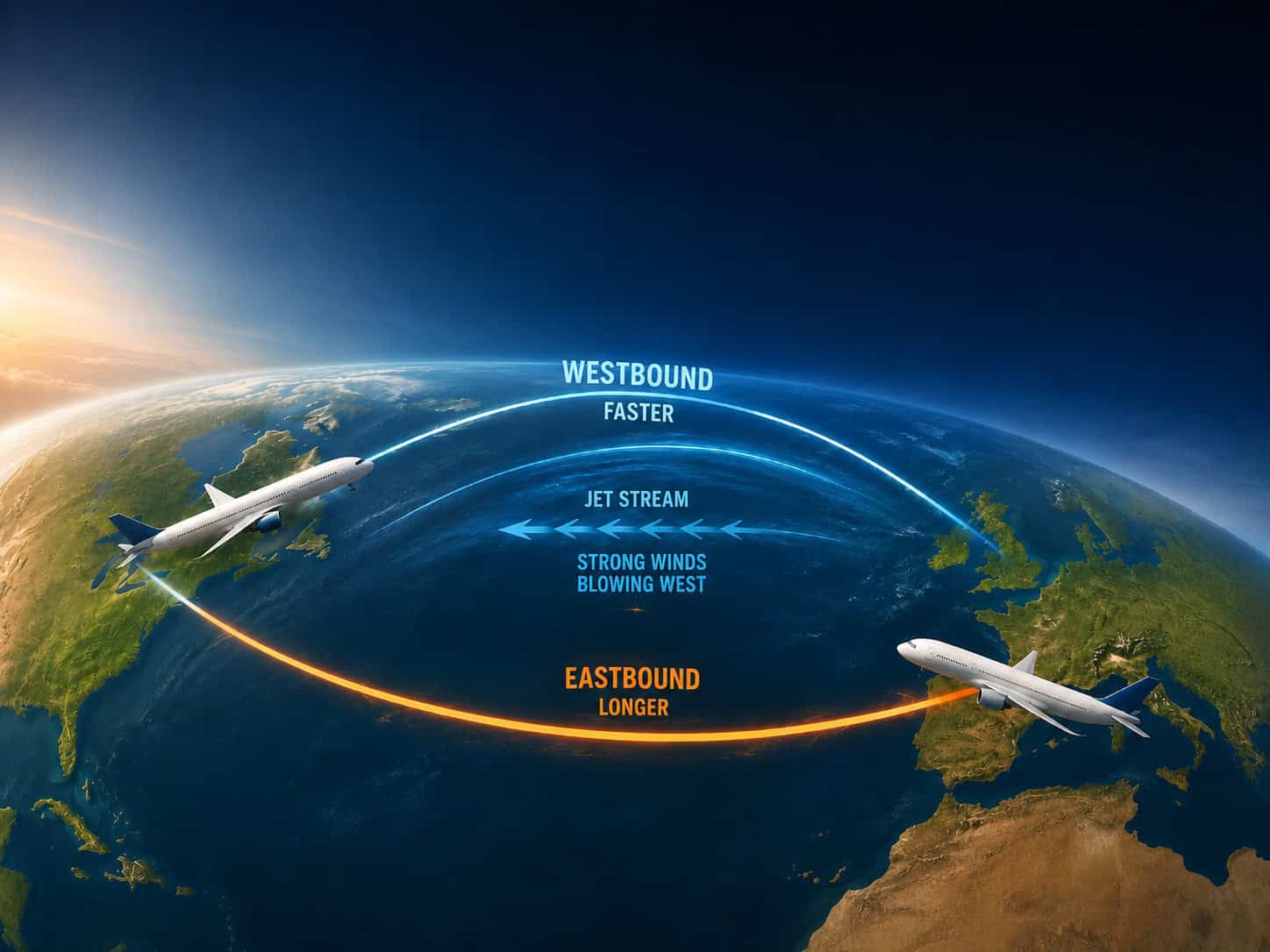
Book a round trip from New York to London and check the flight times. The eastbound leg, heading toward Europe, is scheduled at roughly six and a half to seven hours. The trip home is closer to seven and a half or eight.
Same aircraft, same airline, same 3,450 miles (5,550 km) of open ocean. Yet one direction is reliably an hour or more longer than the other. It is not bad luck, and it is not the calendar.
The two flights are not even following the same path across the Atlantic. Every day, airlines lay down one set of ocean routes for planes heading east and a completely separate set for planes heading west. This is the story of why that happens, and why the ocean over the North Atlantic gets a brand-new road map twice a day.
The short answer: a river of wind in the sky
High over the North Atlantic sits the jet stream, a narrow band of very fast wind that almost always blows from west to east. It is the single biggest reason the two directions differ.
Planes heading east to Europe want to climb into that wind and ride it like a moving walkway. Planes heading west to America want to stay out of it, because to them the same wind is a headwind pushing them back. So each direction gets its own route: one aimed straight into the fast air, the other steered around it.
The answer in one line
The jet stream blows west to east across the Atlantic. Eastbound flights fly into it for a tailwind and get there faster; westbound flights route away from it to dodge the headwind, so they fly a different, often longer path home.
What the jet stream actually is
The jet stream is a fast-moving current of air that circles the globe at roughly the altitude where airliners cruise, around 30,000 to 40,000 feet. It exists because cold polar air and warm tropical air meet, and the sharp temperature difference between them sets the air racing eastward.
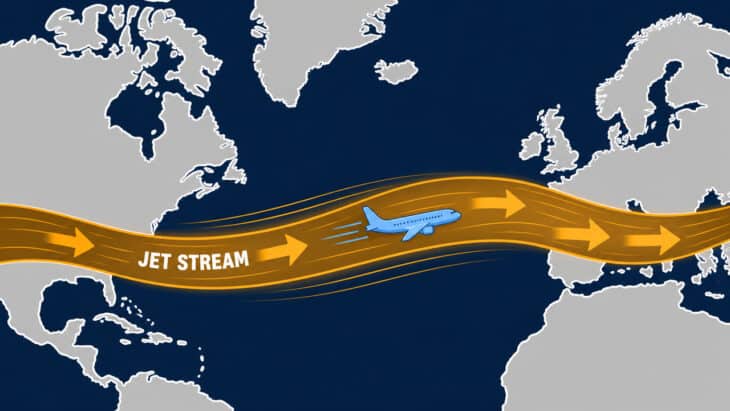
Its core winds commonly run 100 to 200 mph (160 to 320 km/h), and in a strong winter storm they can push past 250 mph. The stream is strongest and lowest in winter, when the temperature gap is at its widest, which is exactly when the eastbound speed boost is biggest.
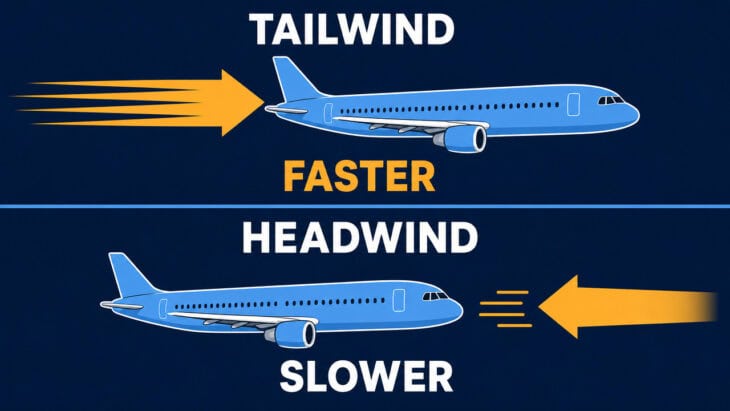
For a plane, a wind coming from behind is free ground speed. If your aircraft flies through the air at 565 mph and a 150 mph tailwind is carrying the whole air mass along with you, your speed over the ground climbs toward 700 mph, and the ocean shrinks. Turn around and fly into that same wind, and it works against you the entire way. This is the core of the difference between a headwind and a tailwind, and over 3,000 miles of ocean it adds up to a full hour of flight time.
How far a tailwind can take you
In February 2020, a British Airways 747 rode an unusually strong jet stream during Storm Ciara and flew New York to London in 4 hours 56 minutes, a subsonic record. Its speed over the ground hit 825 mph with a tailwind touching 260 mph, even though the aircraft never came close to breaking the sound barrier through the air around it.
The North Atlantic Tracks: a highway that moves every day
Because the jet stream wanders, planners cannot just draw permanent airways across the Atlantic and leave them there. Instead, air traffic controllers publish a fresh set of routes twice a day called the North Atlantic Tracks, sometimes shortened to the NATs.
Think of it as a motorway that gets rebuilt overnight to sit wherever the wind is most useful. Controllers in Prestwick, Scotland, and Gander, Canada, look at the forecast jet stream, then string together a handful of parallel tracks spaced out across the ocean.
The eastbound tracks are laid down to run right through the jet stream, so European-bound traffic can harvest the tailwind. The westbound tracks are placed to sidestep it, often bending well north or south of the direct line so America-bound flights are not fighting the wind head-on.
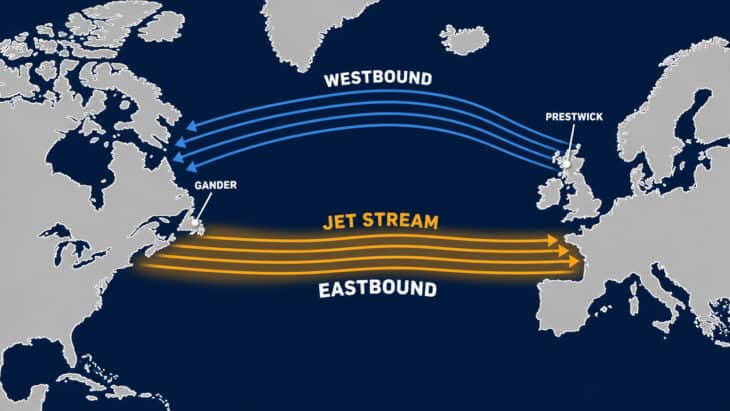
The timing is deliberate too. The heavy eastbound flow crosses overnight and the westbound flow crosses during the day, so the two sets of tracks rarely need the same piece of sky at the same time.
| Eastbound (to Europe) | Westbound (to America) | |
|---|---|---|
| Time of day flown | Mostly overnight | Mostly daytime |
| Relationship to jet stream | Routed into it | Routed around it |
| Effect of the wind | Tailwind (faster) | Headwind avoided (slower anyway) |
| Typical New York to London | About 6.5 to 7 hours | About 7.5 to 8 hours |
Deciding which track to file, and how much fuel to carry for the wind that day, is part of the flight dispatcher’s job before you ever board. The same wind that saves time eastbound is why the fuel load for the westbound leg is planned so carefully: fighting a headwind burns more.
Why not just fly straight? The great-circle problem
There is a second, quieter reason the two directions look different on a map, and it has nothing to do with wind. It is the shape of the Earth.
On a flat map, the shortest line between New York and London looks like a straight horizontal dash. On the actual globe, the shortest path, called the great-circle route, curves noticeably north, arcing up toward Greenland and Iceland before dropping into Europe. That is genuinely the shorter way, even though it looks longer on a flat chart.
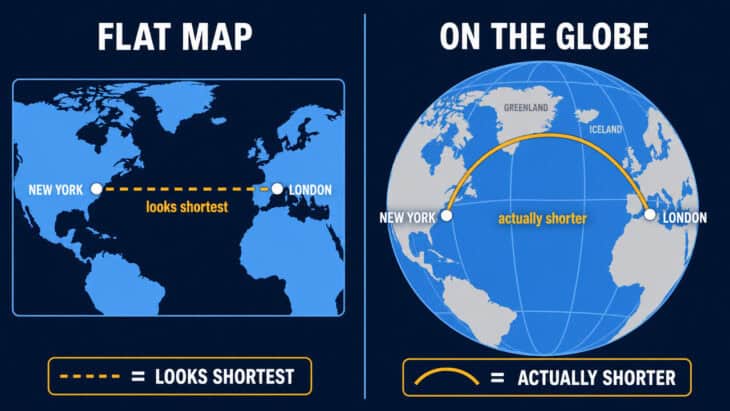
Neither direction flies that pure geometric line, though. Each one nudges off the great circle to chase the best wind: eastbound flights slide toward wherever the jet stream is strongest, westbound flights slide away from it. So the eastbound and westbound paths end up as two different curves across the same ocean, one shaped to grab the wind and one shaped to duck it.
You can calculate the actual great circle distance between any two airports in the world, as well as estimated flight time in both directions, using our flight time estimator tool.
The myth: it is not just a headwind, and pilots are not sightseeing
Most passengers who notice the longer trip home explain it to themselves as a headwind on that one flight. That is half right, and it misses the interesting part.
The common misconception
People assume the return flight is slower because it happened to hit a headwind that day. In reality, the westbound flight is deliberately routed onto a different path to avoid the jet stream. The time gap is built into the plan before takeoff, not bad luck in the air.
The wind is not a random event the pilots stumble into. Its position is forecast, the tracks are drawn around it, and the westbound flight is scheduled longer on purpose. The headwind is real, but the more accurate picture is that airlines reroute to spend as little time in it as possible.
The flip side myth is that the longer westbound path is a detour for its own sake, or that the plane is somehow taking the scenic route. It is the opposite: burning extra minutes on a curved track to save fuel and dodge a 150 mph wall of air is the efficient choice, not a wasteful one.
It also explains why the gap is not fixed. In a calm-wind week the two legs can be nearly even; in a stormy winter the eastbound flight can arrive startlingly early while the return crawls. The routes and the times move because the wind moves.
So the next time your outbound flight to Europe lands ahead of schedule and the trip home drags, you are not imagining it. Somewhere over the Atlantic, your plane is riding, or avoiding, the same river of wind that has been quietly shaping every transatlantic crossing since the jet age began.
Two flights, one ocean, two entirely different roads, redrawn every single day around a wind you never see.
Sources and references used for research and fact-checking.
Get the Newsletter
The latest aviation news and stories sent to your inbox.
About the Author
Tim is the owner and lead editor of AeroCorner since 2019, overseeing aviation content covering aircraft, airlines, airports, and the broader aviation industry. Through years of researching, writing, editing, and publishing aviation-focused content, he has developed extensive practical knowledge of commercial aviation and air travel. Based in Asia and a frequent traveler himself, Tim also brings firsthand passenger experience to AeroCorner’s coverage. Outside of publishing, he has also explored aviation firsthand through hands-on flight training in New Zealand.