Military Trainers
Lockheed Martin T50 Golden Eagle
ICAO: K50
Subsonic jet trainer developed during the 1940s
The latest aviation news and stories sent to your inbox.
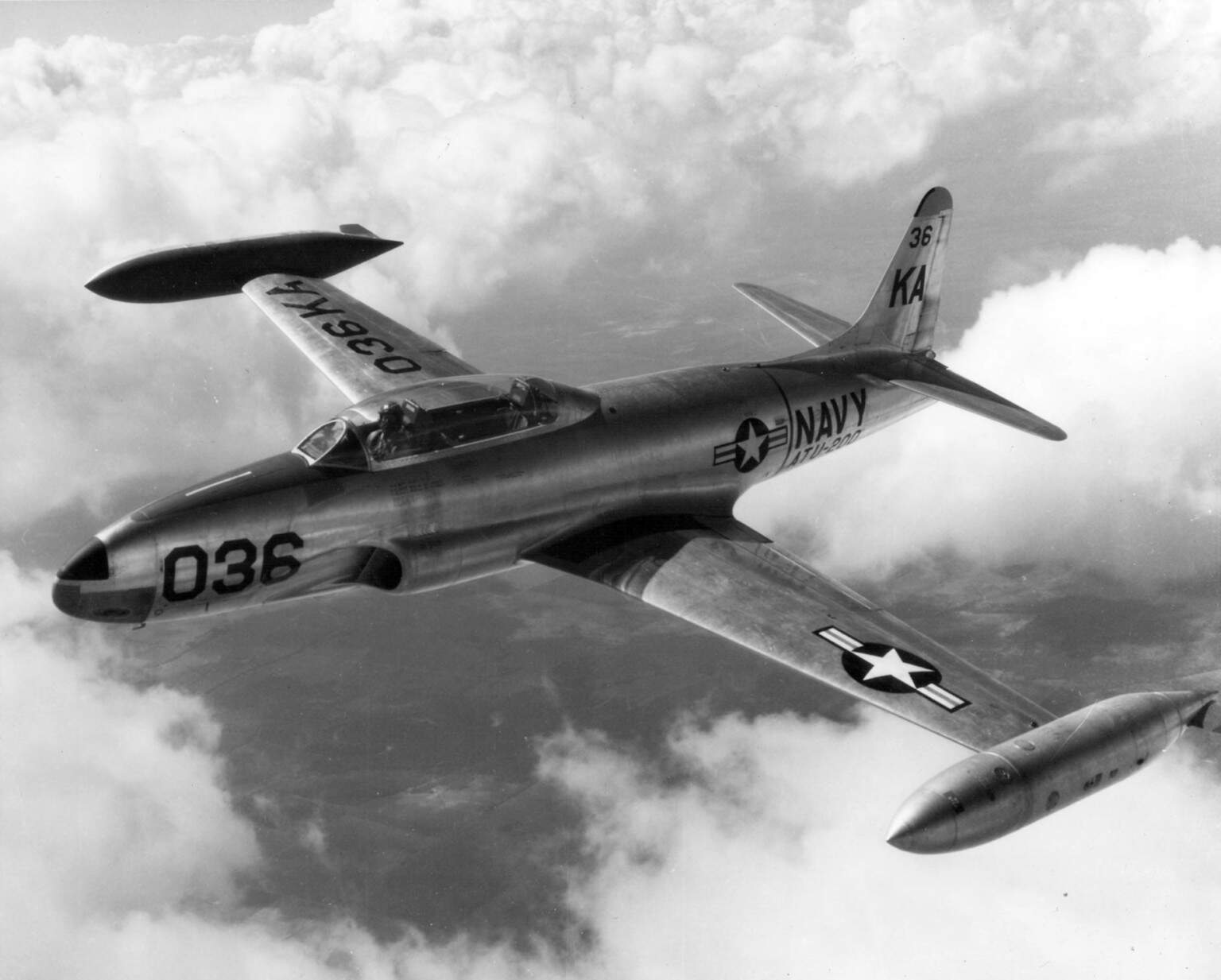
The Lockheed T-33 Shooting Star was designed by Clarence Kelly Johnson and manufactured by Lockheed as an American subsonic trainer aircraft during the late 1940s. Based on the Lockheed P-80/F-80 jet fighter, the T-33 Shooting Star first flew in March 1948 and was retired in July 2017. It was produced from 1948 to 1959 with a total number of 6,557 aircraft built.
Live Fleet Activity (T33)
Fetching live data…


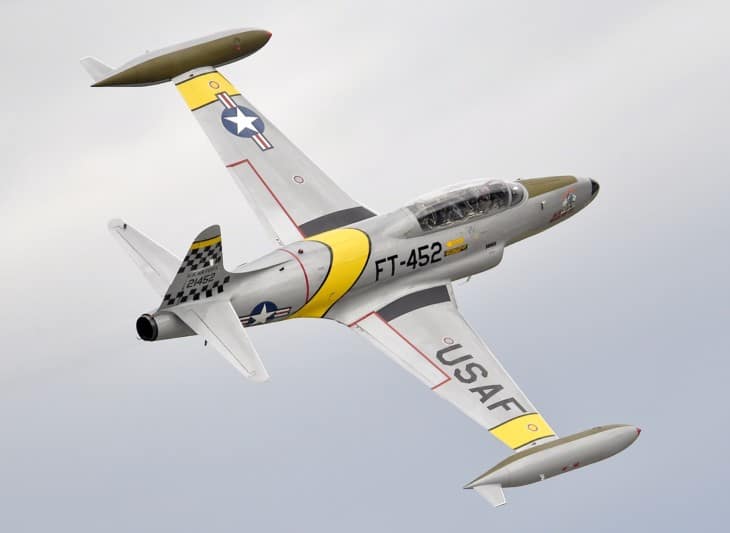
On March 22, 1948, the Lockheed T-33 with the initial designation TF-80C took to the air for the first time. It was operated by the American test pilot Tony LeVier. The aircraft was produced from 1948 until 1959 with a total number of 6,557 T-33s built. It was operated by several air forces such as the United States Air Force, Japan Air Self Defense Force, German Air Force, and Bolivian Air Force. In 1949, the aircraft was used by the United States Navy as a land-based trainer. It was given the designation TV-2, then T-33B in 1962.
The T-33 Shooting Star was derived from the P-80/F-80 with a lengthened fuselage and an added second seat, as well as an instrumentation system and enhanced flight control system. It can carry two crew members and has an external length of 11.51 meters, an external height of 2.5 meters, and a fuselage diameter of 1.1 meters. It has a tail height of 3.56 meters and a wheelbase of 4 meters. The wingspan is 11.85 meters and the wing area is 21.81 square meters. It has an empty weight of 3,794 kg, a gross weight of 5,475 kg, a maximum takeoff weight of 6,832 kg, and a maximum payload of 700 kg. The fuel tank capacity is 813 US gal.
The aircraft is powered by a single Allison J33-A-35 engine. It is a turbojet engine with water injection, a single-stage double-sided centrifugal compressor, fourteen can type stainless combustion chambers, a single-stage axial turbine, and a wet sump oil system. The engine produces a maximum thrust of 5,400 lbf for takeoff with water injection and 4,600 lbf of maximum continuous dry thrust. The maximum speed of T-33 at sea level is 520 knots and the cruise speed is 395 knots. It has a travel range of 1,108 nautical miles. It can fly up to 48,000 feet and can climb at a rate of 4,870 feet per minute. The T-33 is also equipped with two hardpoints with a capacity of 907 kg of bombs or rockets.
Sources and references used for research and fact-checking.