


Table of Contents
Yes, a civilian can legally own a fighter jet. By the Classic Jet Aircraft Association’s count, about 1,000 privately owned vintage and classic jets fly in the United States. They range from Czech trainers to ex-Navy Skyhawks, and a few demilitarized F-16s have been sold to wealthy individuals.
The catch is which jets. Nobody sells a private buyer a frontline F-35, and the Pentagon does not sell flyable retired fighters to the public. Most civilian fighters are older types bought abroad, stripped of its weapons, and flown in the FAA’s Experimental Exhibition category by a pilot holding a special authorization.
| Hurdle | What it means in practice |
|---|---|
| Getting the jet | Retired US fighters go to the Davis-Monthan “boneyard,” which cannot sell them; combat types such as the F-14 are wrecked before disposal. Civilian jets come from foreign air forces instead. |
| Weapons and export law | Jets are sold demilitarized. A still-militarized jet, like a 1980 F-16 listed in Florida in 2019, is marketed to defense contractors under ITAR rules. |
| Airworthiness | Most fly as “Experimental, Exhibition” aircraft, with limits on where and why they fly. They cannot be used for personal transportation. |
| Pilot qualification | Turbojet-powered airplanes need a type rating, and ex-military experimental jets need an FAA experimental aircraft authorization on the pilot certificate. |
| Money | 2024 asking prices ran from $50,000 for a non-flying display jet to $3.2 million. A popular L-39 trainer costs about $1,000 to $2,000 per flight hour to run. |
Why You Can’t Buy a Retired Fighter From the Pentagon
Retired US fighters are stored by the Aerospace Maintenance and Regeneration Group (AMARG) at Davis-Monthan Air Force Base in Arizona. The base’s FAQ was blunt: AMARG “cannot sell or donate aircraft.” Federal property rules forbid direct sales, and the aircraft still belong to the service that delivered them.
Once a service decides a jet has no further value, it is prepared for disposal and passed to a Defense Department demilitarization center in Tucson, which sells what is left at government auction. Preparation includes stripping military components and, on combat types such as the F-14, “catastrophic damage to the aircraft to preclude flight.”
That damage can mean smashed wings and fuselages, or demolition down to chunks the size of an old silver dollar. A Congressional Research Service report on the program warns that, when enforcement fails, harmful weaponry and parts end up with private citizens and potential enemies of the United States.
So the flyable American fighter jets in private hands mostly took a detour: sold or given to a foreign air force first, then sold on to a private owner years later.
Where Civilian Fighter Jets Actually Come From
Foreign air forces retiring their fleets are the main supply. Czech-built trainers, Soviet MiGs, French Mirages and secondhand American jets have all reached the civilian market this way, and the buyers range from collectors to companies.
Some of the biggest buyers are contractors that play the enemy in military training. Draken International, founded in Lakeland, Florida in 2012, is described as running the largest privately owned fleet of former military tactical jets, about 150 aircraft, with a 2021 fleet that included A-4K Skyhawks, Mirage F1s, L-159s and MiG-21bis fighters.


Draken also agreed in 2021 to buy up to 24 F-16s from the Netherlands and Norway. Those sales were canceled, and by 2024 the jets had been redirected to Ukraine and Romania.
Top Aces had already flown one. It bought second-hand F-16A/B “Netz” fighters from Israel, planning a fleet of 29 at the time, and flew the first one from Mesa Gateway Airport in Arizona in May 2021. The War Zone called it the first time a private adversary company had flown a fourth-generation fighter of any kind.
Individual sales happen too. In 2019 JetLease Palm Beach listed for $8.5 million a 1980 F-16 Fighting Falcon it had acquired from Jordan. It had logged 6,000 hours on an airframe upgraded to fly at least 8,000.
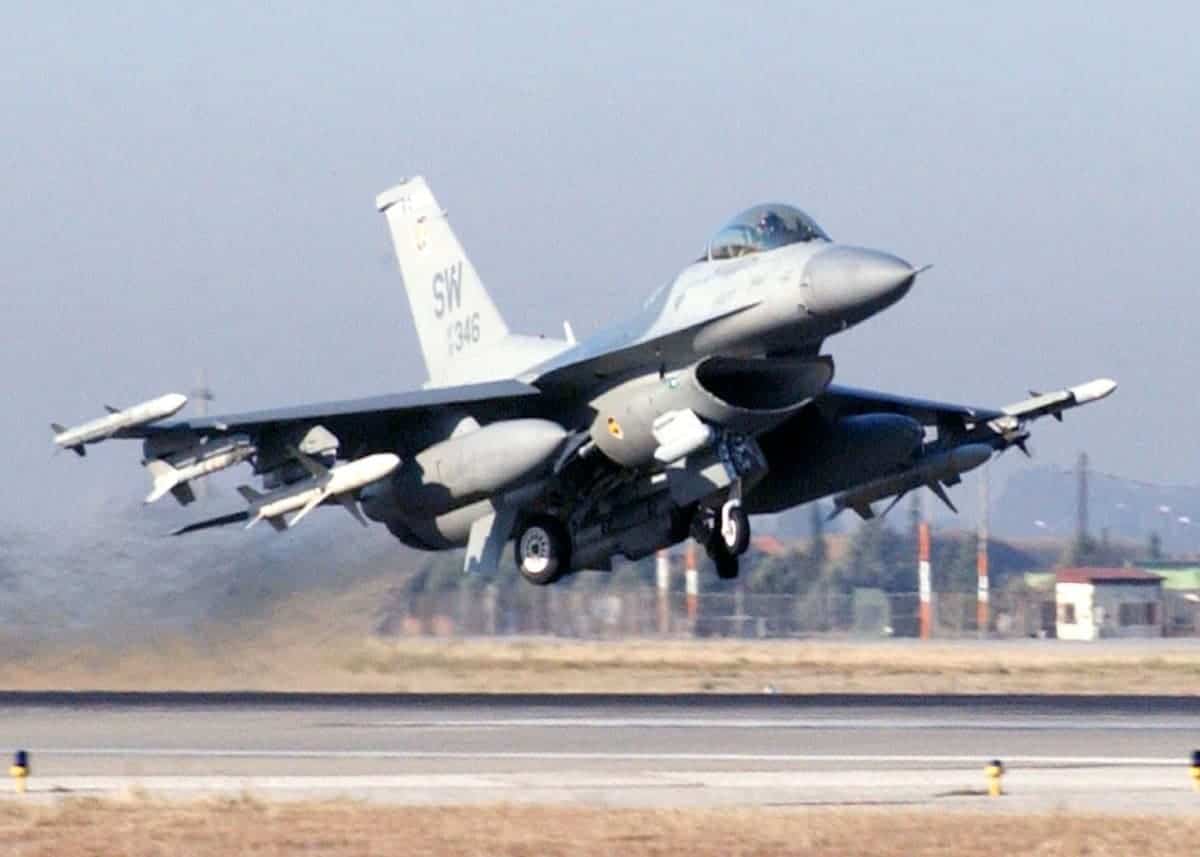
That jet was not aimed at hobbyists. According to The Drive, it remained militarized, it was marketed to contractor air service providers, and any buyer had to comply with the International Traffic in Arms Regulations (ITAR).
How Much Does a Fighter Jet Cost to Buy?
Far less than most people guess, at least to buy. A SlashGear survey of live listings in April 2024 found demilitarized jets asking anywhere from $50,000 to $3.2 million.
| Jet | Origin | Asking price (2024) |
|---|---|---|
| Mikoyan MiG-21UM | Soviet trainer, static display (not flyable) | $50,000 |
| LTV A-7E Corsair II | US Navy attack jet, static display (not flyable) | $50,000 |
| Aero L-29 Delfin | Czech jet trainer | $79,000 |
| Canadair CL-41G Tebuan | Malaysian ground-attack trainer | $199,900 |
| Saab J 35 Draken | Swedish fighter | $250,000, plus about $150,000 in inspections |
| Douglas A-4 Skyhawk | US Navy attack jet | $650,000 |
| Aero L-39C Albatros | Czech jet trainer | $875,000 |
| SIAI-Marchetti S-211 | Italian jet trainer | $975,000 |
| Douglas TA-4J Skyhawk | US Navy two-seat trainer | $3.2 million |
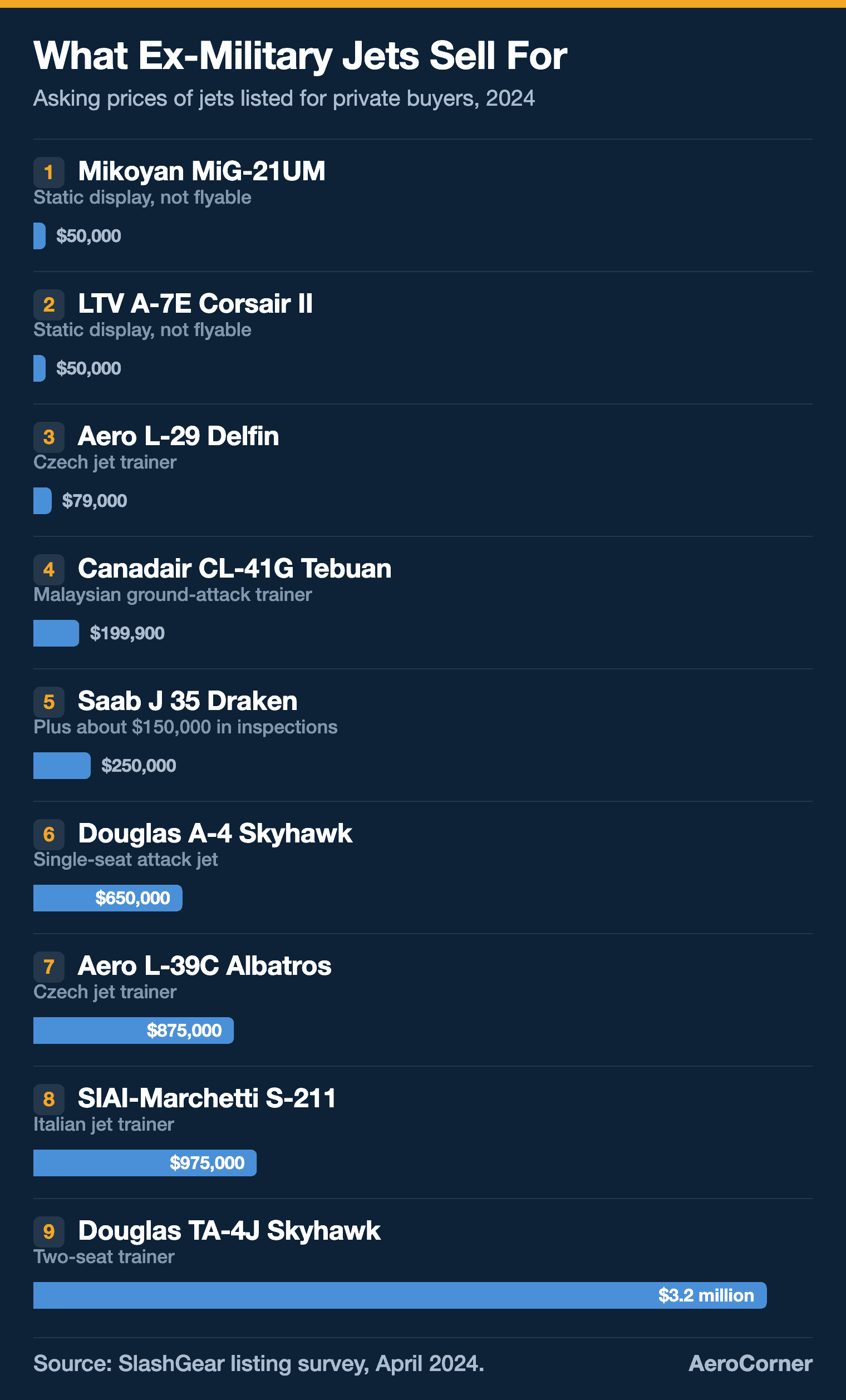
The cheap end is not a bargain fighter ready to fly. Both $50,000 listings were static display airframes that cannot fly, so flyable jets started around $79,000 for an L-29. Even then, the Saab Draken listing came with a separate $150,000 inspection estimate.

Prices also vary widely for the same type. MiGFlug puts typical civilian L-39 Albatros sales at roughly $200,000 to $500,000, well under the $875,000 one 2024 listing asked.
The real cost is running it. Civil L-39 operators quote about $1,000 to $2,000 per flight hour all-in, and the L-39 is the economical one, with a single fuel-efficient turbofan. The Classic Jet Aircraft Association warns that a low purchase price is often offset by higher operating costs.
If a fighter is out of reach, the same buying steps apply to ordinary aircraft. Our guide to the ways to buy your own plane covers financing, inspections and ownership costs.
Can a Civilian Fly a Fighter Jet? The Pilot Rules
Owning the jet does not mean you can fly it. FAA rule 14 CFR 61.31 requires a pilot in command of any turbojet-powered airplane to hold a type rating for that aircraft.
Most ex-military jets fly on an experimental certificate, which the type-rating rule largely exempts. Instead, their operating limitations require an FAA-issued authorization to act as pilot in command, covered in FAA Order 8900.1, Volume 5, Chapter 9, Section 2.
For models that also exist in type-certificated form, a January 2025 FAA notice lays out two routes. A pilot can pass a type rating test in a type-certificated example of the same model, or complete the required training and an evaluation for an “experimental aircraft authorization,” which is then entered on the pilot certificate for that make and model only.
An exhibition jet is not a private jet
Most civilian fighters are licensed in the Experimental, Exhibition category. According to the Classic Jet Aircraft Association, many carry restrictions on where they may be flown and for what purpose, and they may not be used for personal transportation.
Even as a passenger, fast jet flying is brutal. Hard turns pile on G-forces that can leave a first-timer fighting to stay alert. Watch the “F18 – Flight Baptism – Are you with me Steve?” video on YouTube.
Civilians and Celebrities Who Own Fighters
Art Nalls bought Sea Harrier XZ439 in Britain in October 2005 and first flew it on November 10, 2007. Nalls describes it as the world’s first privately owned and flown Harrier of any kind.
He later added a two-seat Harrier T.8 trainer in 2014, and in 2020 put his Harriers and spare parts up for sale. Watch the “How to Buy a Fighter Jet” video on YouTube.
The best-known celebrity warbird is a propeller fighter, not a jet. Tom Cruise bought his P-51 Mustang in 2001, and it is the one that appears in Top Gun: Maverick.
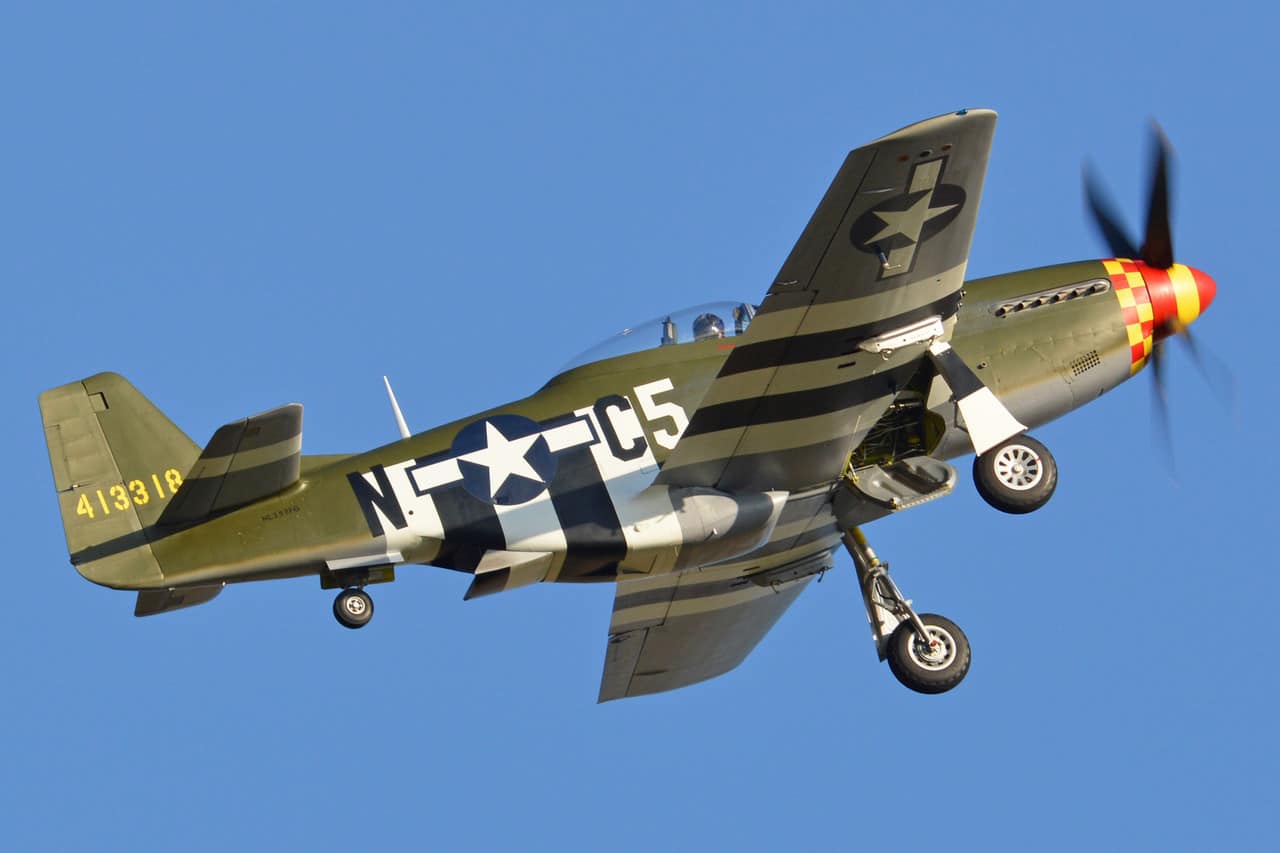
His aircraft was built in 1944 as an F-6K photo-reconnaissance Mustang and later restored without its cameras. AvGeekery calls it one of only two flyable F-6Ks in the world, out of 164 built, and it once carried the name “Kiss Me Kate.”
FAQ
Sources and references used for research and fact-checking.
- Classic Jet Aircraft Association, FAQ
- Davis-Monthan Air Force Base, Frequently Asked Questions: Can I buy a plane or part from AMARG?
- Congressional Research Service, Demilitarization of Significant Military Equipment
- Legal Information Institute, 14 CFR 61.31, Type rating requirements, additional training, and authorization requirements
- Federal Aviation Administration, Notice N 8900.729, Specialty Aircraft Examiners Conducting Practical Tests in Experimental Aircraft
- Aviation Pros (Miami Herald), A Working F-16 Fighter Jet is for Sale in Florida. So, What Can a Buyer Use It For?
- SlashGear, 10 Fighter Jets You Can Actually Buy (And How Much They Cost)
- MiGFlug, Aero L-39 Albatros: History, Specs and Stories
- The War Zone, The First Privately Owned F-16 Aggressor Jet Has Taken To The Sky
- Wikipedia, Draken International
- Wikipedia, Art Nalls
- AvGeekery, Movie Star Aircraft: The Top Gun P-51 Mustang in Top Gun: Maverick
Get the Newsletter
The latest aviation news and stories sent to your inbox.
About the Author

Victoria is a First Officer on the Airbus A320. Flying across the skies of Europe, Victoria lives her life both metaphorically and literally with her head in the clouds.