Military Trainers
Alenia Aermacchi MB-339
ICAO: M339
Italy's lead-in fighter trainer, now also sold as a light fighter.
Updated: by Tim de Vries
The latest aviation news and stories sent to your inbox.
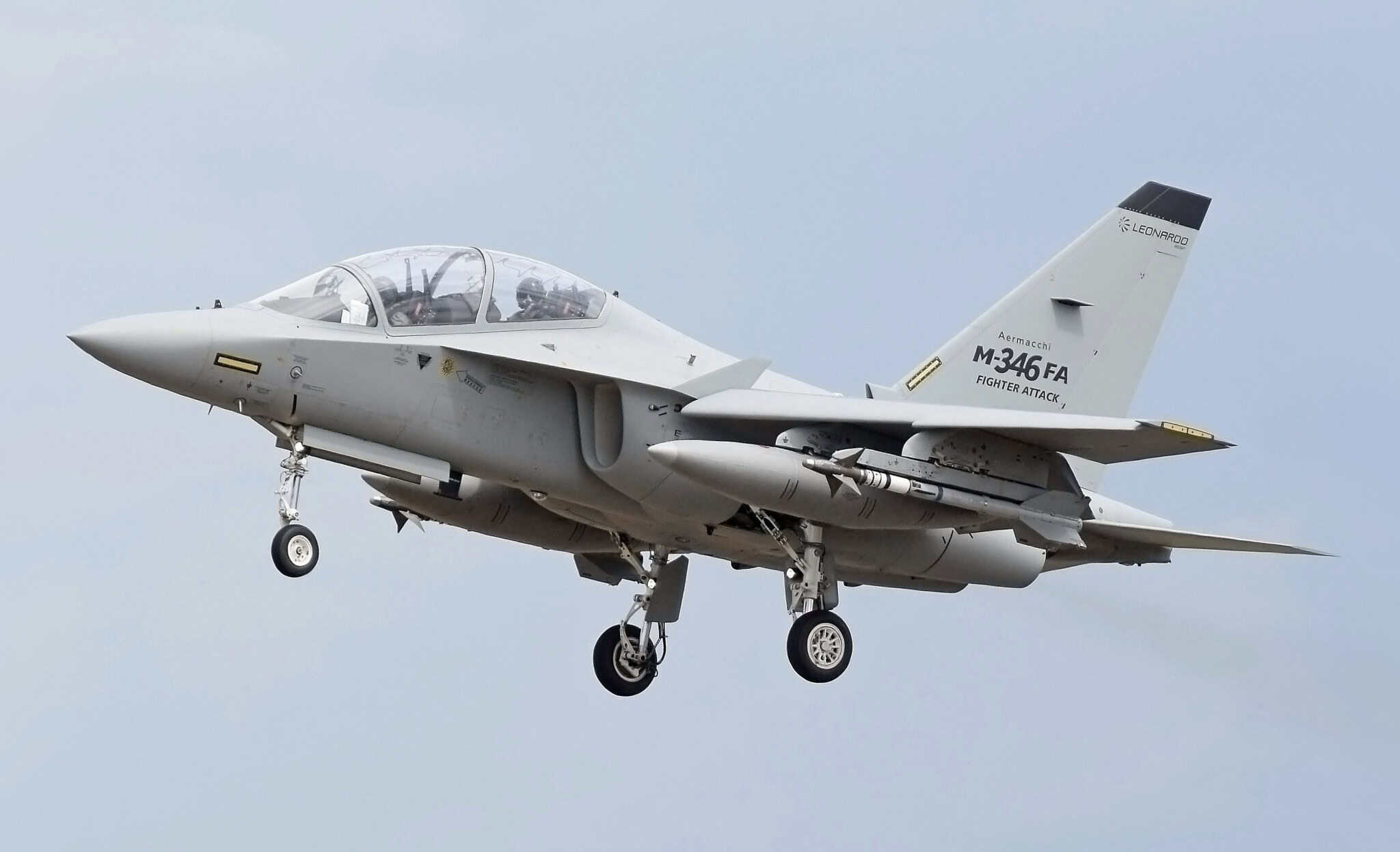
The Leonardo M-346 Master is an Italian twin-engine advanced jet trainer built to prepare pilots for fourth- and fifth-generation fighters such as the F-35 and the Eurofighter. Its fly-by-wire controls can be set to mimic the handling of the jet a student will fly next, and the combat-capable M-346FA doubles as a light fighter. It serves with the air forces of Italy, Israel, Singapore, Poland, Greece, Qatar and Turkmenistan.
Live Fleet Activity (M346)
Fetching live data…


The M-346 Master is a twin-engine, two-seat advanced jet trainer built in Italy by Leonardo, the company that absorbed Alenia Aermacchi in 2016. Its job is the last step before a pilot straps into a front-line fighter: lead-in fighter training, which the Italian Air Force calls Phase IV.
The design brief was to make a trainer that flies and feels like a modern fighter without costing like one. Its avionics are modeled on those of the Eurofighter Typhoon, the Saab Gripen and the F-22, so students arrive at their squadrons already fluent in how a modern fighter cockpit works.
By December 2025, Leonardo said the type had flown more than 150,000 hours, with nearly 160 aircraft sold and 20 countries either training on it or having chosen it as a light fighter. The full specification table for the M-346 is on this page.
The M-346 started life as a Russian-Italian project. In 1992, Aermacchi agreed to back Yakovlev’s new trainer for the Russian Air Force, and the joint aircraft, marketed as the Yak/AEM-130, first flew in 1996.
Russian funding dried up, and by mid-2000 the partners split. Yakovlev kept developing what became the Yakovlev Yak-130, while Aermacchi turned its share into a heavily reworked, Western-equipped aircraft with Honeywell F124 turbofans in place of the originally planned Lotarev DV-2S engines.
The first M-346 prototype flew on July 15, 2004. The first low-rate production aircraft, in final configuration, rolled out on April 10, 2008, and Italy’s military type certificate followed on June 20, 2011.
Singapore, the first export customer, took its jets in 2013 and 2014. The Italian Air Force started its first M-346 training course in September 2015, as the successor to the Aermacchi MB-339.
The heart of the aircraft is a quadruplex, full-authority fly-by-wire system that keeps it controllable at angles of attack above 30 degrees. Instructors can set the g and angle-of-attack limits independently, so the same jet can behave like a gentle trainer on one sortie and like the fighter a student is heading to on the next.
The other half is the embedded tactical training system, or ETTS. It simulates radar, targeting pods, weapons and electronic warfare in flight, and can inject computer-generated friendly and enemy aircraft, either preloaded before takeoff or streamed live from the ground over a datalink.
That lets an M-346 fly what the Italian Air Force calls live, virtual and constructive training: real jets, pilots in simulators and synthetic threats in the same exercise. Leonardo’s pitch is that every hour flown this way is an hour not flown on a far more expensive front-line fighter.

The best-known home of that system is the International Flight Training School at Decimomannu in Sardinia, run by the Italian Air Force and Leonardo since 2018. Pilots from more than a dozen air forces have trained there, including Japan, Germany, Qatar, Singapore and the UK.
In September 2025, 10 U.S. Air Force student pilots began a course there, the first time U.S. student pilots have trained for their wings at a foreign NATO school. Israel’s M-346s, meanwhile, prepare pilots for the F-15, F-16 and F-35.
Not in level flight. The M-346 has no afterburner, and Leonardo’s published maximum level speed is 590 kt (679 mph, 1,093 km/h), which is transonic, just under the speed of sound.
It can go supersonic in a dive. On December 18, 2008, Aermacchi announced an M-346 had reached Mach 1.15, and Leonardo’s own performance sheet gives a limit of Mach 1.2. The 572-knot figure quoted by some operators, including Singapore’s Ministry of Defence, is the airframe’s limit speed in equivalent airspeed, a structural limit rather than a top speed.
Range needs the same care. The panel shows 1,070 nm (1,230 mi, 1,980 km) on internal fuel, and Leonardo quotes 1,470 nm with external tanks. A removable probe adds in-flight refueling on top of that.
The two Honeywell F124-GA-200 engines each make 6,280 lbf (28 kN) of thrust. That is enough for a sea-level climb of 22,000 ft/min (112 m/s), a ceiling of 45,000 ft (13,700 m) and a load factor of +8 g, which the jet can sustain at sea level.
The M-346 has grown from a pure trainer into a family, and the names overlap enough to cause confusion.

The M-346FA carries up to 6,600 lb (3,000 kg) of external stores across seven stations: one under the fuselage, four under the wings and two on the wingtips. The published weapons list includes AIM-9 Sidewinder and IRIS-T missiles, Mark 82 and Mark 83 bombs, Maverick missiles and 12.7 mm and 20 mm gun pods.
Leonardo sells it as a jet for jobs that do not need a front-line fighter: air policing, intercepting slow movers, close air support, reconnaissance and flying as the enemy in training. Its 2019 sales presentation put its running costs at about a third of a high-end fighter’s fuel bill and a sixth of its maintenance bill.
That argument is winning orders from air forces without an existing light-combat jet. Turkmenistan operates four M-346FAs and two FTs, and Nigeria, Austria and Indonesia have all signed for the combat version since 2021.
Seven air forces fly the M-346 today, most of them as the final step before their own front-line fighters.

Four more customers have jets on order. Nigeria bought 24 M-346FAs in a contract worth about $1.4 billion, and its first three passed factory acceptance testing in Italy in July 2026.
Austria signed for 12 M-346 F Block 20s in December 2025 to replace its retired Saab 105s, with the first due in 2028; the whole package, including weapons and simulators, has been reported at about €1.5 billion. Indonesia signed for 12 more in July 2026, worth around €1 billion, with deliveries from 2030, and the International Test Pilots School in Canada ordered six trainers in May 2026.

The M-346 has tried to win an American trainer contract twice. For the U.S. Air Force’s T-X competition to replace the Northrop T-38 Talon, Leonardo offered it as the T-100, first with General Dynamics and then with Raytheon, both of which pulled out.
Price was one sticking point: the jet’s flyaway cost was $25 million in early 2017, and Raytheon wanted it cut by 30 percent. Leonardo DRS bid alone, and the Air Force chose Boeing’s design, now the T-7 Red Hawk.
The second attempt is still live. Textron offers a U.S.-built Beechcraft M-346N, to be assembled in Wichita, for the Navy’s Undergraduate Jet Training System, the program to replace the T-45 Goshawk.
The Navy dropped the need for arrested carrier landings, so the M-346N needs no tailhook or catapult bar. Lockheed Martin left the race in April 2026 and Boeing on June 12, 2026, leaving the M-346N and Sierra Nevada’s Freedom Trainer. In September 2026, the Navy pushed its award date back again, by three months.
Two more contests are open. Canada entered talks with Italy in June 2026 to buy the M-346 for Royal Canadian Air Force lead-in training (see our roundup of Canadian fighter jets), and in July 2026 Leonardo said it would bid to replace the RAF’s BAE Hawk.
The two jets are cousins, not copies. They share an aerodynamic starting point, but the M-346 was rebuilt with Western engines, flight controls and avionics after the partnership ended in 2000, and the split agreement divided the markets: Yakovlev could sell to former Soviet states, India, Slovakia and Algeria, and Aermacchi to NATO countries and others.
The clearest head-to-head came in Azerbaijan, which chose the M-346 in 2020 despite its higher price. Its commanders cited the M-346’s lighter weight and better maneuverability, and problems manufacturing the Yak-130’s engines.
The M-346 has also met the KAI T-50 Golden Eagle in export contests. Indonesia chose the T-50 for its trainer in 2011, then came back for the M-346 in 2026, and Colombia’s air force selected the M-346FA over the FA-50, though that purchase has stayed uncertain.
The last widely reported flyaway price was $25 million per aircraft, in January 2017. That covers the jet alone.
Export contracts cost far more per airframe because they bundle simulators, spares, training, weapons and years of support. Nigeria’s 24 jets came to about $1.4 billion, and Austria’s 12, with weapons and simulators, to about €1.5 billion.
Leonardo’s case is that the trainer saves money further down the line. Its 2019 presentation claimed the M-346 cuts the cost of converting a pilot to a front-line fighter by more than 40 percent, because so much of that training moves onto the cheaper jet.
Three crashes stand out in the M-346’s record. A prototype crashed on November 18, 2011, after leaving the Dubai Airshow on its way back to Italy.
On May 11, 2013, a company test aircraft crashed near Piana Crixia in northern Italy; the pilot ejected, and the type was grounded for more than three months during the investigation. On July 12, 2024, a Polish Air Force demonstration jet crashed during a display near Gdynia, killing its pilot, Major Robert Jeł.
About $25 million per aircraft, the flyaway price reported in January 2017. Full export deals cost much more per jet because they include simulators, training, weapons and long-term support: Nigeria’s 24-aircraft contract was worth about $1.4 billion.
Not in level flight. Its maximum level speed is 590 kt (679 mph, 1,093 km/h), just below Mach 1, because it has no afterburner. It has exceeded the speed of sound in a dive, reaching Mach 1.15 in 2008.
Leonardo of Italy, which absorbed the original builder, Alenia Aermacchi, in 2016. The jets are built at Venegono Superiore in Italy. In the U.S., Textron’s Beechcraft is offering a version assembled in Wichita as the M-346N.
Two Honeywell F124-GA-200 turbofans without afterburners, each producing 6,280 lbf (28 kN) of thrust. Aermacchi chose the F124 in July 2000, in place of the Lotarev DV-2S the joint Yak/AEM-130 design had planned to use.
Not as an American aircraft, yet. U.S. Air Force students began training on Italian Air Force M-346s in Sardinia in September 2025. The Beechcraft M-346N is one of two remaining bids to replace the Navy’s T-45 Goshawk, with a contract award not expected before 2027.
No single jet holds that title, and the M-346 is not a contender: it is a trainer that also serves as a light fighter. For the aircraft that front-line air forces rate most highly, see our ranking of the best fighter jets in the world.
Sources and references used for research and fact-checking.