Fighter Jets
Lockheed Martin F-35 Lightning II
ICAO: F35
America's first operational jet fighter, built in 143 days and flown in combat over Korea.
Updated: by Tim de Vries
The latest aviation news and stories sent to your inbox.
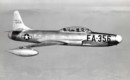
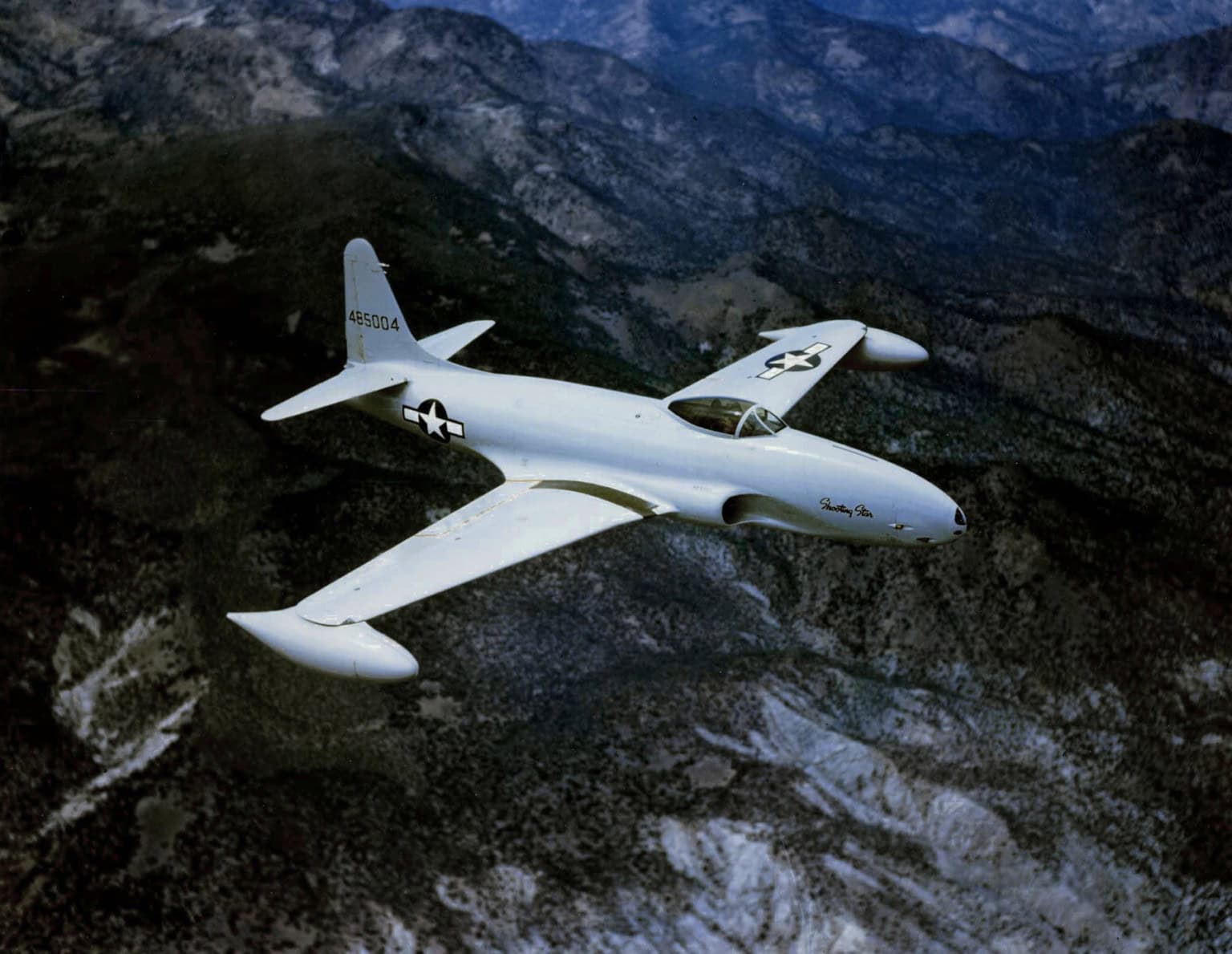
The Lockheed P-80 Shooting Star was America’s first operational jet fighter. Kelly Johnson’s team built the prototype in 143 days, and it first flew on January 8, 1944. Renamed the F-80 in 1948, it flew fighter, fighter-bomber and reconnaissance missions in the Korean War, and Lockheed built 1,714 production aircraft before the design lived on as the T-33 trainer.


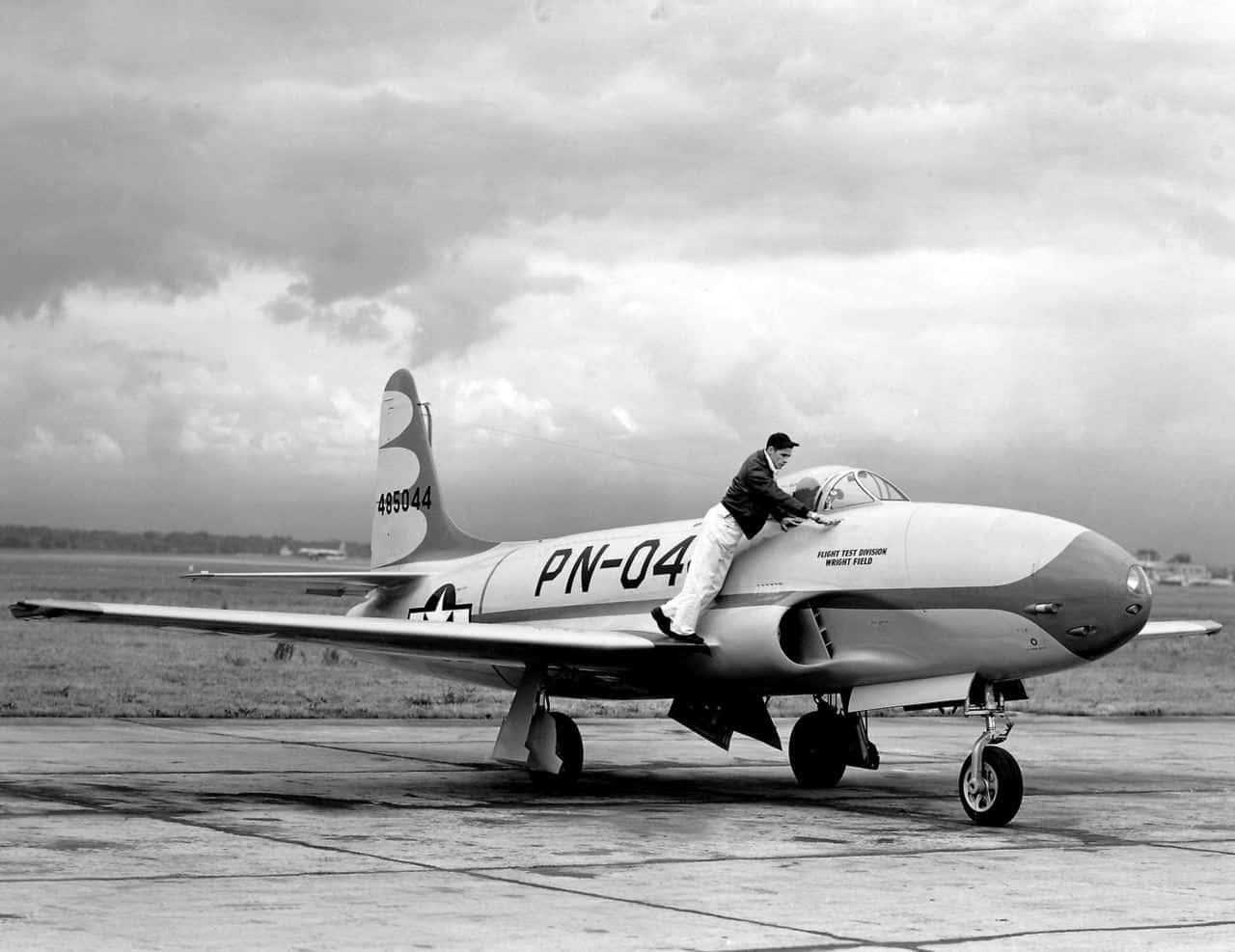

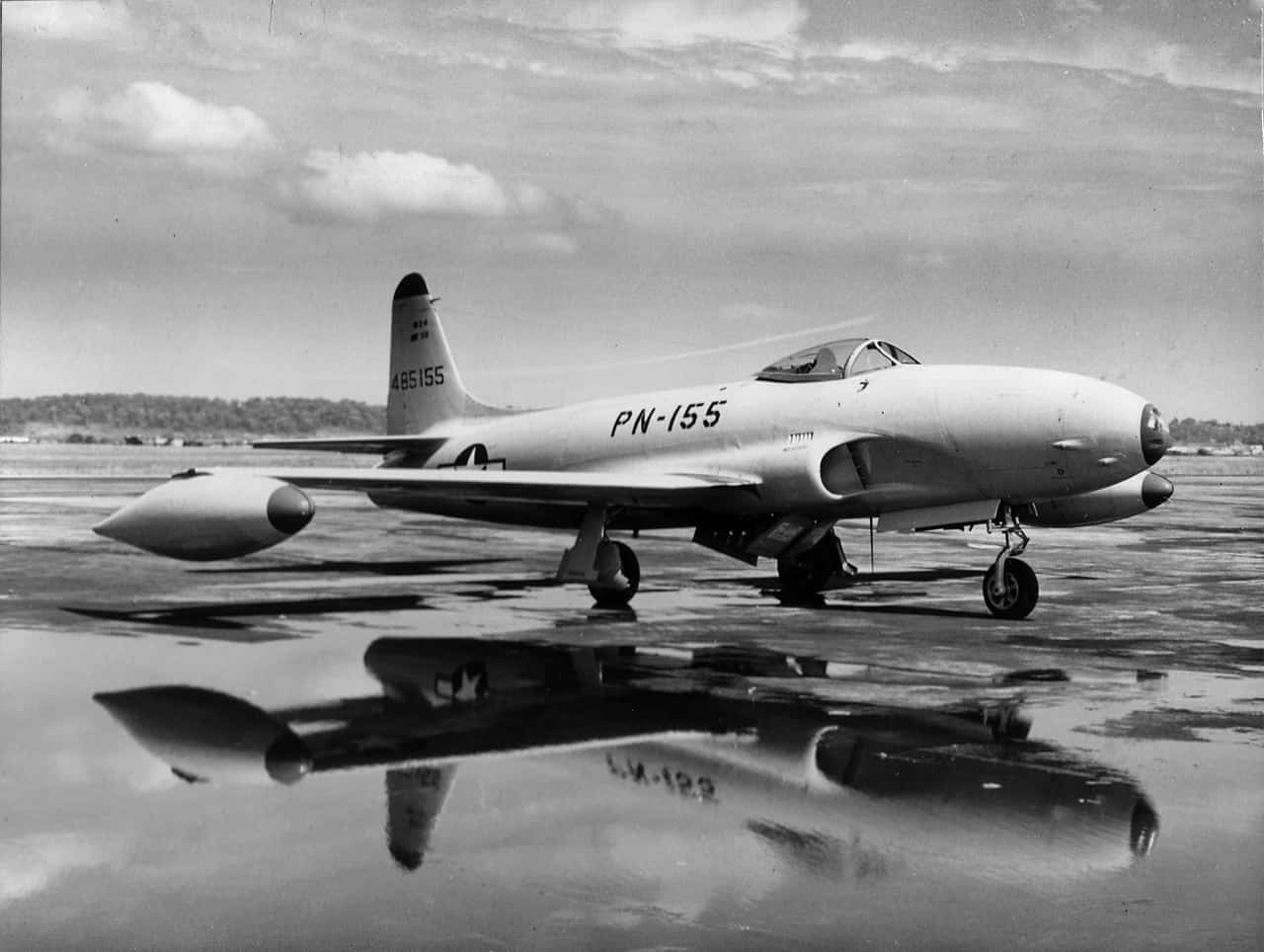

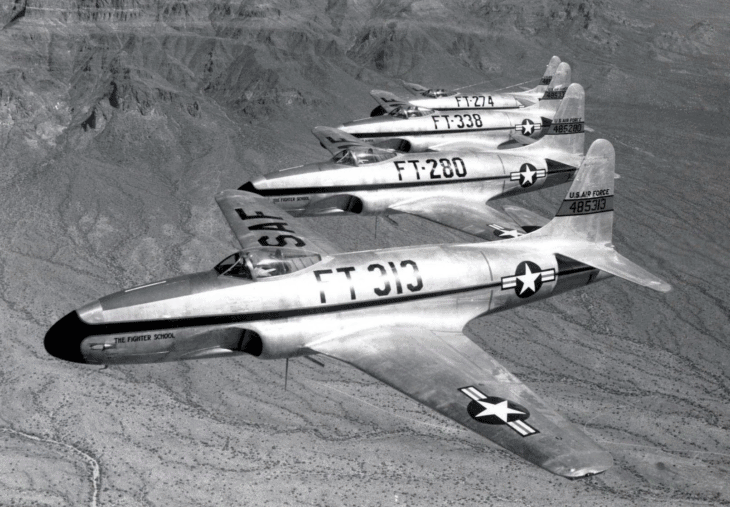
The Lockheed P-80 Shooting Star is a single-seat, straight-winged jet fighter and America’s first operational jet fighter. It first flew on January 8, 1944, and the US Air Force renamed it the F-80 in June 1948.
It arrived just too late to fight in World War II, then made up about half of the Air Force’s fighter strength when the Korean War began. Lockheed built 1,714 production Shooting Stars between 1945 and 1950, and the design lived on in the two-seat T-33 trainer.
The specification panel on this page describes the F-80C, the final and most-produced production model.
America was slow to build a useful jet. Its first, the Bell P-59 Airacomet, flew in October 1942 but performed only marginally better than piston fighters, and it served as a test bed and trainer.
By 1943 the Army Air Forces knew Germany was preparing to field the Messerschmitt Me 262, so it asked Lockheed for a real combat jet. The design was built around the British Halford H-1B, later named the de Havilland Goblin.
Lockheed gave the job to Clarence “Kelly” Johnson, and work on the XP-80 began in June 1943. To keep it secret, Johnson walled off the work area with engine crates and a circus tent, and someone nicknamed the site the “Skunk Works” after a moonshine still in the Li’l Abner comic strip.
Lockheed promised a prototype in 180 days. According to the National Air and Space Museum, it was ready to fly in 143.
Then both inlet ducts collapsed during a ground run, and the engine was damaged. The first flight had to wait for a replacement Goblin, which de Havilland supplied from the engine meant for its own Vampire prototype.
On January 8, 1944, Lockheed chief test pilot Milo Burcham flew the prototype, nicknamed “Lulu-Belle,” for the first time at Muroc, the California base now called Edwards Air Force Base.
Lulu-Belle also helped protect American bombers before any P-80 reached Europe. In mid-1944 it took part in exercises to work out defenses against jet attacks on bombers. They showed jet pilots would prefer to attack from behind, so escort fighters were moved higher, where they could dive on attacking Me 262s.
Production P-80s used a larger American engine, the General Electric I-40, which Allison built as the J33. Two XP-80A prototypes were built around it, nicknamed the “Gray Ghost” and the “Silver Ghost.”
A Shooting Star prototype became the first American jet to fly faster than 500 mph (805 km/h) in level flight, but sources disagree on the details.
The National Air and Space Museum says Lulu-Belle reached 547 mph (880 km/h) on its first flight, while Wikipedia gives 502 mph for the XP-80 in testing and the Air Force Materiel Command’s history credits the XP-80A.
Wikipedia also notes that a specially modified piston-engined P-47 Thunderbolt, the XP-47J, reached 504 mph in August 1944. So whether a Shooting Star was the first American aircraft of any kind past 500 mph depends on which account is right.
Thirteen YP-80A service-test aircraft were ordered, and four went to Europe. Two in Italy flew operational sorties in early 1945 but never met an enemy aircraft, so the P-80 saw no combat in World War II.
The Army ordered 1,000 P-80As in February 1945. After the war ended, wartime plans for 5,000 aircraft were cut to 2,000.
Early P-80 flying killed several pilots. Burcham died on October 20, 1944, when the third YP-80A crashed, and Major Frederic Borsodi was killed demonstrating a YP-80A at Burtonwood, England, in January 1945.
On August 6, 1945, Major Richard Bong, America’s top-scoring ace of the war, was killed on an acceptance flight of a production P-80. Both Burcham’s and Bong’s crashes were traced to main fuel pump failures.
In 1946 the P-80 had the highest accident rate of any Army Air Forces fighter, and pilot inexperience was a factor. Pilots coming from piston fighters misjudged the slower throttle response of early jets and lost track of their speed.
The answer was a two-seat jet trainer. Lockheed stretched the fuselage to fit an instructor, and the result, the T-33, went on to far outnumber its parent, with 6,557 built.
On January 27, 1946, Colonel William Councill flew a P-80 nonstop from Long Beach to New York, the first transcontinental jet flight. He covered 2,457 miles (3,954 km) in 4 hours 13 minutes, averaging 584 mph (940 km/h) with the help of tailwinds.
On June 19, 1947, Colonel Albert Boyd flew the one-off P-80R racer to a world speed record of 623.753 mph (1,003.8 km/h) at Muroc. The record had been held by a British Gloster Meteor, and the National Museum of the US Air Force says it returned the title to the United States after nearly 24 years.
The P-80R had a smaller canopy, redesigned intakes, a shorter wing, a modified engine, and a fuel tank in place of the guns. It is on display at the museum in Dayton, Ohio.
The P-80 also features in our list of famous firsts in aviation.
The XP-80 was the single Goblin-powered prototype. The two XP-80As introduced the GE I-40 with a bigger fuselage and a pressurized cockpit, and the YP-80As were the service-test batch.
The P-80A was the first production model, with 524 built. The FP-80A, later RF-80A, was a photo-reconnaissance version with cameras in the nose, and 152 were built new.
The 240 P-80Bs had a thinner wing, a newer J33-A-21 engine, and the first ejection seat on a Shooting Star, which was retrofitted to earlier aircraft.
The P-80C, renamed F-80C in June 1948, was the final and most numerous version, with roughly 800 built new. It first flew on March 1, 1948, and after the Korean War around 130 F-80As were brought up to a similar standard.
Reconnaissance RF-80Cs, radio-controlled QF-80 target drones, and the Navy’s TO-1 trainers, later TV-1, rounded out the family. The two-seat TF-80C prototype led to the T-33 and to the radar-equipped F-94 Starfire interceptor.
The full specification table for the F-80C is on this page. A few of its figures need context, because published Shooting Star numbers vary a lot by model and by load.
Speed first. The panel’s 594 mph (956 km/h) is the F-80C’s top speed at sea level, about Mach 0.76, and Joe Baugher gives 543 mph (874 km/h) at 25,000 feet (7,620 m). The earlier P-80A was slower, at 558 mph (898 km/h) at sea level.
Engine thrust needs a note. The panel gives 4,600 lbf (20.5 kN) for the J33-A-35 without water injection, and Wikipedia gives 5,400 lbf (24.0 kN) with it, while Baugher assigns 4,600 lbf to the earlier J33-A-23 and 5,400 lbf to the -35.
The panel’s range, about 1,380 miles (1,200 nm), is Baugher’s maximum range with external fuel. On internal fuel the normal range was 825 miles (1,328 km).
The fuel figure is internal fuel only, 425 US gallons (1,609 L), and up to 755 gallons (2,858 L) could be carried in total. Tip tanks varied: the P-80A carried 225-gallon tanks, while F-80Cs used 260- or 265-gallon tanks, or 230-gallon tanks mounted on squared-off wingtips.
That is why the panel’s 38 ft 9 in (11.81 m) wingspan is quoted without tip tanks. Weight depends on load too, from 12,200 lb (5,534 kg) gross to the 16,856 lb (7,646 kg) maximum takeoff weight in the panel.
The Shooting Star carried six .50-caliber machine guns in the nose, and the F-80C had 300 rounds per gun. Lulu-Belle flew with all six guns from the start, which was unusual for a prototype.
Under the wings, an F-80C could carry up to 2,000 lb (907 kg) of bombs, napalm or rockets, or eight 5-inch HVAR rockets. In service, many F-80Cs got two extra wing pylons and provision for sixteen rockets.
When the Korean War began in June 1950, the F-80 made up roughly half of the Air Force’s fighter strength, and squadrons were already based in Japan. It flew as a day fighter, a fighter-bomber and, as the RF-80, a photo-reconnaissance aircraft.
On June 27, 1950, according to the Planes of Fame Air Museum, an F-80 of the 35th Fighter Squadron shot down two Il-10s over South Korea, America’s first jet victories. It appears in our roundup of the fighter jets of the Korean War.
On November 8, 1950, Lieutenant Russell Brown, flying an F-80C of the 16th Fighter-Interceptor Squadron, was credited with shooting down a MiG-15. Both the Air Force and Smithsonian museums call it the first all-jet air battle.
The record is contested. Soviet records say no MiG was lost that day, and a Soviet pilot claimed an F-80 on November 1 that American records attribute to anti-aircraft fire.
The swept-wing MiG-15, with a top speed of 668 mph (1,075 km/h), was faster than the straight-winged F-80. The F-86 Sabre soon took over air combat, and the F-80 moved to ground attack.
The 8th Fighter-Bomber Wing, the longest-serving F-80 unit in Korea, flew the type until May 1953. By the end of the war, reconnaissance versions were the only F-80s still flying there.
The Air Force credits F-80s with destroying 17 aircraft in air-to-air combat and 24 on the ground. In return, 368 F-80s were lost in Korea: 277 on combat missions and 91 in non-combat accidents.
Of the 277 lost on operations, 113 fell to ground fire and 14 to enemy aircraft. Ground fire, not enemy fighters, was the bigger threat.
Me 262: After the war, the Army Air Forces compared the two jets directly and concluded the German fighter was superior to the P-80 in acceleration and speed and about equal in climb. The twin-engined Me 262 also had a higher critical Mach number, so it could fly closer to the speed of sound before drag rose sharply.
For the German side of that story, see our guide to German jet aircraft of World War II.
Gloster Meteor: The first Allied jet fighter reached combat first, shooting down V-1 flying bombs from mid-1944, while no P-80 fought before the war ended. The P-80R took the world speed record from a Meteor in 1947.
T-33: The T-33 is the P-80’s two-seat trainer derivative, with a longer fuselage for the instructor. Lockheed built 6,557 T-33s against 1,714 single-seat P-80s.
The Navy tested the P-80 early. On November 1, 1946, Marine Major Marion Carl flew one from the carrier USS Franklin D. Roosevelt, making deck-run takeoffs, catapult launches and arrested landings.
Later, 50 F-80Cs went to the Navy as land-based jet trainers, designated TO-1 and later TV-1. Sixteen went to the Marine Corps, where many pilots were still flying the F4U Corsair, and equipped VMF-311.
The Air Force withdrew its last F-80s in 1959. From 1957, surplus F-80Cs went to Latin America: Brazil received 33, Chile about 30, Colombia 25, Ecuador and Peru 16 each, and Uruguay at least 18.
Chile was the last operator and retired its F-80s in 1974.
Lulu-Belle, the original XP-80, belongs to the National Air and Space Museum, which transferred it from the Air Force in 1949. The museum lists it as not currently on display.
The National Museum of the US Air Force in Dayton shows the P-80R record-setter and an F-80C that flew combat missions in Korea, painted as it was in 1950 with the 8th Fighter-Bomber Group.
Other survivors include a P-80A at Planes of Fame in Chino, California, a P-80B at the Pima Air and Space Museum in Tucson, and a P-80C at the EAA museum in Oshkosh, Wisconsin. In April 2024, the March Field Air Museum in Riverside, California, took delivery of a former Navy TV-1 for eventual restoration and display.
We found no evidence of an airworthy P-80. The FAA’s aircraft registry database, downloaded on September 15, 2026, lists just one current F-80C registration, N729A, and Wikipedia describes that aircraft, 49-0719, as in storage awaiting restoration at Yanks Air Museum.
A registration does not mean an aircraft can fly. For a flying Shooting Star, the practical route is the T-33, some of which are still airworthy, and our guide explains whether a civilian can own a fighter jet.
According to Knaack’s cost figures, as tabled by Wikipedia, a P-80A had a flyaway cost of $110,000. That is in approximately 1947 dollars and is not adjusted for inflation.
The other models cost less: $107,796 for the FP-80A, $95,000 for the P-80B, and $93,456 for the F-80C and TF-80C.
It was a sound design that was quickly overtaken. The P-80 had the worst accident rate of any Army Air Forces fighter in 1946 and was outclassed by the swept-wing MiG-15 over Korea. Once pilots were trained it proved reliable, and after the F-86 arrived it served on as a fighter-bomber.
Not in World War II. Two YP-80As flew operational sorties in Italy in early 1945 without meeting enemy aircraft. The F-80 fought extensively in the Korean War from June 1950, and the Air Force museum calls it the first USAF jet used in combat.
It was America’s first operational jet fighter, built in 143 days by the team that became Lockheed’s Skunk Works. It made the first transcontinental jet flight, set a world speed record as the P-80R, and was credited with a MiG-15 in the first jet-versus-jet battle, though Soviet records dispute that claim.
Lockheed built 1,714 production P-80s and F-80s from 1945 to 1950, and some references give 1,715. Its two-seat derivative, the T-33, added 6,557 more.
The Bell P-59 Airacomet was the first American jet fighter to fly, in October 1942, but it never became a front-line combat aircraft. The P-80 Shooting Star was the first jet fighter the US Army Air Forces used operationally.
The F-80C reached 594 mph (956 km/h) at sea level, about Mach 0.76, and the P-80A 558 mph. The one-off P-80R racer set a world record of 623.753 mph in 1947.
They are the same aircraft. In June 1948 the new US Air Force replaced the “P” for pursuit with “F” for fighter, so the P-80C became the F-80C.
We found no evidence of one. As of September 2026, the FAA register lists a single F-80C, which is in museum storage awaiting restoration. Some of the closely related T-33 trainers still fly.
A P-80A had a flyaway cost of $110,000 and an F-80C $93,456, according to Knaack’s figures in approximately 1947 dollars, not adjusted for inflation.
Sources and references used for research and fact-checking.